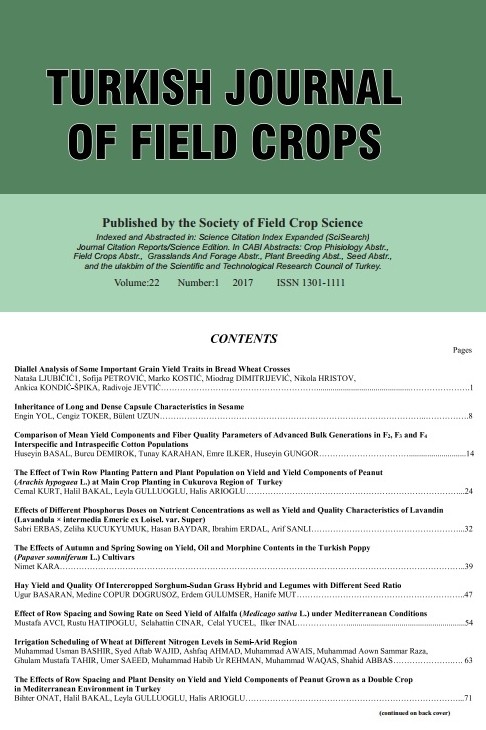
COMPARISON OF MEAN YIELD COMPONENTS AND FIBER QUALITY PARAMETERS OF ADVANCED BULK GENERATIONS IN F2, F3 AND F4 INTERSPECIFIC AND INTRASPECIFIC COTTON POPULATIONS
Abstract
The performance of interspecific and intraspecific cotton hybrid populations were compared to investigate the
correlation among the F2, F3 and F4 bulk generations in terms of yield, lint percentage, and fiber quality from
2009 to 2011. In addition, the effect of combining abilities on hybrid performance were investigated at further
generations. For this purpose, nine interspecific and six intraspecific hybrids with eight parents were
evaluated under the west part of Turkey (Aegean region) environmental conditions. With the generation
progresses, the highest drops in fiber length and fiber strength were detected in interspecific due to the
inbreeding depression and genetic breakdown in advanced populations. Based on 15 tested hybrids, the
observed mean yield and fiber quality in the F2 do not adequately predict the performance of hybrids in the F4
generation. Thus, selection of individual plants should be delayed until the F4 generation especially for
interspecific hybrids, but individual plants would be selected at early generation in intraspecific hybrid
populations. In the study it was found that a higher general combining ability (GCA) does not necessarily
confer a higher specific combining ability (SCA) and that the GCA and SCA were independent of one another,
and that in F4 high yielded hybrid population was obtained from cross which at least one parent of hybrid has
maximum positive GCA effects. These results indicated that instead of using only one criteria, the F2
performance for intraspecific hybrids and the F3 performance for interspecific hybrids, low heterosis and
inbreeding depression, combining ability of parents could be used together to determine the most promising
hybrid populations to be used as a source for further selection.
Keywords
References
- Ahuja, S.L. and L.S. Dhayal. 2007. Combining ability estimates
- for yield and fiber quality traits in 4 × 13 line × tester crosses
- of G. hirsutum. Euphytica. 153:87-98.
- Ashokkumar, K. K.S. Kumar, and R. Ravikesavan. 2014. An
- update on conventional and molecular breeding approaches
- for improving fiber quality traits in cotton. African Journal
- of Biotechnology. Vol. 13:1097-1108.
Details
Primary Language
English
Subjects
-
Journal Section
Research Article
Authors
Huseyin Basal
Türkiye
Burcu Demırok
This is me
Türkiye
Tunay Karahan
This is me
Türkiye
Emre Ilker
This is me
Huseyin Gungor
This is me
Türkiye
Publication Date
June 15, 2017
Submission Date
March 28, 2017
Acceptance Date
November 23, 2016
Published in Issue
Year 2017 Volume: 22 Number: 1
Cited By
Combining Ability and Hybrid Power in İnterspecific (Gossypium hirsutum L. x Gossypium barbadense L.) Line x Tester Hybrids of Cotton
Turkish Journal Of Field Crops
https://doi.org/10.17557/tjfc.871366Performances of F3 and F4 Bulk Populations in Cotton (Gossypium hirsutum L.)
Yüzüncü Yıl Üniversitesi Tarım Bilimleri Dergisi
https://doi.org/10.29133/yyutbd.1292327