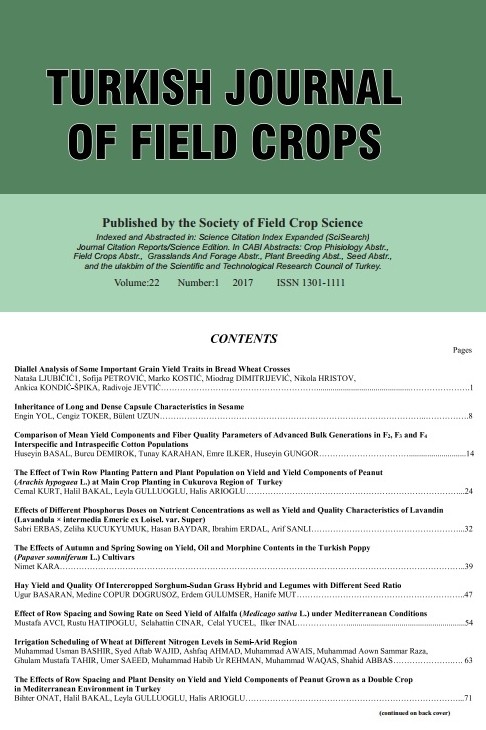
APPLICATION OF MULTIVARIATE STATISTICAL ANALYSIS FOR BREEDING STRATEGIES OF SPRING SAFFLOWER (Carthamus tinctorius L.)
Abstract
This study aimed to assess oil yield components and their interrelationships of spring safflower lines
and varieties by using different statistical techniques to increase the oil yield in safflower breeding
program. Field experiments were conducted at the Transitional Zone Agricultural Research Institute
in Eskisehir, Turkey during 2014, 2015 and 2016. Correlation, simple linear regression, stepwise
multiple regression, path, principal component and cluster analyze were used to investigate the
relationships between oil yield and some components in spring safflower. The results revealed that
characters affecting oil yield, which is important to determine selection criteria in plant breeding,
vary according to statistical methods. Therefore, to obtain reliable result, it is essential to use
multivariate statistical methods for scanning significant characters in studied material. According to
the numbers of common characters determined in different statistical analyzes; oil content, seed
weight, seed yield and number of head per plant would be important selection criteria for improved
oil yield in the breeding material studied. The lines and varieties may be used in hybridization
program and their hybrids may yield more transgressive sergeants for these characters for oil yield
improvement.
Keywords
References
- Afroz, R., M. S. H. Sharif and L. Rahman. 2004. Genetic variability, correlation and path analysis in mustard and rape (Brassica spp.). Bangladesh J. P1ant. Breed. Genet.17:59-63.
- Ahmadzadeh, A.R. 2013. Genetic diversity and classification of spring safflower (Carthamus tinctorius) cultivars using morphological characters. Advances in Bio. Research Adv. 4:125-131.
- Arslan, B. 2007. The path analysis of yield and its components in safflower (Carthamus tinctorius L.). J. of Bio. Sci. 7:668-672.
- Behnam, T., A. Said, S. Mohamadreza, B. B. Alireza and G. Gafari. 2011. Path analysis of seed and oil yield in safflower (Carthamus tinctorius L.). Int. J. Agric. Crop. Sci. 3:114-122.
- Bidgoli, A.M., G.A. Akbari, M.J. Mirhadi, E. Zand and S. Soufizadeh. 2006. Path analysis of the relationships between seed yield and some morphological and phonological traits in safflower (Carthamus tinctorius L.). Euphytica 148:261-268.
- Camas, N., A.K. Ayan and C. Cirak. 2005. Relationships between seed yield and some characters of Safflower (Carthamus tinctorius L.) cultivars grown in the middle black sea conditions. VIth Int. Safflower Conference. 06-10 June 2005. Istanbul.
- Camas, N. and Esendal, E. 2006.Estimates of broad-sense heritability for seed yield and yield components of safflower (Carthamus tinctorius L.). Hereditas 143:55-57.
- Gencer, O., S.N. Sinan and F. Gulyasar. 1987. Relationship between oil and traits using correlation and path coefficient analysis in safflower. J. Agric. Faculty 2:37-43.
Details
Primary Language
English
Subjects
-
Journal Section
Research Article
Authors
Arzu Kose
*
Türkiye
Oguz Onder
This is me
Türkiye
Ozlem Bılır
This is me
Türkiye
Ferda Kosar
This is me
Türkiye
Publication Date
June 15, 2018
Submission Date
January 19, 2018
Acceptance Date
January 19, 2018
Published in Issue
Year 2018 Volume: 23 Number: 1
Cited By
Effective Screening of Tropical Wheat Mutant Lines under Hydroponically Induced Drought Stress Using Multivariate Analysis Approach
Asian Journal of Plant Sciences
https://doi.org/10.3923/ajps.2021.172.182Mutasyon Islahı ile Geliştirilmiş Bazı Aspir (Carthamus tinctorius L.) Hatlarının Tarımsal Performansları
Türk Tarım ve Doğa Bilimleri Dergisi
https://doi.org/10.30910/turkjans.685982Morphological Formation, Fatty Acid Profile, and Molecular Identification of Some Landraces of Ethiopian Brassica as a Promising Crop to Support Breeding Programs
Plants
https://doi.org/10.3390/plants10071431Characterization of Maize Hybrids (Zea mays L.) for Detecting Salt Tolerance Based on Morpho-Physiological Characteristics, Ion Accumulation and Genetic Variability at Early Vegetative Stage
Plants
https://doi.org/10.3390/plants10112549Image Based-Phenotyping and Selection Index Based on Multivariate Analysis for Rice Hydroponic Screening under Drought Stress
Plant Breeding and Biotechnology
https://doi.org/10.9787/PBB.2021.9.4.272Characterizing Maize Genotypes for Salt Tolerance Using Morphological and Ionic Traits at Seedling Stage
International Letters of Natural Sciences
https://doi.org/10.56431/p-03pzu8Morpho-physiological and biochemical characterization of African spider plant (Gynandropsis gynandra (L.) Briq.) genotypes under drought and non-drought conditions
Frontiers in Plant Science
https://doi.org/10.3389/fpls.2023.1197462Selections of donors depending on agronomic traits, seed yield components, and fatty acid profile for genetic improvement of Carthamus using stepwise multiple regression
OCL
https://doi.org/10.1051/ocl/2020063Influence of Incremental Short Term Salt Stress at the Seedling Stage on Root Plasticity, Shoot Thermal Profile and Ion Homeostasis in Contrasting Wheat Genotypes
Agriculture
https://doi.org/10.3390/agriculture13101946Genetic Parameters and Multivariate Analysis to Determine Secondary Traits in Selecting Wheat Mutant Adaptive on Tropical Lowlands
Plant Breeding and Biotechnology
https://doi.org/10.9787/PBB.2020.8.4.368Identification of cold tolerance and some agronomic traits of advanced safflower genotypes developed by hybridization
Journal of the American Oil Chemists' Society
https://doi.org/10.1002/aocs.12754Evaluation of yield of safflower (Carthamus tinctoriusL.) genotypes under semi-arid conditions
Plant Genetic Resources: Characterization and Utilization
https://doi.org/10.1017/S1479262120000301Enhanced growth and stress tolerance in Barley (Hordeum vulgare) through biopriming with Aspergillus niger CSR3: a promising approach for sustainable agriculture in saline environments
Cereal Research Communications
https://doi.org/10.1007/s42976-023-00456-5Determination of morpho-physiological and yield traits of maize inbred lines (Zea mays L.) under optimal and drought stress conditions
Frontiers in Plant Science
https://doi.org/10.3389/fpls.2022.959203A New Approach to Select Doubled Haploid Rice Lines under Salinity Stress Using Indirect Selection Index
Rice Science
https://doi.org/10.1016/j.rsci.2021.05.007Dissecting Physiological and Agronomic Diversity in Safflower Populations Using Proximal Phenotyping
Agriculture
https://doi.org/10.3390/agriculture13030620Harnessing on Genetic Variability and Diversity of Rice (Oryza sativa L.) Genotypes Based on Quantitative and Qualitative Traits for Desirable Crossing Materials
Genes
https://doi.org/10.3390/genes14010010Assessment of the Genetic Diversity in 160 Safflower Genotypes Focusing on oil Quality Characteristics
Journal of Crop Breeding
https://doi.org/10.61186/jcb.15.48.113A comprehensive multivariate approach for GxE interaction analysis in early maturing rice varieties
Frontiers in Plant Science
https://doi.org/10.3389/fpls.2024.1462981Characterization of high-yielding aman rice genotypes through genetic and agronomic analysis
Journal of Crop Improvement
https://doi.org/10.1080/15427528.2024.2417050Interrelationships among agro-morphological characteristics of Iranian safflower germplasm under cold and rain-fed conditions
Ecological Genetics and Genomics
https://doi.org/10.1016/j.egg.2025.100354Silicon‐Mediated Mitigation of Salt Stress in Maize Plants
Plant-Environment Interactions
https://doi.org/10.1002/pei3.70073Genetic and multivariate analysis of some local and advanced selected Aman rice genotypes under Bangladesh condition
Discover Plants
https://doi.org/10.1007/s44372-025-00352-8Digital and multivariate analysis of lettuce seed vigor: Impact of hydropriming on physiological potential
Advances in Horticultural Science
https://doi.org/10.36253/ahsc-17532Evaluation of Germination and Emergence Traits as Indicators of Salt Stress Tolerance in Maize Varieties under Controlled Conditions through Multivariate Analysis
Kahramanmaraş Sütçü İmam Üniversitesi Tarım ve Doğa Dergisi
https://doi.org/10.18016/ksutarimdoga.vi.1750026