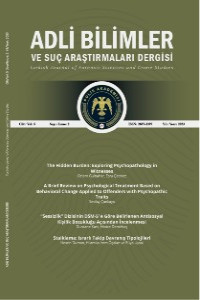

The Journal of Forensic Sciences and Crime Studies is focused on "Forensic Sciences" in terms of its purpose and has set itself the principle of publishing original theoretical and practical studies addressing problems related to Forensic Sciences and associated sub-disciplines at both national and international levels, in a disciplinary or interdisciplinary manner. It is open to all studies prepared in this context.
Forensic sciences, in today's world, is a branch of science that operates on the principle of examining and evaluating material evidence obtained during legal and administrative investigations, in the stages of identifying the crime and the criminal, and proving the crime and guilt. It draws support from many disciplines. For this science to develop and be properly implemented, it is crucial to be able to follow the disciplines it receives help from and the scientific developments and research in these areas. Forensic sciences, evolving on a multidisciplinary basis, have a field of study that encompasses areas such as medicine, biology, chemistry, anthropology, statistics, psychology, sociology, law, and economics, as well as their sub-disciplines. Therefore, the importance of working in this field in accordance with correct and scientific criteria and being able to publish these studies through the right sources is indisputable. It is believed that the Journal of Forensic Sciences and Crime Research can bring together many disciplines and offer them to researchers and academics, and can attain the status of a reference journal in this field.
The language of writing is Turkish and English. For Turkish articles, the Turkish Language Association's (TDK) online Current Dictionary and Writing Rules should be followed for spelling, punctuation, and abbreviations. Submitted papers should be scientifically accurate in terms of language and expression, clear, and understandable.
Articles should include the following sections:
• Title: Turkish and English
• Abstract: Turkish and English (each between 200-300 words)
• Keywords: Turkish and English (each between 3-8 words)
• Text: Introduction, section headings, and conclusion: Turkish or English
• References
The elements listed above, excluding the references, should adhere to the following format in the text:
For natural sciences related to forensic sciences (such as chemistry, physics, biology, mathematics, statistics, engineering, and health sciences), the word count should be between 1500-5000 words.
For social sciences related to forensic sciences (such as psychology, linguistics, sociology, and law), the word count should be between 4000-8000 words. The author’s name should be written in italic bold, 11 pt, on the right corner under the article's title, and the author’s title, institution, and email address should be written in a footnote with an asterisk (*) in 9 pt. Other explanations in the form of footnotes should be numbered either within the text or at the bottom of the page. The text should be written in Times New Roman, 11 pt, with one and a half line spacing, and explanatory footnotes should be in 9 pt and single-spaced.
For book reviews, special attention should be paid to the following:
Book review texts should be between 1000 and 1500 words.
In the heading information, the title of the book under review, the author, city of publication, publisher, year of publication, and ISBN number should be included.
The name of the author conducting the review should be written in italic bold, 11 pt, in the right corner under the article's title, and the author’s title, institution, and email address should be written in a footnote with an asterisk (*) in 9 pt.
Book reviews should not merely summarize the work but critically evaluate it. The reviewer may agree or disagree with the ideas presented in the book or highlight exemplary or lacking aspects of the content, judgments, or structure. The reviewer should clearly express their own thoughts about the book.
A book review should shed light on the most important points presented in the book and critically discuss them. The review should follow a general structure, including an introduction, summary of the book, critical discussion, and conclusion.
"Hiçbir ad altında yazar veya kurumundan ücret alınmaz."