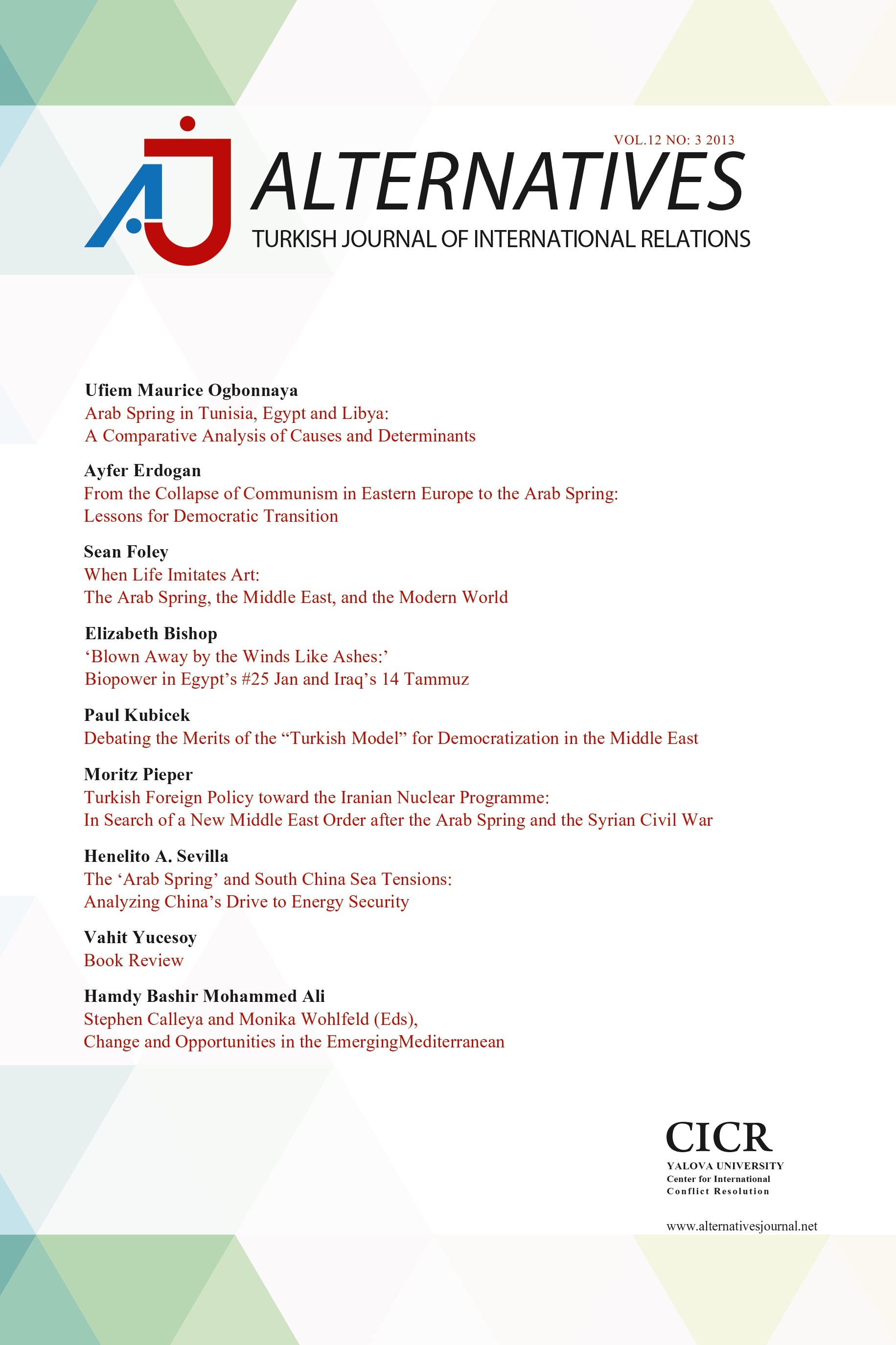
The Arab Spring and South China Sea Tensions: Analyzing China's Drive to Energy Security

Volume: 12 Number: 3 June 1, 2013
  • Henelito A. Sevilla
EN

The Arab Spring and South China Sea Tensions: Analyzing China's Drive to Energy Security

Abstract

The Arab Spring has brought significant changes to the political landscape in many Middle Eastern and North African (MENA) countries since early 2011. It has also affected the geo strategic and economic interests of powerful emerging Asian states, especially China and other net-energy consuming countries. One immediate result of the Arab Spring is its highly disrupted impact (a ' Black Swan') on the production and supply of crude oil to the economies in Asia due to their high degree of reliance on hydrocarbon from the Middle East. Chinese reactions to Arab Spring have fed tensions between itself and the countries with which it shares the South China Sea, most importantly the Philippines and Vietnam. This paper demonstrates that the black swan effect of the Arab Spring is manifested in the renewal of a geo-strategic competition in the South China Sea as China is re-asserting its historical claims over the control of the area and of its possible hydrocarbon reserves.

Keywords

References

  1. Alterman, Jon B., and Garver, John W. “The Vital Triangle.” Center for Strategic and International Studies, May 20, 2008. Accessed February 23, 2013, http://csis.org/publication/vital-triangle.
  2. Bacik, Gokhan. “The Arab Spring versus China.” Today’s Zaman, November 27, 2011. Accessed July 26, 2012, http://www.todayszaman.com/columnist-264098-the-arab-spring-versus-china.html.
  3. Bouchentouf, Amine. “Black Swan events in 2012 could push oil to $200.” Energ and Capital, 2001.
  4. Accessed January 4, 2012, http://seekingalpha.com/article/313482-black-swan-events-in-2012-could-push-oil- to-200.
  5. Brennan, Elliot. “Rising Tide of Conflict in South China Sea,” Asia Times, March 3, 2012. Accessed October 20, 2012. http://www.atimes.com/atimes/China/NC03Ad01.html.
  6. Cole, Bernard D. “Oil for the Lamps of China”-Beijing’s 21st –Century Search for Energy.” McNair Paper 67 of the Institute of National Strategic Studies, National Defense University, Washington DC. p. 15., 2003.
  7. Accessed June 28, 2010, http://www.ndu.edu/inss/docuploaded/198_428.McNair.pdf.
  8. Downs, Erica S. “Getting China to Turn on Iran.” The National Interests, July 19, 2012. Accessed October 3, 2012, http://nationalinterest.org/commentary/getting-china-turn-iran-7215.

Details

Primary Language

English

Subjects

-

Journal Section

-

Authors

Henelito A. Sevilla This is me

Publication Date

June 1, 2013

Submission Date

November 7, 2015

Acceptance Date

-

Published in Issue

Year 2013 Volume: 12 Number: 3

APA
Sevilla, H. A. (2013). The Arab Spring and South China Sea Tensions: Analyzing China’s Drive to Energy Security. Alternatives: Turkish Journal of International Relations, 12(3), 93-107. https://izlik.org/JA97AR25WF
AMA
1.Sevilla HA. The Arab Spring and South China Sea Tensions: Analyzing China’s Drive to Energy Security. Alternatives: Turkish Journal of International Relations. 2013;12(3):93-107. https://izlik.org/JA97AR25WF
Chicago
Sevilla, Henelito A. 2013. “The Arab Spring and South China Sea Tensions: Analyzing China’s Drive to Energy Security”. Alternatives: Turkish Journal of International Relations 12 (3): 93-107. https://izlik.org/JA97AR25WF.
EndNote
Sevilla HA (June 1, 2013) The Arab Spring and South China Sea Tensions: Analyzing China’s Drive to Energy Security. Alternatives: Turkish Journal of International Relations 12 3 93–107.
IEEE
[1]H. A. Sevilla, “The Arab Spring and South China Sea Tensions: Analyzing China’s Drive to Energy Security”, Alternatives: Turkish Journal of International Relations, vol. 12, no. 3, pp. 93–107, June 2013, [Online]. Available: https://izlik.org/JA97AR25WF
ISNAD
Sevilla, Henelito A. “The Arab Spring and South China Sea Tensions: Analyzing China’s Drive to Energy Security”. Alternatives: Turkish Journal of International Relations 12/3 (June 1, 2013): 93-107. https://izlik.org/JA97AR25WF.
JAMA
1.Sevilla HA. The Arab Spring and South China Sea Tensions: Analyzing China’s Drive to Energy Security. Alternatives: Turkish Journal of International Relations. 2013;12:93–107.
MLA
Sevilla, Henelito A. “The Arab Spring and South China Sea Tensions: Analyzing China’s Drive to Energy Security”. Alternatives: Turkish Journal of International Relations, vol. 12, no. 3, June 2013, pp. 93-107, https://izlik.org/JA97AR25WF.
Vancouver
1.Henelito A. Sevilla. The Arab Spring and South China Sea Tensions: Analyzing China’s Drive to Energy Security. Alternatives: Turkish Journal of International Relations [Internet]. 2013 Jun. 1;12(3):93-107. Available from: https://izlik.org/JA97AR25WF