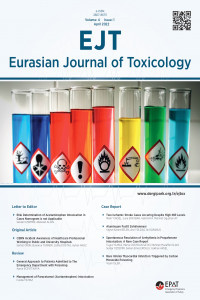
Eurasian
Journal of Toxicology (Eurasian J Tox), as a double-blind peer reviewed journal
published by the Emergency Medicine Physicians’ Association of Turkey, to
publish original articles, editorial comments, review articles, case reports,
letters to editor, scientific letters, clinical imaging and education articles,
that can contribute to the medical literature in the field of clinical
toxicology and drug reasearches.
Editorial
and publication processes of the journal are shaped in accordance with the
guidelines of the international organizations such as the the World Association
of Medical Editors (WAME), the International Council of Medical Journal Editors
(ICMJE), the Council of Science Editors (CSE), the Committee on Publication
Ethics (COPE), and the European Association of Science Editors (EASE).
The journal follows the Principles of Transparency and Best Practice in
Scholarly Publishing (doaj.org/bestpractice).
An
approval of research protocols by Ethics Committee in accordance with
international agreements (World Medical Association Declaration of Helsinki
“Ethical Principles for Medical Research Involving Human Subjects”, amended in
October 2013, www.wma.net )
is required for experimental, clinical and drug studies and some case reports.
If required, ethics committee reports or an equivalent official document may be
requested from the authors. For manuscripts concerning experimental research on
humans, a statement should be included that shows informed consent of patients
and volunteers was obtained following a detailed explanation of the procedures
that they may undergo. For studies carried out on animals, the measures taken
to prevent pain and suffering of the animals should be stated clearly.
Information on patient consent, name of the ethics committee and the ethics
committee approval number should also be stated in the materials and methods
section of the manuscript. It is the authors’ responsibility to carefully
protect the patients’ anonymity. For photographs that may reveal the identity
of the patients, releases signed by the patient or their legal representative
should be enclosed.
Journal’s publication language is English. In addition, the title, abstract and keywords of all published articles must be available in English. It is mandatory to send title, abstract and keywords in both languages together with the manuscript.
Manuscript
Format
Manuscripts
should be created using Microsoft Word and be double-spaced with 2.5-cm margins
on all sides. The recommended font is Times New Roman and the recommended font
size is 12 point. References should be arranged according to the citation order
in the manuscript.
Manuscript
Preparation
The
manuscripts should be prepared in accordance with ICMJE-Recommendations for the
Conduct, Reporting, Editing and Publication of Scholarly Work in Medical
Journals (updated in December 2017 - http://www.icmje.org/icmje-recommendations.pdf).
Authors are required to prepare manuscripts in accordance with CONSORT
guidelines for randomized research studies, STROBE guidelines for observational
original research studies, STARD guidelines for studies on diagnostic accuracy,
PRISMA guidelines for systematic reviews and meta-analysis, ARRIVE guidelines
for experimental animal studies and TREND guidelines for non-randomized public
behavior.
Manuscripts
can be submitted online via http://dergipark.gov.tr/ejtox
Authors
are required to submit the;
Copyright
Transfer Form which states transfer of the copyright about the
submitted manuscript to Eurasian Journal of Toxicology.
Author
Contributions Form
Cover
Letter: To the editor in which you detail matters you
wish the editors to consider.
Title
Page: A separate title page should be submitted with
all submissions, and this page should include;
ü
The full
title of the manuscript
ü
Name(s),
affiliations and major degree(s) of the author(s)
ü
Grant
information and detailed information on the other sources of support,
ü
The name,
affiliation, address, work telephone, fax number, mobile phone number and
e-mail address of the corresponding author,
ü
Acknowledgement
of the individuals who contributed to the preparation of the manuscript, but do
not fulfil the authorship criteria.
ü
Conflict
of interest statement. In the case of ‘no conflicts of interest’, that
statement should be in form of: “All authors declare that they have no conflicts
of interest regarding this manuscript.”
Abstract: The
abstract of Original Articles should be structured with subheadings (Objective,
Materials and Methods, Results and Conclusion). It is mandatory to send an abstract in Turkish and English languages together with the manuscript.
Keywords: The
submission must be accompanied by a minimum of three and a maximum of five
keywords for subject indexing at the end of the abstract (they must be terms
from the medical subject headings - MeSH - list of the Index Medicus: PubMed
MeSH Browser). The keywords should be listed in full without abbreviations.
Manuscript
Types
Original Articles: The
entire manuscript for a full-length article, including references and tables,
should be no more than 5000 words. The main text of original articles should be
structured with Introduction, Materials and Methods, Results, Discussion,
Conclusion subheadings. Limit for references is 40.
Case Reports: The
text should include Abstract, Introduction, Case Report, Discussion, Conclusion
subheadings. The entire manuscript for a full-length article, including
references and table, should be no more than 1500 words. Limit for references
is 20 and only one table or figure can be added.
Review Articles: The
authors may be invited by the journal. For uninvited articles authors must
contact the editor. The entire manuscript should be no more than
5000 words and the abstract should be a maximum of 400 words. Limit
for references is 50.
Letter to the Editor: Abstract, Keywords,
Tables, Figures, Images and other media are not included. The text should be
unstructured. The manuscript that is being commented on must be properly cited
within the manuscript. The entire manuscript should be no more than 500
words. Limit for references is five and only one table or figure can be
added.
References
While
citing publications, preference should be given to the latest, most up to date
publications. If an ahead of print publication is being cited the DOI number
should be provided. Authors are responsible for the accuracy of references.
Journal titles should be abbreviated in accordance with the journal
abbreviations in Index Medicus/ Medline/PubMed (for journal abbreviations
consult the List of Journals indexed for MEDLINE, published annually by NLM).
When there are 6 or fewer authors, all authors should be listed. If there are 7
or more authors the first 6 authors should be listed followed by “et al”. The
reference styles for different types of publications are presented in the
following examples:
Journal
article: Lewin MR, Stein J, Wang R, Lee MM, Kernberg M,
Boukhman M, et al. Humming is as effective as Valsalva’s maneuver and
Trendelenburg’s position for ultrasonographic visualization of the jugular
venous system and common femoral veins. Ann Emerg Med. 2007; 50: 73-7.
Book
Section: Sherry S. Detection of thrombi. In: Strauss HE, Pitt
B, James AE, editors. Cardiovascular Medicine. St Louis: Mosby; 1974.p.273-85.
Books
with Single Author: Cohn PF. Silent myocardial ischemia and
infarction. 3rd ed. New York: Marcel Dekker; 1993.
Editor(s)
as author: Norman IJ, Redfern SJ, editors. Mental health care for
elderly people. New York: Churchill Livingstone; 1996.
Conference
Proceedings: Bengisson S. Sothemin BG. Enforcement of data
protection, privacy and security in medical informatics. In: Lun KC, Degoulet
P, Piemme TE, Rienhoff O, editors. MEDINFO 92. Proceedings of the 7th World
Congress on Medical Informatics; 1992 Sept 6-10; Geneva, Switzerland.
Amsterdam: North-Holland; 1992.p.1561-5.
Scientific
or Technical Report: Smith P. Golladay K. Payment for durable
medical equipment billed during skilled nursing facility stays. Final report.
Dallas (TX) Dept. of Health and Human Services (US). Office of Evaluation and
Inspections: 1994 Oct. Report No: HHSIGOE 169200860.
Thesis: Kaplan
SI. Post-hospital home health care: the elderly access and utilization
(dissertation). St. Louis (MO): Washington Univ. 1995.
Epub
ahead of print Articles: Logan, BK, Mohr ALA, Friscia
M, Krotulski AJ, Papsun DM, Kacinko SL, et al. (2017) Reports of adverse events
associated with use of novel psychoactive substances, 2013–2016: a review.
Journal of Analytical Toxicology. doi: 10.1093/jat/bkx031
Manuscripts
published in electronic format: Rupprecht C. Ready for
more-than-human? Urban residents’ willingness to coexist with animals and
plants. Version: 1. SocArXiv [Preprint]. [posted 2016 Jul 13; revised 2016 Dec
07; cited 2017 Feb 15]: [22 p.]. Available from:https://osf.io/preprints/socarxiv/hbcmz/.
Tables
Tables
should be included in the main document, presented after the reference list and
they should be numbered consecutively in the order they are referred to within
the main text. A descriptive title must be placed above the tables. Abbreviations
used in the tables should be defined below the tables by footnotes (even if
they are defined within the main text). Tables should be created using the
“insert table” command of the word software and they should be arranged clearly
to provide an easy reading. Data presented in the tables should not be a
repetition of the data presented within the main text but should be supporting
the main text.
Figures
and Figure Legends
Figures,
graphics and photographs should be submitted as separate files (in TIFF or JPEG
format). The files should not be embedded in a word document or the main
document. When there are figure subunits, the subunits should not be merged to
form a single image. Thick and thin arrows, arrowheads, stars,
asterisks and similar marks can be used on the images to support figure
legends. Like the rest of the submission, the figures too should be blind. Any
information within the images that may indicate an individual or institution
should be blinded. The minimum resolution of each submitted figure should be
300 DPI. To prevent delays in the evaluation process all submitted figures
should be clear in resolution and large in size (minimum dimensions 100 x 100
mm). Figure legends should be listed at the end of the main
document.
Acronyms
and Abbreviations
All
acronyms and abbreviations used in the manuscript should be defined at first
use in the main text. The abbreviation should be provided in parenthesis
following the definition. Acronyms and abbreviations should not be used in the
abstract.
Submission
Checklist
You can
use this list to make a final check of your submission before you send it to
the journal for review. Ensure that the following items are present:
· One
author has been designated as the corresponding author with contact details
including name, affiliation, address, work telephone, fax number, mobile phone
number and e-mail address.
· All
necessary files have been uploaded:
ü
Cover
Letter
ü
Title
Page
ü
Manuscript
ü
Figures
ü
Supplemental
files (where applicable)
ü
Author
Contributions Form
ü
Copyright
Transfer Form
·
Ensure
all figure and table citations in the text match the files provided
·
Manuscript
has been spell checked and grammar checked
·
All
references mentioned in the Reference List are cited in the text, and vice
versa
·
Permission
has been obtained for use of copyrighted material from other sources (including
the Internet)
·
A
conflict of interests statement is provided in the Title Page even if the
authors have no competing interests to declar
·
Journal
aim and scope have been reviewed
For
further information,
Acil
Tıp Uzmanları Derneği
Address: Yukarı
Ayrancı Güleryüz Sok. No: 26/19 06550 Çankaya, Ankara, Turkey
Phone: +90
312 426 12 14
Fax:+90
312 426 12 44
E-mail:info@ejtoxicology.com
 April 30, 2022
Page
1-2
April 30, 2022
Page
1-2