TR
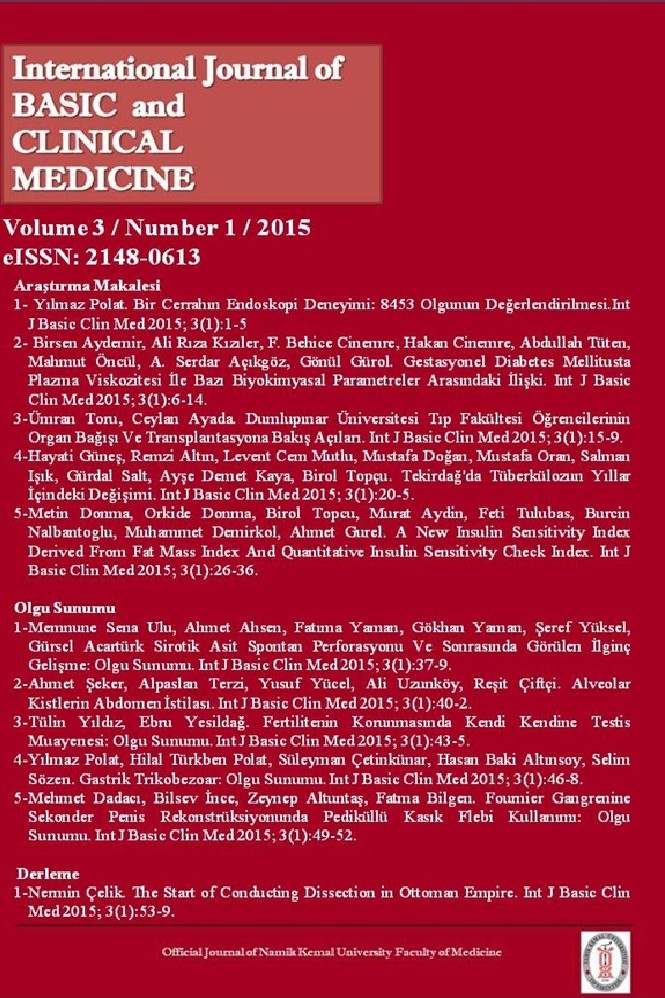
A new insulin sensitivity index derived from fat mass index and quantitative insulin sensitivity check index
Abstract
Objective: Obesity has recently become one of the most important health problems throughout the world. This fact led to the controversies on the clinical use of insulin sensitivity indices. Indices previously described or introduced in this study have been evaluated to choose one, which is capable of exhibiting significant distinctions between healthy children and those involved in the classes of childhood obesity.
Materials and Methods: A total of 179 girls; 81 morbidly obese(MO), 42 obese(O), 16 overweight(OW) and 40 normal(N) participated in the study. Groups were constituted based upon age- and sex-specific body mass index percentiles tabulated by World Health Organization. Homeostasis Model Assessment of Insulin Resistance(HOMA-IR), HOMA-IR/BMI, log HOMA-IR, fasting glucose/fasting insulin ratio(FGIR), quantitative insulin sensitivity check index(QUICKI), Raynaud, reciprocal insulin indices and also new indices HOMA-IR*BMI, HOMA-IR*fat mass index(FMI), QUICKI*BMI, QUICKI*FMI were calculated. The cut-offs 3.16 and 2.5 for HOMA-IR, 7 and 6 for FGIR, 0.357 and 0.328 for QUICKI were evaluated to estimate insulin resistance. Statistical analyses were performed with Predictive Analytics SoftWare(PASW) Statistics 18.
Results and Conclusion: QUICKI*FMI was able to make a clear-cut separation between the groups. A new trilogy for cut-offs (HOMA>2.5, FGIR<7, QUICKI<0.328); each giving the similar results, has been suggested. Multifaceted character of QUICKI was also introduced. QUICKI was capable of discriminating MO from O when 0.328 cut-off was used, and O from OW when 0.357 cut-off was used. QUICKI*FMI index, a new one, was unique in detecting the advanced level of differences(p≤0.005) between N-OW, OW-O and O-MO groups during childhood obesity.
Key words
Obesity, childhood, insulin sensitivity index
Keywords
References
- Ogden CL, Carroll MD, Kit BK, Flegal KM. Prevalence of obesity and trends in body mass index among US children and adolescents, 1999–2010. JAMA 2012; 307(5): 483–490.
- Childhood overweight and obesity. Available from: http://www.who.int/dietphysicalactivity/childhood/en/ {Last updated: 2014}
- Childhood obesity facts. Available from: http://www.cdc.gov/healthyyouth/obesity/facts.htm/201 2 {Last updated: July 10, 2013}
- National Center for Health Statistics. Health, United States, 2011: With Special Features on Socioeconomic Status and Health. Hyattsville, MD; U.S. Department of Health and Human Services; 2012.
- Brufani C, Grossi A, Fintini D et al. Cardiovascular fitness, insulin resistance and metabolic syndrome in severely obese prepubertal Italian children. Horm Res 2008; 70(6): 349-356.
- Rizzo AC, Goldberg TB, Silva CC, Kurokawa CS, Nunes HR, Corrente JE. Metabolic syndrome risk factors in overweight, obese, and extremely obese Brazilian adolescents. Nutr J 2013; 12: 19.
- Tobisch B, Blatniczky L, Barkai L. Cardiometabolic risk factors and insulin resistance in obese children and adolescents: relation to puberty. Pediatr Obes 2013 Nov 13. [Epub ahead of print]
- Adam TC, Tsao S, Page KA, Hu H, Hasson RE, Goran MI. Insulin sensitivity and brain reward activation in overweight Hispanic girls: a pilot study. Pediatr Obes 2013 Dec 20. [Epub ahead of print]
Details
Primary Language
Turkish
Subjects
Health Care Administration
Journal Section
Research Article
Publication Date
April 21, 2016
Submission Date
January 14, 2015
Acceptance Date
-
Published in Issue
Year 2015 Volume: 3 Number: 1
APA
Donma, M., Donma, O., Topçu, B., Aydın, M., Tülübaş, F., Nalbantoğlu, B., Demirkol, M., & Gürel, A. (2016). A new insulin sensitivity index derived from fat mass index and quantitative insulin sensitivity check index. International Journal of Basic and Clinical Medicine, 3(1), 26-36. https://izlik.org/JA93EP94UD
AMA
1.Donma M, Donma O, Topçu B, et al. A new insulin sensitivity index derived from fat mass index and quantitative insulin sensitivity check index. International Journal of Basic and Clinical Medicine. 2016;3(1):26-36. https://izlik.org/JA93EP94UD
Chicago
Donma, Metin, Orkide Donma, Birol Topçu, et al. 2016. “A New Insulin Sensitivity Index Derived from Fat Mass Index and Quantitative Insulin Sensitivity Check Index”. International Journal of Basic and Clinical Medicine 3 (1): 26-36. https://izlik.org/JA93EP94UD.
EndNote
Donma M, Donma O, Topçu B, Aydın M, Tülübaş F, Nalbantoğlu B, Demirkol M, Gürel A (April 1, 2016) A new insulin sensitivity index derived from fat mass index and quantitative insulin sensitivity check index. International Journal of Basic and Clinical Medicine 3 1 26–36.
IEEE
[1]M. Donma et al., “A new insulin sensitivity index derived from fat mass index and quantitative insulin sensitivity check index”, International Journal of Basic and Clinical Medicine, vol. 3, no. 1, pp. 26–36, Apr. 2016, [Online]. Available: https://izlik.org/JA93EP94UD
ISNAD
Donma, Metin - Donma, Orkide - Topçu, Birol - Aydın, Murat - Tülübaş, Feti - Nalbantoğlu, Burçin - Demirkol, Muhammet - Gürel, Ahmet. “A New Insulin Sensitivity Index Derived from Fat Mass Index and Quantitative Insulin Sensitivity Check Index”. International Journal of Basic and Clinical Medicine 3/1 (April 1, 2016): 26-36. https://izlik.org/JA93EP94UD.
JAMA
1.Donma M, Donma O, Topçu B, Aydın M, Tülübaş F, Nalbantoğlu B, Demirkol M, Gürel A. A new insulin sensitivity index derived from fat mass index and quantitative insulin sensitivity check index. International Journal of Basic and Clinical Medicine. 2016;3:26–36.
MLA
Donma, Metin, et al. “A New Insulin Sensitivity Index Derived from Fat Mass Index and Quantitative Insulin Sensitivity Check Index”. International Journal of Basic and Clinical Medicine, vol. 3, no. 1, Apr. 2016, pp. 26-36, https://izlik.org/JA93EP94UD.
Vancouver
1.Metin Donma, Orkide Donma, Birol Topçu, Murat Aydın, Feti Tülübaş, Burçin Nalbantoğlu, Muhammet Demirkol, Ahmet Gürel. A new insulin sensitivity index derived from fat mass index and quantitative insulin sensitivity check index. International Journal of Basic and Clinical Medicine [Internet]. 2016 Apr. 1;3(1):26-3. Available from: https://izlik.org/JA93EP94UD