Issue: 7 , 3/28/25

Year: 2025

Research Article

Abdullah Demir
Asst. Prof. Dr. Abdullah DEMİR ANKARA YILDIRIM BEYAZIT ÜNİVERSİTESİ, İSLAMİ İLİMLER FAKÜLTESİ, TEMEL İSLAM BİLİMLERİ BÖLÜMÜ, KELAM VE İSLAM MEZHEPLERİ TARİHİ ANABİLİM DALI Web
Islamic Sects, Kalam

Tetkik aims to provide an open-access academic platform for Turkish-Islamic Culture researchers from within and outside Turkey to share and discuss their research results. Encouraging critical perspectives, the journal aims to advance the study of Turkish-Islamic Culture to a higher level by publishing the works of researchers with high scientific quality.

Tetkik accepts research articles prepared in the field of Turkish-Islamic culture as well as critical text publication studies.


Subjects

Turkish-Islamic culture

Social Sciences
  • LC Classification: Philosophy. Psychology. Religion

  • Cultural Studies (Turkish-Islamic Culture Studies)
Humanities
  • History (Turkish-Islamic History)
  • Literature (Turkish-Islamic Literature)
  • Philosophy (Turkish-Islamic Philosophy)
  • Music (Turkish-Islamic Music)
  • Religion (Islamic Studies) 


Keywords
  • Turkish World
  • Turkish-Islamic Culture
  • Turkish-Islamic Synthesis
  • Turkish Language and Literature
  • Turkish-Islamic Literature
  • Turkish Folk Culture
  • Turkish Peoples
  • Turkish Culture
  • Turkish Mythology
  • Turkish Humor
  • Turkish-Islamic History
  • Turkish-Islamic Works
  • Turkish Theatre
  • Turkish-Islamic Arts
  • Turkish-Islamic Music
  • Turkish-Islamic Philosophy
  • Turkish-Islamic Cultural Heritage
  • Turkish Manuscripts

Submission Dates

For the March issue: October 20 - December 20 | For the September issue: April 20 - June 20

Graduate students' studies are accepted for review only if they are co-authored with their advisors.

Writing Manuscript
Authors of original research should address the topic in an original way and an objective discussion. A paper should contain sufficient detail and references to permit others to replicate the work. Fraudulent or knowingly inaccurate statements constitute unethical behavior and are unacceptable.


Originality
The author must provide assurance that the article is original, has not been previously published elsewhere, and is not under consideration for publication elsewhere, in another language.


Originality of Sources
Authors should ensure that they are writing a completely original paper and that if they have used the work or words of others, it is appropriately cited. Privately obtained information, such as in conversations, correspondence, or discussions with third parties, should not be used without the express and written permission of the source.


Data Access and Retention
Authors may be asked to provide the research data supporting their paper for editorial review and/or to comply with the open data requirements of the journal. Authors should be prepared to provide public access to such data, if practicable, and should be prepared to retain such data for a reasonable number of years after publication. The Tetkik recommends uploading research data to TUBITAK's Aperta Portal.[2]


Multiple and Concurrent Publication
An author should not publish an article containing the same research in more than one journal. Submitting the same article to more than one journal at the same time is unethical behavior. An author should not submit a previously published article for consideration in another journal, except in the form of an abstract.


Publication of research that involve human subjects (i.e., surveys and interviews)
For research conducted in all branches of science that requires ethics committee approval (ethics committee approval should be obtained, this approval should be stated and documented in the article. In research that requires ethics committee permission, information about the permission (name of the committee, date, and number) is in the method section, and also on one of the first/last pages of the article; In case of reports, information about signing the informed consent/consent form should be included in the article.


Competing Interests
Conflict of Interest is any financial or other interest that may conflict with one's work, significantly impair objectivity, or provide an unfair advantage to any person or organization. All authors must disclose in their writing any financial and personal relationships with individuals or organizations that may be seen to improperly influence their work. All financial support resources and the role of sponsors in the study should be explained during the conduct of the research and the preparation of the article. If there is no source of funding, this should also be stated. Examples of potential conflicts of interest that need to be disclosed include consultations, hiring, and grants. Potential conflicts of interest should be disclosed at the earliest possible stage.


Notification of Errors
When an author notices a material error or inaccuracy in his published work, he should notify the journal immediately. It is also the author's obligation to cooperate in retracting or correcting the article if deemed necessary by the editor. If the editor or publisher learns from a third party that a published work contains errors, it is the author's obligation to cooperate with the editor, including notifying the editor.


Image Integrity
It is not acceptable to enhance, obscure, move, remove, or introduce a specific feature within an image. Authors must abide by the policy for graphic images enforced by the journal.

28060

Manuscript Preparation

  1. Language: Turkish or English
  2. The language of the journal is Turkey Turkish and English.
  3. Types of Article: Research Article
  4. The Journal publishes Research Papers and Book Reviews. There is no word limit for research papers. However, we advise the authors to make the work as concise as possible for dissemination.
  5. Article Format: MS Word Template
  6. Image Format: JPEG: minimum of 300 dpi
  7. Bibliography Style: ISNAD Citation Style
  8. Authors are required to carefully review the list and order of authors before submitting their manuscript and to provide the definitive list of authors at the time of original submission.
  9. Graduate students' studies are accepted for review only if they are co-authored with their advisors.
Citation Style
The Tetkik requires writers to use the ISNAD Citation Style. In the field of science, ISNAD footnote or in-text system, whichever is widely used, can be preferred. ISNAD Turkish (PDF) ISNAD English (PDF)ISNAD Arabic (PDF)ISNAD Persian (PDF)


Submission checklist
It is hoped that this list will be useful during the final checking of an article prior to sending it to the journal's Editor for review.
  • Author information added.
  • E-mail address
  • Full mailing address
  • Phone number
  • All necessary files have been uploaded
  • Article text
  • Copyright Agreement
  • The manuscript has been "spellchecked" and "grammar-checked"
  • All references mentioned in the Reference list are cited in the text, and vice versa.


Submit Manuscript
The account of the corresponding author of the manuscript should be used in the applications. All correspondence regarding the application is forwarded to the responsible author via e-mail sent through the journal system. When uploading the file of the main text of the article, make sure that this file does not contain any elements that decipher the identity of the author, due to the double-blind peer review process.

Submission URL: dergipark.org.tr/en/journal/4082/submission/step/manuscript/new
Files You Need To Download Separately: Manuscript Full TextCopyright Form


Keeping track of your submission
You can keep track of your manuscript throughout the process by going to your author area in Journal System. Here it will list for you manuscripts you have submitted under "Submitted manuscripts". If your manuscript is sent for external peer review, you will find reviewers' comments in the decision letter. Please click on "Manuscripts with decision" and click on "View decision letter."

Editorial Duty of Confidentiality

The Tetkik's editors treat all submitted manuscripts as confidential documents, which means they will not divulge information about a manuscript to anyone without the authors' permission. During the process of manuscript review the following people may also have access to manuscripts:

  • Editors and editorial staff at The Tetkik,
  • External reviewers,
  • Members of the journal's editorial committees,
  • The only occasion when details about a manuscript might be passed to a third party without the authors’ permission is if the editor suspects serious research misconduct.


Allegations of Scientific misconduct - Suspect Research or Publication Misconduct
There are differing definitions of scientific misconduct. At The Tetkik, we deal with these problems on a case by case basis while following guidance produced by the major publication ethics bodies. Editors have a duty to act if they suspect misconduct or if an allegation of misconduct is brought to them. This duty extends to both published and unpublished papers. Editors should not simply reject papers that raise concerns about possible misconduct. They are ethically obliged to pursue alleged cases. Editors should follow the COPE flowcharts where applicable. Editors should first seek a response from those suspected of misconduct. If they are not satisfied with the response, they should ask the relevant employers or institution, or some appropriate body (perhaps a regulatory body or national research integrity organization) to investigate. Editors should make all reasonable efforts to ensure that a proper investigation into alleged misconduct is conducted; if this does not happen, editors should make all reasonable attempts to persist in obtaining a resolution to the problem. This is an onerous but important duty.

The Tetkik abides the Ethics Toolkit for a Successful Editorial Office. Oku Okut Press and editors of Tetkik; will take reasonable steps to prevent the publication of papers where plagiarism, citation manipulation, data tampering, data fabrication, and other research misconduct have occurred. In no case will Tetkik or its editors knowingly allow such misconduct to occur. If Okut Okut Press and its editors are aware of any allegations of research misconduct related to an article published in their journal, they will follow COPE’s guidelines in dealing with allegations.

Reviewers should notify the Editor when they suspect research or publication misconduct. The editor is responsible for carrying out the necessary actions by following the COPE recommendations.

The Tetkik undertakes implementing the COPE Flowcharts when it encounters allegations of misconduct on the following or similar issues.

Complaints Procedure

This procedure applies to complaints that relate to content, procedures, or policies that are the responsibility of The Tetkik or our editorial staff. Complaints may provide an opportunity and a spur for improvement, and we aim to respond quickly, courteously, and constructively. The complaint must relate to content, procedures, or policies that are the responsibility of The Tetkik or our editorial staff. Complaints should be directly emailed to tetkik@okuokut.org, and will be dealt with confidentially. The editor responds promptly to complaints. The editor follows the procedure set out in the COPE flowchart on complaints.
Complaints at The Tetkik are coordinated by the complaints team, with individual complaints handled by the relevant member of the editorial team and the opportunity for escalation if they cannot be resolved.

  • In the case that this initial response is felt to be insufficient, the complainant can request that their complaint is escalated to a more senior member of the team.
  • If the complainant remains unhappy, complaints may be escalated to an executive editor and, ultimately the editor-in-chief, whose decision is final.
    If a complainant remains unhappy after what the editor-in-chief considers a definitive reply, the complainant may complain to Oku Okut Association.
  • If possible, a full response will be made within two weeks.

COPE publishes a code of practice for editors of scientific journals. It will facilitate the resolution of disputes with member editors, journals, and publishers, but only once a journal’s own complaints procedures have been exhausted.


Appeal Process
Peer review by editors and external reviewers is usually based on a mix of evidence and opinion, and some decisions to reject may be close calls. We welcome serious appeals. If you believe that we have rejected your article wrongly, perhaps because we have misunderstood its scientific content, please submit an appeal (rebuttal) letter to our editorial team at tetkik@okuokut.org. Do not try to submit a revised version of your article at this stage. If we agree, on reading your rebuttal letter, that your appeal is warranted we may then invite you to submit a revised version of your article that we will enter again into our peer review process. Lastly, we can consider only one appeal per manuscript, so please spend as much time and effort on writing the rebuttal letter as you think necessary to put the case clearly - you have one chance, so use it well. We have found that prolonged negotiation over rejected papers are usually unsatisfactory for both authors and editors, so we no longer engage in this.


Conflicts of Interest
Conflict of interest exists when professional judgment concerning a primary interest may be influenced by a secondary interest (such as financial gain or personal rivalry). We believe that, to make the best decision on how to deal with an article, we should know about any competing interests that authors may have, and that if we publish the article readers should know about them too.

Conflict of Interest is any financial or other interest that may conflict with one's work, significantly impair objectivity, or provide an unfair advantage to any person or organization. All authors must disclose in their writing any financial and personal relationships with individuals or organizations that may be seen to improperly influence their work. All financial support resources and the role of sponsors in the study should be explained during the conduct of the research and the preparation of the article. If there is no source of funding, this should also be stated. Examples of potential conflicts of interest that need to be disclosed include consultations, hiring, grants. Potential conflicts of interest should be disclosed at the earliest possible stage.

The Tetkik has a declared process for handling submissions from the editors, employees or members of the editorial board to ensure unbiased review. Such manuscripts are primarily directed to other journals. If this is not possible, the author's role in the Journal will be temporarily terminated. These submissions are reviewed through a double-blind process.

The editor must not be involved in decisions about papers which s/he has written him/herself or have been written by family members. Further, any such submission must be subject to all of the journal’s usual procedures. The editor shall apply the ICMJE guidelines relating to the disclosure of potential conflicts of interest by authors and reviewers. 

28060

Publication Ethics
Publication Ethics may be defined as a self-regulatory mechanism insisting on integrity on the part of authors, peer reviewers, and publishers to establish higher standards of editorial processing”. Ethical standards for publication exist to ensure high-quality scientific publications, public trust in scientific findings, and that people receive credit for their ideas.
  • Ethical researchers do not plagiarize.
  • They do not misreport sources.
  • They do not conceal objections that they cannot rebut.
  • They do not caricature or distort opposing views.
  • They do not destroy or conceal sources and data important for those who follow.

Peer-reviewed studies are the ones that support and materialize the scientific method. At this point, it is of utmost importance that all parties included in the publication process (authors, readers, and researchers, publisher, reviewers, and editors) comply with the standards of ethical considerations. The Tetkik adheres to national and international standards on research and publication ethics. It complies with Press Law, Intellectual and Artistic Works Law, and Higher Education Institutions Scientific Research and Publication Ethics Directive. The Tetkik adopted the International Ethical Publishing Principles published by the Committee on Publication Ethics (COPE), Directory of Open Access Journals (DOAJ), Open Access Scholarly Publishers Association (OASPA), and World Association of Medical Editors (WAME). It also undertakes to comply with the Decisions of the Turkey Editors' Workshop.


Duplicate Publication

Duplicate publication is the publication of the same article or substantially similar articles in more than one journal. The editor returns the article unreviewed. After that, the editor may consider no articles by any of the authors for a period of time and may announce publicly in the journal (perhaps as a simultaneous announcement with the editor of the journal that published the earlier article) that the authors have submitted a previously published article, or may do any combination of these actions, at the editor’s discretion.


Simultaneous submission of manuscripts
Authors may not send the same manuscript to more that one journal at the same time. If the editor learns of possible simultaneous submission, the editor reserves the right to consult with the other editor(s) who have received the article. Further, the editor may return the article without review, or may reject it without regard to the reviews, or make this decision in discussion with the other editor(s) involved, and may decide to consider no articles from the author from the authors for a period of time, and may also write to the authors' employers, or may do any combination of these actions, at the editor’s discretion.


Publication Check for Plagiarism
In an instructional setting, plagiarism occurs when a writer deliberately uses someone else’s language, ideas, or other original (not common knowledge) material without acknowledging its source.

The Tetkik routinely screens article submissions for Plagiarism. The studies submitted for review are checked for plagiarism using the Turnitin software. The similarity rate is expected to be less than 15%. The main measure of similarity is that the author complies with the citation and citation rules. Even though the similarity rate is 1%, if the citation and citation are not duly made, plagiarism may still be in question. In this respect, citation and citation rules should be known and carefully applied by the author: www.isnadsistemi.org

All submitted manuscripts to the journal are scanned for similarity via Turnitin to prevent plagiarism. Plagiarism, duplication, false authorship/denied authorship, research/data fabrication, article slicing, slicing, copyright infringement, and concealment of conflict of interest are considered unethical behaviors. All articles that do not comply with accepted ethical standards are removed from the publication. This includes articles with possible irregularities and inconsistencies detected after publication.


Data fabrication and falsification
Data fabrication means the researcher did not actually do the study but made up data. Data falsification means the researcher did the experiment but then changed some of the data. Both of these practices make people distrust scientists. If the public is mistrustful of science, then it will be less willing to provide funding support.


Human participants
The Tetkik requires that all research involving personal or sensitive data or material relating to human participants that is not legally available to the public is subject to formal ethical review.


Dealing with allegations of research misconduct
The Tetkik abides the Ethics Toolkit for a Successful Editorial Office. Oku Okut Press and editors of the Tetkik; will take reasonable steps to prevent the publication of papers where plagiarism, citation manipulation, data tampering, data fabrication, and other research misconduct have occurred. In no case will Tetkik or its editors knowingly allow such misconduct to occur. If Okut Okut Press and its editors are aware of any allegations of research misconduct related to an article published in their journal, they will follow COPE’s Ethical Principles Flow Chart.


Complaints
Should you encounter any unethical act or content in the journal apart from the ethical responsibilities listed above, please notify the journal by e-mail at tetkik@okuokut.org

28060


Research Ethics
The Tetkik adheres to the highest standards in research ethics and follows the principles of international research ethics as defined below. The authors are responsible for the compliance of the manuscripts with the ethical rules.
  • Principles of integrity, quality, and transparency should be sustained in designing the research, reviewing the design, and conducting the research.
    The research team and participants should be fully informed about the aim, methods, possible uses and requirements of the research, and risks of participation in research.
  • The confidentiality of the information provided by the research participants and the confidentiality of the respondents should be ensured. The research should be designed to protect the autonomy and dignity of the participants.
  • Research participants should participate in the research voluntarily, not under any coercion.
  • Any possible harm to participants must be avoided. The research should be planned in such a way that the participants are not at risk.
  • The independence of research must be clear; any conflict of interest or must be disclosed.
  • In experimental studies with human subjects, written informed consent of the participants who decide to participate in the research must be obtained. In the case of children and those under wardship or with confirmed insanity, the legal custodian’s assent must be obtained.
  • If the study is to be carried out in any institution or organization, approval must be obtained from this institution or organization.
  • In studies with a human subject, it must be noted in the method’s section of the manuscript that the informed consent of the participants and ethics committee approval from the institution where the study has been conducted have been obtained.
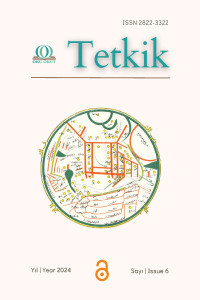

There are NO PUBLICATION FEES (article processing charges or APCs) to publish with this journal.
Tetkik is an open-access, peer-reviewed scientific e-journal that publishes research articles that will contribute to the field of Turkish-Islamic culture twice a year, in March and September. All charges of the Tetkik are covered by Okut Okut Press. The publication of articles and the execution of article processes in the journal are free of charge. No processing fee or submission fee is charged under any other names (editorial processing charges, language editing fees, colour charges, submission fees, page charges, membership fees, print subscription costs, or other supplementary charges). As part of its publication policies, Tetkik does not accept sponsorship or advertisements.

Editor

Abdullah Demir
Asst. Prof. Dr. Abdullah DEMİR ANKARA YILDIRIM BEYAZIT ÜNİVERSİTESİ, İSLAMİ İLİMLER FAKÜLTESİ, TEMEL İSLAM BİLİMLERİ BÖLÜMÜ, KELAM VE İSLAM MEZHEPLERİ TARİHİ ANABİLİM DALI Web
Islamic Sects, Kalam
Miyase Yavuz Altıntaş
Asst. Prof. Dr. Miyase YAVUZ ALTINTAŞ ANKARA HACI BAYRAM VELİ ÜNİVERSİTESİ Web
Islamic Law

Managing Editor

Hümeyra Haciibrahimoğlu
Res. Assist. Hümeyra HACİİBRAHİMOĞLU Ankara Yıldırım Beyazıt Üniversitesi, İlahiyat Fakültesi, Temel İslam Bilimleri, Kelam Web
Kalam

Ethical Editor

İsmail Bulut
Prof. Dr. İsmail BULUT Hitit Üniversitesi İlahiyat Fakültesi Web
Religion, Society and Culture Studies, Islamic Studies, Kalam

English Language Editors

Mehmet Ata Az
Prof. Dr. Mehmet Ata AZ ANKARA YILDIRIM BEYAZIT ÜNİVERSİTESİ
Philosophy of Religion, Islamic Philosophy
Arif Bakla
Prof. Dr. Arif BAKLA ANKARA YILDIRIM BEYAZIT ÜNİVERSİTESİ
Translation and Interpretation Studies, Early English Languages, Education
Default avatar
Dr. Instructor Abdülmecid Yasir EKŞİCİ ANKARA HACI BAYRAM VELİ ÜNİVERSİTESİ
Islamic Law

Statistics Editor

Fatih Kaleci
Asst. Prof. Dr. Fatih KALECİ Necmettin Erbakan Üniversitesi, Matematik ve Fen Bilimleri Eğitimi Bölümü, Matematik Eğitimi Anabilim Dalı Web
Big Data, Mathematics Education, Mathematical Economics

Editorial Board

Default avatar
Prof. Dr. Muhammed Ali YAZIBAŞI ANKARA YILDIRIM BEYAZIT ÜNİVERSİTESİ
Education, Religion, Society and Culture Studies
Hüseyin Akyüz
Prof. Dr. Hüseyin AKYÜZ ANKARA HACI BAYRAM VELİ ÜNİVERSİTESİ İLAHİYAT FAKÜLTESİ
Hadith
Muhammet Ali Asar
Assoc. Prof. Dr. Muhammet Ali ASAR ANKARA HACI BAYRAM VELİ ÜNİVERSİTESİ
Hadith
İrfan Erdoğan
Assoc. Prof. Dr. İrfan ERDOĞAN NECMETTİN ERBAKAN ÜNİVERSİTESİ, AHMET KELEŞOĞLU İLAHİYAT FAKÜLTESİ Web
Religious Education
Serkan Sayar
Dr. Serkan SAYAR Milli Eğitim Bakanlığı
History of Religion, Christian Studies, Comparative Religious Studies, Jewish Studies
Default avatar
Prof. Dr. Osman DEMİR Ankara Hacı Bayram Veli Üniversitesi
Kalam
Ayşe Mine Akar
Asst. Prof. Dr. Ayşe Mine AKAR SİVAS CUMHURİYET ÜNİVERSİTESİ Web
Sufism
Philosophy, Metaphilosophy, Epistemology, Philosophy of Science, Philosophy of Environment, Philosophy of Value, Philosophy of State, Philosophy of Religion, Ethics, Philosophy of Law, Philosophy of Economics, Philosophy of Human Being, Islamic Philosophy, Metaphysics , Philosophy of Society, Philosophy of History, Philosophy of Society, Turkish Islamic Philosophy, Logic, History of Philosophy, History of Ideas, Ancient Philosophy, Hellenistic Philosophy, Philosophy in Turkiye, History of Turkish Ideas, Professional Ethics
Ahmet Yemenici
Assoc. Prof. Dr. Ahmet YEMENİCİ ANKARA YILDIRIM BEYAZIT ÜNİVERSİTESİ, İSLAMİ İLİMLER FAKÜLTESİ Web
Religious Education, Religion, Society and Culture Studies
Erdem Can Öztürk
Prof. Dr. Erdem Can ÖZTÜRK ANKARA HACI BAYRAM VELİ ÜNİVERSİTESİ İLAHİYAT FAKÜLTESİ Web
Turkish Islamic Literature, Turkish Language and Literature, Classical Turkish Literature Out of Ottoman Field, Classical Turkish Literature of Ottoman Field, New Turkish Language (Turkish of Old Anatolia, Ottoman, Turkiye), Classical Turkish Literature
Süleyman Abanoz
Asst. Prof. Dr. Süleyman ABANOZ SELÇUK ÜNİVERSİTESİ, İLAHİYAT FAKÜLTESİ
Psychology of Religion
Abdullah Demir
Asst. Prof. Dr. Abdullah DEMİR ANKARA YILDIRIM BEYAZIT ÜNİVERSİTESİ, İSLAMİ İLİMLER FAKÜLTESİ, TEMEL İSLAM BİLİMLERİ BÖLÜMÜ, KELAM VE İSLAM MEZHEPLERİ TARİHİ ANABİLİM DALI Web
Islamic Sects, Kalam
Hakan Hemşinli
Assoc. Prof. Hakan HEMŞİNLİ Van Yüzüncü Yıl Üniversitesi
Philosophy of Religion, Enlightenment , Turkish and Islamic Intellectual History
Ömer Faruk Söylev
Assoc. Prof. Dr. Ömer Faruk SÖYLEV KÜTAHYA DUMLUPINAR ÜNİVERSİTESİ İLAHİYAT FAKÜLTESİ FELSEFE VE DİN BİLİMLERİ BÖLÜMÜ DİN PSİKOLOJİSİ ANA BİLİM DALI Web
Psychology of Religion
Yaşar Yiğit
Prof. Dr. Yaşar YİĞİT ANKARA YILDIRIM BEYAZIT ÜNİVERSİTESİ, İSLAMİ İLİMLER FAKÜLTESİ
Criminal Law, Islamic Law
Default avatar
Prof. Dr. Celal DEMİR AFYON KOCATEPE ÜNİVERSİTESİ
Turkish Education
Mustafa Koç
Prof. Dr. Mustafa KOÇ Eskişehir Osmangazi Üniversitesi İlahiyat Fakültesi Web
Psychology of Religion
Mehmet Ali Şimşek
Prof. Dr. Mehmet Ali ŞİMŞEK CUMHURİYET ÜNİVERSİTESİ, İLAHİYAT FAKÜLTESİ
Arabic Language and Rhetoric
Emine Enise Yakar
Assoc. Prof. Dr. Emine Enise YAKAR Recep Tayyip Erdogan University
Legal Theory, Jurisprudence and Legal Interpretation, Law and Religion, Islamic Studies (Other)
Aydın Kudat
Assoc. Prof. Dr. Aydın KUDAT ANKARA YILDIRIM BEYAZIT ÜNİVERSİTESİ Web
Linguistics, Law and Legal Studies, Recitation of the Qur'an and Qiraat
Default avatar
Assoc. Prof. Sema ÇELEM ANKARA HACI BAYRAM VELİ ÜNİVERSİTESİ/İSLAMİ İLİMLER FAKÜLTESİ Web
Tafsir
Mustafa Necati Barış
Prof. Dr. Mustafa Necati BARIŞ ANKARA HACI BAYRAM VELİ ÜNİVERSİTESİ İLAHİYAT FAKÜLTESİ İSLAM TARİHİ VE SANATLARI BÖLÜMÜ İSLAM TARİHİ ANABİLİM DALI
Political and Civilization History of Islam, History of Islam
Saffet Kartopu
Prof. Dr. Saffet KARTOPU Ankara Hacı Bayram Veli Üniversitesi İlahiyat Fakültesi
Psychology of Religion
Ömer Soner Hunkan
Prof. Dr. Ömer Soner HUNKAN NECMETTİN ERBAKAN ÜNİVERSİTESİ
History of Central Asia, History of Seljuk, History of Muslim Turkish Countries and Societies
Yüksel Salman
Assoc. Prof. Dr. Yüksel SALMAN YILDIRIM BEYAZIT ÜNİVERSİTESİ
Islamic Law
Necati İşler
Dr. Necati İŞLER ANKARA ÜNİVERSİTESİ, İLAHİYAT FAKÜLTESİ, İLAHİYAT PR. Web
Turkish Islamic Literature

Field Editors

Default avatar
Asst. Prof. Dr. Faruk NARMANLI GİRESUN ÜNİVERSİTESİ, İSLAMİ İLİMLER FAKÜLTESİ
Islamic Arts, Art History, Architectural, Line in Turkish Islamic Art, Turkish-Islamic Arts History
Ottoman history
Sema Yılmaz
Assoc. Prof. Dr. Sema YILMAZ SİVAS CUMHURİYET ÜNİVERSİTESİ
Psychology of Religion, Religious Studies (Other)
Serkan Sayar
Dr. Serkan SAYAR Milli Eğitim Bakanlığı
History of Religion, Christian Studies, Comparative Religious Studies, Jewish Studies
Hüseyin Şıra
Asst. Prof. Dr. Hüseyin ŞIRA Ankara Yıldırım Beyazıt Üniversitesi İlahiyat Fakültesi
Turkish Islamic Literature
Rukiye Aysun İnan
Asst. Prof. Dr. Rukiye Aysun İNAN Ankara Yıldırım Beyazıt Üniversitesi
History of Religion, Religion, Society and Culture Studies
Default avatar
Asst. Prof. Dr. Feyza DOĞRUYOL SAKARYA ÜNİVERSİTESİ
Comparative Political Movement, Middle East Studies, Contemporary History of Iran, History of İslamic sects, Islamic Sects
Default avatar
Res. Assist. Dr. Zehra Betül DİNDAROĞLU RECEP TAYYİP ERDOĞAN ÜNİVERSİTESİ
Islamic Economy, Family Law, Law and Religion, Comparative Law, Ottoman Institutions and Civilization (Other), Religion, Society and Culture Studies, Islamic Law
Ömer Faruk Karaköse
Res. Assist. Dr. Ömer Faruk KARAKÖSE RECEP TAYYİP ERDOĞAN ÜNİVERSİTESİ, İLAHİYAT FAKÜLTESİ
Philosophy, Religion, Society and Culture Studies
İsa Yalçın
Asst. Prof. Dr. İsa YALÇIN BİTLİS EREN ÜNİVERSİTESİ İLAHİYAT FAKÜLTESİ Web
Sufism
Yavuz Selim Göl
Asst. Prof. Dr. Yavuz Selim GÖL Giresun Üniversitesi İlahiyat Fakültesi
Political and Civilization History of Islam, History of Islam, Religion, Society and Culture Studies
Social Media Studies, Social Media Applications and Analysis, Philosophy of Artificial Intelligence, Peace Studies, Sociology of Religion, Studies in Religious Traditions (Excl. Eastern, Jewish, Christian and Islamic Traditions), Comparative Religious Studies, Religious Studies (Other), Islamic Studies (Other)
Yasin Yiğit
Assoc. Prof. Dr. Yasin YİĞİT KIRIKKALE ÜNİVERSİTESİ, İSLAMİ İLİMLER FAKÜLTESİ
Religious Education
Esma Aygün Yakın
Res. Assist. Dr. Esma AYGÜN YAKIN Yozgat Bozok Üniversitesi
Philosophy of Value, Philosophy of Religion, Ethics
Default avatar
Assoc. Prof. Dr. Emrullah KILIÇ ANKARA HACI BAYRAM VELİ ÜNİVERSİTESİ
Philosophy of Value, Ethics, Philosophy of Human Being, Philosophy of Culture , Turkish Islamic Philosophy, History of Philosophy
Ebru Adıyaman
Asst. Prof. Dr. Ebru ADIYAMAN Erzincan Binali Yıldırım Üniversitesi Web
Hadith
Default avatar
Dr. Instructor Abdülmecid Yasir EKŞİCİ ANKARA HACI BAYRAM VELİ ÜNİVERSİTESİ
Islamic Law
Hümeyra Haciibrahimoğlu
Res. Assist. Hümeyra HACİİBRAHİMOĞLU Ankara Yıldırım Beyazıt Üniversitesi, İlahiyat Fakültesi, Temel İslam Bilimleri, Kelam Web
Kalam

Assistant Editors

Elvira Tagaeva
Doctoral Elvira TAGAEVA KYRGYZ - TURKISH MANAS UNIVERSITY, FACULTY OF THEOLOGY
History of İslamic sects, Islamic Sects
Rukiye Gedikli
Post Graduate Rukiye GEDİKLİ İBN HALDUN ÜNİVERSİTESİ
History of Religion
Default avatar
Professional Merve Nur ÇAM HİTİT ÜNİVERSİTESİ
Tafsir
Ulanbek Kalmurza Uulu
Res. Assist. Dr. Ulanbek KALMURZA UULU KIRGIZİSTAN-TÜRKİYE MANAS ÜNİVERSİTESİ
Religious Studies (Other), Islamic Law, Islamic Studies (Other)
Merve Türkeri
Post Graduate Merve TÜRKERİ ISTANBUL MEDENIYET UNIVERSITY
Islamic Law
Abdullah Dağ
Doctoral Abdullah DAĞ Oku Okut Derneği/Akademi
Islamic Sects, Kalam
Beyzanur Petek
Beyzanur PETEK GAZİ ÜNİVERSİTESİ, GAZİ EĞİTİM FAKÜLTESİ
Philosophy Education