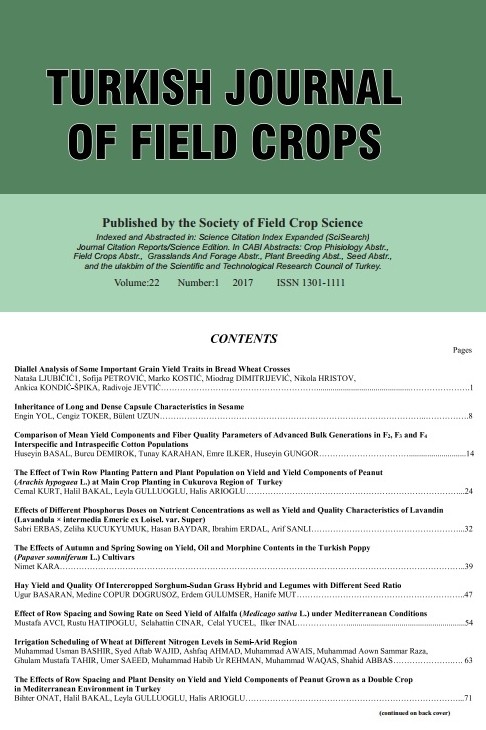
Research Article

MOLECULAR CHARACTERIZATION OF MUTATION REGIONS IN HERBICIDE-RESISTANT QUINOA (Chenopodium quinoa Willd.) MUTANT LINES

Volume: 29 Number: 2 December 24, 2024
EN

MOLECULAR CHARACTERIZATION OF MUTATION REGIONS IN HERBICIDE-RESISTANT QUINOA (Chenopodium quinoa Willd.) MUTANT LINES

Abstract

Quinoa (Chenopodium quinoa Willd.) is a viable alternative crop due to its adaptability to unfavorable climate and soil conditions, and its seeds are nutritionally rich. However, the lack of selective herbicides for weed control in quinoa fields poses a significant challenge for cultivation. Consequently, developing herbicide-resistant quinoa lines is essential. In this study, the Titicaca variety of quinoa was used. Sodium azide at a concentration of 1.5 mM was employed for mutagenesis. Herbicide-resistant plants were identified by applying herbicides from the imazamox to the M3 generation. The resistant lines were designated as ET-6, ET-7, OT-11, and T-103. Among the four mutant lines obtained through seed mutagenesis, the OT-11 line exhibited a cytosine to adenine (C→A) substitution in the ALS gene, while the ET-6 line showed a thymine to guanine (T→G) substitution. These mutations in the OT-11 and ET-6 genotypes were classified as transversion-type mutations. A transition-type mutation was observed in the T-103 mutant line, involving a thymine to cytosine (T→C) substitution at nucleotide 1114. The findings suggest that effective weed control in quinoa cultivation can be achieved by developing varieties resistant to IMI group herbicides. Continued research on herbicide resistance should focus on the ET-6, OT-11, and T-103 lines in subsequent generations

Keywords

Supporting Institution

Atatürk Üniversitesi Bilimsel Araştırma Projeleri kapsamında desteklenmiştir

Project Number

FDK-2019-7186

References

  1. Al-Qurainy, F. and S. Khan. 2009. Mutagenic effects of sodium azide and its application in crop improvement. World Applied Sciences Journal. 6(12): 1589-1601.
  2. Ausubel, F.M., R. Brent, R.E. Kingston, D.D. Moore, J.G. Seidman, J.A. Smith and K. Struhl. 1994. Current protocols in molecular biology. Volume 1. Wiley, New York.
  3. Basaran, F. 2021. Imidazolinone-tolerant crop plants and their use in weed control. Journal of Agriculture. 4(2): 67-79.
  4. Beckie, HJ., G. Seguin-Swartz, H. Nair, S.I. Warwick, and E.Johnson. 2004. Multiple herbicide-resistant canola can be controlled by alternative herbicides. Weed Science. 52:152– 157.
  5. Chuchert, S., Nualsrı, C., Soonsuwon, W. 2022. Genetıc Varıabılıty and Dıversıty of Upland Rıce Landraces. Turkish Journal of Field Crops. 2022, 27(2), 175-181.
  6. Carpıcı, Budaklı, E., S. Erol, B.B. Asık, O. Arslan. 2023. Influences of sowıng date and harvest stage on dry matter yield and forage qualıty of Quınoa (Chenopodium quinoa Willd.). Turkish Journal of Field Crops. 28(1): 26-36.
  7. Duke, S. O. 2005. Taking stock of herbicide-resistant crops ten years after introduction. Pest Manage Sci. 61: 211–218. FAOSTAT. FAOSTAT Database. 2022. Available Online: https://www.fao.org/faostat/en/#data/QCL (accessed time 14 June 2024).
  8. Geren, H. 2015. Effects of different nitrogen levels on the grain yield and some yield components of quinoa (Chenopodium quinoa Willd.) under Mediterranean climatic conditions.Turkish Journal of Field Crops. 20(1): 59-64.

Details

Primary Language

English

Subjects

Field Crops and Pasture Production (Other)

Journal Section

Research Article

Publication Date

December 24, 2024

Submission Date

April 18, 2024

Acceptance Date

August 2, 2024

Published in Issue

Year 2024 Volume: 29 Number: 2

APA
Egritas, Ö., Tan, M., & Haliloğlu, K. (2024). MOLECULAR CHARACTERIZATION OF MUTATION REGIONS IN HERBICIDE-RESISTANT QUINOA (Chenopodium quinoa Willd.) MUTANT LINES. Turkish Journal Of Field Crops, 29(2), 101-105. https://doi.org/10.17557/tjfc.1469935
AMA
1.Egritas Ö, Tan M, Haliloğlu K. MOLECULAR CHARACTERIZATION OF MUTATION REGIONS IN HERBICIDE-RESISTANT QUINOA (Chenopodium quinoa Willd.) MUTANT LINES. TJFC. 2024;29(2):101-105. doi:10.17557/tjfc.1469935
Chicago
Egritas, Ömer, Mustafa Tan, and Kamil Haliloğlu. 2024. “MOLECULAR CHARACTERIZATION OF MUTATION REGIONS IN HERBICIDE-RESISTANT QUINOA (Chenopodium Quinoa Willd.) MUTANT LINES”. Turkish Journal Of Field Crops 29 (2): 101-5. https://doi.org/10.17557/tjfc.1469935.
EndNote
Egritas Ö, Tan M, Haliloğlu K (December 1, 2024) MOLECULAR CHARACTERIZATION OF MUTATION REGIONS IN HERBICIDE-RESISTANT QUINOA (Chenopodium quinoa Willd.) MUTANT LINES. Turkish Journal Of Field Crops 29 2 101–105.
IEEE
[1]Ö. Egritas, M. Tan, and K. Haliloğlu, “MOLECULAR CHARACTERIZATION OF MUTATION REGIONS IN HERBICIDE-RESISTANT QUINOA (Chenopodium quinoa Willd.) MUTANT LINES”, TJFC, vol. 29, no. 2, pp. 101–105, Dec. 2024, doi: 10.17557/tjfc.1469935.
ISNAD
Egritas, Ömer - Tan, Mustafa - Haliloğlu, Kamil. “MOLECULAR CHARACTERIZATION OF MUTATION REGIONS IN HERBICIDE-RESISTANT QUINOA (Chenopodium Quinoa Willd.) MUTANT LINES”. Turkish Journal Of Field Crops 29/2 (December 1, 2024): 101-105. https://doi.org/10.17557/tjfc.1469935.
JAMA
1.Egritas Ö, Tan M, Haliloğlu K. MOLECULAR CHARACTERIZATION OF MUTATION REGIONS IN HERBICIDE-RESISTANT QUINOA (Chenopodium quinoa Willd.) MUTANT LINES. TJFC. 2024;29:101–105.
MLA
Egritas, Ömer, et al. “MOLECULAR CHARACTERIZATION OF MUTATION REGIONS IN HERBICIDE-RESISTANT QUINOA (Chenopodium Quinoa Willd.) MUTANT LINES”. Turkish Journal Of Field Crops, vol. 29, no. 2, Dec. 2024, pp. 101-5, doi:10.17557/tjfc.1469935.
Vancouver
1.Ömer Egritas, Mustafa Tan, Kamil Haliloğlu. MOLECULAR CHARACTERIZATION OF MUTATION REGIONS IN HERBICIDE-RESISTANT QUINOA (Chenopodium quinoa Willd.) MUTANT LINES. TJFC. 2024 Dec. 1;29(2):101-5. doi:10.17557/tjfc.1469935

Turkish Journal of Field Crops is published by the Society of Field Crops Science and issued twice a year.
Owner : Prof. Dr. Behçet KIR
Ege University, Faculty of Agriculture, Department of Field Crops
Editor in Chief : Prof. Dr. Emre ILKER
Address : 848 sok. 2. Beyler İşhanı No:72, Kat:3 D.313 35000 Konak-Izmir, TURKEY
Email :  turkishjournaloffieldcrops@gmail.com contact@field-crops.org