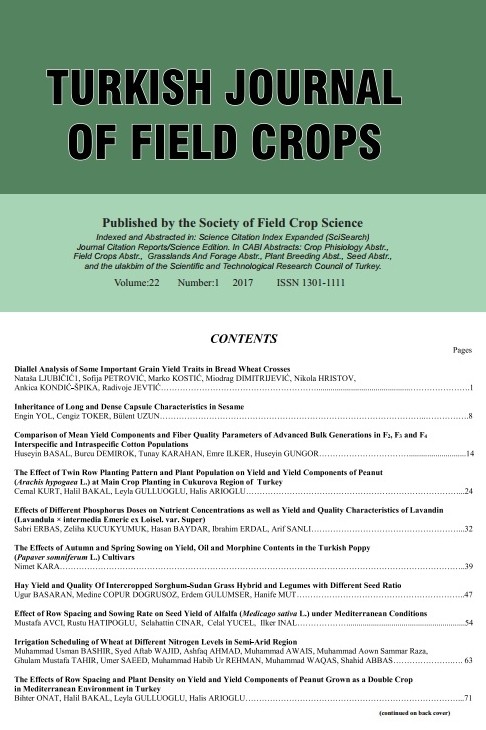
HAY YIELD AND QUALITY OF INTERCROPPED SORGHUM-SUDAN GRASS HYBRID AND LEGUMES WITH DIFFERENT SEED RATIO
Abstract
In this study, sorghum-sudangrass hybrid ‘Aneto’ and legumes (soybean and cowpea) intercropping at
different seed rates (100:100; 50:100, 100:50) were examined for hay yield, protein content, protein yield,
relative feed value (RFV) and mineral content (P, K, Mg, Ca) in 2013 and 2014. As legume Yesilsoy (Syes) and
Yemsoy (Syem) verieties of soybean and Ulkem (C) varietiy of cowpea were used. Sorghum-sudangrass hybrid x
legume intercropping produced higher hay and protein yield compare to their monocrops. RFV of hay also
exalted with intercropping copmpare to alone sorghum-sudangrass hybrid (S). Over the years, the highest hay
yield was obtained from S intercropped with Syes at 100:100 (21.61 t ha-1
), 100:50 (20.68 t ha-1
) seed rates and
with C at 50:100 (20.40 t ha-1
) seed rate. Protein yield was the highest in 100S:100Syes tratment in 2013 (2.16 t
ha-1
), 2014 (2.85 t ha-1
) and combined years (2.50 t ha-1
). However, S intercropping with C at 100:100, 50:100
(in 2013) and at 50:100 (in 2014) seed rates were at par with 100S:100Syes. This study indicated that seed rate
and species or variety selection extremly important in mixture cropping. Thus, generally sorghum-sudangrass
hybrid and ‘Yesilsoy’ variety of soybean at 100:100 seed rate exhibited the best results in regarding hay and
protein yield in the present conditions.
Keywords
References
- Adeniyan, O. N., O.A. Aluko, S.O. Olanipekun, J.O. Olasoji and V.O. Aduramigba-Modupe. 2014. Growth and yield performance of cassava/maize ıntercrop under different plant population density of maize. J. of Agricultural Sci. 6(8): 35- 40.
- Ahmad, A., A. Riaz, M. Naeem and A. Tanveer. 2007. Performance of forage sorghum intercropped with forage legumes under different planting patterns. Pakistan J. Bot. 39(2): 431-439.
- Albayrak, S. and H. Ekiz. 2005. An investigation on the establishment of artificial pasture under Ankara’s ecological conditions. Turk J. Agric For. 29: 69–74.
- Asci, O.O., Z. Acar and Y.K. Arıcı. 2015. Hay yield, quality traits and interspecies competition of forage pea-triticale mixtures harvested at different stages. Turkish Journal of Field Crops, 20(2):166-173.
- Ayan, I., H. Mut, U. Basaran, Z. Acar, O. Onal Asci. 2012. Forage potential of cowpea (Vigna unguiculata L. Walp). Turkish Journal of Field Crops, 17(2):135-138.
- Ball, D.M., C.S. Hoveland and G.D. Lacefield. 2007. Southern Forages. 4th ed. International Plant Nutrition Institute, Norcross, GA.
- Cecen, S., M. Oten and C. Erdurmus. 2005. Assesment of Sorghum (Sorghum bicolor L.), Sudangrass (Sorghum sudanense L.) and Corn (Zea mays L.) as Second Crop in the Coastal Region of West Mediterranean Belt of Turkey. J. of Agriculture Faculty of Akdeniz Univ. 18(3): 337-341.
- Egbe, O.M. 2005. Evaluation of some agronomic potentials of pigeonpea genotypes for intercropping with maize and sorghum in Southern Guinea Savanna. Ph.D. Thesis, University of Agriculture, Makurdi, Nigeria.
Details
Primary Language
English
Subjects
-
Journal Section
Research Article
Publication Date
June 15, 2017
Submission Date
September 27, 2016
Acceptance Date
September 27, 2016
Published in Issue
Year 2017 Volume: 22 Number: 1
Cited By
EVALUATION OF FORAGE TURNIP + CEREAL MIXTURES FOR FORAGE YIELD AND QUALITY TRAITS
Turkish Journal Of Field Crops
https://doi.org/10.17557/tjfc.1014538