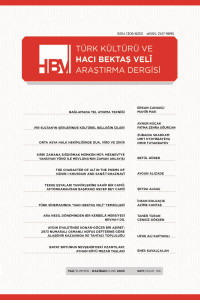
Aim
The Journal of Turkish Culture and Hacı Bektaş Velî Research was founded in 1994 as the scholarly organ of the Turkish Culture and Hacı Bektaş Velî Research Centre at Gazi University; it is an international, peer-reviewed journal devoted to original and methodologically rigorous scholarship. Its fundamental aim is to provide a forum for the study of the cultural history of the Turks and of the traditions of belief, thought, and spirituality formed within that history—scholarship governed by scientific criteria, theoretically accomplished, and grounded in primary sources—and to make this body of knowledge available to national and international academic communities. In pursuit of this aim, the journal regards the promotion of the scholarly publication of dispersed and hitherto unexamined source materials, the convergence of the methods and insights of different disciplines upon a shared field of inquiry, and the articulation of the accumulated learning of the field with current theoretical debate—thereby offering a venue of high standard to the national academy and the international scholarly community alike—as the cornerstone of its editorial policy.
Scope
The Journal of Turkish Culture and Hacı Bektaş Velî Research takes as its centre of gravity the study of Alevism and Bektashism together with the religious and spiritual history of Anatolia, yet it does not confine its scope to this core. The history of Sufism and the Sufi orders, the futuwwa and malāmatī movements, popular belief, and the oral and written heritage of spiritual life fall within its purview, as do studies in literature, art, and material culture bearing upon Turkish–Islamic history and civilisation.
The journal's scope is methodologically and disciplinarily multi-layered: it encompasses history, philology and manuscript studies, the religious sciences, the sociology, anthropology, psychology, and philosophy of religion, the history of religions, folklore, art history, ethnomusicology, and literary studies, in the measure of their bearing upon Turkish culture and the religious history of the Turks. Geographically it is centred on Anatolia but extends to the Balkans, the Caucasus, Iran, Turkestan, Inner Asia, and the broader Turkish–Islamic world, including the diaspora extensions of these regions; chronologically it is open to all periods from the medieval era to the present.
The journal gives priority to research articles grounded in primary sources—articles resting upon archival materials, manuscripts, fieldwork data, or the testimony of original texts. Contributions are expected to make a distinctive and noteworthy contribution to their field, advancing new evidence, new interpretations, or new theoretical approaches. Work that merely rehearses the existing literature, confines itself to summarising secondary sources, or fails to develop an original argument is incompatible with the journal's editorial line and will be returned without review. It is a fundamental condition that submissions have not been previously published elsewhere, nor be under simultaneous consideration by any other publication. For work supported by an institution or fund, the name of the supporting body and the project number must be stated. All submissions undergo double-blind peer review.