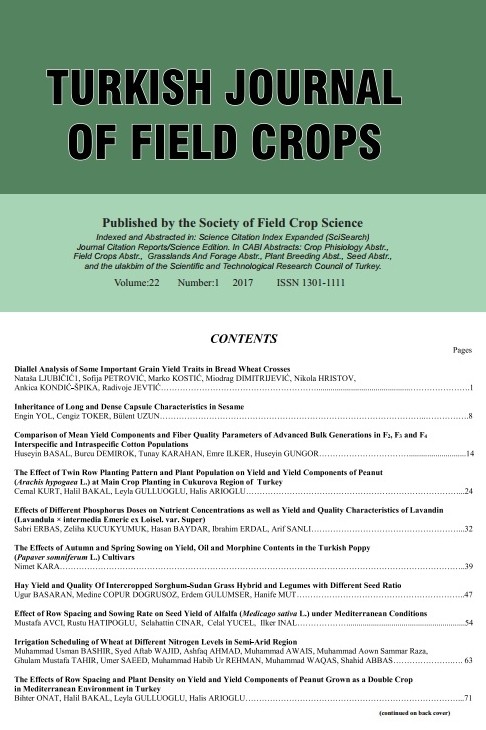
EFFECT OF HIGH AIR AND SOIL TEMPERATURE ON YIELD AND SOME YIELD COMPONENTS OF PEANUT (Arachis hypogaea L.)
Abstract
This research was conducted as a main crop in University of Cukurova, Faculty of Agriculture Field Crops Department in 2016 and 2017 growing seasons. The objective of this study was to determine the effect of high air and soil temperature on pod yield and some yield component of peanut (Arachis hypogaea L.) breeding lines in main crop growing season in Mediterranean region in Turkey. In this study, 22 peanut lines (F6 and F7) belonging to Brantley x Halisbey crossing and NC-7 variety (st) were used as a plant material. The experimental design was a Randomized Complete Block with three replications. The main yield component such as pod number, pod weight, 100-seed weight, and pod yield per hectare values of lines were investigated. The maximum air temperature data was recorded day by day during the growing period in both years and average daily maximum air temperatures were higher in 2017 than in 2016. When the pod yield compared in 2016 and 2017, it is found that the pod yield was lower (21.5%) in 2017 than in 2016. The high air and soil temperature was negatively affected the pod yield of peanut breeding lines. It was found that the breeding lines differ in their sensitivity to high temperatures.
Keywords
References
- Anonymous. 2012. http://www.ipcc.ch. 2012. The Intergovernmental Panel on Climate Change (IPCC), Czechoslovakia.
- Anonymous. 2017a. The meteorological data for Adana. The Turkish State Meteorological Service Adana Regional Directorship, 2016 and 2017.
- Anonymous. 2017b. The Meteorological Data for Adana. Faculty of Agriculture Meteorological Station.
- Arıoglu, H., H. Bakal, L. Gulluoglu, C. Kurt and B. Onat. 2016. The determination of important agronomic and quality characteristics of some peanut varieties grown in main crop conditions. Journal of Field Crops Central Research Institute, 25 (Special issue 2):24-29.
- Arioglu, H.H. and T. Ersoy. 1987. The effect of high temperature at growing period on soybean [Glycine max (L.) Merr] yield. J. of Natural Science 11(2):262-268.
- Awal, M. A. and T. Ikeda. 2002. Effects of changes in soil temperature on seedling emergence and phenological development in field-grown stands of peanut (Arachis hypogaea L.). Environ. Exp. Bot. 47:101-113.
- Caliskan, S., M.E. Caliskan, M. Arslan and H. Arioglu. 2008. Effects of sowing date and growth duration on growth and yield of groundnut in a Mediterranean-type environment in Turkey. Field Crops Res. 105:131-140.
- Canavar, O. and M.A. Kaynak. 2008. Effect of different planting dates on yield and yield components of peanut (Arachis hypogaea L.). Turkish Journal of Agriculture and Forestry 32:521-528.
Details
Primary Language
English
Subjects
-
Journal Section
Research Article
Authors
Leyla Gulluoglu
*
This is me
Türkiye
Halil Bakal
This is me
Türkiye
Bihter Onat
This is me
Türkiye
Publication Date
June 15, 2018
Submission Date
March 27, 2018
Acceptance Date
March 27, 2018
Published in Issue
Year 2018 Volume: 23 Number: 1
Cited By
CHARACTERIZATION OF PEANUT (Arachis hypogaea L.) GERMPLASM FOR MORPHOLOGICAL AND QUALITY TRAITS IN AN ARID ENVIRONMENT
Turkish Journal Of Field Crops
https://doi.org/10.17557/tjfc.615176GENETIC AND ENVIRONMENTAL VARIABILITY, HERITABILITY AND GENETIC ADVANCE IN POD YIELD, YIELD COMPONENTS, OIL AND PROTEIN CONTENT OF PEANUT VARIETIES
Turkish Journal Of Field Crops
https://doi.org/10.17557/tjfc.1050448Farklı Yer Fıstığı Çeşitlerinin Melezlenmesinden Elde Edilen İleri Kademelerdeki Yer Fıstığı Hatlarının, Önemli Tarımsal ve Kalite Özelliklerinin Belirlenmesi
Ziraat Mühendisliği
https://doi.org/10.33724/zm.1095281Intercropping red chili with leguminous crops to improve crop diversity and farmers’ resilience to climate change effects in dryland
IOP Conference Series: Earth and Environmental Science
https://doi.org/10.1088/1755-1315/1192/1/012001The Impact of the Sowing Time on Peanuts Yield`s Components in Marginal Sandy Soils in Southern Oltenia, Romania
Romanian Agricultural Research
https://doi.org/10.59665/rar4029Optimizing sowing date and plant density improve peanut yield by mitigating heat and chilling stress
Agronomy Journal
https://doi.org/10.1002/agj2.21307The effect of different irrigation treatments on yield and water productivity of Arachis Hypogaea L. under semi‐arid conditions in Iran
Irrigation and Drainage
https://doi.org/10.1002/ird.2461Determination of optimum irrigation and effect of deficit irrigation strategies on yield and disease rate of peanut irrigated with drip system in Eastern Mediterranean
Agricultural Water Management
https://doi.org/10.1016/j.agwat.2019.04.033Optimizing sowing date for peanut genotypes in arid and semi-arid subtropical regions
PLOS ONE
https://doi.org/10.1371/journal.pone.0252393An efficient estimation of crop performance in sheep fescue (Festuca ovina L.) using artificial neural network and regression models
Scientific Reports
https://doi.org/10.1038/s41598-022-25110-8Mitigating heat-induced yield loss in peanut: Insights into 24-epibrassinolide-mediated improvement in antioxidant capacity, photosynthesis, and kernel weight
Field Crops Research
https://doi.org/10.1016/j.fcr.2024.109521Phenotyping for heat tolerance in food crops
Plant Physiology Reports
https://doi.org/10.1007/s40502-024-00833-0Optimal digging time of peanut in the mid‐southern United States
Agronomy Journal
https://doi.org/10.1002/agj2.70156Navigating Climate Change Challenges for a Resilient Future in Groundnut Production: A Review
Journal of Agronomy and Crop Science
https://doi.org/10.1111/jac.70111