Jul 14, 2026
Publication Type
Articles
Research Article
AMİSOS Journal aims to contribute to the accumulation of knowledge in the social sciences, particularly in subjects such as Archaeology, Anthropology, Cultural Heritage, and Ancient History, by publishing works of scientific quality at the national and international levels in the field of Social Sciences.
The journal covers topics such as Paleoanthropology, Physical Anthropology, Prehistory, Protohistory, Near Eastern Archaeology, Experimental Archaeology, Classical Archaeology, Anatolian and Near Eastern Archaeology, Ancient History, Hittitology, Sumerology, Latin Language and Literature, Greek Language and Literature, Childhood and Child Archaeology, Anthropological Archaeology, Settlement Archaeology, Underwater Archaeology, Archaeometallurgy, Archaeozoology, Archaeobotany, Byzantine Art, Ottoman Art, European Art, Numismatics, History of Architecture, Restoration and Conservation, Museology, and other related or auxiliary topics in the social sciences, as well as related interpretations, approaches, and theories.
Since 2016, AMİSOS Journal has been published twice a year, in June and December, in accordance with the status of an “International Peer-Reviewed Journal.” It may also be published as a Special Issue by decision of the Editorial Board.
AMİSOS Journal
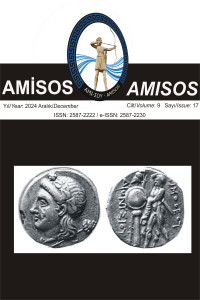
Amisos Journal is an international peer-reviewed journal published twice a year (June-December) online, containing the texts of papers presented at all conferences, as well as original and high-quality articles, reviews, and book reviews that bring scientific innovation. Decisions regarding the journal's publication, content, scope, and layout are made by the editor-in-chief based on proposals from the editorial board members.
Scope and Principles
The journal covers main topics in the social sciences, such as anthropology, archaeology, archaeometry, epigraphy, philology, art history, conservation/restoration, architectural history, and museology, as well as related, associated, or auxiliary topics and related interpretations, approaches, and theories. The journal includes original research and commentary articles, news, excavation reports, and book reviews that bring scientific innovation in line with its scope.
Articles must not have been previously published elsewhere or accepted for publication in order to be published in our journal. Authors guarantee that the article they submit to the journal is original and has not been previously published, even in another language, or submitted to another journal for publication. Papers presented at a scientific meeting and not yet published may be accepted for publication in our journal, provided that this circumstance is stated. If the article submitted for publication is derived from the author's thesis (bachelor's, master's, or doctoral), this should be clearly stated.
Articles submitted to the journal are sent to the relevant field editor if they are deemed suitable after preliminary review. If the article is deemed suitable after review by the field editor, it is sent to two reviewers (blind review). If necessary, it may also be sent to a third reviewer. Articles received should not be expected to be published in the first issue following the initial submission date, depending on the volume of articles in the field.
Articles submitted to the journal should not have been previously published or submitted to another journal for publication. Authors should obtain a similarity report for articles to be submitted to the journal and send it along with the article. The similarity ratio should not exceed 20% in total for the work to be published. For articles produced from postgraduate theses, the similarity ratio should not exceed 30% in total and 10% in the primary source. The similarity ratio of submitted articles is also checked by our journal using the iThenticate program. Articles that do not meet the ratio are returned. Works submitted for publication must be prepared in accordance with academic writing rules and in one of the following languages: Turkish, German, English, or Russian. The copyright form must be completed and submitted with the manuscript. The relevant editor may make any necessary corrections to the manuscript. The abstract in a foreign language may be corrected by the foreign language editor if deemed necessary.
Scientific studies submitted to the journal must pay the utmost attention to compliance with research and publication ethics.
Manuscript Submission Guidelines
Manuscripts submitted to Amisos Journal should be written in Book Antiqua font, 1.5 line spacing, 12 point; footnotes should be in APA 7 style, 10 point. However, if a special font has been used during writing due to the requirements of certain fields, these fonts should be sent along with the article. The submitted manuscript must be unpublished and not submitted for consideration to any other journal for publication.
Ethics Committee Approval
According to the decisions taken by the relevant committees of TÜBİTAK ULAKBİM TR DİZİN, for 2020, all articles other than compilation-type articles submitted for publication in all journals indexed in TR DİZİN and currently under review must be accompanied by the following from their authors:
Research requiring Ethics Committee approval
• Any research conducted using qualitative or quantitative approaches that require data collection from participants through surveys, interviews, focus group studies, observations, experiments, or interview techniques.
• The use of humans and animals (including material/data) for experimental or other scientific purposes.
• Clinical research conducted on humans.
• Research conducted on animals.
• Retrospective studies in accordance with the personal data protection law,
In addition;
• Indicating that an “Informed consent form” has been obtained in case presentations,
• Obtaining and indicating permission from the owners for the use of scales, surveys, and photographs belonging to others,
• Indicating compliance with copyright regulations for the ideas and works of art used
Ayrıntılı Bilgi İçin Linklere Tıklayınız.
https://tubitak.gov.tr/sites/default/files/20689/ekbn_2020.pdf
https://tubitak.gov.tr/sites/default/files/20689/yasal_ozel_izin_belgesi_bilgi_notu.pdf
Page Layout:
The article template should be downloaded and written on without altering the template. Click here to download the template.
Top margin: 2.5 cm
Bottom margin: 2.5 cm
Right margin: 2.5 cm
Left margin: 2.5 cm
Text size: 12 pt,
Paragraph spacing: 6 pt
Paragraph indent: 1.25 cm
Line spacing: 1.5
Title:
The title should be descriptive of the article, reflecting its main concepts, discussions, and main argument, and should not exceed 12 words if possible. It should be in Book Antiqua font, 12 pt, capital letters, and centered. Only the title of the article should appear above the text and abstract; the author's name should not be included. For papers presented at a conference but not yet published, the name, date, and location of the conference should be indicated.
Authors should provide their information in the journal system, not in the text of the paper, including their names, full and clear institutional addresses, telephone and fax numbers, email addresses, and ORCID IDs. This information will not be sent to reviewers.
If the article has an Ethics Committee Report, the necessary information should be added to the first page.
Abstract
The abstract should be in Book Antiqua, 10 point, single line spacing, no paragraph indentation, and consist of 150-200 words. Articles in foreign languages should have a Turkish abstract.
Keywords: There should be at least 5 keywords.
Introduction
The text should be written in Book Antiqua font, 12 point, with 1.5 line spacing, a paragraph indent of 1.25 cm, and a paragraph spacing of 0 pt before and 6 pt after. The text, including images, should not exceed 30 pages. The introduction should clearly present the topic of the study, identify the gap or problem in the literature, and explain the purpose of the study.
1. Main Title
1.1. Subtitle
2. Main Title
2.1. Subtitle
"Block quotations should be in 10-point italicized quotation marks. Block quotations should be given in italics in 10-point quotation marks."
Figures, Drawings, Graphs, and Tables
Table titles should be centered above the table, while other figures, maps, etc. should be centered below the title. Images, drawings, maps, figures, tables, and graphs should be numbered consecutively. They should be referenced in the text as (Image 1), (Figure 1), (Graph 1), (Table 1).
Conclusions and Recommendations
The conclusion should be written in Book Antiqua, 12 point.
References
Every work cited in footnotes within the article text must be added to the references. Works should be listed alphabetically by author's last name. The APA 7 system should be used when citing sources.
Summary
For articles written in Turkish, an expanded English summary of 750-1000 words should be added. The summary should be 10 point font, single-spaced, and justified. The summary should start on a new page.
A summary is not required for articles written in English.
Author Contribution Rates
The first author contributed %....., and the second author contributed %....., to the study.
Conflict of Interest Statement
There is no financial conflict of interest with any institution, organization, or individual regarding our article titled “…………………………………………………………………………………………………” and there is no conflict of interest among the authors.
If there is a conflict of interest, please describe the scope of the conflict in the space below.
Artificial Intelligence (AI) Usage Statement
No artificial intelligence was used in any part of our work.
Artificial intelligence was used partially in …… sections of our work; it was used entirely in ……. sections, stages, or parts.
NOTES
• In the literature review, publications previously made on the subject in Amisos must be taken into consideration.
• It is crucial that footnotes and references comply with the APA 7 Style system to avoid unnecessary time loss due to revision requests.
• Abbreviations used in articles should be based on the TDK Spelling Guide.
• "In accordance with the conditions of TÜBİTAK ULAKBİM; for articles to be submitted to the journal: For studies requiring data collection through methods such as scales, surveys, interviews, and observations, the ethical committee approval (name of the ethical committee, decision date, and number) must be stated and documented on the first and last pages of the article and in the methods section. Information regarding the signing of the informed consent form must be included in the article. Evidence that ethical principles were observed during the data collection process (such as obtaining permission to use others' scales, surveys, or documents) must be presented in the article.
Articles must state that research and publication ethics have been adhered to. Accordingly, in studies requiring ethics committee approval, information about the approval (committee name, date, and number) should be included in the article title as a reference.
* Articles prepared according to these formal requirements should not exceed 30 pages, although there is no page limit.
The publication processes implemented in the AMİSOS Journal form the basis for the impartial and reputable development and distribution of knowledge. In this regard, the processes applied directly reflect the quality of the work of authors and the institutions supporting them. Peer-reviewed studies are those that embody and support the scientific method. At this point, it is important that all stakeholders in the process (authors, readers and researchers, publishers, reviewers, and editors) adhere to ethical standards. Our journal expects all stakeholders to bear the following ethical responsibilities within the scope of publication ethics.
The ethical duties and responsibilities listed below have been prepared by taking into account the guidelines and policies published by the Committee on Publication Ethics (COPE) as open access and the YÖK Scientific Research and Publication Ethics Guidelines.
No royalties are paid for published articles.
Authors' Ethical Responsibilities
All authors submitting work to the journal are deemed to have assumed legal responsibility for their submissions. The responsibility for plagiarism lies with the author. If an article is derived from the author's own work, this must be indicated in a footnote. No information should be used without citing the source.
Articles submitted to the journal will be evaluated after being scanned for similarity. The similarity rate can be a maximum of 20%.
The names of those who contributed to the work submitted for publication must be indicated. At the same time, adding the name of a person who did not contribute to the work is scientifically unethical. In such cases, the responsibility lies with the person who submitted the article.
A study should not be submitted to more than one journal at the same time.
Distorting the information and documents used, using expressions that disparage individuals and institutions, and offending national and religious sentiments are expressions that should not be included in academic studies.
Ethical Responsibilities of Reviewers
Experts appointed as reviewers should evaluate the works submitted to them impartially and in accordance with scientific ethical rules.
The work should be evaluated within a timeframe deemed appropriate for the reviewer, and the results should be uploaded to the system. This is important both for the journal's publication process and for the fulfillment of the researcher's academic desires and expectations.
If the reviewers identify any unethical situations related to the submitted work that the editors have not noticed, they should immediately report them to the journal editors.
In order to avoid being victimized in subsequent criticism and legal sanctions, reviewers are expected to exercise due care when reviewing articles, ensuring they are read thoroughly and evaluated carefully.
Ethical Duties and Responsibilities of Editors
AMİSOS editors and subject editors should have the following ethical duties and responsibilities based on the guidelines published by the Committee on Publication Ethics (COPE) as open access: “COPE Code of Conduct and Best Practice Guidelines for Journal Editors.”
Editors have the following roles and responsibilities:
-Striving to meet the information needs of readers and authors,
-Ensuring the continuous development of the journal,
-Implementing processes to improve the quality of works published in the journal,
-Supporting freedom of thought,
-Ensuring academic integrity,
-Maintaining work processes without compromising intellectual property rights and ethical standards,
-Demonstrating openness and transparency in publishing matters requiring correction or clarification.
Relationships with readers
-Editors should make decisions taking into account the information, skills, and experience expectations of all readers, researchers, and practitioners. They should ensure that published works contribute to readers, researchers, practitioners, and the scientific literature, and are original in nature. Furthermore, editors are obligated to consider feedback from readers, researchers, and practitioners and to provide explanatory and informative feedback.
Relationships with Authors
The duties and responsibilities of editors towards authors are as follows:
-Editors should make positive or negative decisions based on the importance, original value, validity, clarity of expression, and the aims and objectives of the journal.
-Works that are suitable for publication should be accepted for preliminary review unless they have serious problems.
- Editors should not disregard positive referee recommendations unless there is a serious problem with the work.
- New editors should not change decisions made by previous editors regarding works unless there is a serious problem.
- The “Blind Refereeing and Evaluation Process” must be published, and editors should prevent any deviations from the defined processes.
-Editors should publish an “Author Guide” that details everything authors can expect from them. These guides should be updated at regular intervals.
-Authors should receive clear and informative notifications and feedback.
Relationships with referees
The duties and responsibilities of editors towards referees are as follows:
-Referees should be selected according to the subject of the work.
-They are responsible for providing referees with the information and guidance they will need during the evaluation phase.
-They must monitor for any conflicts of interest between authors and referees.
-They must keep the identities of referees confidential in the context of blind refereeing.
-They should encourage referees to evaluate the work in an impartial, scientific, and objective manner.
-It must evaluate referees based on criteria such as timeliness and performance.
-It must establish practices and policies to improve the performance of referees.
-It must take the necessary steps to dynamically update the referee pool.
-It must prevent rude and unscientific evaluations.
-It must take steps to ensure that the referee pool is diverse.
Relations with the editorial board
Editors should ensure that all editorial board members proceed in accordance with publication policies and guidelines. They should inform editorial board members about publication policies and keep them up to date on developments. They should train new editorial board members on publication policies and provide them with the information they need.
Additionally, editors should:
-Ensure that members of the editorial board evaluate submissions impartially and independently.
-Identify new editorial board members who can contribute and are suitably qualified.
-Submit works appropriate to the expertise of editorial board members for evaluation.
-Maintain regular interaction with the editorial board.
-Organize meetings with the editorial board at regular intervals to discuss publication policies and the development of the journal.
Relationships with the journal owner and publisher:
The relationship between editors and publishers is based on the principle of editorial independence. According to the written agreement between editors and publishers, all decisions made by editors are independent of the publisher and journal owner.
Conflicts of interest:
Editors ensure that the publication process is completed independently and impartially, taking into account conflicts of interest between authors, reviewers, and other editors.
If You Encounter an Unethical Situation:
If you encounter unethical behavior or content in our journal that is not covered by the ethical responsibilities mentioned above, please report it by email to amisos.dergi@gmail.com.
Other Indexes
Baş Editör / Head-Editor
Editör / Editor
Editör Yardımcısı / Vice Editor
Alan Editörleri / Field Editors
Advisory and Editorial Board
writeing editor
Foreign Language Editors
Secretariat
Publications Editor