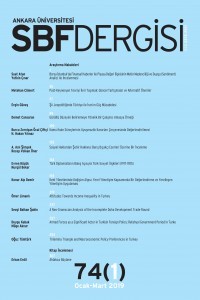
Trilemma Triangle and Macroeconomic Policy Preferences in Turkey
Abstract
This study investigates the validity of the trilemma hypothesis and various trilemma policy configurations among the exchange rate stability, financial openness and monetary autonomy in Turkey covering the period of 1970-2014. Trilemma policy measures are obtained from Aizenman, Chinn, and Ito (2013). Estimation results confirm that trilemma constraint is binding, and the policy-makers in Turkey pursue a policy combination of capital mobility and monetary autonomy between 2001 and 2014. More importantly, growing international reserves at the same period gave CBRT more self-confidence to violate trilemma constraint and pursue more stable exchange rates. This result potentially explain why Turkey has been accumulating international reserves in parallel with rising deviations from the trilemma constraint.
Keywords
References
- Referans 1 Aizenman, Joshua and Jaewoo Lee (2007), “International Reserves: Precautionary versus Mercantilist Views, Theory and Evidence”, Open Economies Review, 18:191–214.
Details
Primary Language
English
Subjects
-
Journal Section
Research Article
Authors
Publication Date
February 6, 2019
Submission Date
May 22, 2017
Acceptance Date
September 27, 2017
Published in Issue
Year 2019 Volume: 74 Number: 1
Cited By
An Econometric Approach to the Turkish Economy -A Research in the MundellFleming Model Framework
Fiscaoeconomia
https://doi.org/10.25295/fsecon.1089671Which Combination of Impossible Trinity Choices Ensures Output and Price Stabilities in India? A Sign‐Restricted Vector Autoregressive Analysis
Economic Papers: A journal of applied economics and policy
https://doi.org/10.1111/1759-3441.12364