Volume: 5 Issue: 2 , 10/31/25

Year: 2025

Research Article

Aim:
Journal of Dicle Academy is an internationally published ACADEMIC and PEER-REVIEWED journal that started publishing in 2021. The studies sent to our journal were prepared in the basic field of Social, Humanities and Administrative Sciences; It is expected to be based on scientific methods, develop suggestions for problems and contribute to the field. Our journal takes care to publish and disseminate studies that will contribute to scientific developments. In this context, Dicle Academy Journal aims to evaluate the knowledge accumulated in the basic fields of social, human and administrative sciences from past to present, to develop this knowledge and to produce new ideas that contribute to the field.

Scope:
In our journal, original research articles are published on all subjects related to the basic field of Social, Humanities and Administrative Sciences. Studies in Turkish and English are evaluated, provided that they are directly or indirectly related to the field in question. Studies that are outside the purpose and scope of our journal are not published.

Subject Category

Core Field ●Social, Human and Administrative Sciences
Science Area ●Archaeology ●History ●Linguistics ●Literature ●Law ●Econometrics ●Quantitative Decision Methods ●Educational Sciences ●Philosophy ●Sociology ●Accounting ●Finance ●Theology ●Journalism ●Communication ●Cinema ●Economics ●Business ●Public Administration ●Finance ●Health Management ●Social Service ●Marketing ●Advertising ●Tourism

Target Audience: The target audience of our journal consists of academics, researchers, professionals, students and relevant professional and academic institutions and organizations.

GENERAL INFORMATION
-The studies to be sent to the journal must be written using the sample template below, created according to the journal writing rules.
-The Cover Page, Copyright Transfer Form, Conflict and Ethics Declaration and Similarity Report must be uploaded along with the Full Text file.
-Author information should never be included in the Full Text file when the article is first uploaded to the system. Author information will be added after the article processing processes are completed. The Cover Page should contain only the title and author information.
-Articles other than Turkish and English are not accepted in our journal.
-If your article requires an ethics committee certificate, upload the document in question; In cases where an ethics committee document is not required, a Conflict and Ethics Declaration document must be prepared. Situations where an Ethics Committee Certificate is required are explained on the Ethical Principles and Publication Policy page.
Download ARTICLE TEMPLATE

Download COVER SHEET

Download COPYRIGHT TRANSFER FORM

Download CONFLICT AND ETHICS DECLARATION FORM

-After pasting their work onto the ARTICLE TEMPLATE, authors must upload this file to the system.
-Articles that are not prepared in accordance with our writing rules, sent with incomplete documents, or do not comply with APA 7 referencing are returned to the author at the pre-check stage without being evaluated.
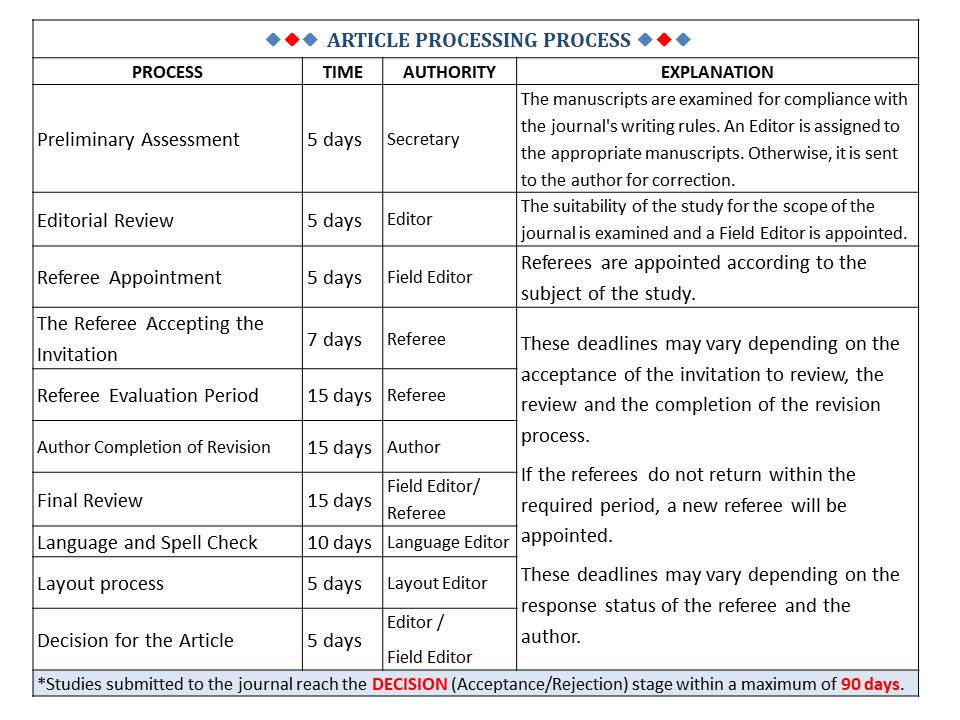
31552

WRITING RULES
In accordance with the universal rules of scientific text writing, articles must include general elements such as Title, Author Information, Abstract, Keywords, Section Headings, Quotation, Conclusion and References. These are arranged as follows.
Page Structure and Font Format
Articles should be written in Microsoft Office Word, on paper size A4 and in the "Cambria" font style, with "11 point font" and "1.15" line spacing. Margins top, bottom, left edge and right edge should be 2.5 cm.
Article Title
The title should be written at the top of the text, centered, all letters capitalized, 12 point, bolded with Cambria font, first in 6 pt, then in 6 pt, and with single line spacing.
The English title should appear immediately after the Turkish title. It should be written in all capital letters, Cambria font, 10 point, centered, no bold, 6 pt before and after, single line spacing.
Author Information
The name(s) of the author(s), without a title, should be given in bold, right below the English title and centered, and the surname(s) should be given in capital letters, 10 pt.
The professional information of the author(s) should be given in the order of title, institution, e-mail and ORCID number, separated by commas and just below the author's name and surname. It should be 9 point, normal and centered. Numbering should be added as x2, not as a footnote.
Abstract
The abstract should be written in Turkish, centered below the author information, bold, 9 pt, first 6 pt, then 6 pt, written in capital letters, under the heading (ÖZET), expressing the content in the most appropriate way, consisting of at least 100 and at most 250 words.
English Abstract, below the Turkish Abstract and Key Words, centered, bold, 9 pt, first 6 nk and then 6 pt, written in capital letters (ABSTRACT), expressing the content in the most appropriate way, minimum 100, maximum 250. It must be written in English consisting of words.

Keywords
Under the ÖZET, to the right of the heading (Anahtar Kelimeler:), written in bold in 9-point font, at least three and at most five Keywords, also written in 9-point font, should be given. There should be a period at the end.
English Keywords should be given at least three and at most five, written in 9-point font, to the right of the (Keywords:) heading, written in 9-point boldface, after the English Abstract.
Main Text
The main text should be written in Cambria font, 11 point, first 6 pt, then 6 nk and 1.15 line spacing. There should not be any spaces before or after any heading. The number of pages of the study should not exceed 25 pages, including bibliography.
The sources used in the article must be arranged in accordance with APA 7 referencing rules, each document mentioned must be included in the references section, and a bibliography must be added at the end of the study in accordance with the reference notation.
Titling

Main headings should be numbered as 1st, 2nd, 3rd, … in Cambria font, 11 points; Subheadings should be written as 1.1., 1.2., 1.3., …. Main headings should be written with all letters capitalized and subheadings, the first letters of each word should be capitalized and the other letters should be lowercase. The REFERENCES heading is not numbered.

Tables, Figures and Graphs
Table title; It should be written in 11 point font, above the table, centered. Table numbers will be sequential (Table 1.). There will be no spaces before or after. The expression Table 1. will be written in bold, but the Table title will be written normally. Table content can be written in 11, 10, 9 or 8 point font, depending on the situation. The table should be extended on both sides and centered. Vertical lines should not be used in the table.
The source notation should be located immediately below the table. It should be 9 point and centered. Source: statement should be bold, but the source text should be written normally.
Figure and Graphic title; It will be written in 11 point font, at the top, centered. Figure numbers will be sequentially (Figure 1.) or (Graph 1.). There will be no spaces before or after. Figure 1. or Graph 1. will be written in bold, but the Table title will be written normally. References for tables, figures or graphs should be given at the bottom, centered, in 9-point font.
Pictures
Pictures, photographs and other visuals are given in color, high resolution or scanned, just below the section or paragraph in the text.
Images, like Tables and Figures, are numbered and titled in the format (Image/Image/Photo 1.). The sources from which the images are taken are also shown below the images, such as tables and figures.

CONFLICT AND ETHICS STATEMENT
After writing the bibliography, "Conflict and Ethics Statement" should be added to the end of the article. In studies that have received Ethics Committee permission, information about the relevant document should be provided under the METHOD heading.


Conflict of Interest Declaration: There is no conflict of interest between any person, institution or organization that may be a party to this study.
Support and Acknowledgments: No financial support was received from any institution or organization for the study. We would like to thank the Editors of Dicle Academy Journal for their interest and effort and the referees for their contributions.
Ethics Committee Permission: The subject of the study does not require ethics committee permission. The authors declare that ethical rules were followed in all preparation processes of this study. Or. Ethics committee approval for the research was received from the Xxxx University Rectorate Xxxx Ethics Committee with the decision dated 00.00.2024 and numbered 00/11. The authors declare that ethical rules were followed in all preparation processes of this study.
Contribution Rate: The authors contributed equally to the work. Or. The contribution rate of the 1st author is approximately 60%, and the contribution rate of the 2nd author is 40%.

* * * * *
EXTENDED ABSTRACT
Only extended English abstracts are requested from Turkish articles. Extended abstracts should be at least 500 and at most 1000 words, should include the purpose, method, findings, results and discussions of the article and should be given after the References section. The extended abstract should also be prepared in accordance with the font specifications used in the main text. It should be written in Cambria font, 11 point, first 6 pt, then 6 nk and 1.15 line spacing.


PRINCIPLES REGARDING REFERENCES

-Articles must be edited taking into account APA 7th edition basic referencing rules.
-The sources used in the article are given under the left-aligned, bold "REFERENCES" heading, like other headings in the text. This title is given on the same page after leaving a space after the end of the text.
-Space between paragraphs/references should be written with Before (0 pt) After (6 pt), 11 pt and single line spacing, justified on both sides.
-In in-text reference, the author's name and date information must be exactly the same as the author's name and date information in the bibliography.
-Numbering or bullet points are not used in the bibliography. In cases where the number of authors is twenty or less, all author names are included in the imprint.
-Before uploading an article to Journal of Dicle Akademy, the studies must be prepared according to APA 7 rules. Studies that are not edited according to the APA 7 system are sent back to the author to correct this problem before being evaluated.
-Detailed information about APA 7 format can be accessed at: https://apastyle.apa.org/style-grammar-guidelines/references/examples.

ARTICLE
Note: In APA 7, the spelling "Doi: ..." in Doi writing was removed and the rule was introduced to write all addresses starting with "http". If the article has a Doi number, it should be added. In articles, the article name should be written in lowercase letters in a plain font, and the journal name should be written in italics and in capital letters. Journal volume issue in italics, issue no. must be in parentheses and plain.
-In case more than one author is cited in a parentheses, the studies are “; ” should be separated by (semicolon): (Creswell, 2014; Yıldırım & Şimşek, 2013; Narin et al. 2019)
- You can easily access the DOI numbers of the studies in your bibliography from the link below. (When you copy all the studies in your bibliography and paste them into the field in the relevant link, bibliographies with DOI numbers will be displayed.)

https://apps.crossref.org/SimpleTextQuery?s=08

BOOKS AND BOOK SECTION
The book name should be given in italics and lowercase letters. There should be a period at the beginning and end of the book name, and then the publishing house should be given with a plain capital letter.
Single Author
Gürbüz, A. (2020). The path to self-knowledge in the light of Zen and Sufism (5th ed.). Human Publications. https://doi.org/10.54821/uiecd.1122493
With Two Authors
Özsoylu, A. F. & Ergen, Z. (2014). Public sector analysis in Turkey. Karahan Publications. https://doi.org/10.54821/uiecd.1122493

Ethical Principles and Publication Policy
Dicle Academy Journal attaches great importance to ethical standards and academic integrity in scientific publishing. All parties involved in the publication process—authors, reviewers, and editors—are expected to act in accordance with the following ethical responsibilities.

1. Publication Ethics and Scientific Integrity
All manuscripts submitted to the journal must be original, scientifically sound, and contribute to the field.

Research data must be presented truthfully and without manipulation. Fabrication, falsification, or data misrepresentation is strictly prohibited.

For studies involving human or animal subjects, ethical committee approval must be obtained and clearly stated within the manuscript.

2. Responsibilities of Authors
Authors are jointly responsible for the content and accuracy of the manuscript.

Submissions must be unpublished and not under review elsewhere.

Any potential conflict of interest must be declared.

Ethical approval documents must be submitted where required, especially for studies involving human participants.

All sources and references must be properly cited to avoid plagiarism. The journal utilizes plagiarism detection software.

3. Responsibilities of Editors
Editors must ensure that each submission is evaluated objectively and fairly, based on scientific merit alone.

Confidentiality must be maintained throughout the evaluation process.

Editors should recuse themselves from editorial decisions in cases of conflict of interest.

It is the editor’s responsibility to initiate appropriate action when ethical misconduct is suspected.

4. Responsibilities of Reviewers
The journal operates a double-blind peer-review process.

Reviewers must provide constructive, unbiased, and timely evaluations based on academic criteria.

Reviewers must not share or use any information from the manuscript for personal gain.

They should alert the editors to any potential ethical issues or similarities to other published works.

5. Ethical Approval and Informed Consent
Studies that require ethical approval must submit the official approval document and include this information in the Methods section of the article.

Research involving surveys, interviews, or observational data must also have ethical approval.

Participant confidentiality and voluntary consent must be ensured in all human-based research.

6. Publication Policy
Dicle Academy Journal is a biannual and open-access journal. No fees are charged to authors for submission or publication.

While authors retain copyright, the right of publication is transferred to the journal.

Articles may be published in Turkish or English, and must conform to academic writing standards and correct grammar.

7. Handling of Ethical Misconduct
In cases of suspected ethical violations, the journal will follow the procedures and recommendations of the COPE (Committee on Publication Ethics).

If misconduct is confirmed, the manuscript may be rejected or retracted, even post-publication. Authors will be informed accordingly.

8. Reference Guidelines and Compliance
The ethical framework of Dicle Academy Journal is based on:

COPE – Committee on Publication Ethics

Council of Higher Education (YÖK) Scientific Research and Publication Ethics Directive

TR Dizin Ethical Principles and Rules


Note: These ethical principles and publication policy statement have been originally prepared by Dicle Academy Journal in accordance with its institutional vision. It has not been copied from any other source and reflects the journal’s unique ethical stance.

In accordance with the principle of open and free academic publishing, Dicle Academy Journal does not demand any payment from the authors during the submission, evaluation and publication processes. Readers or researchers can download and print any published article free of charge. Articles are freely available digitally.

Editor-in-Chief

Econometrics, Applied Macroeconometrics, Time-Series Analysis

Editors

Finance and Investment, Behavioural Finance, Financial Markets and Institutions

Economics Field Editors

Islamic Economy, Microeconomic Theory, Microeconomics, Labor Economics, Behavioural Economy, Experimental Economy

Business Field Editors

İbrahim Çemberlitaş
Assoc. Prof. Dr. İbrahim ÇEMBERLİTAŞ VAN YÜZÜNCÜ YIL ÜNİVERSİTESİ Web
Auditing and Accountability, Financial Accounting, International Accounting
Durmus Yıldırım
Assoc. Prof. Durmus YILDIRIM ONDOKUZ MAYIS ÜNİVERSİTESİ, İKTİSADİ VE İDARİ BİLİMLER FAKÜLTESİ
Financial Institutions, Finance and Investment, Behavioural Finance, Financial Forecast and Modelling, Financial Markets and Institutions, Investment and Portfolio Management

Econometrics Field Editors [

Sadullah Çelik
Assoc. Prof. Dr. Sadullah ÇELİK Aydın Adnan Menderes Üniversitesi Nazilli İktisadi ve İdari Bilimler Fakültesi Web
Decision Support and Group Support Systems, Machine Learning, Stream and Sensor Data, Artificial Intelligence, Time-Series Analysis, Demography, Statistics, Statistical Analysis, Engineering, Multiple Criteria Decision Making
Gökhan Konat
Assoc. Prof. Dr. Gökhan KONAT ABANT İZZET BAYSAL ÜNİVERSİTESİ
Econometrics Theory, Econometric and Statistical Methods, Panel Data Analysis, Time-Series Analysis

Political Science and Public Administration

Ali Çiçek
Asst. Prof. Dr. Ali ÇİÇEK SİVAS CUMHURİYET ÜNİVERSİTESİ, İKTİSADİ VE İDARİ BİLİMLER FAKÜLTESİ, KAMU YÖNETİMİ BÖLÜMÜ, SİYASET VE SOSYAL BİLİMLER ANABİLİM DALI Web

Assist. Prof. Ali Cicek

Political Science, Comparative Political Institutions
Turkish Political Life

Health Management

Mustafa Erbir
Assoc. Prof. Dr. Mustafa ERBİR KAYSERİ ÜNİVERSİTESİ, SOSYAL BİLİMLER MESLEK YÜKSEKOKULU
Health Management, Strategy

Social Work

Kaan Koçali
Asst. Prof. Dr. Kaan KOÇALİ İSTANBUL GELİŞİM ÜNİVERSİTESİ, İSTANBUL GELİŞİM MESLEK YÜKSEKOKULU, iŞ SAĞLIĞI VE GÜVENLİĞİ PROGRAMI
Work and Occupational Diseases , Labour Law, Ergonomi, Labor Economics and Industrial Relations, Labor Economics and Economic Demography , Occupational Health and Safety, Fire Safety Engineering, Mine Design, Management and Economy, Mining Methods and Mine System Analysis, Occupational Health and Safety in Mines, Ergonomi and Human Factors Management

International Relations

Cybersecurity Policy, Eu Regional Policy , International Politics, American Studies, Turkish Foreign Policy, International Security

Literature Field Editor

Kazım Yoldaş
Prof. Dr. Kazım YOLDAŞ Bursa Uludağ Üniversitesi
Classical Turkish Literature of Ottoman Field, Classical Turkish Literature

Theology Field Editors

Default avatar
Assoc. Prof. Dr. Abdulkerim ÖNER DİCLE ÜNİVERSİTESİ
History of Islam
Sociology of Religion, Religion, Society and Culture Studies

Educational Sciences Field Editors

Zakir Elçiçek
Assoc. Prof. Dr. Zakir ELÇİÇEK Dicle Üniversitesi Ziya Gökalp Eğitim Fakültesi Eğitim Bilimleri Bölümü
Education, Statistical Analysis Methods
Tuba Akar
Asst. Prof. Dr. Tuba AKAR SİNOP ÜNİVERSİTESİ Web
Education, Early Childhood Education, Child Development Education

Communication Field Editors

Ülhak Çimen
Assoc. Prof. Dr. Ülhak ÇİMEN Ataturk University, Faculty of Communication, Department of Radio, Cinema and Television, Erzurum, Türkiye Web

Doç. Dr. 

Communication Studies, Communication Theories, Communication Technology and Digital Media Studies, New Media, Philosophy of Communication, Communication Sociology

Sociology

Bülent Kara
Prof. Dr. Bülent KARA NİĞDE ÖMER HALİSDEMİR ÜNİVERSİTESİ
Environmental Sociology, Sociology of Law, Urban Sociology and Community Studies
Default avatar
Asst. Prof. Dr. Muhterem UYSAL BİNGÖL ÜNİVERSİTESİ, FEN-EDEBİYAT FAKÜLTESİ, SOSYOLOJİ BÖLÜMÜ
Social Media Studies, Sociology, Body Sociology, Sociology (Other)

History

Default avatar
Dr. Instructor Zeliha Buket KALAYCI YOZGAT BOZOK ÜNİVERSİTESİ
History of Ottoman Economy, Ottoman Institutions and Civilization, History of Ottoman Minorities, Intellectual History of Ottoman

Law

Aytuğ Altın
Asst. Prof. Dr. Aytuğ ALTIN KARAMANOĞLU MEHMETBEY ÜNİVERSİTESİ
Administrative Law, Public Administration

Turkish Language Editor

Seyhan Kardeş
Asst. Prof. Dr. Seyhan KARDEŞ DİCLE ÜNİVERSİTESİ
Persian Language, Literature and Culture

English Language Editor

Kader Güzel
Asst. Prof. Dr. Kader GÜZEL MUS ALPARSLAN UNIVERSITY
British and Irish Language, Literature and Culture, Contemporary Drama Studies

Secretary

Resul Akkaya
Professional Resul AKKAYA DİCLE ÜNİVERSİTESİ
Climate Change Science (Other), Organic Agriculture

Editorial Board

Cybersecurity Policy, Eu Regional Policy , International Politics, American Studies, Turkish Foreign Policy, International Security
İbrahim Çemberlitaş
Assoc. Prof. Dr. İbrahim ÇEMBERLİTAŞ VAN YÜZÜNCÜ YIL ÜNİVERSİTESİ Web
Auditing and Accountability, Financial Accounting, International Accounting
Econometrics, Applied Macroeconometrics, Time-Series Analysis
Development Economics - Macro, Policy of Treasury, Monetary Policy, International Finance, International Economics, International Economics (Other)
Sadullah Çelik
Assoc. Prof. Dr. Sadullah ÇELİK Aydın Adnan Menderes Üniversitesi Nazilli İktisadi ve İdari Bilimler Fakültesi Web
Decision Support and Group Support Systems, Machine Learning, Stream and Sensor Data, Artificial Intelligence, Time-Series Analysis, Demography, Statistics, Statistical Analysis, Engineering, Multiple Criteria Decision Making
Finance and Investment, Behavioural Finance, Financial Markets and Institutions
Kazım Yoldaş
Prof. Dr. Kazım YOLDAŞ Bursa Uludağ Üniversitesi
Classical Turkish Literature of Ottoman Field, Classical Turkish Literature
Islamic Economy, Microeconomic Theory, Microeconomics, Labor Economics, Behavioural Economy, Experimental Economy
Oktay Kızılkaya
Prof. Dr. Oktay KIZILKAYA Malatya Turgut Özal Üniversitesi
Econometrics, Econometric and Statistical Methods, Panel Data Analysis, Applied Macroeconometrics, Time-Series Analysis
Education, Education Management
Durmus Yıldırım
Assoc. Prof. Durmus YILDIRIM ONDOKUZ MAYIS ÜNİVERSİTESİ, İKTİSADİ VE İDARİ BİLİMLER FAKÜLTESİ
Financial Institutions, Finance and Investment, Behavioural Finance, Financial Forecast and Modelling, Financial Markets and Institutions, Investment and Portfolio Management
Gökhan Konat
Assoc. Prof. Dr. Gökhan KONAT ABANT İZZET BAYSAL ÜNİVERSİTESİ
Econometrics Theory, Econometric and Statistical Methods, Panel Data Analysis, Time-Series Analysis
Turkish Political Life
Default avatar
Dr. Instructor Zeliha Buket KALAYCI YOZGAT BOZOK ÜNİVERSİTESİ
History of Ottoman Economy, Ottoman Institutions and Civilization, History of Ottoman Minorities, Intellectual History of Ottoman
Aytuğ Altın
Asst. Prof. Dr. Aytuğ ALTIN KARAMANOĞLU MEHMETBEY ÜNİVERSİTESİ
Administrative Law, Public Administration
Kaan Koçali
Asst. Prof. Dr. Kaan KOÇALİ İSTANBUL GELİŞİM ÜNİVERSİTESİ, İSTANBUL GELİŞİM MESLEK YÜKSEKOKULU, iŞ SAĞLIĞI VE GÜVENLİĞİ PROGRAMI Web
Work and Occupational Diseases , Labour Law, Ergonomi, Labor Economics and Industrial Relations, Labor Economics and Economic Demography , Occupational Health and Safety, Fire Safety Engineering, Mine Design, Management and Economy, Mining Methods and Mine System Analysis, Occupational Health and Safety in Mines, Ergonomi and Human Factors Management
Tuba Akar
Asst. Prof. Dr. Tuba AKAR SİNOP ÜNİVERSİTESİ Web
Education, Early Childhood Education, Child Development Education
Mustafa Erbir
Assoc. Prof. Dr. Mustafa ERBİR KAYSERİ ÜNİVERSİTESİ, SOSYAL BİLİMLER MESLEK YÜKSEKOKULU
Health Management, Strategy
Ali Çiçek
Asst. Prof. Dr. Ali ÇİÇEK SİVAS CUMHURİYET ÜNİVERSİTESİ, İKTİSADİ VE İDARİ BİLİMLER FAKÜLTESİ, KAMU YÖNETİMİ BÖLÜMÜ, SİYASET VE SOSYAL BİLİMLER ANABİLİM DALI Web
Political Science, Comparative Political Institutions

Science and Advisory Board

Maria Nascimento Cunha
Prof. Dr. Maria Nascimento CUNHA ISMT - Instituto Miguel Torga
Women's Studies, Stress, Hospitality Management
Azamat Maksüdünov
Assoc. Prof. Dr. Azamat MAKSÜDÜNOV KIRGIZİSTAN-TÜRKİYE MANAS ÜNİVERSİTESİ Web
Entrepreneurial Marketing, Entrepreneurship
Political Economy Theory, Development Economics - Macro, European Union Economy, International Economic Foundation, Regional Development and Globalisation in International Economics, Foreign Trade, Foreign Trade Policy, International Economics (Other)
Selvira Draganović
Dr. Selvira DRAGANOVİć International University of Sarajevo
Psychological Counseling Education, Psychotherapy Practise and Research
Default avatar
Prof. Dr. Olga NOSOVA Mykolas Romeris University
Institutional Economics Theory, International Corporation, Applied Economics (Other)
Human Resources Management, Corporate Social Responsibility, Entrepreneurship, Organisation and Management Theory
Asm Mahmudul Hasan
Asst. Prof. Dr. Asm Mahmudul HASAN KARABÜK ÜNİVERSİTESİ
International Law
Raşit Çavuşoğlu
Prof. Dr. Raşit ÇAVUŞOĞLU İzmir Kâtip Çelebi Üniversitesi
Turkish Islamic Literature
Hakan Tahiri Mutlu
Assoc. Prof. Dr. Hakan Tahiri MUTLU BOLU ABANT İZZET BAYSAL ÜNİVERSİTESİ, İKTİSADİ VE İDARİ BİLİMLER FAKÜLTESİ, İŞLETME BÖLÜMÜ, SAYISAL YÖNTEMLER ANABİLİM DALI
Statistical Analysis, Quantitative Decision Methods , Applied Statistics
Zhakhangir Nurmatov
Assoc. Prof. Zhakhangir NURMATOV Ahmet Yesevi Üniversitesi
Religion, Society and Culture Studies, Tafsir
Default avatar
Prof. Dr. Prof.dr. Zekeriyya ARI BURSA ULUDAĞ ÜNİVERSİTESİ
Law and Legal Studies
Yunus Emre Avcı
Assoc. Prof. Yunus Emre AVCI SİİRT ÜNİVERSİTESİ
Education, Education Management
Human Resources Management, Strategy, Management and Organisational Behaviour, Leadership
Marketing, Consumer Behaviour
Modern Turkish Literature in Turkiye Field
Default avatar
Dr. Fatih ERMİŞ It is not affiliated with an institution
Turkish and Islamic Intellectual History, Intellectual History of Ottoman, Islamic Intellectual History
Prof. Dr. Shamsul Alam
Prof. Dr. Prof. Dr. Shamsul ALAM University of Dhaka, Bangladesh
Islamic Studies

26676                                                                                                          26799                                                                                                   26798

Dicle Academy Journal is licensed under a Creative Commons Attribution-NonCommercial 4.0 International (CC BY-NC 4.0) License.