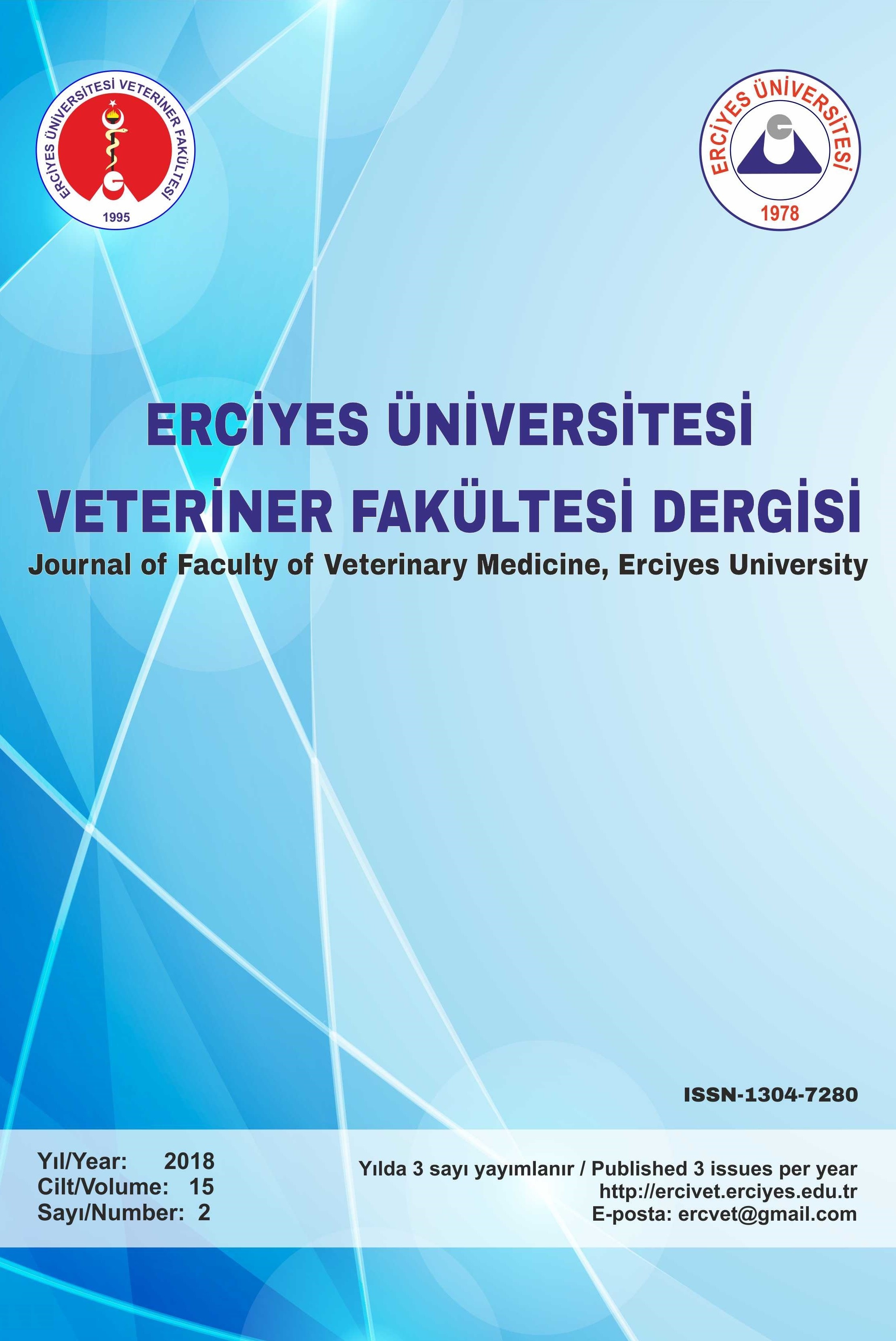
The journal aims to publish the original research articles, reviews and case reports in the fields of veterinary sciences, in general: veterinary clinical sciences, veterinary pre-clinical sciences, veterinary basic sciences, food hygiene and technology, and animal science and animal nutrition. The journal accepts articles that are written in both English and Turkish. The journal published regularly three issues a year in April, August and December.
The Journal of Erciyes University Faculty of Veterinary Medicine is a peer-reviewed scientific periodical journal which was first published in 2004 and continues to date. The journal is devoted to providing a platform for publishing and disseminating the scientific knowledge regarding veterinary science.
1. The Journal of Faculty of Veterinary Medicine, Erciyes University publishes original research articles, short communications, case reports, letter to editor and original review articles related to the field of Veterinary Medicine.
2. Formal language of manuscripts is Turkish. Manuscripts in English are also accepted. The publication of English-language manuscripts is given priority.
3. Publications should be in A4 format, double spacing and Arial 10 font size. With a margin of 2.5 cm from each edge, the page number should be placed at the bottom right of the pages. Original articles and reviews should not exceed 14 pages and case reports, research notes and short papers should not exceed 7 pages including illustrations, figures and references.,
4. For correspondence, author's name, title, ORCID number, and E-mail address should be written on cover page of the manuscripts.
5. Studies were presented in a meeting and published as an abstract can be published with indication of this status at the bottom of the cover page.
6. Information should be included on any institutions financially contributed to the study as a footnote on the cover page.
7. The cover page should be supplied as a separate page and include: Turkish running title (bold and first letters capital), English title (first letters capital), short title (max 40 characters and first letters of first word is capital, others should be written as small), author(s) names (without titles), author(s) affiliations (Superscript numbers should be given to the surnames of authors as affiliation information).
8. The summaries in Turkish and English should be written on the next page. The title page must contain the Turkish and English summaries (up to 250 words) with no paragraph and not more than five Key words in Turkish and English. Key words must be placed below summary with an alphabetical order (comma delimited). Only the first Key word must start with a capital letter. For non-Turkish authors, there is no obligation to write summary and keywords in Turkish.
9. Original research paper must be organized as follows: Cover page, Summary (Turkish and English), Key words (Turkish and English), Introduction, Material and Methods, Results, Discussion and Conclusion, Acknowledgements, References, Tables and Figures and Correspondence. All titles in the text should be written in bold. There should be no paragraph indent in the text and continuous line number should be given.
10. Review articles are considered for publications if they are original and contain recent developments and accepted for publication if the authors have at least 3 papers directly related to the subject. Reviews must be organized as follows: Summary (Turkish and English), Key Words (Turkish and English), Introduction, Sub-headings of the subject, Conclusion, Acknowledgements, References, Tables and Figures and Correspondence.
11. Case reports must be organized as follows: Summary (Turkish and English), Key Words (Turkish and English), Introduction, Case(s), Discussion and Conclusion, Acknowledgements, References, Tables and Figures and Correspondence.
12. In the studies requiring the ethics approval, the name and approval number of the institution of the Ethics Committee must be specified in the Materials and Methods section of manuscript.
13. The place where the tables and figures belong in the text should be indicated as underlined and upperlined.
14. Decimal expressions should be used in the dot.
15. Species names and anatomical terms in Latin should be italicized. All measurement specifications must follow the SI (Systeme Internationale) units.
16. Tables must be given in a separate page after the text. First letters of first word should be capital, others should be written as small in the headings of the tables. Title of tables and figures should be numbered in order as Table 1. Internal and lateral lines should not be used in the tables. Descriptive information and explanations should be placed below the tables.
17. Each picture, graphic and drawing; should be given as figure and should be written as Figure 1. Each one should be on a separate page. Descriptive information and explanations should be placed below the figures. Pictures should be the least 300dpi resolution.
18. References should be specified in the text at the end of the sentence. Author surnames and the date of publication should be specified in parentheses. If the reference has two names, the names should be given after the publication year (eg, Kaldhone and Nayak, 2008). If the reference has more than two names should be given as “et al.,” (eg, Kaldhone et al., 2008). If the source is used at the beginning of the sentence, the year of publication should be specified in parentheses after the names of the authors.
19. References should be placed in alphabetical order and hanging 0.5 cm inwards in the references section. Punctuation should be taken into consideration as shown in the examples, Journal abbreviations must be in line with Index Medicus. The reference list must not contain more than 30, 45, and 15 references for original research articles, reviews and case reports, respectively.
20. References;
20.1. If the reference is a periodical, citation must be done as shown below;
Example: Kaldhone P, Nayak R, Lynne AM, Dvaid DE, McDermott PF, Logue CM, Foley SL. Characterisation of Salmonella enterica serovar Heidelberg from turkey-associated sources. Appl Environ Microbiol 2008; 74(16): 5038-46.
20.2. If the reference is from chapter of a book with an editor, citation must be done as shown below;
Example: Hornbeck P. Assay for antibody production. Colign JE. Kruisbeek AM. Marguiles DH. eds. In: Current Protocols in Immunology. New York: Greene Publishing Associates, 1991; pp. 105-32.
20.3. If the reference is a book, citation must be done as shown below;
Example: Fleiss JL. Statistical Methods for Rates and Proportions. Second Edition. New York: John Wiley and Sons,1981; p.103.
20.4. If the reference is whole book with an editor, citation must be as below;
Example: Balows A, Mousier WJ, Herramafl KL, eds. Manual of Clinical Microbiology. Fifth Edition. Washington DC: IRL Press, 1990; p. 37.
20.5. If the reference is from meeting, citation must be done as shown below;
Example: Entrala E, Mascarp C. New structural findings in Cryptosporidium parvum oocysts. Eighth International Congress of Parasitology (ICOPA VIII). October, 10-14, 1994; İzmir-Türkiye.
20.6. If the reference is from a thesis, citation must be done as shown below;
Example: Erakinci G. Investigation of Antibodies Against Parasites in Blood Donors. PhD Thesis. Ege Univ. Institute of Health Sciences. Parasitology Program, Izmir-Turkey, 1993.
20.7. The reference is a website on the internet, citation must be done as shown below;
Example: TUIK. Hayvancılık İstatistikleri. http://www.tuik.gov.tr/ hayvancilik.app/hayvancilik.zul; Accessed Date: 14.03.2010.
21. Once the studies one published in the journal, all the responsibility belongs to the authors.
22. The final checklist should be followed when submitting manuscripts and the “Copyright Release Form” must be signed by all authors in order. Manuscripts which are not prepared in accordance with the “Instructions for authors” will not be processed.
The publication processes of the Journal of the Erciyes University Faculty of Veterinary Medicine are carried out on the basis of the objective evaluation, development and sharing of qualified scientific articles in the fields of clinical and experimental research articles in various branches of health, original case reports and literature reviews. In this context, the ethical rules that authors, journal editors, referees and publishers must comply with are listed below and have been prepared in line with the guidelines and policies published by the "Committe on Publication Ethics - COPE (https://publicationethics.org/)".
For authors;
Originality and plagiarism
Authors should ensure that they have written and submit only entirely original works, and if they have used the work and/or words of others, that this has been appropriately cited. No data, text, or figures by others are presented as if they were the author’s own. Publications that have been influential in determining the nature of the work reported in the manuscript should also be cited. Plagiarism in all its forms constitutes unethical publishing behavior and is unacceptable. Plagiarism checker in this journal: http://www.ithenticate.com/ which is subscribed by Erciyes University
Authorship of the manuscript
Only persons who meet these authorship criteria should be listed as authors in the manuscript: (i) made significant contributions to the conception, design, execution, data acquisition, or analysis/interpretation of the study; and (ii) drafted the manuscript or revised it critically for important intellectual content; and (iii) have seen and approved the final version of the paper and agreed to its submission for publication. All persons who made substantial contributions to the work reported in the manuscript (such as technical help, writing and editing assistance, general support) but who do not meet the criteria for authorship must not be listed as an author, but should be acknowledged in the "Acknowledgements" section after their written permission to be named as been obtained. The corresponding author should ensure that all appropriate coauthors (according to the above definition) and no inappropriate coauthors are included in the author list and verify that all coauthors have seen and approved the final version of the manuscript and agreed to its submission for publication.
Multiple or duplicate submission
Papers describing essentially the same research should not be published in more than one journal or primary publication. Hence, authors should not submit for consideration a manuscript that has already been published in another journal. Submission of a manuscript concurrently to more than one journal is unethical publishing behavior and unacceptable.
Conflicts of interest
Authors should - at the earliest stage possible (generally by submitting a disclosure form at the time of submission and including a statement in the manuscript) - disclose any conflicts of interest that might be construed to influence the results or their interpretation in the manuscript. All sources of financial support for the work should be disclosed (including the project number and source of financial support).
Acknowledgement of sources
Authors should ensure that they have properly acknowledged the work of others, and should also cite publications that have been influential in determining the nature of the reported work. Authors should not use information obtained in the course of providing confidential services, such as refereeing manuscripts or grant applications, unless they have obtained the explicit written permission of the author(s) of the work involved in these services.
Peer review
Authors are obliged to participate in the peer review process and cooperate fully by responding promptly to editor’s requests for raw data, clarifications, and proof of ethics approval and copyright permissions.
For reviewers;
Contribution to editorial decisions
Peer review assists editors in making editorial decisions and, through editorial communications with authors, may assist authors in improving their manuscripts. Peer review is an essential component of formal scholarly communication and lies at the heart of scientific endeavor.
Promptness
Any invited referee who feels unqualified to review the research reported in a manuscript or knows that its prompt review will be impossible should immediately notify the editors and decline the invitation to review so that alternative reviewers can be contacted.
Confidentiality
Any manuscripts received for review are confidential documents and must be treated as such; they must not be shown to or discussed with others except if authorized by the Editor-in-Chief (who would only do so under exceptional and specific circumstances). This applies also to invited reviewers who decline the review invitation.
Standards of objectivity
Reviews should be conducted objectively and observations formulated clearly with supporting arguments so that authors can use them for improving the manuscript. Personal criticism of the authors is inappropriate.
Acknowledgement of sources
Reviewers should identify relevant published work that has not been cited by the authors. Any statement that is an observation, derivation or argument that has been reported in previous publications should be accompanied by the relevant citation. A reviewer should also notify the editors of any substantial similarity or overlap between the manuscript under consideration and any other manuscript (published or unpublished) of which they have personal knowledge.
Disclosure and conflicts of interest
Any invited referee who has conflicts of interest resulting from competitive, collaborative, or other relationships or connections with any of the authors, companies or institutions connected to the manuscript and the work described therein should immediately notify the editors to declare their conflicts of interest and decline the invitation to review so that alternative reviewers can be contacted. Unpublished material disclosed in a submitted manuscript must not be used in a reviewer’s own research without the express written consent of the authors. Privileged information or ideas obtained through peer review must be kept confidential and not used for the reviewer’s personal advantage. This applies also to invited reviewers who decline the review invitation.
There are no submission fees, publication fees or page charges for publication in ""Erciyes Üniv Vet Fak Derg"
Being an English Language instructor since 2005, Mustafa ÖZER holds a PhD degree in Applied Linguistics. With him being mainly interested in data-driven learning, he carries out studies in a network of fields such as autonomous learning, corpus linguistics, EAP, ESP, corpus-based teaching of academic writing, and the use of technology in ELT classrooms. He studied veterinary English extensively and co-authored a research paper developing a systematic list of academic words in this field.
Profesör Ali Aydın, İstanbul Üniversitesi Veteriner Fakültesi Gıda Hijyeni ve Teknolojisi Bölümü'nde çalışmaktadır. Ali, veteriner hekimliği ve yüksek lisans derecelerini 1996 yılında Türkiye'de, gıda bilimi doktorasını ise İstanbul Gıda Hijyeni ve Teknolojisi Bölümü'nde tamamlamıştır. Öte yandan Ali, 15.07.1997 - 31.10.1997 tarihleri arasında Ludwig Maximillian Üniversitesi, Veteriner Fakültesi, Et Hijyeni ve Teknolojisi Bölümü'nde Misafir Bilim Adamı olarak çalışmıştır. Ali, 2008 yılında doktora sonrası faaliyet için Viyana Veterinerlik Üniversitesi'ni ziyaret etmiştir. Ayrıca, Georgia Üniversitesi Gıda Güvenliği Merkezi'nde 1 yıl çalışmıştır. 1996'dan beri İstanbul Üniversitesi'nde araştırmacı bilim insanı ve veteriner epidemiyoloji dersleri veren kıdemli öğretim görevlisi olarak çalışmaktadır. Bu yıllar içinde 60 araştırma projesinde proje lideri ya da araştırmacı olarak yer almıştır. Gıda kaynaklı virüsler de dahil olmak üzere çeşitli gıda kaynaklı patojenlerin prevalansı, insidansı, coğrafi dağılımı ve genetik ilişkileri üzerine hakemli uluslararası dergilerde 200'den fazla yayını ve 3000'e yakın atıfı bulunmaktadır.
Short Bio:
Prof. Mariusz P. Kowalewski, PhD
Obtained his Doctor of Veterinary Medicine (DVM) degree from the Faculty of Veterinary Medicine at the University of Warmia and Mazury in Olsztyn, Poland, in 2002. From 2002 to 2006, he pursued his PhD in reproductive biology at the joint graduate program of the Faculties of Medicine and Veterinary Medicine, Justus-Liebig-University (JLU) in Giessen, Germany. Afterwards, 2006-2007 he completed postdoctoral training at the Institute of Veterinary Anatomy, Histology, and Embryology at JLU, and at the Texas Tech University Health Sciences Center (TTUHSC), School of Medicine, Department of Cell Biology and Biochemistry, Lubbock, Texas, USA, between 2007 and 2009. Since 2009, he has held the position of Principal Investigator, leading his own research group at the Institute of Veterinary Anatomy (IVA) within the Vetsuisse Faculty at the University of Zurich (VSF, UZH) in Zurich, Switzerland. In 2012, he received Venia legendi (Habilitation) in the fields of Veterinary Anatomy, Histology, and Embryology from UZH, and in 2014, he became a Professor of Functional Microanatomy at VSF, UZH.
Currently, he serves as a Professor of Veterinary Anatomy, Histology, and Embryology, and from 2019 serves as a Head of the Institute, and leads the Group of Reproductive Endocrinology at VSF, UZH. He is involved in teaching courses on veterinary gross anatomy, histology, embryology, developmental and reproductive biology.
His research interests encompass comparative reproductive biology and endocrinology of domestic animals, endocrine regulation of canine luteal and placental function, concepto-maternal communication in accompanying animals, and mechanisms of STAR-dependent and hypoxia-mediated steroidogenesis.
ORCID account: https://orcid.org/0000-0002-4565-7714
PubMed: http://www.ncbi.nlm.nih.gov/pubmed?term=Kowalewski%20MP%20%5BAuthor%5D
1992 Ankara Üniversitesi Veteriner Fakültesi mezunu olan A. Arzu Yiğit, aynı yıl başladığı Fizyoloji doktorasını 1997 de tamamlamış, 2003 yılında doçent, 2008 yılında Profesör olmuştur. Halen Başkent Üniversitesi Tıp Fakültesi Fizyoloji ABD da öğretim üyesi olup, aynı zamanda aynı Üniversitenin Deney Hayvanları Üretim ve Araştırma Merkez Müdürü olarak görev yapmaktadır. Başlıca çalışma alanları endokrin bozucular, antioksidan sistem ve deney hayvanı modelleridir.
dölerme ve suni tohumlama