
Volume: 5 Issue: 2 , 12/23/25

Year: 2025

Review

Research Article

Default avatar
Prof. Dr. Ayşegül ALAYBEYOĞLU İZMİR KATİP ÇELEBİ ÜNİVERSİTESİ, MÜHENDİSLİK VE MİMARLIK FAKÜLTESİ Web
Image Processing, Artificial Intelligence, Fuzzy Computation, Embedded Systems
Gözde Çay
Asst. Prof. Dr. Gözde ÇAY İZMİR KATİP ÇELEBİ ÜNİVERSİTESİ
Circuits and Systems, Analog Electronics and Interfaces, Digital Processor Architectures, Embedded Systems, Numerical Design
Emre Şatır
Asst. Prof. Dr. Emre ŞATIR İZMİR KATİP ÇELEBİ ÜNİVERSİTESİ

Dr. Emre Şatır lisans eğitimini Dokuz Eylül Üniversitesi Bilgisayar Mühendisliği Bölümünde tamamlamış ve buradan üçüncülük derecesi ile mezun olmuştur. Yüksek lisansını Bilgi Getirimi (Information Retrieval) alanında yine Dokuz Eylül Üniversitesinde yapmış, doktor unvanını ise Ege Üniversitesinden almıştır. Kısa bir özel sektör deneyimi de bulunan Dr. Emre Şatır, lisansüstü eğitimi boyunca Manisa Celal Bayar Üniversitesi Bilgisayar Mühendisliği Bölümünde araştırma görevlisi olarak çalışmıştır. Doktora tez konusu makine çevirisi çözümlemesi (machine translation decoding) olan Dr. Emre Şatır, doktora eğitimi sırasında “Sinirsel Makine Çevirisi İçin Yeni Bir Çözümleme Yaklaşımı Geliştirme” isimli TÜBİTAK projesinde araştırmacı olarak çalışmıştır. Makine çevirisi dışında aynı zamanda Yapay Zekâ, Makine Öğrenmesi ve Doğal Dil İşleme alanlarında da çalışmaktadır. Dr. Emre Şatır hâlihazırda İzmir Kâtip Çelebi Üniversitesi Bilgisayar Mühendisliği Bölümü öğretim üyesidir. Lisans düzeyinde Hesaplama Teorisi, Programlama Dilleri, lisansüstünde ise Doğal Dil İşleme ve Makine Çevirisi gibi dersleri vermektedir.

Deep Learning, Natural Language Processing, Artificial Intelligence (Other)
Ümit Sarp
Dr. Instructor Ümit SARP IZMIR KATIP CELEBI UNIVERSITY Web
Numerical Computation and Mathematical Software, Data Structures and Algorithms, Mathematical Sciences
Default avatar
Asst. Prof. Dr. Ünzile YAMAN Izmir Katip Celebi University
Pharmaceutical Toxicology, Toxicology
Default avatar
Assoc. Prof. Dr. Hilal KAHRAMAN İZMİR KATİP ÇELEBİ ÜNİVERSİTESİ
Philosophy, Epistemology, Philosophy of Science, Philosophy of History
Kezban Hitay Sarp
Dr. Instructor Kezban HİTAY SARP BALIKESİR ÜNİVERSİTESİ, BİGADİÇ MESLEK YÜKSEKOKULU
Financial Markets and Institutions, Financial Risk Management, Real Estate Financing, Household Finance and Financial Literacy, Investment and Portfolio Management
Kadriye Filiz Balbal
Asst. Prof. Dr. Kadriye Filiz BALBAL DOKUZ EYLUL UNIVERSITY, FACULTY OF SCIENCE, DEPARTMENT OF COMPUTER SCIENCE, COMPUTER SCIENCES PR.
Deep Learning, Neural Networks, Supervised Learning, Machine Learning Algorithms, Classification Algorithms, Data Mining and Knowledge Discovery, Natural Language Processing, Artificial Intelligence (Other), Computer Software, Programming Languages
Default avatar
Assoc. Prof. Dr. Bilal DEMİR BALIKESİR ÜNİVERSİTESİ, NECATİBEY EĞİTİM FAKÜLTESİ
Cryptography, Mathematical Sciences, Algebra and Number Theory, Group Theory and Generalisations, Combinatorics and Discrete Mathematics (Excl. Physical Combinatorics)

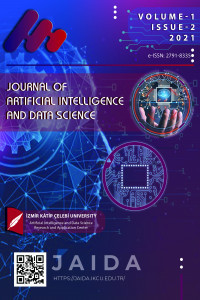
The Journal of Artificial Intelligence and Data Science (JAIDA) is an international, scientific, peer-reviewed, and open-access e-journal. It is published twice a year and accepts only manuscripts written in English. The aim of JAIDA is to bring together interdisciplinary research in the fields of artificial intelligence and data science. Both fundamental and applied research are welcome. Besides regular papers, this journal also accepts research field review articles.


The following types of papers are welcome: (i) Research articles; (ii) Review articles; and (iii) Letters to the editor.


Main topics of interest include (but are not limited to):https://dergipark.org.tr/tr/download/journal-file/35351

Intelligent Agents

Intelligent Information Systems

Decision Support Systems

Expert Systems

Fuzzy Systems

Robotics

Big Data

Computer Vision

Pattern Recognition

Augmented Reality

Virtual Reality

Internet of Things

Bioinformatic

Data Mining

Supervised Learning

Unsupervised Learning

Reinforcement learning

Ensemble Learning

Deep Learning

Natural Language Processing

Constraint Satisfaction Problems

Global Optimization

Combinatorial Optimization

Evolutionary Computation

Metaheuristics

Manuscript Template 
Please read carefully and use the template file for preparing your papers.

Copyright Transfer
Please manually fill out the entire copyright form. You can upload the scanned file at your submission.

Declaration of Interest

Please manually fill out the declaration of interest form. You can upload the scanned file at your submission.


Authors Contributions
Please manually fill out the authors contributions form.  You can upload the scanned file at your submission.


Details

The abstract should be short and at most 250 words. The format is a single column using 11 pt Times New Roman font, and justified.

Articles should not exceed 15 pages and should include following (or similar) sections: (i) Abstract, (ii) Introduction, (iii) Methodology, (iv) Results, (v) Conclusions, (vi) Declaration of Interest, (vii) Acknowledgements (if necessary), (viii) Author Contributions, (ix) References, (x) Appendix (if necessary).

The paper dimension should be A4. The following margins are used in the paper layout: Top: 2.5 cm; Left: 2 cm; Bottom: 2 cm; Right: 1.5 cm.

The format is single column. The text should be prepared in Times New Roman typeface, 11 pt, and justified. The first line of each paragraph should have 0.5 cm indentation.

For special parts of the paper the following text style should be used:

• Paper title: Times New Roman, 14 pt, bold, aligned centered, first character of each word is capitalized.
• Header 1: Times New Roman, 11 pt, bold, aligned left, first character of each word is capitalized, numbered (1, 2, …).
• Header 2: Times New Roman, 11 pt, bold, aligned left, only the first character of the first word is capitalized, numbered (1.1, 1.2, …).
• Header 3: Times New Roman, 11 pt, underlined, italic, aligned left, only the first character of the first word is capitalized, numbered (1.1.1, 1.1.2, …).
• Before each header add 12 pt, and after each header add 6 pt spacing.
• For sections such as Acknowledgements, References, and Appendix use the header 1 style without numbering.

All tables and figures must be of high quality, readable and good use of page layout. Tables, figures, and their captions are centered. Font size of table and figure captions should be 10 pt. Table contents should also be centered and the font size should be 8 or 9. Table and figure labels should be bold.

Equations are centered with center tab. Equation number is given in parenthesis. Justify all equation numbers using a right tab; do not use left tabs, spaces, or tables. You can refer to specific equations using the abbreviation “Eq. (1)”, “Eqs. (2), (4) and (5)” and “Eqs. (2)-(5)”.

For citation and references please follow the IEEE Citation and Reference Style. Some examples are journal article [1], book [2], technical report [3], paper published in conference proceedings [4], general web site [5], and software [6].

References
[1] K. A. Nelson, R. J. Davis, D. R. Lutz, and W. Smith, “Optical generation of tunable ultrasonic waves,” Journal of Applied Physics, vol. 53, no. 2, Feb., pp. 1144-1149, 2002.
[2] W. K. Chen, Linear Networks and Systems. Belmont, CA: WadsworthPress, 2003.
[3] K. E. Elliott and C. M. Greene, “A local adaptive protocol,” Argonne National Laboratory, Argonne, France, Tech. Report. 916-1010-BB, 7 Apr. 2007.
[4] J. Smith, R. Jones, and K. Trello, “Adaptive filtering in data communications with self improved error reference,” In Proc. IEEE International Conference on Wireless Communications ’04, 2004, pp. 65-68.
[5] J. Geralds, “Sega Ends Production of Dreamcast,” vnunet.com, para. 2, Jan. 31, 2007. [Online]. Available: http://nli.vnunet.com/news/1116995. [Accessed Sept. 12, 2007].
[6] Thomson ISI, Endnote 7. [CD-ROM]. Berkeley, CA: ISI ResearchSoft, 2006.

The Journal of Artificial Intelligence and Data Science (JAIDA) is committed to upholding the highest standards of publication ethics and takes all possible measures against any publication malpractices. Papers are accepted for evaluation only if they have not been published, they are not being considered for publication simultaneously elsewhere, and they are not going to be submitted for publication elsewhere.

JAIDA is committed to maintain the highest academic and ethical standards in line with the principles of the Committee of Publication Ethics (COPE), Council of Science Editors (CSE), and International Committee of Medical Journal Editors (ICMJE).

Role of authors

We follow the recommendations of the ICMJE that authorship be based on the following 4 criteria:

Substantial contributions to the conception or design of the work; or the acquisition, analysis, or interpretation of data for the work.
Drafting the work or revising it critically for important intellectual content.
Final approval of the version to be published.
Agreement to be accountable for all aspects of the work in ensuring that questions related to the accuracy or integrity of any part of the work are appropriately investigated and resolved.
All authors should meet all the four criteria for authorship above. Please click for the detailed information.

Role of editors

We follow the guidelines for editor roles and responsibilities of CSE. Editors of scientific journals have responsibilities toward the authors, the peer reviewers, the journal’s readers and the scientific community, the owners/publishers of the journals, and the public as a whole.

Peer review by external referees with the proper expertise is the most common method to ensure manuscript quality. However, editors or associate editors may sometimes reject manuscripts without external peer review to make the best use of their resources. Reasons for this practice are usually that the manuscript is outside the scope of the journal, does not meet the journal’s quality standards or is of limited scientific merit, or lacks originality or novel information.

Editors are responsible for:

Describing, implementing, and regularly reviewing policies for handling ethical issues and allegations or findings of misconduct by authors and anyone involved in the peer review process.

Monitoring and ensuring the fairness, timeliness, thoroughness, and civility of the peer-review editorial process.

Keeping all information about a submitted manuscript confidential, sharing it only with those involved in the evaluation, review, and publication processes.

Please click for the detailed information.

Role of reviewers

We follow the guidelines for review roles and responsibilities of CSE. Reviewers are responsible for:

Providing written, unbiased, constructive feedback in a timely manner on the scholarly merits and the scientific value of the work, together with the documented basis for the reviewer’s opinion.

Avoiding personal comments or criticism.

Maintaining the confidentiality of the review process: not sharing, discussing with third parties, or disclosing information from the reviewed paper.

Alerting the editor about any potential personal, financial or perceived conflict of interest and declining to review when a conflict exists.

Noting any ethical concerns, such as any violation of accepted norms of ethical treatment of animal or human subjects or substantial similarity between the reviewed manuscript and any published paper or any manuscript concurrently submitted to another journal that may be known to the reviewer.

Please click for the detailed information.

Paper submission/processing is free of charge.

Editör

Ümit Sarp
Dr. Instructor Ümit SARP IZMIR KATIP CELEBI UNIVERSITY
Numerical Computation and Mathematical Software, Data Structures and Algorithms, Mathematical Sciences
Default avatar
Prof. Dr. Ayşegül ALAYBEYOĞLU İZMİR KATİP ÇELEBİ ÜNİVERSİTESİ, MÜHENDİSLİK VE MİMARLIK FAKÜLTESİ
Image Processing, Artificial Intelligence, Fuzzy Computation, Embedded Systems

Yardımcı Editörler

Ümit Sarp
Dr. Instructor Ümit SARP IZMIR KATIP CELEBI UNIVERSITY
Numerical Computation and Mathematical Software, Data Structures and Algorithms, Mathematical Sciences

Alan Editör Kurulu

Kadriye Filiz Balbal
Asst. Prof. Dr. Kadriye Filiz BALBAL DOKUZ EYLUL UNIVERSITY, FACULTY OF SCIENCE, DEPARTMENT OF COMPUTER SCIENCE, COMPUTER SCIENCES PR.
Deep Learning, Neural Networks, Supervised Learning, Machine Learning Algorithms, Classification Algorithms, Data Mining and Knowledge Discovery, Natural Language Processing, Artificial Intelligence (Other), Computer Software, Programming Languages
Algebra and Number Theory
Default avatar
Asst. Prof. Dr. Ahmet EMİN KARABÜK ÜNİVERSİTESİ
Algebra and Number Theory
Ümit Aydoğan
Asst. Prof. Dr. Ümit AYDOĞAN İZMİR KATİP ÇELEBİ ÜNİVERSİTESİ, SOSYAL VE BEŞERİ BİLİMLER FAKÜLTESİ
Media Studies, Communication Studies, Communication Theories, Communication Systems, Communication Technology and Digital Media Studies, Internet, Internet Publishing, Mass Media, Media Industry Studies, Radio Programming , Radio Broadcasting, Radio-Television, Television Programming, Television Broadcasting, New Communication Technologies, New Media
Murat Kayacan
Prof. Dr. Murat KAYACAN İZMİR KATİP ÇELEBİ ÜNİVERSİTESİ

İzmir Kâtip Çelebi Üniversitesi İlahiyat Fakültesi Fakültesi Tefsir Ana Bilim Dalında öğretim üyesidir. 

Artificial Intelligence (Other), Religion, Society and Culture Studies
Nesibe Yalçın
Assoc. Prof. Dr. Nesibe YALÇIN ERCİYES ÜNİVERSİTESİ, MÜHENDİSLİK FAKÜLTESİ
Information and Computing Sciences, Cyberphysical Systems and Internet of Things, Deep Learning, Machine Learning Algorithms, Information Security and Cryptology, Data Mining and Knowledge Discovery
Ümit Sarp
Dr. Instructor Ümit SARP IZMIR KATIP CELEBI UNIVERSITY
Numerical Computation and Mathematical Software, Data Structures and Algorithms, Mathematical Sciences
Bekir Emiroğlu
Assoc. Prof. Dr. Bekir EMİROĞLU İZMİR KATİP ÇELEBİ ÜNİVERSİTESİ, İSLAMİ İLİMLER FAKÜLTESİ
Social Media Studies, Multicultural, Intercultural and Cross-Cultural Studies, Values ​​education, Sociology of Religion
Mehmet Erdal Özbek
Assoc. Prof. Dr. Mehmet Erdal ÖZBEK İzmir Katip Çelebi Üniversitesi Mühendislik ve Mimarlık Fakültesi
Audio Processing, Machine Learning, Signal Processing
Sehran Dilmaç
Assoc. Prof. Dr. Sehran DİLMAÇ İzmir Katip Çelebi Üniversitesi

Doç. Dr. Sehran Dilmaç, Atatürk Üniversitesi Kazım Karabekir Eğitim Fakültesi Resim-İş Öğretmenliği Bölümünde (2003) ve Anadolu Üniversitesi İktisat Fakültesi Siyaset Bilimi ve Kamu Yönetimi Bölümünde (2012) lisans eğitimlerini; Atatürk Üniversitesi Eğitim Bilimleri Enstitüsü Resim-İş Eğitimi Bölümünde yüksek lisans eğitimini (2012); Atatürk Üniversitesi Sosyal Bilimler Enstitüsü Felsefe Tarihi Bölümünde doktora eğitimini (2017); Gazi Üniversitesi Güzel Sanatlar Enstitüsü Bileşik Sanatlar Anasanat Dalında Sanatta Yeterlik (2018) eğitimlerini tamamladı. Dilmaç, İzmir Katip Çelebi Üniversitesi Sanat ve Tasarım Fakültesi Temel Sanat Eğitimi Bölümüne 2019 yılında Doktor Öğretim Üyesi olarak atandı ve 2021 yılında İzmir Katip Çelebi Üniversitesi Sanat ve Tasarım Fakültesi Temel Sanat Eğitimi Bölümünde Doçent oldu. Hâlen aynı üniversitede görev yapan Doç. Dr. Sehran Dilmaç'ın ulusal ve uluslararası dizinlerde taranan dergilerde yayımlanmış çok sayıda makalesi mevcuttur. Doç. Dr. Sehran Dilmaç'ın araştırma alanları arasında güzel sanatlar eğitimi, sanat ve edebiyat yer almaktadır.

Fine Arts Education, Philosophy of Art, Fine Arts
Olgun Aydın
Asst. Prof. Dr. Olgun AYDIN Politechnika Gdanska
Deep Learning, Data Engineering and Data Science, Applied Statistics
Mustafa Agah Tekindal
Prof. Dr. Mustafa Agah TEKİNDAL İZMİR KATİP ÇELEBİ ÜNİVERSİTESİ, TIP FAKÜLTESİ, TEMEL TIP BİLİMLERİ BÖLÜMÜ, BİYOİSTATİSTİK ANABİLİM DALI
Biostatistics
Default avatar
Asst. Prof. Dr. Muhammet Mustafa BAHŞI MANISA CELAL BAYAR UNIVERSITY
Machine Learning (Other), Applied Mathematics, Theoretical and Applied Mechanics in Mathematics, Mechanical Vibrations and Noise
Default avatar
Assoc. Prof. Dr. Hilal KAHRAMAN İZMİR KATİP ÇELEBİ ÜNİVERSİTESİ
Philosophy, Epistemology, Philosophy of Science, Philosophy of History
Semih Çakır
Asst. Prof. Dr. Semih ÇAKIR ZONGULDAK BÜLENT ECEVİT ÜNİVERSİTESİ
Information and Computing Sciences, Networking and Communications, Cloud Computing, Deep Learning, Machine Learning Algorithms, Information Security and Cryptology, Data Security and Protection, Data and Information Privacy, Software and Application Security, Cybersecurity and Privacy (Other), Computer Software, Programming Languages
Default avatar
Assoc. Prof. Dr. Mustafa ERGUN ONDOKUZ MAYIS ÜNİVERSİTESİ, EĞİTİM FAKÜLTESİ, MATEMATİK VE FEN BİLİMLERİ EĞİTİMİ BÖLÜMÜ, FEN BİLGİSİ EĞİTİMİ ANABİLİM DALI
Artificial Intelligence (Other), Chemistry Education, Science Education, Educational Technology and Computing
Default avatar
Dr. Instructor Sümeyye SINIR İZMİR KATİP ÇELEBİ ÜNİVERSİTESİ
Mathematical Sciences, Hydromechanics, Numerical Modelization in Civil Engineering, Mechanical Engineering, Solid Mechanics, Numerical Methods in Mechanical Engineering
Default avatar
Prof. Dr. Merih PALANDÖKEN İZMİR KATİP ÇELEBİ ÜNİVERSİTESİ

Dr. Merih Palandoken completed  M.S. degree study in Microelectronics and Microsystems Engineering at Technical University of Hamburg, Hamburg, Germany, in 2005 under DAAD scholarship and Ph.D. degree in Theoretical Electrical Engineering at Technical University of Berlin, Germany in 2012. He is currently working in the department of Electrical and Electronics Engineering at Izmir Katip Celebi University. His research interests are analytical/numerical design and modeling of active/passive wireless components in the micro/millimeter wave frequencies especially in the field of RF energy harvesting systems, compact microwave absorbers, machine learning based smart RF component and IoT compatible sensor design, microwave probe design, electrically small bioimplantable antennas and RFID systems. He is working as the vice head of Artificial Intelligence and Data Science Research and Application Center at Izmir Katip Celebi University.

Modelling and Simulation, Engineering Electromagnetics, Radio Frequency Engineering
Default avatar
Assoc. Prof. Dr. Mehmet Ali BELEN İSKENDERUN TEKNİK ÜNİVERSİTESİ
Engineering Electromagnetics, Radio Frequency Engineering, Antennas and Propagation
Default avatar
Assoc. Prof. Dr. Ersin KANAT ZONGULDAK BÜLENT ECEVİT ÜNİVERSİTESİ
Finance and Investment
Mathematical Sciences
Mucahit Yalçın Öztüfekci
Assoc. Prof. Mucahit Yalçın ÖZTÜFEKCİ İZMİR KATİP ÇELEBİ ÜNİVERSİTESİ
Music Performance, Musicology and Ethnomusicology, Composition in Turkish Classical Music, Interpretation in Turkish Classical Music, Music (Other)
Cem Çırak
Assoc. Prof. Dr. Cem ÇIRAK İZMİR KATİP ÇELEBİ ÜNİVERSİTESİ, SANAT VE TASARIM FAKÜLTESİ
Music, Religious Music, Music Performance, Theories of Music, Composition in Turkish Folk Music, Interpretation in Turkish Folk Music, Composition in Turkish Classical Music, Interpretation in Turkish Classical Music
Default avatar
Dr. Goknur GİNER The University of Melbourne

Dr. Göknur Giner, 2013 yılında İzmir Ekonomi Üniversitesi'nde Uygulamalı Matematik ve İstatistik alanında doktora derecesini aldı. 2014 yılında Avustralya Melbourne'de WEHI'de (Walter and Eliza Hall Institute) Smyth Lab'a postdoktoral araştırmacı olarak katıldı ve RNA-Seq teknolojilerini kullanarak hastaların kanser alt tiplerini sınıflandırma ve önemli genetik pathwayleri belirleme üzerine yeni araçlar geliştirdi. Şu anda WEHI Biyoinformatik Bölümü'nde Papenfuss Lab'de kıdemli araştırmacı olarak görev yapmaktadır. Çalışmaları, çeşitli CRISPR teknolojilerinden elde edilen sgRNA verilerini modellemek ve kanserin ilerlemesine neden olan kritik genleri ve terapiye dirençli genleri daha iyi anlamak üzerine yoğunlaşmaktadır. CRISPR verilerinin analizi ve gen düzenleme teknolojilerinin kanser araştırmalarına entegre edilmesi konularında uzmandır. Dr. Giner’in çalışmaları CASS Vakfı tarafından desteklenmektedir ve bu destekle geliştirdiği CuReSPR yazılımı, kanser biyolojisi ve kişiselleştirilmiş tedavi alanındaki araştırmalarda kullanılmaktadır.

Numerical Computation and Mathematical Software, Metabolic Medicine
Default avatar
Asst. Prof. Dr. Ünzile YAMAN Izmir Katip Celebi University
Pharmaceutical Toxicology, Toxicology
Algebra and Number Theory, Applied Mathematics (Other)
Default avatar
Asst. Prof. Dr. Osman GÖKALP İZMİR YÜKSEK TEKNOLOJİ ENSTİTÜSÜ, MÜHENDİSLİK FAKÜLTESİ
Deep Learning, Neural Networks, Artificial Intelligence, Natural Language Processing, Evolutionary Computation
Kezban Hitay Sarp
Dr. Instructor Kezban HİTAY SARP BALIKESİR ÜNİVERSİTESİ, BİGADİÇ MESLEK YÜKSEKOKULU
Financial Markets and Institutions, Financial Risk Management, Real Estate Financing, Household Finance and Financial Literacy, Investment and Portfolio Management
Artificial Intelligence (Other)
Default avatar
Assoc. Prof. Dr. Bilal DEMİR BALIKESİR ÜNİVERSİTESİ, NECATİBEY EĞİTİM FAKÜLTESİ
Cryptography, Mathematical Sciences, Algebra and Number Theory, Group Theory and Generalisations, Combinatorics and Discrete Mathematics (Excl. Physical Combinatorics)

All articles published by JAIDA are licensed under a Creative Commons Attribution 4.0 International License.

88x31.png