Case Report

Bladder Crystal Formation shown as false positive cause in F-18 Fluorodeoxyglucose (FDG) Positron Emission Tomography/Computed Tomography (PET/CT)

Volume: 2 Number: 1 April 15, 2022
  • Zehra Pınar Koç *

Bladder Crystal Formation shown as false positive cause in F-18 Fluorodeoxyglucose (FDG) Positron Emission Tomography/Computed Tomography (PET/CT)

Abstract

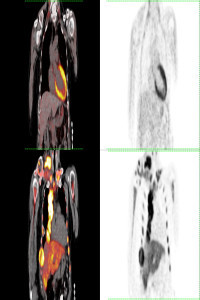
Introduction: There are some false positivity reasons for the bladder in FDG PET/CT. This case report demonstrates one of these causes which were not reported before. Case and outcomes: A male patient sixty-five years of age with known diagnosis of metastatic colon carcinoma receiving chemotherapy treatment referred for follow up FDG PET/CT which showed partial metabolic response and suspicious calcified lesion in the bladder wall with significant FDG accumulation. Cystoscopy and pathology results demonstrated crystal formation and adjacent inflammation as an explanation. Discussion: The FDG accumulations due to foreign materials have been reported in elsewhere in the body before in the literature. This accumulation in this case may represent foreign body reaction. Conclusion: This case report showed an interesting false positive lesion demonstrated firstly in the literature as far as we know. The follow up results confirmed that the FDG accumulation in the bladder was a false positive.

Keywords

References

  1. 1. Boudabbous S., Arditi D., Paulin E., Koessler T., Rougemont A.L., Montet X. Ossifying metaplasia of urothelial metastases: original case with review of the literature. BMC Med Imaging. 2015 ;15:30
  2. 2. Cormio L., Sanguedolce F., Massenio P., Di Fino G., Selvaggio O., Bufo P., et al. Osseous metaplasia within a urothelial bladder cancer nodal metastasis: a case report. Anal Quant Cytopathol Histpathol. 2014;36:117–9
  3. 3. Gladdy R.A., Qin L.X., Moraco N., Edgar M.A., Antonescu C.R., Alektiar K.M., et al. Do radiation-associated soft tissue sarcomas have the same prognosis as sporadic soft tissue sarcomas? J Clin Oncol. 2010;28:2064–9
  4. 4. Mantzarides M., Papathanassiou D., Bonardel G., et al. High-grade lymphoma of the bladder visualized on PET. Clin Nucl Med. 2005; 30:478-80
  5. 5. Treglia G., Bongiovanni M., Giovanella L. A rare case of small cell neuroendocrine carcinoma of the urinary bladder incidentally detected by F-18 FDG PET/CT. Endocrine. 2014; 45:156-157
  6. 6. Lin Y., Lu Y.Y., Wang H.Y., Tsai S.C., Lin W.Y. Accidental finding of bladder cancer in 99mTc methylene diphosphonate whole-body bone scan. Clin Nucl Med. 2013;38:643-5
  7. 7. Parekh A., Hagan I., Capaldi L., Lyburn I. Incidental Papillary Bladder Carcinoma on 18F-Fluoromethylcholine PET/CT Undertaken to Evaluate Prostate Malignancy. Clin Nucl Med. 2017 .;42:721-722
  8. 8. Osman M.M., Altinyay M.E., Abdelmalik A.G., Brickman T.M., Varvares M.A., Nguyen N.C. FDG PET/CT incidental diagnosis of a synchronous bladder cancer as a fourth malignancy in a patient with head and neck cancer. Clin Nucl Med. 2011;36:496-7

Details

Primary Language

English

Subjects

Oncology and Carcinogenesis

Journal Section

Case Report

Authors

Zehra Pınar Koç * This is me
0000-0002-3274-5790
Türkiye

Publication Date

April 15, 2022

Submission Date

March 9, 2022

Acceptance Date

March 20, 2022

Published in Issue

Year 2022 Volume: 2 Number: 1

APA
Koç, Z. P. (2022). Bladder Crystal Formation shown as false positive cause in F-18 Fluorodeoxyglucose (FDG) Positron Emission Tomography/Computed Tomography (PET/CT). Molecular Oncologic Imaging, 2(1), 9-11. https://izlik.org/JA87NN25FS
AMA
1.Koç ZP. Bladder Crystal Formation shown as false positive cause in F-18 Fluorodeoxyglucose (FDG) Positron Emission Tomography/Computed Tomography (PET/CT). Molecular Oncologic Imaging. 2022;2(1):9-11. https://izlik.org/JA87NN25FS
Chicago
Koç, Zehra Pınar. 2022. “Bladder Crystal Formation Shown As False Positive Cause in F-18 Fluorodeoxyglucose (FDG) Positron Emission Tomography Computed Tomography (PET CT)”. Molecular Oncologic Imaging 2 (1): 9-11. https://izlik.org/JA87NN25FS.
EndNote
Koç ZP (April 1, 2022) Bladder Crystal Formation shown as false positive cause in F-18 Fluorodeoxyglucose (FDG) Positron Emission Tomography/Computed Tomography (PET/CT). Molecular Oncologic Imaging 2 1 9–11.
IEEE
[1]Z. P. Koç, “Bladder Crystal Formation shown as false positive cause in F-18 Fluorodeoxyglucose (FDG) Positron Emission Tomography/Computed Tomography (PET/CT)”, Molecular Oncologic Imaging, vol. 2, no. 1, pp. 9–11, Apr. 2022, [Online]. Available: https://izlik.org/JA87NN25FS
ISNAD
Koç, Zehra Pınar. “Bladder Crystal Formation Shown As False Positive Cause in F-18 Fluorodeoxyglucose (FDG) Positron Emission Tomography Computed Tomography (PET CT)”. Molecular Oncologic Imaging 2/1 (April 1, 2022): 9-11. https://izlik.org/JA87NN25FS.
JAMA
1.Koç ZP. Bladder Crystal Formation shown as false positive cause in F-18 Fluorodeoxyglucose (FDG) Positron Emission Tomography/Computed Tomography (PET/CT). Molecular Oncologic Imaging. 2022;2:9–11.
MLA
Koç, Zehra Pınar. “Bladder Crystal Formation Shown As False Positive Cause in F-18 Fluorodeoxyglucose (FDG) Positron Emission Tomography Computed Tomography (PET CT)”. Molecular Oncologic Imaging, vol. 2, no. 1, Apr. 2022, pp. 9-11, https://izlik.org/JA87NN25FS.
Vancouver
1.Zehra Pınar Koç. Bladder Crystal Formation shown as false positive cause in F-18 Fluorodeoxyglucose (FDG) Positron Emission Tomography/Computed Tomography (PET/CT). Molecular Oncologic Imaging [Internet]. 2022 Apr. 1;2(1):9-11. Available from: https://izlik.org/JA87NN25FS