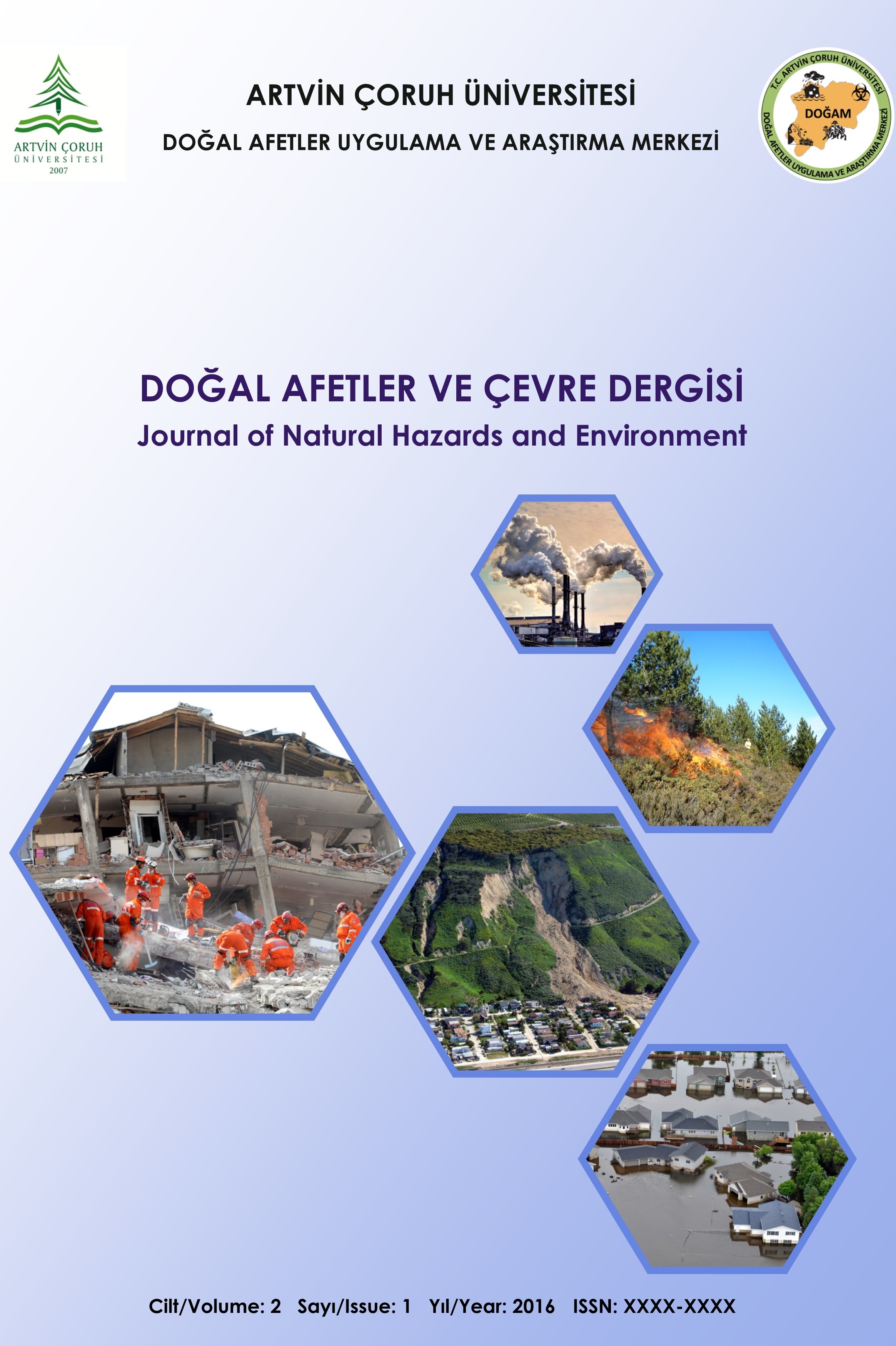
Araştırma Makalesi
BibTex RIS Kaynak Göster

Günlük Maksimum Yağış Verilerinin Klasik ve Yenilikçi Yöntemlerle Trendlerinin Belirlenmesi

Yıl 2026, Cilt: 12 Sayı: 1, 84 - 100, 25.01.2026
https://doi.org/10.21324/dacd.1696071

Öz

İklim değişikliği, hidrolojik döngü üzerinde önemli etkilere sahiptir ve su kaynaklarının sürdürülebilir yönetimi açısından yağış trendlerinin belirlenmesi büyük önem taşımaktadır. Bu çalışmada, Türkiye’nin çeşitli bölgelerinde bulunan meteoroloji istasyonlarından elde edilen 1961-2020 yıllarına ait günlük maksimum yağış verileri kullanılarak trend analizleri gerçekleştirilmiştir. Çalışmada klasik ve yenilikçi trend analiz yöntemleri uygulanmıştır. Klasik yöntem olarak Mann-Kendall (MK) testi, modern yaklaşımlar olarak ise Yenilikçi Trend Analizi (YTA) ve türevleri (Geliştirilmiş YTA, Çift-YTA, Geliştirilmiş Görselleştirme ile Çift-YTA) kullanılmıştır. Tüm analizler Python kullanılarak gerçekleştirilmiş ve verilerin görselleştirilmesi sağlanmıştır. Analiz sonuçlarına göre, Marmara'nın kuzeybatısı ve Trakya'da yer alan Çanakkale, Çorlu ve Edirne istasyonlarında bütüncül olmayan artan trendler tespit edilmiştir. Batı Anadolu'da Dikili istasyonunda bütüncül olmayan artan trend eğilimi gözlemlenirken, Güneyde Dörtyol istasyonunda stabil artan trend görülmüştür. İç Anadolu’daki Niğde ve Yozgat istasyonlarında bütüncül olmayan artan trendler belirlenirken, Karadeniz Bölgesi'nde İnebolu istasyonunda bütüncül artan trend, Zonguldak istasyonunda ise azalan trend tespit edilmiştir. Elde edilen bulgular, analiz edilen istasyon verilerine göre son 60 yılda günlük maksimum yağış değerlerinde genel olarak artış eğiliminin olduğunu ortaya koymaktadır. Bu durum, iklim değişikliğinin bölgesel ölçekte yağış rejimleri üzerinde etkili olabileceğine işaret etmektedir. Çalışmada kullanılan farklı trend analiz yöntemleri, yağış verilerinin trend yapısını daha detaylı incelemeye olanak tanımış ve klasik yöntemlere kıyasla daha kapsamlı değerlendirme imkânı sağlamıştır.

Kaynakça

  • Çiçek, İ., & Ataol, M. (2009). Türkiye’nin su potansiyelinin belirlenmesinde yeni bir yaklaşım. Coğrafi Bilimler Dergisi, 7(1), 51–64. https://doi.org/10.1501/Cogbil_0000000094
  • Dabanlı, İ., Şen, Z., Yeleğen, M. Ö., Şişman, E., Selek, B., & Güçlü, Y. S. (2016). Trend assessment by the innovative-Şen method. Water Resources Management, 30(14), 5193–5203. https://doi.org/10.1007/s11269-016-1478-4
  • Gao, F., Wang, Y., Chen, X., & Yang, W. (2020). Trend analysis of rainfall time series in Shanxi Province, Northern China (1957–2019). Water, 12(9), Article 2335. https://doi.org/10.3390/w12092335
  • Güçlü, Y. S. (2018a). Alternative trend analysis: Half time series methodology. Water Resources Management, 32(7), 2489–2504. https://doi.org/10.1007/s11269-018-1942-4
  • Güçlü, Y. S. (2018b). Multiple Şen-innovative trend analyses and partial Mann-Kendall test. Journal of Hydrology, 566, 685–704. https://doi.org/10.1016/j.jhydrol.2018.09.034
  • Güçlü, Y. S. (2020). Improved visualization for trend analysis by comparing with classical Mann–Kendall test and ITA. Journal of Hydrology, 584, Article 124674. https://doi.org/10.1016/j.jhydrol.2020.124674
  • Hussain, M. M., & Mahmud, I. (2019). pyMannKendall: A Python package for non parametric Mann Kendall family of trend tests. Journal of Open Source Software, 4(39), Article 1556. https://doi.org/10.21105/joss.01556
  • Hussain, M. M., Mahmud, I., & Bari, S. H. (2023). pyHomogeneity: A Python package for homogeneity test of time series data. Journal of Open Research Software, 11, Article 4. https://doi.org/10.5334/jors.427
  • Jhajharia, D., Shrivastava, S. K., Sarkar, D., & Sarkar, S. (2009). Temporal characteristics of pan evaporation trends under the humid conditions of northeast India. Agricultural and Forest Meteorology, 149(5), 763–770.
  • Karabulut, M., & Cosun, F. (2007). Kahramanmaraş ilinde yağışların trend analizi. Coğrafi Bilimler Dergisi, 7(1), 65–83. https://doi.org/10.1501/Cogbil_0000000095
  • Karahan, H. (2019). Şiddet-süre-frekans bağıntıları ve kümeleme analizi yardımıyla homojen alt bölgelerin belirlenmesi: Ege Bölgesi için bir uygulama. Pamukkale Üniversitesi Mühendislik Bilimleri Dergisi, 25(8), 998–1013.
  • Kendall, M. G. (1970). Rank correlation methods (4th ed.). Griffin.
  • Lehmann, E. L., & D’Abrera, H. J. M. (2006). Nonparametrics: Statistical methods based on ranks (Rev. 1st ed.). Springer.
  • Mann, H. B. (1945). Nonparametric tests against trend. Econometrica, 13(3), 245–259. https://doi.org/10.2307/1907187
  • Md Juber Alam, & Majumder, A. (2022). Statistical analysis of rainfall trend and its variability (1901–2020) in Kolkata, India. Bulletin of Geography. Physical Geography Series, 23, 5–16. https://doi.org/10.12775/bgeo-2022-0006
  • Pir, H., Ceribasi, G., & Ceyhunlu, A. I. (2024). The effect of climate change on energy generated at hydroelectric power plants: A case of Sakarya river basin in Turkey. Renewable Energy, 223, Article 120077. https://doi.org/10.1016/j.renene.2024.120077
  • Rama, B., et al. (2022). Oceans and coastal ecosystems and their services. In H.-O. Pörtner et al. (Eds.), Climate change 2022: Impacts, adaptation and vulnerability (pp. 379–550). Cambridge University Press.
  • Sam, M. G., Nwaogazie, I. L., & Ikebude, C. (2022). Climate change and trend analysis of 24-hourly annual maximum series using Mann-Kendall and Sen slope methods for rainfall IDF modeling. International Journal of Environment and Climate Change, 12(2), 44–60. https://doi.org/10.9734/ijecc/2022/v12i230628
  • Saplıoğlu, K. (2015). A new methodology for trend analysis: A case study in Burdur and Isparta, Turkey. Fresenius Environmental Bulletin, 24(10A), 3344–3351.
  • Saplıoğlu, K., & Güçlü, Y. S. (2022). Combination of Wilcoxon test and scatter diagram for trend analysis of hydrological data. Journal of Hydrology, 612, Article 128132. https://doi.org/10.1016/j.jhydrol.2022.128132
  • Sarı, C. (2023). Python programlama dili kullanılarak günlük maksimum yağış verilerinin trend analizleri [Yüksek lisans tezi, İstanbul Teknik Üniversitesi]. YÖK Ulusal Tez Merkezi. https://tez.yok.gov.tr/UlusalTezMerkezi
  • Sarı, C. (2025). Tez verileri ve analiz kodları [GitHub deposu]. https://github.com/hebelemetu/tezim
  • Sen, P. K. (1968). Estimates of the regression coefficient based on Kendall’s tau. Journal of the American Statistical Association, 63(324), 1379–1389. https://doi.org/10.1080/01621459.1968.10480934
  • Şen, Z. (2012). Innovative trend analysis methodology. Journal of Hydrologic Engineering, 17(9), 1042–1046. https://doi.org/10.1061/(ASCE)HE.1943-5584.0000556
  • Sneyers, R. (1990). On the statistical analysis of series of observations (Technical Note No. 143, WMO No. 415). World Meteorological Organization.
  • Swed, F. S., & Eisenhart, C. (1943). Tables for testing randomness of grouping in a sequence of alternatives. The Annals of Mathematical Statistics, 14(1), 66–87. https://doi.org/10.1214/aoms/1177731494
  • Zeybekoğlu, U., & Karahan, H. (2018). Standart süreli yağış şiddetlerinin eğilim analizi yöntemleriyle incelenmesi. Pamukkale Üniversitesi Mühendislik Bilimleri Dergisi, 24(6), 974–1004. https://doi.org/10.5505/pajes.2017.54265
  • Zeybekoğlu, U. (2018). Bulanık C-ortalamalar yöntemi ile Karadeniz Bölgesi standart süreli yağış şiddetlerinin kümelenmesi. Gümüşhane Üniversitesi Fen Bilimleri Dergisi, 8(1), 147–154. https://doi.org/10.17714/gumusfenbil.334693

Trend Determinations of Daily Maximum Precipitation Data with Classical and Innovative Methods

Yıl 2026, Cilt: 12 Sayı: 1, 84 - 100, 25.01.2026
https://doi.org/10.21324/dacd.1696071

Öz

Climate change has significant effects on the hydrological cycle and determining precipitation trends is of great importance for sustainable management of water resources. In this study, trend analyses were performed using daily maximum precipitation data for the years 1961-2020 obtained from meteorological stations located in various regions of Turkey. Classical and innovative trend analysis methods were applied in the study. Mann-Kendall (MK) test was used as the classical method, and Innovative Trend Analysis (ITA) and its derivatives (Improved ITA, Double-ITA, Improved Visualization Double-ITA) were used as modern approaches. All analyses were performed using the python and data visualization was provided. According to the analysis results, non-monotonic increasing trends were detected in the northwest of Marmara and Çanakkale, Çorlu and Edirne stations located in Thrace. While a non-monotonic increasing trend was observed in the Dikili station in Western Anatolia, a monotonic increasing trend was observed in the Dörtyol station in the South. While non-monotonic increasing trends were determined at Niğde and Yozgat stations in Central Anatolia, a monotonic increasing trend was determined at İnebolu station in the Black Sea Region and a decreasing trend was determined at Zonguldak station. The findings show that there has been a general increasing trend in daily maximum precipitation values in Türkiye in the last 60 years. This situation provides important evidence that climate change affects precipitation regimes throughout Turkey, although it shows regional differences. The findings reveal that, according to the analyzed station data, there has been a general increasing trend in daily maximum precipitation values over the last 60 years. This situation indicates that climate change may have an impact on precipitation regimes at the regional scale. Different trend analysis methods used in the study allowed for a more detailed examination of the trend structure of precipitation data and provided a more comprehensive evaluation opportunity compared to classical methods.

Kaynakça

  • Çiçek, İ., & Ataol, M. (2009). Türkiye’nin su potansiyelinin belirlenmesinde yeni bir yaklaşım. Coğrafi Bilimler Dergisi, 7(1), 51–64. https://doi.org/10.1501/Cogbil_0000000094
  • Dabanlı, İ., Şen, Z., Yeleğen, M. Ö., Şişman, E., Selek, B., & Güçlü, Y. S. (2016). Trend assessment by the innovative-Şen method. Water Resources Management, 30(14), 5193–5203. https://doi.org/10.1007/s11269-016-1478-4
  • Gao, F., Wang, Y., Chen, X., & Yang, W. (2020). Trend analysis of rainfall time series in Shanxi Province, Northern China (1957–2019). Water, 12(9), Article 2335. https://doi.org/10.3390/w12092335
  • Güçlü, Y. S. (2018a). Alternative trend analysis: Half time series methodology. Water Resources Management, 32(7), 2489–2504. https://doi.org/10.1007/s11269-018-1942-4
  • Güçlü, Y. S. (2018b). Multiple Şen-innovative trend analyses and partial Mann-Kendall test. Journal of Hydrology, 566, 685–704. https://doi.org/10.1016/j.jhydrol.2018.09.034
  • Güçlü, Y. S. (2020). Improved visualization for trend analysis by comparing with classical Mann–Kendall test and ITA. Journal of Hydrology, 584, Article 124674. https://doi.org/10.1016/j.jhydrol.2020.124674
  • Hussain, M. M., & Mahmud, I. (2019). pyMannKendall: A Python package for non parametric Mann Kendall family of trend tests. Journal of Open Source Software, 4(39), Article 1556. https://doi.org/10.21105/joss.01556
  • Hussain, M. M., Mahmud, I., & Bari, S. H. (2023). pyHomogeneity: A Python package for homogeneity test of time series data. Journal of Open Research Software, 11, Article 4. https://doi.org/10.5334/jors.427
  • Jhajharia, D., Shrivastava, S. K., Sarkar, D., & Sarkar, S. (2009). Temporal characteristics of pan evaporation trends under the humid conditions of northeast India. Agricultural and Forest Meteorology, 149(5), 763–770.
  • Karabulut, M., & Cosun, F. (2007). Kahramanmaraş ilinde yağışların trend analizi. Coğrafi Bilimler Dergisi, 7(1), 65–83. https://doi.org/10.1501/Cogbil_0000000095
  • Karahan, H. (2019). Şiddet-süre-frekans bağıntıları ve kümeleme analizi yardımıyla homojen alt bölgelerin belirlenmesi: Ege Bölgesi için bir uygulama. Pamukkale Üniversitesi Mühendislik Bilimleri Dergisi, 25(8), 998–1013.
  • Kendall, M. G. (1970). Rank correlation methods (4th ed.). Griffin.
  • Lehmann, E. L., & D’Abrera, H. J. M. (2006). Nonparametrics: Statistical methods based on ranks (Rev. 1st ed.). Springer.
  • Mann, H. B. (1945). Nonparametric tests against trend. Econometrica, 13(3), 245–259. https://doi.org/10.2307/1907187
  • Md Juber Alam, & Majumder, A. (2022). Statistical analysis of rainfall trend and its variability (1901–2020) in Kolkata, India. Bulletin of Geography. Physical Geography Series, 23, 5–16. https://doi.org/10.12775/bgeo-2022-0006
  • Pir, H., Ceribasi, G., & Ceyhunlu, A. I. (2024). The effect of climate change on energy generated at hydroelectric power plants: A case of Sakarya river basin in Turkey. Renewable Energy, 223, Article 120077. https://doi.org/10.1016/j.renene.2024.120077
  • Rama, B., et al. (2022). Oceans and coastal ecosystems and their services. In H.-O. Pörtner et al. (Eds.), Climate change 2022: Impacts, adaptation and vulnerability (pp. 379–550). Cambridge University Press.
  • Sam, M. G., Nwaogazie, I. L., & Ikebude, C. (2022). Climate change and trend analysis of 24-hourly annual maximum series using Mann-Kendall and Sen slope methods for rainfall IDF modeling. International Journal of Environment and Climate Change, 12(2), 44–60. https://doi.org/10.9734/ijecc/2022/v12i230628
  • Saplıoğlu, K. (2015). A new methodology for trend analysis: A case study in Burdur and Isparta, Turkey. Fresenius Environmental Bulletin, 24(10A), 3344–3351.
  • Saplıoğlu, K., & Güçlü, Y. S. (2022). Combination of Wilcoxon test and scatter diagram for trend analysis of hydrological data. Journal of Hydrology, 612, Article 128132. https://doi.org/10.1016/j.jhydrol.2022.128132
  • Sarı, C. (2023). Python programlama dili kullanılarak günlük maksimum yağış verilerinin trend analizleri [Yüksek lisans tezi, İstanbul Teknik Üniversitesi]. YÖK Ulusal Tez Merkezi. https://tez.yok.gov.tr/UlusalTezMerkezi
  • Sarı, C. (2025). Tez verileri ve analiz kodları [GitHub deposu]. https://github.com/hebelemetu/tezim
  • Sen, P. K. (1968). Estimates of the regression coefficient based on Kendall’s tau. Journal of the American Statistical Association, 63(324), 1379–1389. https://doi.org/10.1080/01621459.1968.10480934
  • Şen, Z. (2012). Innovative trend analysis methodology. Journal of Hydrologic Engineering, 17(9), 1042–1046. https://doi.org/10.1061/(ASCE)HE.1943-5584.0000556
  • Sneyers, R. (1990). On the statistical analysis of series of observations (Technical Note No. 143, WMO No. 415). World Meteorological Organization.
  • Swed, F. S., & Eisenhart, C. (1943). Tables for testing randomness of grouping in a sequence of alternatives. The Annals of Mathematical Statistics, 14(1), 66–87. https://doi.org/10.1214/aoms/1177731494
  • Zeybekoğlu, U., & Karahan, H. (2018). Standart süreli yağış şiddetlerinin eğilim analizi yöntemleriyle incelenmesi. Pamukkale Üniversitesi Mühendislik Bilimleri Dergisi, 24(6), 974–1004. https://doi.org/10.5505/pajes.2017.54265
  • Zeybekoğlu, U. (2018). Bulanık C-ortalamalar yöntemi ile Karadeniz Bölgesi standart süreli yağış şiddetlerinin kümelenmesi. Gümüşhane Üniversitesi Fen Bilimleri Dergisi, 8(1), 147–154. https://doi.org/10.17714/gumusfenbil.334693
Toplam 28 adet kaynakça vardır.

Ayrıntılar

Birincil Dil Türkçe
Konular Hidroloji (Diğer)
Bölüm Araştırma Makalesi
Yazarlar

Cihat Sari 0009-0007-9720-2539

Erdem Çoban 0000-0002-4526-7273

Yavuz Selim Güçlü 0000-0002-9939-1157

Gönderilme Tarihi 10 Mayıs 2025
Kabul Tarihi 12 Ekim 2025
Yayımlanma Tarihi 25 Ocak 2026
Yayımlandığı Sayı Yıl 2026 Cilt: 12 Sayı: 1

Kaynak Göster

APA Sari, C., Çoban, E., & Güçlü, Y. S. (2026). Günlük Maksimum Yağış Verilerinin Klasik ve Yenilikçi Yöntemlerle Trendlerinin Belirlenmesi. Doğal Afetler ve Çevre Dergisi, 12(1), 84-100. https://doi.org/10.21324/dacd.1696071
AMA Sari C, Çoban E, Güçlü YS. Günlük Maksimum Yağış Verilerinin Klasik ve Yenilikçi Yöntemlerle Trendlerinin Belirlenmesi. Doğ Afet Çev Derg. Ocak 2026;12(1):84-100. doi:10.21324/dacd.1696071
Chicago Sari, Cihat, Erdem Çoban, ve Yavuz Selim Güçlü. “Günlük Maksimum Yağış Verilerinin Klasik ve Yenilikçi Yöntemlerle Trendlerinin Belirlenmesi”. Doğal Afetler ve Çevre Dergisi 12, sy. 1 (Ocak 2026): 84-100. https://doi.org/10.21324/dacd.1696071.
EndNote Sari C, Çoban E, Güçlü YS (01 Ocak 2026) Günlük Maksimum Yağış Verilerinin Klasik ve Yenilikçi Yöntemlerle Trendlerinin Belirlenmesi. Doğal Afetler ve Çevre Dergisi 12 1 84–100.
IEEE C. Sari, E. Çoban, ve Y. S. Güçlü, “Günlük Maksimum Yağış Verilerinin Klasik ve Yenilikçi Yöntemlerle Trendlerinin Belirlenmesi”, Doğ Afet Çev Derg, c. 12, sy. 1, ss. 84–100, 2026, doi: 10.21324/dacd.1696071.
ISNAD Sari, Cihat vd. “Günlük Maksimum Yağış Verilerinin Klasik ve Yenilikçi Yöntemlerle Trendlerinin Belirlenmesi”. Doğal Afetler ve Çevre Dergisi 12/1 (Ocak2026), 84-100. https://doi.org/10.21324/dacd.1696071.
JAMA Sari C, Çoban E, Güçlü YS. Günlük Maksimum Yağış Verilerinin Klasik ve Yenilikçi Yöntemlerle Trendlerinin Belirlenmesi. Doğ Afet Çev Derg. 2026;12:84–100.
MLA Sari, Cihat vd. “Günlük Maksimum Yağış Verilerinin Klasik ve Yenilikçi Yöntemlerle Trendlerinin Belirlenmesi”. Doğal Afetler ve Çevre Dergisi, c. 12, sy. 1, 2026, ss. 84-100, doi:10.21324/dacd.1696071.
Vancouver Sari C, Çoban E, Güçlü YS. Günlük Maksimum Yağış Verilerinin Klasik ve Yenilikçi Yöntemlerle Trendlerinin Belirlenmesi. Doğ Afet Çev Derg. 2026;12(1):84-100.

Creative Commons License
Doğal Afetler ve Çevre Dergisi, Creative Commons Attribution-NonCommercial-NoDerivatives 4.0 International License ile lisanlanmıştır.