Approximately 27-43% of men and 3-6% of women suffer from inguinal hernia during their lives. Surgery is the only viable treatment for inguinal hernia. As such, more than 20 million people worldwide are operated for inguinal hernia annually. Treatment indications and surgical procedures for inguinal hernia repair have always been discussed from a medical point of view. Along with the development of minimally invasive techniques, laparoscopic methods are frequently used in inguinal hernia surgery. In this study, we aimed to evaluate how both open and laparoscopic tension-free mesh repair methods, both of which are widely used, affect the quality of life in the long-term post-operative period.
This study was designed as a retrospective survey. Short Form-36 (SF-36) questionnaire was used as a postoperative quality of life (QoL) assessment scale. 69 (67.6%) of them underwent open surgery, while 33 (32.4%) of them underwent laparoscopic TEP. The demographic data, complications, SF-36 scale and chronic pain were evaluated, and no significant differences were found between the two groups.
In conclusion, our study compared laparoscopic and open methods and observed no significant differences between the long-term results in two different groups.
Erkeklerin yaklaşık %27-43'ü ve kadınların %3-6'sı yaşamları boyunca kasık fıtığı sorunuyla karşı karşıya kalmaktadır. Ameliyat, kasık fıtığı için tek geçerli tedavi yöntemidir. Bu nedenle, dünya çapında her yıl 20 milyondan fazla kişi kasık fıtığı nedeniyle ameliyat edilmektedir. Kasık fıtığı onarımında tedavi endikasyonları ve cerrahi prosedürler her zaman tıbbi bir bakış açısıyla tartışılmıştır. Minimal invaziv tekniklerin gelişmesiyle birlikte, kasık fıtığı cerrahisinde laparoskopik yöntemler sıklıkla kullanılmaktadır. Bu çalışmada, yaygın olarak kullanılan açık ve laparoskopik gerilimsiz yama onarım yöntemlerinin, her ikisi de ameliyat sonrası uzun dönemde yaşam kalitesini nasıl etkilediğini değerlendirmeyi amaçladık.
Bu çalışma retrospektif bir anket olarak tasarlanmıştır. Ameliyat sonrası yaşam kalitesi değerlendirme ölçeği olarak Kısa Form-36 (SF-36) anketi kullanılmıştır. 69 (%67,6) hastaya açık cerrahi uygulanırken, 33 (%32,4) hastaya laparoskopik TEP uygulandı. Demografik veriler, komplikasyonlar, SF-36 skalası ve kronik ağrı değerlendirildi ve iki grup arasında anlamlı bir fark bulunmadı.
Sonuç olarak, çalışmamızda laparoskopik ve açık yöntemler karşılaştırılmış ve iki farklı grupta uzun dönem sonuçlar arasında anlamlı bir fark gözlenmemiştir.
Kahramanmaraş Sütçü İmam Üniversitesi (KSÜ) Lokal Etik Değerlendirme Kurulu tarafından etik kurul onayı alınmıştır. (Tarih:05.04.2024, Oturum: 2024/03 , Karar no:04)
Kahramanmaraş Sütçü İmam Üniversitesi Tıp Fakültesi
| Birincil Dil | İngilizce |
|---|---|
| Konular | Genel Cerrahi |
| Bölüm | Araştırma Makalesi |
| Yazarlar | |
| Gönderilme Tarihi | 23 Haziran 2025 |
| Kabul Tarihi | 27 Eylül 2025 |
| Yayımlanma Tarihi | 10 Şubat 2026 |
| Yayımlandığı Sayı | Yıl 2026 Sayı: 19 |
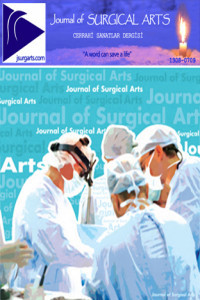
The aim of the Journal of Surgical Arts (Cerrahi Sanatlar Dergisi) is to publish high-quality research articles, review articles on current topics, and rare case reports in the field of surgery. Additionally, expert opinions, letters to the editor, scientific letters, and manuscripts on surgical techniques are accepted for publication, and various manuscripts on medicine and surgery history, ethics, surgical education, and forensic medicine fields are included in the journal.
Medicine, Surgery, Emergency medicine
The editorial and publication processes of the journal are shaped in accordance with the guidelines of the International Council of Medical Journal Editors (ICMJE), the World Association of Medical Editors (WAME), the Council of Science Editors (CSE), the Committee on Publication Ethics (COPE), the European Association of Science Editors (EASE), and National Information Standards Organization (NISO). The journal conforms to the Principles of Transparency and Best Practice in Scholarly Publishing (doaj.org/bestpractice).
Originality, high scientific quality, and citation potential are the most important criteria for a manuscript to be accepted for publication. Manuscripts submitted for evaluation should not have been previously presented or already published in an electronic or printed medium. The submission of previous reviewer reports will expedite the evaluation process. Manuscripts that have been presented in a meeting should be submitted with detailed information on the organization, including the name, date, and location of the organization.
Manuscripts submitted to the Journal of Surgical Arts will go through a peer-review process. The Editor is the final authority in the decision-making process for all submissions.
An approval of research protocols by the Ethics Committee in accordance with international agreements (World Medical Association Declaration of Helsinki âEthical Principles for Medical Research Involving Human Subjects,â amended in October 2013, www.wma.net) is required for experimental, clinical, and drug studies and for some case reports.
Journal of Surgical Arts requires and encourages the authors and the individuals involved in the evaluation process of submitted manuscripts to disclose any existing or potential conflicts of interests, including financial, consultant, and institutional, that might lead to potential bias or a conflict of interest. Any financial grants or other support received for a submitted study from individuals or institutions should be disclosed to the Editorial Board.
When submitting a manuscript to Journal of Surgical Arts, authors accept to assign the copyright of their manuscript to the Journal. If rejected for publication, the copyright of the manuscript will be assigned back to the authors. When using previously published content, including figures, tables, or any other material in both print and electronic formats, authors must obtain permission from the copyright holder. Legal, financial and criminal liabilities in this regard belong to the author(s).
Journal of Surgical Arts allows reuse and remixing of contents as category "CC BY" in accordance with a Creative Commons license or other types of license with similar conditions. Journal allows the readers to read, download, copy, distribute, print, search, or link to the full texts of its articles and allows readers to use them for any other lawful purpose.
The aim of the Journal of Surgical Arts (Cerrahi Sanatlar Dergisi) is to publish high-quality research articles, review articles on current topics, and rare case reports in the field of surgery. Additionally, expert opinions, letters to the editor, scientific letters, and manuscripts on surgical techniques are accepted for publication, and various manuscripts on medicine and surgery history, ethics, surgical education, and forensic medicine fields are included in the journal.
The journal doesn't have an article processing charge (APC) or any submission charges.
Hepatopankreatobiliyer cerrahi, Bariatrik cerrahi ve Laparoskopik cerrahi
Gastroenterolojik cerrahi, Kolorektal cerrahi ve Bariatrik cerrahi
Hepatopankreatobiliyer cerrahi ve Transplantasyon
Genel Cerrahi, Hepatopankreatobiliyer cerrahi ve Transplantasyon
Hepatopankreatobiliyer cerrahi, Kolorektal cerrahi ve Acil karın cerrahisi
Plastik ve Rekonstrüktif Cerrahi