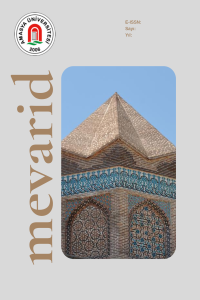
Turgut Cansever ve İslam Estetiği
Öz
Bu makale, İslam sanat ve estetik anlayışının temel ilkelerini ele alarak, bu anlayışın mimarlık ve şehir düşüncesi üzerindeki yansımalarını incelemeyi amaçlamaktadır. İslam sanatında estetik, yalnızca biçimsel ve görsel bir güzellik anlayışıyla sınırlı değildir. Aksine estetik, varlık, anlam ve hakikat ile kurulan ilişkinin bir sonucu olarak ortaya çıkar. Bu bağlamda güzellik, fayda sağlamak ya da bir karşılık elde etmek amacıyla değil, Hakk’ın varlıktaki tezahürü olarak değerlendirilir. Sanatkâr, eserini ortaya koyarken bireysel kimliğini geri planda tutar ve eserin taşıdığı anlamın muhatabına ulaşmasını esas alır. Bu yaklaşım, İslam sanatında eserin, onu meydana getiren kişiden daha önemli kabul edilmesiyle yakından ilişkilidir. Makalenin ilk bölümünde estetik ve sanat kavramları arasındaki ilişki ele alınmış, estetiğin yalnızca sanat eserleriyle sınırlı olmayan daha geniş bir anlam alanına sahip olduğu vurgulanmıştır. Bu çerçevede estetik, hem sanatta hem de tabiatta var olan güzelliği kapsayan bir anlayış olarak değerlendirilmiştir. İslam sanatında estetik tavrın menfaat, gösteriş ve bireysel öne çıkma arzusundan uzak olduğu anlamı, hakikati ve kutsal olanı merkeze alan bir yapı arz ettiği ortaya konulmuştur. Makalenin ikinci bölümünde ise bu estetik anlayışın mimarlık ve şehir ölçeğindeki karşılığı Turgut Cansever örneği üzerinden incelenmiştir. Cansever, mimarlığı yalnızca teknik bir üretim alanı olarak değil, insanın varlıkla ve mekânla kurduğu ilişkinin bir ifadesi olarak ele almıştır. Onun şehir anlayışı, hareket, yürüme eylemi, mekân idraki ve hayatın sürekliliği gibi unsurlar üzerine kuruludur. Sonuç olarak bu çalışma, İslam sanat ve estetik anlayışının günümüz mimarlık ve şehir tartışmaları için önemli bir düşünsel zemin sunduğunu ve Turgut Cansever’in bu sürekliliği temsil eden önemli bir isim olduğunu ortaya koymaktadır.
Anahtar Kelimeler
Turgut Cansever and Islamic Aesthetics
Öz
This article aims to examine the fundamental principles of Islamic art and aesthetics and to explore how this understanding is reflected in architecture and urban thought. In Islamic art, aesthetics is not limited to a merely formal or visual conception of beauty. Rather, aesthetics emerges as a result of the relationship established with being, meaning, and truth. In this context, beauty is not regarded as a means to provide utility or to obtain a return, but as a manifestation of the Divine (al-Ḥaqq) in existence. While producing a work, the artist places their individual identity in the background and prioritizes the transmission of the meaning embodied in the work to its recipient. This approach is closely related to the understanding in Islamic art that the work itself is considered more important than the individual who produces it. In the first section of the article, the relationship between the concepts of aesthetics and art is discussed, emphasizing that aesthetics possesses a broader field of meaning that is not confined solely to works of art. Within this framework, aesthetics is evaluated as an understanding that encompasses beauty present both in art and in nature. It is demonstrated that the aesthetic attitude in Islamic art is distant from interests, ostentation, and the desire for individual prominence, and instead exhibits a structure centered on meaning, truth, and the sacred. In the second section, the reflection of this aesthetic understanding at the scale of architecture and the city is examined through the example of Turgut Cansever. Cansever approaches architecture not merely as a field of technical production, but as an expression of the relationship human beings establish with existence and space. His conception of the city is built upon elements such as movement, the act of walking, spatial perception, and the continuity of life. In conclusion, this study reveals that the Islamic understanding of art and aesthetics provides an important intellectual ground for contemporary debates on architecture and urbanism, and that Turgut Cansever stands out as a significant figure representing this continuity
Anahtar Kelimeler
Bu çalışmanın hazırlanma sürecinde, dilbilgisi, noktalama işaretleri ve üslup tutarlılığı gibi teknik alanlarda destek almak amacıyla OpenAI tarafından geliştirilen yapay zekâ destekli bir araç olan ChatGPT (GPT-5.2) sürümünden yararlanılmıştır. Çalışmanın bilimsel içeriği, yorumları ve sonuçları tamamen yazara aittir
Bu çalışmanın hazırlanma sürecinde değerli bilgi, tecrübe ve yönlendirmeleriyle her aşamada destek olan danışmanım Dr. Öğr. Üyesi Emrah Özdemir’e içten teşekkürlerimi sunarım.