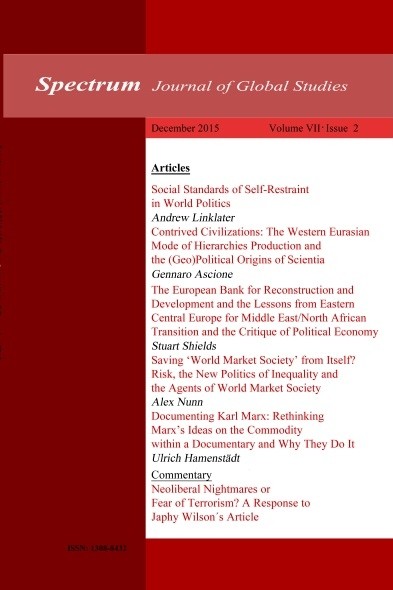
Neoliberal Nightmares
Öz
Neoliberalism died in the financial crisis of 2008. But it has risen from the grave. This uncanny
persistence has coincided with an increased interest in gothic themes in the realms of popular culture
and critical political economy. This paper presents a psychoanalytic diagnosis of this unsettling
scenario. Gothic monsters are identified as symptoms of the Real of Capital as an abstract form of
domination. Neoliberalism is then theorised as a form of obsessional neurosis, which evolves through
its failed attempts to conceal the traumatic dimensions of the Real of Capital. This argument is
illustrated through the strange case of the celebrity development economist Jeffrey Sachs, and his
peculiar transformation from Dr Shock into Mr Aid. I conclude with some reflections on the
nightmarish phenomenon of zombie neoliberalism.
Anahtar Kelimeler
Kaynakça
- Arthur, Christopher J. (2004) The New Dialectic and Marx’s Capital Boston: Brill.
- Calder Williams, Evan. (2011) Combined and Uneven Apocalypse Ropley: Zero.
- Cammack, Paul. (2004) ‘What the World Bank Means by Poverty Reduction and Why It Matters’ New Political Economy 9(2): 189-211.
- Chesterton, GK. (2003) ‘The Real Stab of the Story’, in Katherine Linehan (ed.) Robert Louis Stevenson, The Strange Case of Dr Jekyll and Mr Hyde: an Authoritative Text New York: Norton.
- Crouch, Colin. (2011) The Strange Non-Death of Neo-Liberalism Cambridge: Polity.
- Dean, Mitchell. (2014) ‘Rethinking neoliberalism’ Journal of Sociology 50(2): 150-163.
- Fine, Ben. (2008) ‘Zombieconomics: The Living Death of the Dismal Science in the Age of Neoliberalism’ (Paper for ESRC Neoliberalism Seminar, 01/04/2008).
- Fink, Bruce. (1995) The Lacanian Subject: Between Language and Jouissance Princeton: Princeton University Press.
Ayrıntılar
Birincil Dil
İngilizce
Konular
-
Bölüm
Araştırma Makalesi
Yazarlar
Japhy Wilson
*
Bu kişi benim
Yayımlanma Tarihi
11 Mayıs 2015
Gönderilme Tarihi
10 Nisan 2014
Kabul Tarihi
-
Yayımlandığı Sayı
Yıl 2015 Cilt: 7 Sayı: 1