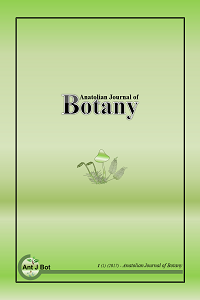
Anatolian Journal of Botany (Ant J Bot) is an open-access, peer-reviewed journal. It publishes original articles, reviews or short communications in all areas of plant biology (biotechnology, diversity, ecology, function, genetics, physiology, structure and systematics) including algae, fungi, lichens and mosses, and chemistry of all above organisms. The journal have been published biannually until the end of 2025. Starting from 2026 the journal publishes continiously.
Anatolian Journal of Botany welcomes only the manuscripts which are written in English, were not published before and not under consideration for publication elsewhere.
All of the procedures related to submission, evaluation and publication are performed electronically via the online system hosted by DergiPark (https://dergipark.org.tr/).
Manuscript Preparation
Manuscript should contain a Title, Key words, an Abstract and the numbered consecutive principle sections, 1. Introduction, 2. Materials and methods, 3. Results and 4. Discussions. Acknowledgements (if any) and References sections should not be numbered.
Title: The title should be brief and concise.
Abstract: The abstract should provide clear information about the research and the results obtained. The main problem to be solved, the main methodology applied, the main important results and conclusions. It should contain all new names (if present) and new situations. Abstract should not contain citations and should not exceed 250 words.
Key Words: 3-5 key words that identify the subject matter of the article, should be given in alphabetical order.
The authors are also required to prepare the title, abstract and keywords in Turkish (optional for foreign authors)
1. Introduction: A state of the art related to the research topic (current knowledge in the field of your research area, containing the respective references, with some more general aspects and deeper information) should be introduced. It should not purely be a review of the subject area, and should not contain the findings or the conclusions.
2. Materials and Method: A clear and complete information should be provided about the materials, and the procedures followed.
3. Results: This section should summarize exactly what is observed and found. The narrated findings without any interpretation and evaluation about them.
4. Discussion: This section should underly the meaning of the research, or highlight the importance of the study and how it might contribute to and/or help fill existing gaps in the field.
Acknowledgments: Names of the funding organisation(s) etc. should be given (if any).
Style and Format of the Manuscript
The text should be typed using Times New Roman characters on A4 paper with the margins 2.2 cm on all sides. The authors are adviced to use the pre ready manuscript template.
Title of the manuscript (12 pt, bold, in sentence case, single spaced and not exceeding two lines)
Author Names: (9 pt, bold, single spaced)
Address line(s): (8.5 pt, single spaced, italic)
Abstract: (8.5 pt, single-spaced, paragraph justified with 0.5 cm indention from each side, 6 pt paragraph spacing before and after)
Key words: (8.5 pt, single-spaced, paragraph justified with 0.5 cm indention from each side, 12 pt paragraph spacing before and after)
Section titles (Introduction, Materials and Methods, Results, Discussion & Acknowledgments) (9.5 pt, Bold, 6 pt (after)
Subsection titles (if necessary) should be numbered as 1.1., 1.2., 2.1., 2.2. … (9.5 pt, bold, 6 pt (after)
Body texts of the sections: (In two columns 0.8 cm apart 9.5 pt, single-spaced, paragraph justified without indention, 6 pt after)
Standart symbols, units, and abbreviations should be used in accordance with the conventions of Scientific Style and Format, and the symbols must be added from symbols menu. Abbraviations should be defined at first mention.
Figures should be cited in text as Figure 1 or (Fig.1). Tables should be cited as Table 1 or (Table 1).
Table and Figure legends: (8.5 pt, single-spaced, paragraph justified, 6 pt (after))
Scientific names, irrespective of rank, must be italicised, but the Latin terms such as et al., in vitro, or in situ should not be italicized.
References should be cited in the text, like (Kaya, 2001), (Kaya and Uzun, 2015), Kaya (2001), Kaya et al. (2015) or Index Fungorum (2018). Unpublished data such as project reports, conference papers (unless published in full-text) MSc or PhD theses, or other unpublished materials should not be cited. For two or more citations use semicolon “;” to seperate them (Kaya, 2001; Kaya et al., 2016).
References should be given in alphabetical order, according to the formats given below (9 pt, single spaced, paragraph justified, 1 cm hanging indent, 4 pt (after))
Kaya A (2015). Contributions to the macrofungal diversity of Atatürk Dam Lake basin. Turkish Journal of Botany 39(1): 162-172.
Uzun Y, Karacan İH, Yakar S, Kaya A (2017). Octospora Hedw., A new genus record for Turkish Pyronemataceae. Anatolian Journal of Botany 1(1): 18-20.
Uzun Y, Kaya A (2019). New additions to Turkish Pezizales from East Blacksea Region. Turkish Journal of Botany (DOI: 10.3906/bot-1802-34 / online)
Breitenbach J, Kränzlin F (1984). Fungi of Switzerland,Vol. 1. Lucerne: Verlag Mykologia.
Davis PH (1965). Flora of Turkey and the East Aegean Islands, Vol. 1. Edinburgh: Edinburgh University Press.
Kaya A (2011). Mantarlar. In: Özuslu E, Tel AZ (eds.). Gaziantep’in Biyolojik Çeşitliliği. Gaziantep: Doğa Koruma Derneği. pp. 29-60.
Kaya A (2009). Contributions to the macrofungi flora of Muş (Turkey) province. In: Ivanova D (ed.). Plant, fungal and habitat diversity investigation and conservation. Proceedings of IV Balkan Botanical Congress, Sofia 2006. Pp. 455–458.
Index Fungorum. http://www.indexfungorum.org/names/Names.asp / [accessed 10 December 2016].
Kuo M (2007). Key to major groups of mushrooms. MushroomExpert.Com Website: http://www.mushroomexpert.com/major_groups.html / [accessed 15 December 2016].
Submission
The manuscript should be submitted electronically via the Internet to the Ant J Bot through the online system provided by DergiPark (https://dergipark.org.tr/ajb). During submission,
1. MS Word copy of the manuscript
2. Copyright Release Form
should be uploaded. Similarity report is prepared automatically by Intihal Net during submission. The submission documents (Manuscript template and Copyright Release Form) can be downloaded from the website of the journal. A high similarity index may cause a direct rejection of the manuscript.
Evalutation
Scientific evaluation starts only if the manuscript fits to the scope of the journal, and meets the technical requirements. Manuscripts that are not prepared according to journal format may not be considered for publication. The editor-in-chief keep the right to reject the manuscript without peer review if it doesn’t fit the scope of the journal or doesn’t comply with the instruction for authors.
The evaluation process is carried out via the web-site prepared by DergiPark, and all processes are recorded by the system. Following the primary evaluation by editorial office and language editor’s evaluation, the editor-in-chief or a designated section editor assigns two or three anonymous blind referees for scientific evaluation. The decision (Acceptance / Rejection) is made upon to the referees' evaluations. Following the acceptance of the manuscript, a galley proof is sent to the corresponding author for final check and corrections. After the approval of the corresponding author regarding the galley proof, the print copy is prepared.