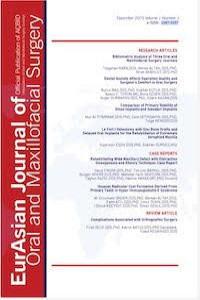
EurAsian Journal of Oral and Maxillofacial Surgery (EJOMS) – Author Guidelines
Welcome to the EurAsian Journal of Oral and Maxillofacial Surgery (EJOMS). To ensure a professional and efficient peer-review process, authors are required to adhere to the following structural and formatting guidelines.
1. Accepted Article Types and Requirements
Full-length Articles: These are original research reports and comprehensive clinical studies that contribute significant new knowledge to the field of oral and maxillofacial surgery. Manuscripts in this category must strictly follow the complete IMRAD structure. The total length of the manuscript, including a structured abstract of up to 300 words, should not exceed 3,500 words. Authors may include a maximum of 6 figures or tables (please note that composite or multi-part figures are not accepted) and are limited to 35 references.
Case Reports: EJOMS welcomes the submission of unique or exceptionally rare clinical cases that offer significant educational insights or illustrate novel surgical approaches. These reports should be concise, with a total word count limit of 1750 words, including a brief 150-word abstract. Submissions may include up to 5 figures or tables and a maximum of 15 references. To maintain focus, case reports are limited to a maximum of five authors.
Letters to the Editor: This format is reserved for scholarly comments regarding articles recently published in EJOMS or for sharing brief, impactful clinical observations. Letters should be focused and not exceed 500 words and 5 references. Authors may include up to 2 figures or tables to support their points. This category does not require an abstract and is limited to five authors.
Short Communications: These manuscripts are intended for the rapid dissemination of preliminary research findings, innovative technical notes, or brief clinical updates. The text is limited to 500 words and should not include an abstract, introduction, or discussion section. Authors may provide up to 4 figures or tables and 5 references. The author list is limited to five individuals.
Review Articles: EJOMS publishes high-level reviews that provide a critical synthesis of current literature on specific topics. Please note that review articles are accepted by invitation from the Editor only. Formatting and length requirements for invited reviews will be provided directly to the authors during the invitation process.
2. Manuscript Structure: Abstract and the IMRAD Protocol
To ensure consistency and discoverability, EJOMS requires specific structures for abstracts and main texts based on the article type.
Abstract and Keywords
The abstract serves as a standalone summary of the work. It should not contain citations or abbreviations (unless defined upon first use).
- Structured Abstract (For Original Research Articles): Original research manuscripts must feature a structured abstract of no more than 350 words, explicitly divided into the following four headings:
- Objective: Briefly state the primary purpose of the study, the research question, or the hypothesis being tested.
- Methods: Describe the study design, setting, participants, and the essential procedures or statistical tests employed.
- Results: Present the most significant findings, including key data and their statistical significance (p-values).
- Conclusion: Provide a concise summary of the clinical implications and the main takeaway based directly on the results.
- Unstructured Abstract (For Case Reports and Other Types): For case reports and other applicable formats, a narrative (unstructured) abstract of no more than 150 words is required. This should be a single, cohesive paragraph that provides a clear overview of the clinical case, its uniqueness, and its contribution to the existing literature.
- Keywords: Immediately following the abstract, provide 3 to 6 keywords. Authors are strongly encouraged to use terms from the Medical Subject Headings (MeSH) database to ensure the article is easily indexed and searchable.
The IMRAD Protocol (For Original Research)
Main text submissions for original studies must follow the IMRAD structure to maintain scientific clarity:
- I - Introduction: Provide the clinical background and the rationale for the study. Clearly identify the knowledge gap and state the specific research objective.
- M - Methods (Materials and Methods): Detail the study design, ethical approvals (IRB), participant selection, and technical protocols. This section must provide enough detail to allow for exact replication of the study.
- R - Results: Report findings objectively and logically. Use tables and figures to support complex data, ensuring they are referenced in the text.
- A - and D - Discussion: Interpret the findings in the context of existing literature. Discuss the clinical significance, address the limitations of the study, and conclude with the main findings. Avoid speculative statements not supported by the data.
3. General Submission Guidelines
- References: Citations must be numbered sequentially in the order they appear in the text and formatted as superscripts. The reference list at the end of the manuscript must follow this numerical order (not alphabetical). Examples fort he references; For further information please visit https://www.nlm.nih.gov/bsd/uniform_requirements.html#journals . For abbreviations of journal names, see the List of Journals Indexed in Index Medicus or access the list at http://www.nlm.nih.gov/tsd/serials/lji.html.
Sample references are given below:
Journal article
Halpern SD, Ubel PA, Caplan AL. Solid-organ transplantation in HIV-infected patients. N Engl J Med. 2002 Jul 25;347(4):284-7.
Article not in English
Ellingsen AE, Wilhelmsen I. Sykdomsangst blant medisin- og jusstudenter. Tidsskr Nor Laegeforen. 2002;122(8):785-7. Norwegian.
Optional: Translation of article title (MEDLINE/PubMed practice):
Ellingsen AE, Wilhelmsen I. [Disease anxiety among medical students and law students]. Tidsskr Nor Laegeforen. 2002 Mar 20;122(8):785-7. Norwegian.
Online journals
Abood S. Quality improvement initiative in nursing homes: the ANA acts in an advisory role. Am J Nurs [Internet]. 2002 Jun [cited 2002 Aug 12];102(6):[about 1 p.]. Available from: https://journals.lww.com/ajnonline/Fulltext/2002/06000/Quality_Improvement_Initiative_in_Nursing_Homes.31.aspx Subscription required.
Book chapter
Meltzer PS, Kallioniemi A, Trent JM. Chromosome alterations in human solid tumors. In: Vogelstein B, Kinzler KW, editors. The genetic basis of human cancer. New York: McGraw-Hill; 2002. p. 93-113.
Entire book
Murray PR, Rosenthal KS, Kobayashi GS, Pfaller MA. Medical microbiology. 4th ed. St. Louis: Mosby; 2002.
Software
Hayes B, Tesar B, Zurow K. OTSoft: Optimality Theory Software. Version 2.3.2 [software]. 2013 Jan 14 [cited 2015 Feb 14]. Available from: https://linguistics.ucla.edu/people/hayes/otsoft/.
Database
CANCERNET-PDQ [database online]. Bethesda, MD: National Cancer Institute; 1996. Updated March 29, 1996
World Wide Web
Gostin LO. Drug use and HIV/AIDS [JAMA HIV/AIDS web site]. June 1, 1996. Available at: http://www.ama-assn.org/special/hiv/ethics. Accessed June 26, 1997 - Visuals: All figures and tables must be cited consecutively in the text. As a reminder, EJOMS does not accept composite/multi-part figures to ensure maximum image clarity.
- Ethical Standards: All research involving human or animal subjects must comply with international ethical standards and include appropriate documentation of approval and consent.
4. Title Page Requirements
To maintain the integrity of our double-blind peer-review process, the title page must be submitted as a completely separate document from the main manuscript file. This page must include the full title of the article, which should be concise, informative, and free of non-standard abbreviations, along with a short running title (maximum 50 characters). It must list the full names, highest academic degrees, and institutional affiliations and ORCID ID number of all contributing authors. Please clearly designate one individual as the Corresponding Author, providing their complete postal address, an active email address, and a telephone number. To ensure accurate academic attribution, we strongly encourage the inclusion of ORCID identifiers for all authors. Finally, the title page must contain all declarations, including funding sources, acknowledgments, and a comprehensive statement regarding any potential conflicts of interest.
Further Considerations and Final Checklist
Before finalizing your submission, please ensure that the following critical requirements have been met to avoid any delays in the editoryal process:
- Language and Proofreading: The manuscript must undergo thorough spell-checking and grammar-checking. To maintain high academic standards, we strongly recommend professional language editing if English is not the authors' first language.
- Reference Cross-checking: Verify that every reference cited within the main text is correctly listed in the Reference List, and conversely, that every entry in the Reference List is cited at least once in the text.
- Copyright Permissions: If your manuscript includes copyrighted materials from other sources (such as figures, tables, or extensive text excerpts), you must obtain and include the official written permissions from the original publisher upon submission.
- Competing Interests Statement: A clear conflict of interest statement must be provided on the Title Page. This is a mandatory requirement for all submissions, even if the authors have no competing interests to declare (e.g., please state: "The authors declare that they have no competing interests").
- Author Contribution Form: To adhere to international authorship guidelines, a completed Author Contribution Form must be uploaded as a separate file. This form must explicitly detail the specific roles of each author in the research and manuscript preparation process.