Whoever seeks and produces, regardless of the field, holds the control of time in their hands. The rest, having accepted their role as consumers, have made waiting a habit. This also means that those who discover and create live as they wish and shape the lives of others. It can be said that developed societies are those who work, search, examine, question, and evaluate.
On the other hand, the rapid development and gradual miniaturization of communication tools have made access to documents and information easier. At the same time, this situation has allowed for reaching larger audiences, reducing the time within the supply-demand order while increasing the mass. Thus, mass communication tools have made the interaction between individuals and communities more functional and powerful. With each passing day, humans are becoming more dependent on shrinking communication devices and increasingly trying to solve their problems through them.
The advancement of civilizations in the production economy has also led to the progress of systematic thinking. Consequently, beyond merely working, working functionally, and beyond merely using time, using it efficiently has become an important issue. This has become extremely significant in the classification, definition, and determination of the function of matter divided into smaller parts.
Social sciences are also a field where the concept of truth is constantly debated, as every individual has managed to broaden the definition of “human.” Therefore, being able to exist in these fields is a value in itself. However, having accurate knowledge of the literature, understanding the purpose, scope, and limitations, and reaching the right methodology are what bring conscious individuals to the forefront in these areas.
Among living civilizations, Turkish civilization is one of those that has contributed most to the accumulation of humanity. In this accumulation, which is characterized by the dominant traits of nobility, humility, cleanliness, and purity, there remain many things for both the world and the region to gain. Although it has gone through periods of stagnation from time to time, when harmony between ideals and structure is achieved, the Turkish nation can easily attain achievements that surprise almost everyone. It is believed that achieving such harmony requires being more selfless, more disciplined, and more vigilant, especially in the social sciences.
Just as introverted societies cannot progress, introversion is unimaginable for nations like the Turkish nation, which is extremely open to developments, always looking outward, and never indifferent to any form of dynamism. It should be considered the primary duty of Turkish scholars to observe every form of movement in the universe, especially those cultures that have possessed added value since ancient times.
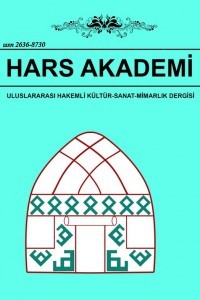
Hars Akademi Journal has chosen the Göktürk alphabet letter Eb / B—which may signify tent, house, camp, homeland, country, or world—as its logo, symbolizing a significant concept within Turkish civilization. The purpose of this choice is to demonstrate that the Turkish society, which has never taken a step back from integration with the world, has always lived by its universal values.
Hars Akademi Journal aims to support studies in the fields of culture, art, and architecture both within and outside the country, accepting the core values of Turkish culture as its foundation.
We wish for Hars Akademi Journal to contribute to Turkish culture and invite the support of all interested parties as authors, readers, and reviewers.
The journal is published to provide publication opportunities for academics, researchers, and artists working in these fields and to contribute to science, art, and culture. While the main language of the journal is Turkish (Turkey Turkish, Azerbaijani Turkish, Kazakh Turkish, Kyrgyz Turkish, Uzbek Turkish, and others), it also supports German and English. The journal, which began publication in June 2018, is published twice a year, in June and December.
