Jun 30, 2026
Publication Type
Articles
Research Article
Book Review
Sinop Journal of Theology aims to publish original research articles, translation articles, book reviews, scientific conference reviews in the field of social sciences, theology and religious studies and to share them with the public. The aim of the journal is to contribute to science by publishing original and qualified studies. Articles submitted for publication are subjected to double blind peer review by at least two reviewers. In addition, a special program used in plagiarism detection confirms that the articles have not been published before and do not contain plagiarism. Sinop Journal of Theology Editorial Board acts in accordance with the Scientific Research and Publication Ethics Directive of the Council of Higher Education.
Sinop Journal of Theology publishes qualified research articles in the fields of social sciences and religious sciences.
Subject Category:
Basic Islamic Sciences: Tafsir, Hadith, Kalam, Islamic Law, History of Islamic Sects, Sufism, Arabic Language and Literature.
Philosophy and Religious Sciences: Islamic Philosophy, Philosophy of Religion, Psychology of Religion, Sociology of Religion, Religious Education, History of Religions, Logic.
Islamic History and Arts: Islamic History, History of Islamic Arts, Turkish-Islamic Literature, Religious Music.
Social and Human Sciences: Religion, Literature, Philosophy, Psychology, Sociology, History
Keywords:
Religion, Philosophy, Literature, History, Tafsir, Hadith, Kalam, Islamic Law, History of Islamic Sects, Sufism, Arabic Language and Literature, Islamic Philosophy, Philosophy of Religion, Psychology of Religion, Sociology of Religion, Religious Education, History of Religions, Logic, Islamic History, History of Islamic Arts, Turkish-Islamic Literature, Religious Music.
You can access the Article Submission Guide here.
You can access the Article Submission Guide video here.
Please download the article template here.
Sinop Journal of Theology aims to publish and share with the public original research articles, book reviews, scientific meeting evaluations, and translation studies in the field of theology and religious studies. Submitted articles must comply with the aims and scope of the journal.
The journal publishes in Turkish, English, and Arabic.
Articles (excluding references, summary, and abstract) must not exceed 9,000 words, and the summary/abstract should be between 200–300 words.
Only original, unpublished manuscripts that are not under review elsewhere and have been approved by all authors for content and submission are accepted for evaluation.
Manuscripts must be prepared in accordance with the journal’s writing guidelines.
Articles must be submitted electronically through the “Submit Article” section of the journal’s website.
All documents and files should be submitted in Word format (.doc or .docx).
Book reviews should not exceed 1,500 words, and the summary/abstract should be between 50–100 words. At least one source (the reviewed work may count) must be listed in the references.
The ISNAD 2nd Edition citation style must be used in the articles.
The TDV Islamic Encyclopedia (DİA) should be used as a reference for the spelling of Arabic-derived words.
The Isnad 2nd Edition Translation Writing Alphabet/Transcription system should be used when translating Arabic-written bibliography into the Latin alphabet.
At the end of the article, before the references, the author’s note and acknowledgment of financial support (if any) should be included.
Formatting Requirements for Submitted Manuscripts:
LAYOUT
A) Page Size: A4 (Width: 21 / Height: 29.7 cm)
B) Page Structure:
Margins: Top 2.5 cm; Bottom 2.5 cm; Right 2.5 cm; Left 2.5 cm; Gutter: 0; Gutter Position: Left.
Layout: Header 1.27 cm; Footer 1.27 cm.
HEADINGS
A) Main Title (in Turkish and English): Capitalize first letters; Font: Times New Roman, 11 pt, Bold. Paragraph; Indent: Left-right 0 cm; Spacing: Before/after 6 pt; Line spacing: Single.
B) Abstract Title (in Turkish and English): Use the template.
Abstract Text (in Turkish and English): Font: Times New Roman, 9 pt. Paragraph; Indent: Left-right 0 cm; Spacing: Before/after 6 pt; Line spacing: 1.15. There should be 3–5 keywords, each beginning with a capital letter.
ARTICLE CONTENT
A) Article Title: Font: Times New Roman, 11 pt, Bold. Paragraph; Indent: Left-right 0 cm; Spacing: Before/after 6 pt; Line spacing: 1.15.
B) Article Text: Font: Times New Roman, 11 pt. Paragraph; First line indent: 0.7 cm; Spacing: Before/after 6 pt; Line spacing: 1.15.
C) Footnotes: Font: Times New Roman, 9 pt. Paragraph; Special: Left 0.2; Hanging indent 0.2 cm; Spacing: Before/after 0 pt; Line spacing: 1.15.
References: Font: Times New Roman, 10 pt. Paragraph; Hanging indent 0.7 cm; Spacing: Before/after 0 pt; Line spacing: 1.15. Every scholarly work must include a references section. References should be written in the Latin alphabet, with attention to accuracy, consistency, and accessibility.
REQUIRED DOCUMENTS FOR ARTICLE SUBMISSION
Full Text
Title Page
Copyright Form
Ethics Committee Approval (if not required, Declaration of No Need for Ethics Committee Approval)
Author Information Form
Similarity Report (The similarity rate must not exceed 15%. This result can be automatically obtained via the Dergipark system.)
Publication Ethics Principles
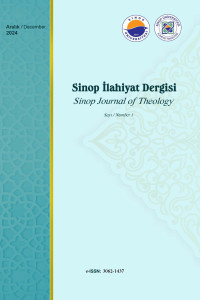
Sinop Journal of Theology is a peer-reviewed journal published two (2) times a year, in June and December, and adheres to national standards of research and publication ethics. Sinop Journal of Theology is prepared in accordance with the guidelines and policies published by the Committee on Publication Ethics (COPE) https://publicationethics.org/ as open access for ethical duties and responsibilities.
Responsibilities of Stakeholders
All parties involved in the publication process must comply with scientific research and publication ethics.
Responsibilities of the Editors
- The editors evaluate the submitted article proposals in an impartial manner, taking into account the relevance of the scope of the journal and the importance and originality of the studies. The editors take care that the published articles contribute to the reader, researcher, practitioner and scientific field and are original.
- The relationship between the editors and the publisher and journal owner is based on the principle of editorial independence.
- Editors do not share information about a submitted manuscript with anyone other than the corresponding author, referees and the editorial board.
- Editors do not have any conflict of interest regarding accepted or rejected manuscripts.
- Editors ensure that all articles accepted for publication are peer-reviewed by at least two referees who are experts in their fields.
- The editors are responsible for deciding which manuscript to publish from the manuscripts submitted to the journal based on the validity of the work in question, its importance to researchers and readers, the comments of the referees, and other legal requirements.
- Editors have the responsibility and authority to accept or reject manuscripts. It is essential that the responsibility and authority are exercised appropriately and in a timely manner.
- Editors ensure that all Advisory Board members carry out the processes in accordance with the publication policies.
- The editors organize periodic meetings with the Editorial Board for publication policies and journal development.
Responsibilities of Authors
- Authors should not include plagiarized or falsified data, and the list of footnotes and bibliography should be complete.
- They should keep the raw data of their work and submit it for editorial review if requested by the journal.
- The names of all authors who actively contributed to the research should be included.
- Those who did not actively contribute to the research should not be included among the authors, and those who contributed to the research other than authorship should be thanked for their contribution to the relevant research.
- Disclose conflicts of interest at the earliest possible stage (usually by submitting a disclosure form at the time of manuscript submission and including a statement in the manuscript).
- All authors are obliged to make editorial corrections.
Responsibilities of Reviewers
- Reviewers should be impartial in their assessment.
- Reviewers should not have any conflict of interest with the research, the authors and/or the research funders.
- Reviewers are expected not to give only yes or no answers, but to elaborate on negative opinions and give reasons for them.
- Reviewers are expected to make a text-centered evaluation only. It is important that they do not use expressions that may damage the reputation and personal rights of the author/authors.
- Reviewers should indicate the works published but not cited related to the research.
- Reviewers should keep the manuscripts they check confidential.
i is to present it as one's own work in whole or in part without citing the owners in accordance with scientific rules.
Sinop Journal of Theology scans all submitted manuscripts with intihal.net to prevent plagiarism. The similarity rate is expected to be less than 15%. If the similarity rate of the scanned article is above the specified level, the article is rejected by the Editorial Board without going through the referee process. The plagiarism report of the rejected article is also shared with the author. The rejected article will not be re-evaluated in any way. Research articles are accepted to the referee process; translation and book introduction articles are reviewed by the editorial board. Sinop Journal of Theology is based on ISNAD 2nd Edition for citations and references.
Other Indexes
Editor in Chief
Assistant Editors
Editorial or Advisory Board
Field Editors
Secretary
Language Editors (English)
Language Editors (Arabic)
Redactors
Publication Editor
Layout Editors
Statistics Editor