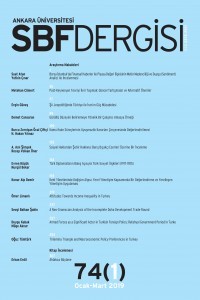
Attitudes Towards Income Inequality in Turkey
Öz
The purpose ofthis paperisto revealfactorsthat affect attitudestowardsincome inequality in Turkey by using World Values Surveys dataset over the period 1990-2011. Unlike previous studies on Turkey, this paper has employed ordered logistic regression with the wider period. Two separate estimations have been run using different explanatory variables. In the first estimation, findings have demonstrated that financial satisfaction of households, religion and political ideologyare crucial factors in the attitude creation process. In the second estimation, trust variables have been run with traditional control variables such as sex, age, education, and marital status. People who trust armed forces, police, European Union, and government support larger income differences almost in all years. Individuals who trust labour unions prefer more equality as expected. Findings reveal that ideologies and religious affiliations of voters are determinative in the development of policies to combat income inequality, among other factors mentioned. In this context, it can be said that there is a strong connection between the concepts of religion, ideology, and justice which is mentioned together with the idea of inequality.
Anahtar Kelimeler
Kaynakça
- Referans 1 Alesina, A. and G.-M. Angeletos (2005), “Fairness and redistribution”, American Economic Review 95 (4), 960–980.
Ayrıntılar
Birincil Dil
İngilizce
Konular
-
Bölüm
Araştırma Makalesi
Yazarlar
Yayımlanma Tarihi
6 Şubat 2019
Gönderilme Tarihi
25 Mayıs 2017
Kabul Tarihi
14 Mart 2018
Yayımlandığı Sayı
Yıl 2019 Cilt: 74 Sayı: 1