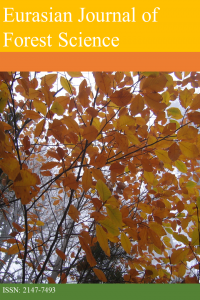
SEASONAL VARIATION IN LIGHT TRANSMISSION AND CANOPY GAPS OF DECIDUOUS ROADSIDE VEGETATION: ASSESSMENT WITHIN FOREST LANDSCAPE
Öz
Deciduous roadside vegetation exhibits seasonal patterns of foliage with varying colors and numbers. Hence the alternating percentage of the gaps within the roadside canopy allows changing percentages of light transmission throughout the year. The leafless roadside vegetation in winter is sequentially subject to budburst, flushing, and development stages until the summer, when the leaves are fully developed both in size and number. Then, defoliation follows senescence, and fading and fall stages occur in sequence until the vegetation becomes leafless in the winter. The percentage of light transmission, canopy gaps, and sunlight duration are different in these different stages. In this study, the seasonal pattern of light transmission and canopy gaps of deciduous vegetation along a rural road section that is surrounded by forest landscape and that connected two cities was monitored. The road selected for the study was located in Bartın watershed in Turkey. Hemispherical photographing and image processing techniques were used to analyze the percentage of light transmission and canopy gaps throughout a foliage year in between 2012 and 2013. During 22 field visits, 220 hemispherical photographs were taken from 10 points along 700 m of the experimental site. Percentage of light transmission, and canopy gaps data were evaluated together with the daily sunlight duration data from the meteorological station. The correlations (r) between mean sunlight duration (msd) and 1) the percentage of mean light transmission (mplt) and 2) the percentage of mean canopy gaps (mpcg) were -0.68 and -0.75, respectively. Both of the correlations were highly significant (P < 0.01). The seasonal patterns of mplt, mpcg, and msd were assessed considering both the roadside vegetation and the surrounding landscape, emphasizing travelers’ and drivers’ perceptions.
Anahtar Kelimeler
Kaynakça
- Ahern, J. (1995). Greenways as a planning strategy. Landscape and Urban Planning, 33, 131-155.
- Antonson, H., Mårdh, S., Wiklund, M., Blomqvist, G. (2009). Effect of surrounding landscape on driving behavior: A driving simulator study. Journal of Environmental Psychology, 29, 493-502.
- Bonan, G., Levis, S., Kergoat, L., Oleson, K.W. (2002). Landscapes as patches of plant functional types: an integrating concept for climate and ecosystem models. Global Biogeochemical Cycles, 16, 1021-1044.
- Boyd, P., Byles, M., Cheifetz, A., Chisholm, J., Copland, A., Double, C., Frances, P., Gavira, A., Hammond, R., O’Hanlon, M., Hawthorne, L., Paxton, S., Riley, L., Stewart-Jones, H., Weeks, J., Whitehorn, T., Widdicombe, S., Wild, F. (1996). The A-Z Plant Directory. Dorling Kindersley Ltd., London, UK.
- Cackowski, J.M., Nasar, J.L. (2003). The restorative effects of roadside vegetation: Implications for automobile driver anger and frustration. Environment and Behavior, 35, 736-751.
- Chen, J.M., Cihlar, J. (1995). Quantifying the effect of canopy architecture on optical measurements of leaf area index using two gap size analysis methods. IEEE Transactions on Geoscience and Remote Sensing, 33, 777-787.
- Chen, S.S., Jim, C.Y. (2008). The urban forest of Nanjing City: Key Characteristics and Management Assessment. In: Carreiro, M.M., Song, Y.C., Wu, J. (Eds.), Ecology, Planning, and Management of Urban Forests, International Perspectives. Springer Science+Business Media, LLC, New York, USA, pp. 259-278.
- Christen, D.C., Matlack, G.R. (2009). The habitat and conduit functions of roads in the spread of three invasive plant species. Biological Invasions, 11, 453-465.
Ayrıntılar
Birincil Dil
İngilizce
Konular
-
Bölüm
Araştırma Makalesi
Yayımlanma Tarihi
30 Aralık 2015
Gönderilme Tarihi
23 Ekim 2015
Kabul Tarihi
-
Yayımlandığı Sayı
Yıl 2015 Cilt: 3 Sayı: 2