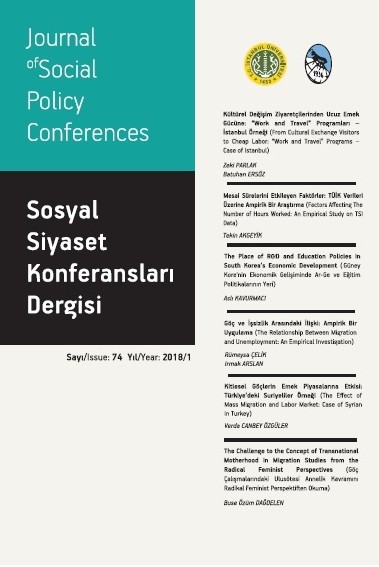
Fazla Çalışmanın İşyükü ve İşgücü Belirleyicileri(Bir Şirketin Veri Seti Üzerine Ampirik Bir Araştırma)
Öz
Anahtar Kelimeler
Kaynakça
- Anxo, D. ve Karlsson, M.s (2019). Overtime Work: A Review of Literature and Initial Empirical Analysis. ILO. Geneva. google scholar
- Anger, Silke (2008). “Overtime Work as a Signaling Device”. Scottish Journal of Political Economy. V. 55 (2): 167-189. google scholar
- Avgoustaki, A. (2015). “Human Resource Practices, Employee Overtime, and Work Uncertainty: Is Overtime Wasted Time?”. [www.dee.uib.eu]. (Erişim: 04.02.2020). google scholar
- Bae, S. (2012). “Nursing Overtime: Why, How Much, and Under What Working Conditions”. Nursing Economic. V. 30 (2): 60-71. google scholar
- Bauer, T. ve Zimmermann, K. F. (1999). “Overtime Work and Overtime Compensation in Germany”.Scottish Journal of Political Economy. 46 (4): 419-436. google scholar
- Beckers, D., Linden, D., Smulders, P.G.W., Kompier, M.A.J., Taris, T.W. ve Geurts, S.A.E. (2008). “Voluntary or Involuntary? Control over Overtime and Rewards for Overtime in Relation to Fatigue and Work Satisfaction”. Work & Stress.V. 22 (1): 33-50. google scholar
- Beltempo, M., Lacroix, G., Cabot, M.ve Piedboeuf, B. (2016). “Factors and Costs Associated with the Use of Registered Nurse Overtime in the Neonatal Intensive Care Unit”. Pediatrics and Neonatal Nursing. 4 (1): 17-23. google scholar
- Berney, B. (2003). Use, Trends, and Impacts of Nurse Overtime In New York Hospitals: 1995-2000. Boston University. Ph. D Thesis. Boston. google scholar
Ayrıntılar
Birincil Dil
Türkçe
Konular
Çalışma Ekonomisi
Bölüm
Araştırma Makalesi
Yazarlar
Tekin Akgeyik
*
Bu kişi benim
0000-0002-7339-363X
Türkiye
Yayımlanma Tarihi
9 Temmuz 2021
Gönderilme Tarihi
24 Ağustos 2020
Kabul Tarihi
13 Nisan 2021
Yayımlandığı Sayı
Yıl 2021 Sayı: 80