Scientific Publication Coordinator

Editor-in-Chief


Field Editors






Editorial Board Members
Smanalieva J. N. obtained her Master’s degree in 2001 at the Department of Food Preservation Technology, Faculty of Technology, Kyrgyz State Technical University. In 2007, she earned her PhD in Food Rheology at the Institute of Food Chemistry and Technology at the Technical University of Berlin (Germany). In 2008, she was appointed Senior Lecturer at the Department of Food Engineering, Faculty of Engineering, Kyrgyz-Turkish “Manas” University, where she underwent continuous professional development and career progression from 2008 to 2018. She was promoted to Acting Associate Professor in 2013 and, in 2017, was officially awarded the academic title of Associate Professor by the Supreme Attestation Commission of the Kyrgyz Republic.
She has extensive international research and teaching experience in the Kyrgyz Republic, Germany, and Switzerland. With support from the German Academic Exchange Service, she conducted several research stays and attended graduate seminars at the Technical University of Berlin. In 2013–2014, she was awarded a scholarship by the Federal Commission for Scholarships for International Students and completed a research internship at the Swiss Federal Institute of Technology in Zurich, Institute of Nutrition and Health.
From 2018 to 2020, Smanalieva J. N. served as Professor at the Technical University of Dresden, where she was appointed Acting Head of the Department of “Nutritional Sciences, Food and Household Economics / Vocational Education.”
From 2022 to 2024, she worked as a Research Fellow at the Max Rubner Federal Research Institute for Nutrition and Food in Karlsruhe.
In 2020, she was appointed a Professor in the Department of Food Science and Technology at I. Razzakov Kyrgyz State Technical University, where she is currently employed. Her teaching responsibilities include core lecture courses in Nutrition, Food Toxicology, and Functional Food Ingredients, and she supervises Master’s and doctoral research projects.
She is currently a researcher in the Department of Food Chemistry at the Technical University of Dresden. Together with Professor Thomas Henle, she leads a sub-project within the international research project “SUFACHAIN – Promoting Sustainable Land Management through the Development of Products, (Technological) Processes and SMEs in the Field of Non-Timber Forest and Agroforestry Value Chains in Central Asia,” funded by the Federal Ministry of Education and Research (BMBF, Germany).
Her publication record comprises more than 60 scientific works.


Dr. Parvaiz Ahmad Naik received his M.Sc. in Mathematics from the University of Kashmir, JK, India in 2008 and his Ph.D. from Maulana Azad National Institute of Technology, India in 2015 with a major in mathematical modeling of biological systems. In 2016, he joined the Islamic University of Science and Technology, Srinagar, JK as an Assistant Professor and served there from Jan 2016- Nov 2018. From Dec 2018-Dec 2019, he worked as a postdoctoral research fellow in the research group of Professor Jian Zu at the School of Mathematics and Statistics, Xi'an Jiaotong University, PR, China. Later got promoted to Assistant Professor in Jan 2020 at the School of Mathematics and Statistics, Xi'an Jiaotong University, PR, China, and served there up to Dec 2022. Currently, he is working as a Professor of Mathematics at Youjiang Medical University for Nationalities, PR, China. He has published more than 45 SCI papers to date in journals of international repute like World Scientific, Elsevier, Springer, American Scientific, Taylor & Francis, etc among which 5 papers are selected as ESI highly cited papers from Web of Science, and more than 25 papers are related to the fractional-order modeling of infectious diseases including HIV, Covid-19, HBV, and others. He has received two young scientist awards (gold medals) for his outstanding research work in the field of mathematical biology. Dr. Naik presided over three scientific research projects related to infectious diseases at the national and international levels. Dr. Naik serves as an Editorial Board Member of several international reputed journals. His research interests lie in biomathematics, infectious disease dynamics, population dynamics, stochastic analysis, calcium dynamics, fractional mathematical models, fractional mathematical theory and method, bifurcation analysis, and dynamical control theory. He has expertise in Latex, Matlab, Python, Mathematica, XPPAUTO, etc.

Mehmet Odabaşı lisans eğitimini Atatürk Üniversitesi Kimya Bölümü’nden, yüksek lisans ve doktora derecesini biyokimya alanındaki çalışmaları ile Hacettepe Üniversitesi'nden aldı. Aksaray Üniversitesi’nde, 2007 yılında Yardımcı Doçent, 2012 yılında Doçent ve 2018 yılında Profesör oldu. Dr. Odabaşı, Aksaray Üniversitesine başladığı 2007 yılında, Biyokimya ve Biyokromatografi Araştırma Grubu'nu kurdu (biochemreg.com). Dr. Odabaşı’nın çalışma alanları, polimerik membranlar, monolitik kolonlar, kriyojeller, kopozit malzemeler, mikroküre ve magnetik taşıyıcıların hazırlanması ve protein enzim, antibadi, nükleik asit ve hormonlar gibi biyolojik moleküller ile ağır metal ve mikrosistin gibi çevresel atıkların uzaklaştırılması üzerinedir. 2025 yılı sonu itibariyle Dr. Odabaşı'nın SCIE kapsamında dergilerde yayınlanmış 80'in üzerinde yayını vardır ve h-indeksi 29'dur.

Dr. Akif AKGUL was born in Izmir, Turkey. Dr. AKGUL received his B.S. degree in Electronics-Computer Education from Kocaeli University in 2009 and in Electrical-Electronics Engineering from Sakarya University in 2013, M.S. and Ph.D. degrees from Sakarya University in 2011 and 2015, respectively, in Electronics-Computer Education and Electrical-Electronics Engineering. His Ph.D. thesis work was on chaos-based cryptology. He has been to The Institute of Electronics, Communications and Information Technology (ECIT) of Queen's University Belfast, United Kingdom in 2015 as a Visiting Researcher. His current research interests include random number generators, cryptology, data hiding, blockchain, IoRT, chaos-based engineering applications. Currently, he is Associate Professor at the Department of Computer Engineering, Faculty of Engineering, Hitit University, Turkey, where he has been involved in projects concerning the study of chaos-based applications.


Jesus M. Munoz-Pacheco is a tenured professor in the Faculty of Electronics Sciences at Benemerita Universidad Autonoma de Puebla. He founded and currently leads the research group Fractional-order Systems and Nonlinear Circuits. He has published about 150 scientific works on chaotic systems and fractional-order calculus. He is ranked in the Top 2% global scientist list published by Stanford University-Elsevier in both the Single year list and the Career list from 2020 to 2025. Dr. Munoz-Pacheco is a senior member of the National System for Researchers by Conahcyt and the Government of Mexico. Dr. Munoz-Pacheco is also an Associate Editor for Frontiers in Physics, IJNM-Wiley, Frontiers in Applied Mathematics and Statistics, Chaos Theory and Applications, and so on.





Yeliz Karaca is an associate professor of mathematics, and a senior research professor at the University of Massachusetts Chan Medical School (UMASS), USA; collaborator at Massachusetts Institute of Technology (MIT), USA. She received her Ph.D. degree in Mathematics with the dissertation entitled “Constituting an Optimum Mathematical Model for the Diagnosis of Multiple Sclerosis” from Marmara University, Türkiye in 2012. Among the other awards she has been given, she was also granted the “Cooperation in Neurological Sciences and Support Award” by Turkish Neurology Association as the first mathematician in Türkiye. She also holds a "medical card" as the only mathematician entitled that sort of card. She also holds a medical card as the only mathematician entitled for it. Furthermore, she received the Outstanding Young Scientist Award in 2012 and Best Paper Awards in her specialized discipline in 2012, 2014, 2016, 2017, 2019, 2020 as well as 2023, among the other awards in different categories. Another award of hers is Outstanding Reviewer Award (Mathematics Journal, MDPI) in 2021.
As for some publications, Dr. Karaca has a book entitled "Computational Methods for Data Analysis" published in 2018 by De Gruyter. Another publication is an edited book named "Computational Science and Its Applications" – Lecture Notes in Computer Science (ICCSA 2020, with series 1-7) by Springer. Her edited book is entitled "Multi-Chaos, Fractal and Multi-Fractional Artificial Intelligence of Different Complex Systems", published by Elsevier in 2022. Another work is entitled Computational Science and Its Applications – Lecture Notes in Computer Science (ICCSA 2023, with series I-9) by Springer. Another book is entitled "Intelligent Fractal-Based Image Analysis: Applications in Pattern Recognition and Machine Vision", published by Elsevier in 2024. Besides these, another publication under publication process is a single-authored book, named "Computational and Mathematical Neuroscience, Biology & Medicine: Clinical and Medical Applications" by Wiley-IEEE Press.
She is the Editor-in-Chief of the book series named “Systems Science & Nonlinear Intelligence Dynamics” (https://www.worldscientific.com/series/ssnid) by World Scientific. She has been acting as an editor, guest editor and associate editor in many different issues in SCI indexed journals such as IEEE Access; Electronics, MPDI; International Journal of Big Data and Analytics in Healthcare (IJBDAH); ICCSA2020-Lecture Notes- Springer; Fractal AI-Based Analyses and Applications to Complex Systems, Fractals- World Scientific among others. In addition, she is the leading guest editor of several special issues, one of which is "Fractal-Fractional AI-Based Analyses and Applications to Complex Systems" (Part I, II, III, IV) at Fractals Journal, World Scientific. Some of the other special issues she has been running are as follows: “Advanced fractional calculus, differential equations and neural networks: analysis, modelling and numerical computations", at the Physica Scripta Journal – IOP science; “Advanced Fractals and Fractional Calculus with Science and Engineering Applications: Computing, Dynamics and Control in Complex Systems" (Part I, II) at the Applied Mathematics in Science and Engineering Journal, Taylor&Francis and "Dynamic Diseases: Mathematical Informed Expert and Knowledge Computing Technology-based Computational Medicine in Complex Systems", at Frontiers in Bioscience-Landmark.
Dr. Karaca has also been acting as a chair, co-chair, member of Advisory Scientific Committee and special session organizer of international conferences some of which are as follows: Image Processing, Wavelet and Applications (IWW), International Conference on Computational Science and Its Applications (ICCSA), International Conference on Nonlinear Science and Complexity (ICNSC), The International Conference on Fractional Differentiation and Its Applications (ICFDA), International Conference on Intelligent Information Processing (IETI ICIIP ) and International Conference on Applied and Industrial Mathematics (ICAIM).
Among her affiliated organizations in which she has active scientific roles and involvement with projects are Organization for Women in Science for the Developing World (OWSD); Complex Human Adaptive Organizations and Systems (CHAOS)- University of Perugia, Italy; International Engineering and Technology Institute (IETI) and Institute of Electrical and Electronics Engineers (IEEE, senior member). She is also a member of many associations and charities. She also has one charity she established herself and she is acting as the co-founder and project manager at Yönetim Araştırmaları Derneği (YÖNAD), which is a charity for Management Research, conducting scientific and industry-related projects, seminars, academic work and conferences.
Her research interests include complex systems sciences with applications in various terrains, applied mathematics, advanced computational methods, AI applications, computational (-algorithmic) complexity, fractional calculus, fractals and multifractals, stochastic processes, different kinds of differential and difference equations, discrete mathematics, algebraic complexity, complexity science, wavelet and entropy, solutions of advanced mathematical challenges, mathematical neuroscience and biology as well as well as advanced data analysis in medicine and other related theoretical, computational and applied domains.


Juan Eduardo Nápoles Valdes, was born in Cuba and currently lives in Argentina, is a PhD in Mathematical Sciences (1994 at the Universidad de Oriente, Santiago de Cuba), was President of the Cuban Society of Mathematics and Computing and is currently Professor at the National University of the Northeast and the National Technological University of Argentina. He directs the Nonlinear Analysis Group (UNNE), research projects and several PhD and Bachelor students.

SHORT CURRICULUM OF MARIA ALESSANDRA RAGUSA
Address: Dipartimento di Matematica e Informatica, Viale Andrea Doria, 6-95125, Catania, Italy. Email:maragusa@dmi.unict.it , mariaalessandra.ragusa@unict.it , Telephone: +390957383060.
Her name is in the list Top Italian Scientists of VIA-Academy, where Italian University Professors of greater impact in the world, that are in the list of the Ministry of University and Research (MIUR), are registered. Born June 18th 1966, degree in Mathematics on july 12th 1988, 110/110 cum laude.
-In 1989 she become Teaching Assistant in Mathematical Analysis in Faculty of Engineering of Catania University. In january 1990 she supports the entrance examination to the doctoral program
Research in Mathematics, V cycle, at Catania University, resulting among the winners.
-In december 1992 she win a competition exam for Assistant Professor of Mathematical Analysis in Catania University. - In june 18th 2012 PhD in Mathematics in Lule˚a University (Sweden).
- In january 2000 she win a competition exam for Associate Professor of Mathematical Analysis in Catania.
- In june 2013 she obtained the national scientific qualification for Full Professor of Mathematical Analysis.
- In october 2017 she becomes Full Professor of Mathematical Analysis in Catania University. Is member of the international association ”Women in Mathematics”.
Winner of the ”Una Tantum” of Catania University, incentive award for academic and scientific merit. Winner of the international prize ”Mathematics 2020 Best Paper Award”.
Winner of the international prize ”Mathematics 2021 Outstanding Re viewer Award”.
Responsable of research projects
-Responsable of National Research Projects, in 2009, 2011 and 2017, 2018, 2019 of ”Gruppo Nazionale per la Analisi Matematica, la Probabilità e le loro Applicazioni (GNAMPA) - Istituto Nazionale di Alta Matematica” - Rome, Italy.
- Responsable of project ”Research in Pairs” of Centro di Ricerca Ma tematica ”Ennio De Giorgi”-Scuola Normale Superiore 2015. -Responsable of 9 ”International ERASMUS Accord” between Univer sity of Catania and: Universit´e de Limoges, France, 2010-13 and 2014-2020, Okan University di Istanbul, Turkey, 2011-14 and 2014-20, Kirsehir University, Turkey, 2011-14 and2014-20, Lulea University, Sweden, 2014-20, Karstad University, Sweden, 2014-20, Narvik University, Norway, 2014-20. 1
Partecipation to research projects
-Partecipant to the ”Programs of Relevant Scientific National Interest (PRIN)” PRIN 1997, PRIN 1999, PRIN 2003, PRIN 2006 and PRIN 2008, 2017 duration 2 years.
-Partecipant to the ”Fund for Investment in Basic Research (FIRB)”, duration 2 years, title: ”Analisi di equazioni a derivate parziali, lineari e non lneari: aspetti metodologici, modellistica, applicazioni”. -Partecipant to the ”Research Projects financed with funds of the Uni versity (PRA)” 1999, PRA 2000, PRA 2001, PRA 2002, PRA 2003, PRA 2004, PRA 2005, PRA 2008 e PRA 2009, ”Piano triennale 2016-2019”, ”ENIGMA”-Egocentric Navigator for Industrial Guidance, Monitoring and Anticipation, n. F/190050/02/X44 2020, ”GNAMPA” 2020, ”PIACERI” 2020.
Governance activities
− Member of 4 Commissions of competition exams
1) Assistant professor in Naples University in 2000,
2) Associate professor in Salerno University in 2004,
3) Associate professor in Naples University in 2006,
4) Assistant professor in Naples-”Parthenope” University in 2008,
5) Associate professor in Modena-Reggio Emilia University in 2018,
6) Associate professor in Naples University in 2018,
7) Assistant professor in Naples University in 2018,
8) Associate professor in Sassari University in 2019,
9) Full professor in King Saud University in 2019.
10) Full professor in King Saud University in 2020.
11) Full professor in Tafila Technical University, Jordan in 2020
12) Associate professor in Education University of Hong Kong in 2020.
13) Associate professor in Tafila Technical University, Jordan in 2020
− Member of the College of the PhD in Applied Mathematics for Engineering in Catania University, cycles XIX, XX XXI, XXII, XXXIV, XXXV, XXXVI and teacher of the course ”Partial Differential Equations”.
− Member of the Education Committee of the Council of Course Study in Science and Technology of the Environment. − Member of the Education Committee of the Council of the Pro gramme in Environmental Sciences.
− Delegate of the Board of the Programme in Environmental Sciences at the Education Committee of the Faculty of Mathematical, Physical and Natural Sciences in Catania University.
− Delegate of the Board of the Master Degree Programme in Sciences and Technologies of the Environment to the Education Committee of the Faculty of Mathematical, Physical and Natural Sciences, Catania University. − Referent for Catania of ”Unione Matematica Italiana”.
− Member of ”Gioenia Academy”, 2 − Inserted from 2013 in the National Register of Expert Assessors of the National Agency of Evaluation of University and Research (A.N.V.U.R.). − Inserted in 2015 in the National Register of Experts of Evaluation of the ”Third mission” (teaching of mathematics in schools) of A.N.V.U.R.
− In 2016 is nominated by A.N.V.U.R. member of evaluation of newly established Master Degree Courses.
− Inserted in 2017 by A.N.V.U.R. in the Register of ”Experts of Sys em” for Institutional Quality Assurance. − In 2018 is appointed by A.N.V.U.R. President of the Evaluation Ex pert (C.E.V.) mission for the initial accreditation and Member of Commission of the Evaluation Expert (C.E.V.) of periodic accreditation of bachelor and master degree courses of new activation. − In 2020 is appointed by National Center of Scientific and Technical Evaluation (NCSTE) in Kazakhstan for assessing international grant projects.
− From october 2022 is in the International Advisory Board List of Ankara University, Turkey. − Vice Dean of the Faculty of Mathematical, Physical and Natural Sciences of Catania University, from 2009 to 2012.
− Elected President of the Master Degree Course (Science for the Protection of the Environment), Catania University from 2012. − Elected Director of C.U.T.G.A.N.A. Research Centre inter - Catania University, 2013 (University Centre for the Protection and Management of Natural Environments and Agro-ecosystems).
− Is appointed by the Ministry of Education, University and Research as national Commissioner for the conferral of the National Scientific Qualification for the functions of University Full and Associate Professor in the competition sector 01 / A1.
− Member proposed of ”Centro di Matematica per la Tecnologia Angelo Marcello Anile” (D.R. n.557, 18/2/2016). - Member proposed of ”Centro interdipartimentale di ricerca per il com munity engagement (CUrE)” of the University of Catania.
- Member of the international committee for PhD in Mathematics in the University of Karlstad (Sweden), on february 10th, 2017. - Member of the international committee for ”Doctorate en Physique” in the Cergy Paris Universit´e (French), october 2020. - Member of the international committee for PhD in Mathematics and Applications in the Universitè Sidi Mohamed Ben Abdellah, Fes (Morocco), march 6th, 2021.
- Member of the international committee for PhD in Mathematics and Applications in the Universit´e Sidi Mohamed Ben Abdellah, Faculty of Sci ences Dhar el Mahraz, Fes (Morocco), march 16–19th, 2021.
- Member of the international committee for PhD in Mathematics in the Universit´e Sidi Mohamed Ben Abdellah, Faculty of Sciences Dhar el Mahraz, F´es (Morocco), december 17th and 18th, 2021.
- Supervisor of PostDoc research fellowships. - Supervisor of Ph.D. theses, master theses and University theses.
- From october 2017 to july 2nd 2019 is Delegate of the Rector for the Internationalization in scientific field.
Conferences and invited lectures
Held, approximately, 100 scientific communications and invited lectures at national and international conferences. Has given seminars in universities of many countries, just as examples:
-of ”Mittag-Leffler” Institute,
-of ”Newton Institute” of Cambridge (UK),
-of Tokyo University of Science,
-of Florida Institute of Technology of Miami, USA
-of Department of Mathematics, Quy-Nhon University, Vietnam,
-of Universidad of Costa Rica, San Josè, Costa Rica, -of Research Melbourne Institute of Technology, Melbourne, -of Department of Mathematics, Harvard University. - Guest research groups in Bari, Bologna, Cagliari, Messina, Milano, Mod ena, Napoli, Reggio Calabria, Roma, Trieste. - Guest invitation during intensive semesters in Istituto Nazionale di Alta Matematica (I.N.D.A.M.), Rome.
- Since 2003 regular guest of ”Scuola Normale Superiore” of Pisa (IT).
Organizing national and international conferences
- Member of the ”Conference Secretariat” of International conference: ”Boundary value problems for elliptic and parabolic operators, in memories of Filippo Chiarenza”, held in Catania, November 12-14, 1998. - Organizer of the session ”Linear Partial Differential Equations” to International conference ” Eleventh International Colloquium on Differen tial Equations ” held in Plovdiv, August 18-23, 2000.
- Organizer, together with prof. Michele Frasca, of the national congress financed by the Ministry of University and of Scientific and Technological Research, entitled: ”Symmetries, Geometric Structures, Evolution and Memory in PDEs ”, Taormina, February 7-9, 2001.
- Organizer, with prof. Sandro Salsa, Michele Frasca and Raul Serapioni, of the international conference ”Fabes - Chiarenza Lectures 2002” held in Syracuse (Italy), December 2-4, 2002. - Organizer, with prof. Rosalba Di Vincenzo, Giuseppe Santagati and Alfonso Villani, of the conference ”Differential Equation Theory and partial control ” Catania, May 3rd, 2003. - Organizer, with prof. Patrizia Daniele, Maria Stella Fanciullo, Michele Frasca, Mario Marino and Giorgio Talenti of the conference financed by PRIN 2003: ”Differential Equations Partial methodological aspects, modeling, applications ” Ragusa, June 29th - July 2nd, 2005. - Organizer, together with prof. Annamaria Barbagallo, of ”Mini Sym posium on Variational Inequalities and Equilibrium Problems” at the international conference ” International Conference of Numerical Analysis and 4 Applied Mathematics 2009 (ICNAAM 2010)” Rhodes (Greece), September 19-25, 2010. - Organizer, with prof. Annamaria Barbagallo, of the International Con ference of Numerical Analysis and Applied Mathematics 2011 (ICNAAM 2011) ”the section entitled” 3nd symposium on variational inequalities and equilibrium problems ”, Halkidiki (Greece), september 19-25, 2011. - Organizer, with prof. Sorina Barza and Lars-Erik Persson, during ”International Conference of the Theory, Methods and Applications on Nonlinear Equations ” of the session ” Operator Theory: Advances and Appli cations ”, Texas A.M. University, Kingsville (USA), december 17-21, 2012. - Organizer, with prof. Giuseppe Di Fazio, Maria Stella Fanciullo e Sal vatore Angelo Marano the conference:” Existence, Regularity and A Priori Bounds for Differential Problems - on the occasion of the 70th birthday of Mario Marino, ” Catania May 3–4, 2013.
- Organizer, with prof. Annamaria Barbagallo, during ” International Conference of Numerical Analysis and Applied Mathematics 2013 (ICNAAM 2013) ” the ”4th symposium on variational inequalities and equlibrium problems”, Rhodes (Greece) september 19-25, 2013.
- Member of the Scientific Committee of the International Conference: ”The 2014 International Conference on Pure Mathematics - Applied Mathematics”, Venice, March 2014.
- Organizer, with prof. Annamaria Barbagallo, the Mini-symposium: ”Variational inequalities, immune systems and local minimizers of function als”, during ”SIMAI 2014, Conference on Applied and Industrial Mathema tics”, Taormina, July 7–10, 2014.
-Organizer, with prof. Sorina Barza, Annette Meidell and Natasha Samko, during the ”World Congress: 10th International Conference on Ma thematical Problems in Engineering, Aerospace and Sciences”, the section dedicated to Professor Lars-Erik Persson, entitled ”Function Spaces, Interpolation Theory, Fourier Analysis, PDE, Inequalities, Homogenization Theory and Applications”, Narvik University, Narvik (Norway), july 15– 18, 2014. - Member of the Global Scientific Committee of the ”Ninth International Conference on Differential Equations and Dynamic Systems” and organizes with prof. Tingxiu Lu (Texas A.M. University-Commerce, USA), the section entitled ”Differential and Integral Inequalities”, Dallas (Texas, USA), may 14–16, 2015.
-Organizer, with prof. Annamaria Barbagallo and Lina Mallozzi of the section ”Variational Methods in Nonlinear Problems” during the ”9th European Conference on Elliptic and Parabolic Problems”, Gaeta (Italy) from may 23 to 27, 2016.
-Organizer, with prof. Giuseppe Di Fazio and Piero Zamboni, of the ”Workshop of Mathematical Analysis, in memory of Filippo Chiarenza”, Catania, june 14th 2016. -Organizer, with prof. Annamaria Barbagallo and Sorina Barza, during ”11th AIMS Conference on Dynamical Systems, Differential Equations and Applications”, of the section ”Function Spaces and Inequalities”, Orlando (USA) july 1-5 2016.
Organizer, with prof. Lars-Erik Persson and Natasha Samko, of the ”Mini-Symposium on Functional Analysis and Related Topics with Applica tions”, during the ”World Congress: 11th International Conference on Ma thematical Problems in Engineering, Aerospace and Sciences”, Universitè Le Rochelle (France), july 5– 7, 2016.
- Organizer, with prof. Annamaria Barbagallo and Dr. Andrea Scapellato, during the International Conference of Numerical Analysis and Applied Mathematics 2011 (ICNAAM 2016) ”the section entitled” 4th symposium on variational inequalities and equilibrium problems ”, Rhodos (Greece), september 19-25, 2016.
- Organizer, with prof. Annamaria Barbagallo and Dr. Andrea Scapelllato, during the ”International Conference on Elliptic and Parabolic Problems” the section entitled ”Variational Analysis for Nonlinear Phenomena”, Gaeta, may, 22–26, 2017. - Organizer, with prof. Annamaria Barbagallo and Dr. Andrea Scapel lato, during the ”12th AIMS Conference on Dynamical Systems, Differential Equations and Applications” the section: ”Analytic approaches on qualittative properties of solutions of PDE”, Taipei, Taiwan, july, 5–9, 2018.
- Organizer, with prof. Annamaria Barbagallo and Dr. Andrea Scapel lato, during the ”10th European Conference on Elliptic and Parabolic Prob lems” the section entitled ”Variational Analysis for Nonlinear Phenomena”, Gaeta, may, 20–24, 2019. - Member, with proff. Mario Villalobos Arias, Pedro Mendez Hernan dez, Marcela Alfaro Cordoba, Paola Boito and Joaquin Rivera, of the Sci entfic Committee of ”XXII SIMMAC, Simposio Internacional de M´etodos Matem´aticos Aplicados a las Ciencias”, Universidad de Costa Rica in San Josè (Costa Rica), february, 25 - 28, 2020 .
- Organizer, with prof. Giuseppe Di Fazio, Maria Stella Fanciullo, Rosa Maria Pidatella, Pietro Zamboni, of the ”International Conference in Mem ory of Filippo Chiarenza - Degenerate Elliptic Operators and Applications”, Catania, november, 12th, 2021. - Organized, with prof.A.O. Akdemir, the workshop ”Fundamental of Regularity for Various Differential Equations and Their Applications” in Agri University (Turkey), march 26-29th, 2022.
Activities in national and international journals
- Editor in Chief of “Journal of Function Spaces”, published by Hindawi (Q 1 class journal).
- Editor in Chief of ”Journal of Mathematics Research”, published by Canadian Center of Science and Education.
- Editor in Chief of “Contributions to Mathematics”, published by Shahin Digital Publisher.
- Editor in Chief of “Electronic Journal of Mathematics”, published by Shahin Digital Publisher.
- Editor in Chief of ”International Journal of Mathematics and Systems Science”, published by EnPress Publisher, LLC.
-Editor, in cooperation with Sorina Barza, Lead Guest Editor Lars-Erik Persson, of a special volume of ”Journal of Inequalities and Applications”, ed. Springer. 2015.
-Is, and has been, member of the Editorial Board of the following international journals: - “Abstract and Applied Analysis”,
- “Advances in Nonlinear Analysis”,
- “AIMS Mathematics”,
- “Applicable Analysis”,
- “Applied Mathematics in Science and Engineering”,
- “Australian Journal of Mathematical Analysis and Applications”,
- “Boundary Value Problems”,
- “Banach Journal of Mathematical Analysis”,
- “Bulletin of the Malaysian Mathematical Sciences Society”,
- “Complex Variables and Elliptic Equations”,
- “Contemporary Mathematics”,
- “Discrete Dynamics in Nature and Society”,
- “Electronic Journal of Qualitative Theory of Differential Equations”,
- “Eurasian Mathematical Journal”,
- “European Journal of Mathematical Analysis”,
- “European Journal of Pure and Applied Mathematics”,
- “Filomat”,
- “Frontiers in Applied Mathematics and Statistics- Section:Dynamical Systems”,
- “Functional Analysis, Approximation and Computation”,
- “Geosciences”,
- “International Journal of Mathematics and Computers in Simulation”,
- “International Journal of Mathematics and Systems Science”,
- “International Journal of Pure Mathematics”,
- “Journal of Applied Mathematics and Computation”,
- “International Journal of Mathematical Physics”;
- “Journal of Mathematics”, publisher:MAYFEB Technology Development, Canada;
- “Journal of Nonlinear Functional Analysis”,
- “Journal of Nonlinear Sciences and Applications”,
- “Functional Analysis, Approximation and Computation”,
- “Mathematical Methods in the Applied Sciences”,
- “Mathematics”,
- “Mathematics and Humanities Engineering”,
- “Moroccan Journal of Pure and Applied Analysis (MJPAA)”, - “PLOS ONE”, Public Library Of Science (USA), - “Research in Applied Mathematics”,
- “SeMA Journal, Boletin de la Sociedad Espaˇnola de Mat. Aplicada”,
- “Transactions Issue Mathematics”.
-Is reviewer for Mathematical Reviews, Zentralblatt fur Mathematik, Nordic Editorial Unit of Zentralblatt.
-Is referee of the following journals: Acta Mathematica Scientia (Beijing, China) ed. Elsevier; Annali di Matematica Pure e Applicata; Arab Journal of Mathematical Sciences, .Emerald, ISSN: 1319-5166, Transactions of the American Mathematical Society (Providence,USA) ed. A.M.S.; Discrete and Continuous Dynamical Systems (Missouri, USA) ed. Am. Inst. Math. Sci.; Discrete Dynamics in Nature and Society ed. Hindawi, Journal of Differential Equations (USA) ed. Else vier; Mathematische Annalen (Heidelberg, Germany) ed. Springer; Journal of Mathematical Analysis and Applications (San Diego, CA) ed. Elsevier; Journal of Global Optimization (USA) ed. Springer, Journal of Inequali ties and Applications (Sylvania, OH, USA) ed. Hindawi publ. Corp.; Filo mat; Mathematical Inequalities and Applications ( Zagreb, Croatia); Central European Journal of Mathematics (Warsaw, Poland) ed. Springer; Boundary value problems (Sylvania, OH, USA) ed. Hindawi publ. Corp.; Italian Journal of Pure and Appl. Mathematics (Italy) ed. Forum; Mathematical Institute of the Serbian Acad. of Sciences and Arts (Serbia) ed. Math. Inst. SANU; Methods and Applications of Analysis (Hong-Kong, China) Int. Press, Boston, Massachusetts, USA; Nonlinear Analysis Serie A: Theory, Methods and Applications (Oxford, U.K.) ed. Elsevier; Applicable Analysis (USA) ed. Taylor and Francis; Advances in Harmonic Analysis and Operator Theory ed. Birkhhauser; Mediterranean Journal of Math ed. Birkhauser, Journal of Mathematical Research (Canada) ed. Canadian Center of Science and Education (CCSE), Analele Stiintifice ale Universitatii Ovidius Constanta, Seria Matematica (Romania), Electronic Journal of Mathematical Analysis and Applications, Numerical Functional Analysis and Optimization, Fixed Point Theory and Applications (Heidelberg, Germany) ed. Springer, Jour nal of Mathematics and Statistics, Journal of Geography, Environment and Earth Science International ISSN: 2454-7352, Filomat, Laws, Sustainability, The European Physical Journal Plus (Società Italiana di Fisica and Springer Verlag GmbH Germany, part of Springer Nature).
Publications
1) Commutators and Morrey Spaces (in coll. G. Di Fazio), Bollettino Unione Matematica Italiana, serie VII (V) - A, n.3 323–332, (1991).
2) Interior estimates in Morrey spaces for strong solutions to non divergence form equations with discontinuous coefficients (in coll. G. Di Fazio), Journal of Functional Analysis, 112(2) 241–256, (1993).
3) Interior estimates for strong solutions in Morrey Spaces for elliptic equations, Proceedings of XIV Congresso U.M.I. (1991).
4) A new approach to some trace theorems, Le Matematiche, XLVIII Fasc II, 323–330, (1993).
5) Regularity for weak solutions to the Dirichlet problem in Morrey space, Rivista Mat. Univ. Parma, (5) 3 355–369, (1994).
6) Continuità delle soluzioni di equazioni ellittiche quasilineari, Proceedings of XV Congresso U.M.I. (1995).
7) An Adams’ type inequality (in coll. P. Zamboni), Comptes Rendus de l’Acad. Bulg. des Sciences, 50 (4), 13–16, (1997).
8) On Morrey’s regularity of strong solutions to elliptic boundary value problems (in coll. G. Di Fazio, D.K. Palagachev), Comptes Rendus de l’Academie Bulg. des Sciences, tome 50 (7), 11–14, (1997).
9) Dirichlet Problem in Morrey Spaces for elliptic equations in non divergence form with VMO coefficients, Proceedings of the Eighth International Colloquium on Differential Equations, 385–390, (1998).
10) Sobolev-Morrey spaces related to an ultraparabolic equation (in coll. S. Polidoro), Manuscripta Mathematica, 96, 371–392, (1998).
11) Regularity of solutions of divergence form elliptic equations, Proceedings of the American Mathematical Society, 128 (2), 533–540, (1999).
12) Oblique derivative problem in Morrey spaces (in coll. D. K. Pala gachev) Proceedings of the Nineth International Colloquium on Differential Equations, 307–310, (1999).
13) Regularity of the first derivatives of the solutions of a class of linear elliptic equations of second order with discontinuous coefficients Proceedings of the Nineth International Colloquium on Differential Equations, 337–342, (1999).
14) Global Morrey regularity of strong solutions to Dirichlet problem for elliptic equations with discontinuous coefficients (in coll. G. Di Fazio, D.K. Palagachev), Journal of Functional Analysis, 166, 179–196, (1999).
15) Local regularity of solutions to quasilinear elliptic equations with general structure (in coll. P. Zamboni), Communications in Applied Analysis, 3 (1), 131–147, (1999).
16) Solvability of the Dirichlet problem in H 1,p,λ 0 (Ω) for a class of linear second order elliptic partial differential equations, Proceedings of EQUADIFF99, 1, 609–611, (1999).
17) On the L p−estimates for the weak solution of divergence form elliptic equations, Int. Journal of Differential Equations and Applications, 1A (2), 165–172, (2000).
18) Elliptic boundary value problem in vanishing mean oscillation hy pothesis, Commentationes Mathematicae Universitatis Carolinae, 40, (4), 651–663, (1999).
19) C (0,α)−regularity of the solution of the Dirichlet problem for elliptic equations in divergence form, Int. Journal of Differential Equations and Applications, 1 (1), 113–125, (2000).
20) Regular oblique derivative problem in Morrey spaces (in coll. D.K. Palagachev, L. Softova), Electr. Journal of Differential Equations, n.39,1–17, (2000) http://www.emis.de/journals/EJDE/Volumes/2000/39.
21) Regularity theory associated to operators with non euclidean geom etry, International Journal of Differential Equations and Applica tions, 3 (4), 459–466, (2001).
22) A potential theoretic inequality (in coll. P. Zamboni), Czechoslo vak Mathematical Journal, 51 (126), 55–65, (2001).
23) Holder regularity for solutions of ultraparabolic equations in divergence form, (in coll. S. Polidoro), Potential Analysis, 14, 341–350, (2001).
24) Stime interne per equazioni ultraparaboliche in forma di divergenza, Proceedings of XVI Congresso U.M.I., (1999).
25) On weak solutions of ultraparabolic equations, Nonlinear Analysis, 47, 503–511, (2001).
26) Boundary value problems for uniformly elliptic operators, Applicable Mathematics, Its Perspectives and Challenges, 82–87, (2001).
27) Istituzioni di Analisi Superiore, (book in coll. G. Santagati), ed. Spazio Libri (2001). 28) A Green function and regularity results for an ultraparabolic equation with a singular potential (in coll. S. Polidoro), Advances in Differential Equations, 7 (2002), 1281–1314, (2002).
29) Local holder regularity for solutions of elliptic system, Duke Ma thematical Journal, 113 (2), (2002).
30) Parabolic systems with non continuous coefficients, Discrete and Continuous Dynamical Systems, 727–733, (2002).
31) Cauchy-Dirichlet problem in Morrey spaces for parabolic equations with discontinuous coefficients (in coll. D.K. Palagachev, L. Softova), Bollettino Unione Matematica Italiana (8) 6-B, 667–683, (2003).
32) Alcuni contributi allo studio di equazioni paraboliche di tipo vari azionale, Proceedings of XVII Congresso U.M.I., (2003).
33) Interior estimates in Campanato spaces related to quadratic functionals (in coll. A. Tachikawa), Proceedings of Research Institute of Mathematical Sciences, Kyoto, 54–65, (2004).
34) Cauchy-Dirichlet problem associated to divergence form parabolic equations, Communications in Contemporary Mathematics, 6 (3), 377–393, (2004).
35) Quasilinear equations with discontinuous coefficients, Communications in Applied Analysis, 9, 337–341 (2005).
36) Holder regularity results for solutions of parabolic equations, Journal of Global Optimization, 79 (2005) 921–934, (2005).
37) Partial regularity of the minimizers for quadratic functionals with VMO coefficients (in coll. A. Tachikawa), London Mathematical Society, 72 (3), 609–620, (2005).
38) The Cauchy-Dirichlet problem for parabolic equations with VMO coefficients, Mathematical and Computer Modelling, 42, 1245–1254, (2005).
39) On continuity of minimizers for certain quadratic growth functionals (in coll. A. Tachikawa), Journal of Mathematical Society of Japan, 57 (3), 691–700, (2005).
40) On some Schrodinger type equations, Proceedings of the 5th ISAAC Congress, World Scientific, 729–736, (2005).
41) Trends and topics on some partial differential equations and systems, Le Matematiche, 60 (II), 447–456, (2005).
42) On sets of zero Hausdorff s-dimensional measure, Proceedings of the Conference on Differential and Difference Equations and Ap plications, Hindawi Publishing Corporation, 963–968, (2006).
43) Continuity of the derivatives of solutions related to elliptic equations, Proceedings of the Royal Society of Edinburgh, 136 (A), 1027–1039, (2006).
44) Solvability of a Dirichlet problem for divergence form parabolic equations, Journal of Nonlinear and Convex Analysis, 7 (3), 515–524, (2006).
45) On certain regularity properties, Bollettino della Accademia Gioenia, 39 (366), 201–206, (2008).
46) On positive solutions of hypoelliptic second order differential equations, Lecture Notes of Seminario Interdisciplinare di Matematica, 6, 209–216, (2007).
47) Linear growth coefficients in quasilinear equations, Nonlinear Differential Equations and Applications, 13, 605–617, (2007).
48) Su una classe di problemi ellittici non lineari, Proceedings of XVIII Congresso U.M.I., (2007).
49) Commutators of fractional integral operators in Vanishing-Morrey Spaces, Journal of Global Optimization, 40 (1), 361–368, (2008).
50) Regularity of the minimizers of some variational integrals (in coll. with A. Tachikawa), Zeitschrift fur Analysis und ihre Anwendungen, 27 (4), 469–482, (2008).
51) Harnack inequality for hypoelliptic ultraparabolic equations with a singular lower order term (in coll. S. Polidoro) Revista Mathematica Iberoamericana, 24 (3), 1011–1046, (2008).
52) Homogeneous Herz spaces and regularity results, Nonlinear Ana lysis Series A: Theory, Methods and Applications 71, 1–6, (2009).
53) Recent advances in Homogeneous Herz spaces and PDE’s, Amer ican Institute of Physics Inc., T. Simos, G. Psihoyios; Ch. Tsitouras; (Eds.), 2 1492–1495, (2009).
54)On a class of derivatives of some vector-valued minimizers, CIRO’10 The Fifth International Conference on Operations Research, Marrakech, (2010).
55) Estimates of the derivatives of minimizers of a special class of variational integral (in coll. A. Tachikawa), Discrete and Continuous Dynamical Systems, 31 (3), 1411–1425, (2011).
56) A new regularity criterion for the nematic liquid crystal flows, (in coll. S. Gala, Q. Liu), Applicable Analysis 1–7, (2011).
57) Immune system network and cancer vaccine (in coll. C. Bianca, M. Pennisi, S. Motta), Proceedings of the International Conference on Numerical Analysis and Applied Mathematics, T. Simos, G. Psihoyios; Ch. Tsitouras Eds., (2011).
58) Metodi e modelli matematici (book in coll. S. Motta), ed. CULC, (2011).
59) Metodi e modelli matematici- Esercizi e Complementi (book in coll. S. Motta, A. Scapellato), ed. CULC, (2013).
60) Interpolation inequalities for weak solutions nonlinear parabolic sys tems (in coll. G. Floridia), Journal of Inequalities and Applications 42, (2011).
61) Differentiability and partial Holder continuity of solutions of nonlinear elliptic systems (in coll. G. Floridia), Journal of Convex Analysis I (19), (2012).
62) Regolarità per i flussi di cristalli liquidi nematici, (in coll. S. Gala, Q. Liu) Proceedings of XIX Congresso U.M.I., (2011).
63) Parabolic Herz spaces and their applications, Applied Mathematical Letters, 25 (10), 1270–1273, (2012).
64) Embeddings for Morrey-Lorentz Spaces, Journal of Optimization Theory and Applications, 154 (2), 491–499, (2012).
65) Necessary and Sufficient condition for a V MO function, Appl. Math. Computation, 218 (24) 11952–11958, (2012).
66) On some results in weighted Morrey spaces with applications to PDE Dept. of engineering sciences and mathematics, research report 2012-02 (in coll. L.-E. Persson, N. Samko, P. Wall), ISSN:1400-4003, (2012).
67) Partial regularity for p(x)−harmonic maps (in coll. A. Tachikawa, H. Takabayashi), Transaction of the American Mathematical Society, 365, 3329–3353, (2013).
68) Uniqueness criterion of weak solutions for the dissipative quasigeostrophic equations in Orlicz-Morrey spaces (in coll. S. Gala, Y. Sawano, H. Tanaka), Applicable Analysis, 1–7, (2013).
69) Logarithmically improved regularity criterion for the nematic liquid crystal flows in B˙ −1 ∞,∞ (in coll. S. Gala, Q. Liu), Computers and Mathematics with Applications, 65, 1738–1745, (2013).
70) On the regularity criteria for the 3D magnetohydrodynamic equations via two components in terms of BMO space (in coll. S. Gala), Mathematical Methods in the applied Sciences, 37 (15), 2320–2325, (2013).
71) Remarks on Leray’s self-similar solutions to the 3D MHD equations (in coll. S. Benbernou, M. Terbeche), Mathematical Methods in the Applied Sciences, 37 (17) 2615–2618, (2014).
72) A remark on regularity criterion of the Boussinesq equations with zero heat conductivity (in coll. S. Gala, Z. Guo), Applied Mathematical Letters, 27, 70–73, (2013).
73) On the regularity criteria for the 3D magnetohydrodynamic equations via two components in terms of BMO space (in coll. S. Benbernou, S. Gala), Mathematical Methods in the Applied Sciences, 37 (15), 2320–2325, (2013).
74) Persistence Analysis in a Kolmogorov-type Model for Cancer - Immune System Competition (in coll. C. Bianca, F. Pappalardo, M. Pennisi), Proceedings of the International Conference on Numerical Analy sis and Applied Mathematics, 1558, 1797–1800, (2013).
75) On interior regularity of minimizers of p(x)-energy functionals (in coll. A. Tachikawa), Nonlinear Analysis, 93, 162-167, (2013).
76) New enviromentally sensitive patch index – ESPI– for MEDALUS protocol, (in coll. A. Duro, V. Piccione, V. Veneziano), AIP Conf. Proc., 10th Int. Conf. on Math. Problems in Engineering, Aerospace and Sciences, ICNPAA 1637, 305–312, (2014).
77) The enviromentally sensitive patch applied to Medalus climate qual ity index, (in coll. A. Duro, V. Piccione, V. Veneziano), AIP Conf. Proc., ICNAAM 1738, 480113, (2016).
78) A regularity criterion in terms of pressure for the 3D viscous MHD equations, (in coll. S. Gala, Z. Zhang), Bull, of the Malaysian Math. Soc., ISSN:0126-6705, 40 (4), 1677–1690, (2015).
79) A regularity criterion for the three-dimensional MHD equations in terms of one directional derivative of the pressure , (in coll. S. Gala, Z. Guo), Computers and Mathematics with Applications 70 (12), 3057–3061, (2015).
80) A regularity criterion for 3D micropolar fluid flows in terms of one partial derivative of the velocity, (in coll. S. Gala), Annales Polonici Mathematici 116 (3), 217–228, (2016).
81) A new regularity criterion for the Navier-Stokes equations in terms of the two components of the velocity, (in coll. S. Gala), El. Journal of Qualitative Theory of Differential Equations, 26, 1-9, (2016).
82) A new regularity criterion for strong solutions to the Ericksen–Leslie system, (in coll. S. Gala), Applicationes Mathematicae 43 (1), 95–103, (2016).
83) Boundary regularity of minimizers of p(x)-energy functionals (in coll. A. Tachikawa), Annales de l’Institut Henri Poincare / Analyse non lineaire, 33 (2) (2016) 451–476, (2016).
84) Logarithmically improved regularity criteria for supercritical quasi geostrophic equations in Orlicz-Morrey Spaces, (in coll. S. Gala), Electronic Journal of Differential Equations, 2016, 1–7, (2016).
85) A logarithmic regularity criterion for the two-dimensional MHD equations, (in coll. S. Gala), Journal of Mathematical Analysis and Applications, 444 (2), 1752–1758, (2016).
86) Note on the weak-strong uniqueness criterion for the β-QG in Mor rey - Campanato space, (in coll. S. Gala), Applied Mathematics and Computation, 293, 65–71, (2017).
87) On the blow-up criterion of strong solutions for the MHD equations with the Hall and ion-slip effects in R3 , (in coll. S. Gala), Zeitschrift fur Angewandte Mathematik und Physik, 67 (2) art.n. 18, (2016).
88)A Remark on the Beale-Kato-Majda Criterion for the 3D MHD Equa tions with Zero Magnetic Diffusivity, (in coll. S. Gala) AIP Conference Proceedings, 1738 art.n. UNSP 480115, (2016).
89) Logarithmically improved regularity criterion for the Boussinesq equations in Besov spaces with negative indices, (in coll. S. Gala) Applicable Analysis, 95 (6) 1271–1279, (2016).
90)Logarithmical regularity criterion of the three-dimensional Boussi nesq equations in terms of the pressure, (in coll. M. Mechdene, S. Gala, Sadek, Z. Guo) , Zeitschrift fur Angewandte Mathematik und Physik, 67 (5) art.n. 120, (2016).
91) Enviromentally Sensitive Path Index of desertification risk in the main habitat of Sicily, (in coll. A. Duro, V. Piccione, V. Rapicavoli, V. 13 Veneziano), AIP Conf. Proc., ICNAAM 1863, art.n.UNSP 510005, (2017).
92) On the regularity in some variational problems, (coll. A.Tachikawa), AIP Conf. Proc., 11th Int. Conf. on Mathematical Problems in Engineering, Aerospace and Sciences, ICNPAA, 1798, (2017).
93) Study of saharian dust influence of PM10 measures in Sicily from 2013 to 2015, (in coll. A. Cuspilici, P. Monforte), Ecological Indicators 76, 297-303, (2017).
94) Note on the blow-up criterion for generalized MHD equations, (in coll. S. Gala), AIP Conf. Proc., 11th Int. Conf. on Mathematical Problems in Engineering, Aerospace and Sciences, ICNPAA, 1798, (2017).
95) Intrinsic Square Functions on Vanishing Generalized Orlicz-Morrey Spaces, (in coll. V. Guliyev, F. Deringoz), Set-Valued Analysis and Ap plications, 25 (4), 807-828, (2017).
96) Mixed Morrey Spaces and their applications to partial differential equations, (in coll. A. Scapellato), Nonlinear Analysis, Theory, Methods and Applications, 151, 51–65, (2017).
97) An improved blow-up criterion for smooth solutions of the two dimensional MHD equations, (in coll. S. Gala, Z. Ye), Mathematical Methods in the Applied Sciences, 40 (1) 279–285, (2017).
98) Partial regularity for minimizers of a class of non autonomous func tionals with nonstandard growth, (in coll. F. Giannetti, A. Passarelli di Napoli, A. Tachikawa), Calculus of Variations and Partial Differential Equations, 56 (6), (2017).
99) On minimizers for functionals under the non-standard growth conditions, (in coll. A. Tachikawa), AIP Conference Proceedings 1738, 480112, (2016).
100)Levels of desertification risk in the sicilian forests according to ME DALUS -ESPI protocol, (in coll. V. Rapicavoli), AIP Conf. Proc., IC NAAM 1863 art.n. 530004, (2017).
101) A logarithmically improved regularity criterion for the 3D MHD equations in Morrey-Campanato space, (in coll. S. Gala),AIMS Mathe matics, 2 (1) 16–23, (2017).
102)A logarithmically improved regularity criterion for the MHD equa tions in terms of one directional derivative of the pressure, (in coll. S. Benbernou, M. Terbeche), Applicable Analysis, 96 (12,) 2140–2148, (2017).
103) A regularity criterion of weak solutions to the 3D Boussinesq equa tions, (in coll. A.M. Alghamdi, S. Gala), AIMS Mathematics, 2 (3) 451– 457, (2017).
104) On the regularity criterion for the Navier-Stokes equations in terms of one directional derivative, (in coll. S. Gala), Asian-European Journal of Mathematics, 10 (1) art.n. 1750012, (2017). 105) A note on regularity criteria in terms of pressure for the 3D viscous MHD equations, (in coll. S. Gala), Mathematical Notes, 102 (3-4) 475– 479, (2017).
106) Logarithmically improved regularity criteria for the Boussinesq equations, (in coll. S. Gala, M. Mechdene), AIMS Mathematics, 2 (2) 336-347, (2017).
107) New challenges on the regularity of minimizers of functionals, (in coll. A. Tachikawa), Journal of Convex Analysis, 25 (2), 675–690, (2018). 108) On the Blow-Up Criterion for Incompressible Stokes-MHD Equations, (in coll. con A.M. Alghamdi, S. Gala), Results in Mathematics, 73 (3) art.n. UNSP 110, (2018).
109) Naturalità e vulnerabilità nei Siti Natura 2000 che insistono sui corridoi ecologici del versante jonico calabrese. Caso studio SIC Foce Neto, (in coll. C. Arcidiacono, R.M.S. Costa, I. Grasso, V. Rapicavoli, M. Seminara, V. Veneziano), Boll. Accademia Gioenia di Scienze Naturali, 51 (381), 7–145, ISSN: 0393-7143, (2018).
110) Commutators and Generalized Local Morrey Spaces, (in coll. V. Guliyev, M. Omarova, A. Scapellato), Journal of Mathematical Analysis and Applications, 457 (2), 1388–1402, (2018).
111) New regularity criteria for the 3D Hall-MHD equations, (in coll. A.M. Alghamdi, S. Gala), Annales Polonici Mathematici, 121 (1) 7–20, (2018).
112) Evaluation of the air pollution in a Mediterranean region by the air quality index, (in coll. P. Monforte), Environ. Monit. Assess. 190: 625, (2018).
113) On Lagrange duality theory for dynamics vaccination games, (in coll. A. Barbagallo), Ricerche di Matematica 67 (2), 969–982, (2018).
114) Monitoring of a natural park through ESPI, (in coll. V. Piccione, M.A. Ragusa, V. Rapicavoli, V.Veneziano), AIP Conference Proceedings vol. 1978, art.n. 140005, (2018).
115) Morrey spaces with mixed norm and regularity results, (in coll. A. Scapellato) Proceedings of XXI Congresso U.M.I., (2019).
116)Moser’s estimates for degenerate Kolmogorov equations with nonnegative divergence lower order coefficients, (in coll. F. Anceschi, S. Polidoro), Nonlinear Analysis - Theory Methods and Applications, 189, art.n. UNSP 111568, (2019).
117)Embedding of vector-valued Morrey spaces and separable differential operators, (in coll. V. Shakhmurov), Bulletin of Mathematical Sciences, 9 (2) art.n. UNSP 1950013, (2019).
118) Weighted extrapolation in grand Morrey spaces and applications to partial differential equations, (in coll. Vakhtang Kokilashvili, Alexander Meskhi) Rend. Lincei Mat. Appl, 30 (1), 67–92, (2019).
119)Holder continuity of weak solutions of p-Laplacian PDEs with VMO coefficients, (in coll. C. Goodrich), Nonlinear Analysis - Theory Methods and Applications, 185, 336–355, (2019).
120) Regularity for minimizers for functionals of double phase with vari able exponents, (in coll. A. Tachikawa), Advances in Nonlinear Analysis, 9 (1), 710-728, (2020). 15
121) A sequence of radially symmetric weak solutions for some nonlocal elliptic problems in R N , (in coll. M. Makvand Chaharlang, A. Razani), Mediterranean Journal of Mathematics, 17 (2), art.n. 53, (2020). ù122) Schr¨odinger type operators on local generalized Morrey spaces related to certain nonnegative potentials, (in coll. V.S. Guliyev, R.V. Guliyev, M. Omarova), Discrete and Continuous Dynamical Systems – B, in honor of prof. J.J. Nieto, 25 (2), 671–690, (2020).
123) A new regularity criteria for the 3D incompressible MHD equa tions via partial derivatives, (in coll. S. Gala), Journal of Mathematical Analysis and Applications, 481 (2), art.n. 12349, (2020).
124) On the regularity of weak solutions of the Boussinesq equations in Besov spaces, (in coll. A. Barbagallo, S. Gala, M. Thera), Vietnam Journal of Mathematics, (2020). 1
25)Partial regularity of solutions to p(x)-Laplacian PDEs with discon tinuous coefficients, (in coll. C. Goodrich, A. Scapellato), Journal of Differential Equations, 268 (9), 5440–5468, (2020).
126) The anisotropic integrability logarithmic regularity criterion to the 3D micropolar fluid equations, (in coll. A.M. Alghamdi, S. Gala, J.-M. Kim), AIMS Mathematics, 3 (1), 359–375, (2020).
127) A regularity criterion for local strong solutions to the 3D Stokes MHD equations, (in coll. A.M. Alghamdi, S. Gala), Annales Polonici Mathematici, 124 (3), 247–256, (2020).
128) The anisotropic integrability logarithmic regularity criterion for the 3D MHD equations, (in coll. A.M. Alghamdi, S. Gala, C. Qian), Electronic Research Archive, 28 (1), 83–193, (2020).
129) A Regularity Criterion of Weak Solutions to the 3D Boussinesq Equations, (in coll. S. Gala), Bulletin of the Brazilian Mathematical Society ,51 (2), 513–525, (2020).
130) A regularity criterion of the 3D MHD equations involving one velocity and one current density component in Lorentz space, (in coll. R. Agarwal, S. Gala), Zeitschrift f¨ur angewandte Mathematik und Physik, 71 (3), art.n. 95, (2020).
131) On the continuation principle of local smooth solution for the Hall MHD equations, (in coll. R. Agarwal, A. M. Alghamdi, S. Gala), Applicable Analysis, (2020).
132)A Navier-Stokes type problem with high order elliptic operator and applications), (in coll. V. Shakhmurov), Mathematics, 8 (12), (2020).
133) A regularity criterion for three-dimensional micropolar fluid equations in Besov spaces of negative regular indices, (in coll. F. Wu), Analysis and Mathematical Physics, 10 (3), art.n. 30, (2021).
134) A regularity criterion in weak spaces to Boussinesq equations, (in coll. R. Agarwal, S. Gala), Mathematics, 8, 920 (2020). Awarded ”Mathe matics 2020 Best Paper Award”.
135) A logarithmically improved regularity criterion for the Boussinesq equations in a bounded domain, (in coll. A.M. Alghamdi, S. Gala), SN Partial Differential Equations and Applications, (2020). 16
136) Regularity criterion via two components of velocity on weak solutions to the shear thinning fluids in R3, (in coll. A.M. Alghamdi, S. Gala, J.Q. Yang), Computational and Applied Mathematics, (2020).
137) Weak solutions for a system of quasilinear elliptic equations, (in coll. A. Razani), Contributions to Mathematics, 1, 11-16, (2020).
138) A note on the regularity criterion of weak solutions for the micropolar fluid equations, (in coll. B. Bendoukha, S. Gala), New Zealand Journal of Mathematics, 50, 101-108, (2020).
139) Solvability of Langevin equations with two Hadamard fractional derivatives via Mittag - Leffler functions, (in coll. M.I. Abbas), Applicable Analysis, (2021).
140)Nonlinear neutral delay differential equations of fourth-order: Oscillation of solutions, (in coll. R. Agarwal, O. Bazighifan), Entropy, 23 (2), 129, 1–10, (2021).
141) A new regularity criterion for weak solutions to the 3D micropolar fluid flows in terms of the pressure, (in coll. S. Gala, M. Thera), Bollettino della Unione Matematica Italiana, (2021).
142) High-order numerical method for two-dimensional Riesz space frac tional advection-dispersion equation, (in coll. A. Borhanifar and S. Valizadehaz), Discrete and Continuous Dynamical Systems- B, (2021).
143) Regularity of solutions of elliptic equations in divergence form in modified local generalized Morrey spaces, (in coll. V.S. Guliyev, M.N. Omarova, A. Scapellato), Analysis and Mathematical Physics (2021).
144) Improved regularity criterion for the 3D Navier-Stokes equations via the gradient of one velocity component, (in coll. A.M. Alghamdi, S. Gala), AIP Conference Proceedings, (2021).
145) Existence of a periodic solution for a coupled system of differential equations, (in coll. A. Razani), AIP Conference Proceedings, (2021).
146) Optical solitons and other solutions to Kaup-Newell equation with Jacobi elliptic function expansion method, (in coll. H.M. Ahmed, W.B. Rabie), Analysis and Mathematical Physics, 11, art.n. 23 (2021).
147) New general variants of Chebyshev type inequalities via generalized fractional integral operators, (in coll. A.O. Akdemir, S.I. Butt, M. Nadeem), Mathematics, 9 art.n. 122, (2021).
148) An existence result for a class of p(x)-anisotropic type equations, (in coll. A. Ourraoui), Symmetry, 13 (4), 633 (2021).
149) On the blow up criterion of local smooth solution for the Hall-MHD equations with zero viscosity, (in coll. S. Gala, E. Galakhov, O. Salieva), Bulletin of the Brazilian Math. Society, (2021).
150) Models for COVID-19 Daily Confirmed Cases in Different Countries), (in coll. Hamdy M.Ahmed, Reda A.Elbarkouky, O.A.M. Omar), Mathematics, 9 (6), art.n.659, (2021).
151) On the hybrid fractional differential equations with fractional proportional derivatives of a function with respect to a certain function, (in coll. M.I. Abbas), Symmetry, 13 (2), 264, 1–16 (2021).
152) Existence of radial solutions of a p(x)-Laplacian problem, (in coll. A. Razani, F. Safari), Advances in Difference Equations, 2021 (1), 17 art.n.215, (2021).
153)Global regularity and stability of solutions to the 3D double-diffusive convection system with Navier boundary conditions, (in coll. F.Wu), Advances in Differential Equations, 26 (7-8), 281–304,(2021).
154) Regularity criteria via one directional derivative of the velocity in anisotropic Lebesgue spaces to the 3D Navier–Stokes equations, (in coll. F. Wu), Journal of Mathematical Analysis and Applications, 502 (2) art.n. 125286, (2021).
155) An improved blow-up criterion for the magnetohydrodynamics with the Hall and ion-slip effects, (in coll. S. Gala), Contemporary Mathematics. Fundamental Directions, 67 (3), (2021).
156) Improved regularity criterion for the 3D Navier–Stokes equations via the gradient of one velocity component, (in coll. S. Gala), Partial Dif ferential Equations and Applications (2021).
157) Fractional integral inequalities via Atangana–Baleanu operators for convex and concave functions, (in coll. A.O. Akdemir, A. Karaoglan, E. Set), Journal of Function Spaces, vol. 2021, Article ID 1055434, (2021).
158) Nonlinear equations of fourth-order with p-Laplacian like operator: oscillation, methods and applications (in coll. O. Bazighifan), Proc. of the American Mathematical Society, 150 (3), 1009-1020, (2022).
159) Existence results for double phase problem in Sobolev - Orlicz spaces with variable exponents in complete manifold (in coll. A. Aberqi, J. Bennouna, O. Benslimane), Mediterranean Journal of Mathematics, 19 (4), art.n.158, (2022).
160) Tripled fixed points and existence study to a tripled impulsive fractional differential system via measures of noncompactness (in coll. S. Etemad, M. Matar, S. Rezapour), Mathematics, 10 (1), (2022).
161) On the absence of global weak solutions for a nonlinear time fractional Schrodinger equation (in coll. M. Aloitaibi, M.Jleli, B. Samet), Applicable Analysis, (2022).
162) On p(z)Laplacian system involving critical nonlinearities, (in coll. A. Aberqi, J. Bennouna, O. Benslimane), Journal of Function Spaces, art.n. 6685771, (2022).
163) Global regularity for the 3D micropolar fluid flows, (in coll. A.M. Alghamdi, S. Gala), Filomat, 36 (6), 1967-1970, (2022).
164) Generalized critical Kirchhoff-type potential systems with Neumann Boundary conditions, (in coll. N.C. Eddine), Applicable Analysis, (2022).
165) Weak solvability of nonlinear elliptic equations involving variable exponents, (in coll. A. Aberqi, J. Bennouna, O. Benslimane), Discrete and Continuous Dynamical Systems- S, doi: 10.3934/dcdss.2022105, (2022).
166) A regularity criterion of 3D incompressible MHD system with mixed pressure-velocity-magnetic field, (in coll. A. Alghamdi, S. Gala), Ren diconti di Matematica e Delle Sue Applicazioni, 43, 165171, (2022).
167) Temperature trend analysis and investigation on a case of variability climate, (in coll. P. Monforte), Mathematics, 10 (13), (2022).
168) Some functional sections in topological sequence spaces, (in coll. A.O. Akdemir, M.T. Ersoy, H. Furkan), Journal of Function Spaces, vol.2021, art.n. 6449630, (2021).
169) Nonlinear fractional differential inclusions with non-singular Mittag - Leffler kernel, (in coll. M.I. Abbas), AIMS Mathematics, vol.7 (11), 20328-20340, (2021).
170) Calderon-Zygmund operators and their commutators on generalized weighted Orlicz-Morrey spaces, (in coll. F. Deringoz, V. Guliyev, M.N. Omarova), Bulletin of Mathematical Sciences, art.n.2250004, (2022). 175) Nonnegative solution of a class of double phase problems with log rithmic nonlinearity, (in coll. A. Aberqi, O. Benslimane, M. Elmassoudi), Boundary Value Problems, vol.2022 (1), art.n.57, (2022).
171) Nonlocal controllability of Sobolev-type conformable fractional stochastic evolution inclusions with Clarke subdifferential, (coll. H.M.Ahmed), Bull. Malays. Math. Sci. Soc., doi: 10.1007/s40840-022-01377-y, (2022).
172) Nonlinear Liouville-type theorems for generalized Baouendi - Grushin operator on Riemannian manifolds, (in coll. M.Jleli, B. Samet), Advances in Differential Equations, 28 (1–2), 143–168, (2022).
173) Some new integral inequalities for a general variant of polynomial convex functions, (in coll. A.O. Akdemir, S.I. Butt, M. Nadeem), AIMS Mathematics, vol.7 (12), 2046120489, (2022).
174) Existence of positive radial solutions for a problem involving weighted Heisenberg p(·)−Laplacian operator, (in coll. A. Razani, F. Safari), AIMS Mathematics, (2022).
175) Identification of enduring Saharan dust storms in a Mediterranean island: Day by day analysis of the contribution given on the PM10 measurements, (in coll. P. Monforte), preprint.
176) Remarks on regularity criteria for the 3D Navier-Stokes equations in mixed Besov spaces, (in coll. F. Wu), preprint.
177) Logarithmically improved regularity criterion of smooth solutions for the 3D nematic liquid crystal flows, (in coll. V. Burenkov, S. Gala), preprint.
178) Abstract elliptic and parabolic equations in Morrey spaces and applications), (in coll. V. Shakhmurov), preprint.
179) A new regularity criterion of the three-dimensional MHD system with zero magnetic diffusivity, (in coll. R. Agarwal, S. Gala, A.M. Alghamdi), preprint.
180) Existence property of solutions for multi-order q-difference FBVPs based on condensing operators and end-point technique, (in coll. S. Etemad, S. Rezapour, A. Zada), Fixed Point Theory.
Layout Editors
Publishing Editor
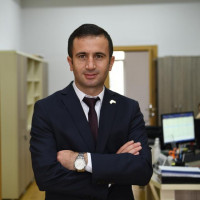
Technical Editor