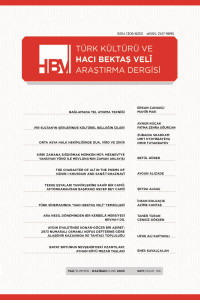
THE CONCEPT OF “THE WORLD” IN THE TARJI-BANDS OF ALI-SHIR NAVA'I AND AGAHI
Öz
This article analyses the ideological and artistic interpretations of Alisher Navoi and Ogahiy’s tarji-bands (tarjî`ât - literally, “bound to return”) reflections on the concept of the world. The discussion extends to the mystical perspectives on the world, distinguishing between two contrasting viewpoints. The first regards the world and its contents as manifestations of the Creator, serving as tools for understanding, studying, and perceiving the divine. The second presents the world as a source of distraction, leading individuals away from Allah, deceiving them, and obstructing the spiritual path. The article also draws on various sources to illustrate how Sufi teachings emphasizing detachment from the world to achieve closeness to God which have profoundly influenced literature as well. Furthermore, the article examines Alisher Navoi’s tarji-bands included in the “Navodir ush-shabob” divan, noting that each stanza and the final line of the eight-paragraph tarji-band begins with the word “world”. Similarly, Muhammad Riza Erniyozbek Ogahiy composed a five paragraph tarji-band on the same theme, with three stanzas incorporating the word dahr (arab. time, destiny) and the first lines of the remaining two featuring the word “the world”. Alisher Navoi addresses various issues of the world in each paragraph: the “world palace” in the first, the “world joy” in the second, the “world garden” in the third, the “world’s beauty” in the fourth and fifth, the “world vessel” in the sixth, and the “world’s guile” in the seventh. Ogahiy, in contrast, explores the concepts of the “worldly home”, “worldly flower beds”, “worldly deceit”, “worldly delight”, and “worldly destruction”, emphasizing how each, despite its allure, ultimately serves to mislead humanity. The article provides a comparative analysis of the two authors’ perspectives on the theme of the world, supported by examples from their works.
Anahtar Kelimeler
Destekleyen Kurum
Kaynakça
- Altıntaş, Ramazan. “İslamî Anlayışa Göre “el-hayâtü’d-dünyâ” Kavramını Yorumlama Biçimleri”. Cumhuriyet Üniversitesi İlahiyat Fakültesi Dergisi, 7 (1), (2003), 129-160.
- Alisher Navoiy asarlari tilining izohli lug’ati. Toshkent, Fan, 4 tomlik, I-IV tom, 1983.
- Alisher Navoiy., Hayrat ul-abror. Toshkent, G.Gulom nomidagi nashriyot-matbaa ijodiy uyi, 2006a
- Alisher Navoiy, Farhod va Shirin, Toshkent, G’.G’ulom nomidagi nashriyot-matbaa ijodiy uyi, 2006b
- Alisher Navoiy, Xazoyin ul-maoniy, Navodir ush-shabob, MAT, 20 tomlik, 4-tom, Toshkent, Fan, 1989
- Alisher Navoiy qomusiy lug‘at. 1-2-jildlar, Toshkent, Sharq, 2016
- Erten, Mevlüt, Kübra Göker, “Kur’an’da Dünya Dereceleri (Üstünlük)”. Kalemname, 6 Cilt, 11 Sayı (2021), 95-113.
- İmam Gazali, Mürsel Sıradağ, “Dünya Bilgisi”. İslam Medeniyeti Dergisi, 3 Cilt, 35-36 Sayı (1973) 41-47.
Ayrıntılar
Birincil Dil
İngilizce
Konular
Osmanlı Sahası Dışındaki Klasik Türk Edebiyatı
Bölüm
İnceleme Makalesi
Yazarlar
Mashxura Xasanova
*
0000-0001-9701-3067
Uzbekistan
Alişir Razzakov
0000-0002-0089-5874
Uzbekistan
Dilfuza Toshniyozova
0009-0001-0916-1519
Uzbekistan
Sobirjon Tohirov
0000-0001-8803-2434
Uzbekistan
Yayımlanma Tarihi
22 Haziran 2026
Gönderilme Tarihi
6 Şubat 2025
Kabul Tarihi
13 Mayıs 2025
Yayımlandığı Sayı
Yıl 2026 Sayı: 118