Volume: 9 Issue: 2 , 12/31/25

Year: 2025

Research Article

Review

Book Review

Other

The Journal of Asian Studies is a peer-reviewed international social sciences journal published by the Asian Studies Application and Research Center of Ankara Hacı Bayram Veli University. The journal aims to promote and disseminate studies that contribute to the scientific development of all disciplines within the social and human sciences, specifically in the field of "Asian Studies" both in Türkiye and worldwide.
The Journal of Asian Studies focuses on scholarly research and discussions within the social and human sciences related to the history, geography, sociology, economy, culture, archaeology, political relations, beliefs and values, and education of Asian countries and nations, including the Turkic peoples of Asia.

Submissions to the Journal of Asian Studies should offer in-depth analysis and discussion of developments and issues concerning disciplines related to the Asian region. Articles must present the scientific literature with an objective perspective, propose measurable and applicable solutions to developments and problems based on scientific methods, and provide direct contributions and original value to the field.
Within this scope, the journal publishes scientific articles, translations, interviews, reviews, and similar works. Studies that are not aligned with the aims, focus, and scope of the journal will not be published.

Submission Guidelines

The Journal of Asian Studies follows the Publication Manual of the American Psychological Association, 7th Edition (APA 7) for citation and referencing guidelines.
For more detailed information, please refer to the Journal of Asian Studies Submission Guidelines and the APA 7 Manual.

Principles Regarding Submission Guidelines

The Editorial Board is responsible for the editing of submitted manuscripts. The current edition of the Turkish Language Association (TDK) Writing Guide is used as the reference for spelling and punctuation. Submissions are expected to comply with the Writing Guide and scientific standards, and to be clear and understandable in terms of language and expression.

Manuscripts submitted for publication should be between 6,000 and 10,000 words.

The title should be written in uppercase letters, 12-point font size, and bold.

The author's academic title and name should be centered, in bold, 11-point font size. The author’s title, affiliation, e-mail address, and ORCID information should be provided in a footnote marked with an asterisk (*) in 9-point font size.

At the beginning of the article, there should be an abstract prepared in both Turkish and English, including the article titles in both languages. The abstract should be between 200-300 words. Directly below the abstract, five keywords in both Turkish and English should be provided. At the end of articles written in Turkish, an Extended Abstract in English, between 1,000-1,500 words, must be included. The Extended Abstract should contain the subheadings: "Introduction" (stating the main findings), "Methodology" (providing information on the methods used), and "Conclusion" (discussing the results obtained in the article).

Except for the title, the entire text should be written in Times New Roman, 11-point font, justified alignment, with single line spacing. Footnotes should be in 9-point font and single-spaced. Margins should be set to 2.5 cm on all sides (top, bottom, right, and left). If necessary, the font size within tables may be reduced.

Paragraph spacing should be set to 6 pt before and after each paragraph.

Section headings and subheadings should be numbered using a sequential decimal system. The numbering should not exceed three levels of depth, and third-level subheadings should be written in italics.

(Example: 1. INTRODUCTION, 2. MAIN SECTION, 2.1. Subsection, 2.1.1. Sub-subsection, etc.)

Principles for Referencing Sources in Footnotes

The Journal of Asian Studies applies the APA 7 (American Psychological Association) system for citations and referencing.

Examples of citation methods according to the APA 7 system are provided below:

1. Direct Quotations: Passages taken directly from another work must be presented without any changes. Quotations fewer than 40 words should be included within the text and enclosed in quotation marks. Quotations of 40 words or more should be formatted as a block quote, indented from the left, in 10-point font size, without quotation marks. No period is added after the parenthesis.

-19. Yüzyılın ikinci yarısından itibaren çok uluslu imparatorlukların zayıflamaya başlaması ve bünyelerinde bulunan etnik yapıların isyan ederek kendi devletlerini kurmak istemelerinden en çok zarar gören devletlerden biri de Osmanlı İmparatorluğu’dur. Balkan coğrafyasında başlayan isyanlar devletin gerilemesine paralel olarak toprak kayıplarıyla sonuçlanmıştır. Devletin modernleşme yönünde toparlanmaya çalışmasını olumsuz etkileyen ekonomik sıkıntılar, 1853-1856 Kırım Savaşı sırasında kendini göstermiş ve Osmanlı’nın ilk dış borçlanmasına sebep olmuştur. Kırım Savaşı’nda Osmanlı askeri gücünün yetersiz görülmesi devletin zayıfladığına dair ibareler bilhassa “Büyük Güçlerin” Osmanlı’nın iç işlerine karışmasına ve gayrimüslimlerin durumu meselesinin ortaya çıkmasına neden olmuştur. (Çeken, 2022, p. 76)

2. According to APA 7, the author-date style is used for citations. When citing a work within the text, the author's surname and the publication year are provided in parentheses.

-Van İngiliz Konsolosu Hallward’ın, isyanın başlangıcında verdiği abartılı ve tahrik edici bilgiler yüzünden Osmanlı Hükümeti Konsolosun bölgeye girmesine izin vermemiş onun yerine olayın ayrıntılı ve tarafsız olarak araştırılması için uluslararası bir komisyonun kurulmasına karar vermiştir (Uras, 1987).

3. If a work has two authors, both authors' surnames should be provided every time the source is cited.

-Humbaracı Ahmed Paşa askerî kariyerinin olumsuz gidişatını durdurmak için çeşitli devletlerin hizmetine girmiş fakat umduğunu bulamamıştır (Çeken ve Hayta, 2022).

4. If a work has three or more authors, according to APA 7, "et al." should be used after the first author's surname from the very first citation.

-Nitelikli eğitimin istihdam üzerinde etkisi büyüktür (Asar et al., 2021).

5. Group authors (such as organizations, associations, and government agencies) should be written in full without abbreviation when mentioned in the text. When citing the source for the first time, the full name should be used; for subsequent citations, an abbreviation is used.

In the first citation of the source within the text:

-(Milli Eğitim Bakanlığı [MEB], 2019)

In the next citation of the source within the text:

-(MEB, 2019)

6. When referring to specific parts of a source, page, section, or paragraph information is provided within the text.

-(Çeken, 2022, p. 151)

-(Turan, 2013, sec. 4)

-(Aguston, 1998, Conclusion section, para. 3)

7. For works without a specified author or those listed as "anonymous," the term Anonymous is used for in-text citations. When referencing such a work in the bibliography, it should be listed alphabetically under Anonymous as the author.

-(Anonymous, 1898)

Principles to Follow in Bibliography Formatting

1. When citing periodicals, for journal articles, ensure that elements such as author, year, title, journal name, volume number, issue number, and page range are complete. Unlike APA 6, in APA 7 the article title should be written in sentence case, meaning only the first letter of the first word and proper nouns are capitalized.

Çeken, M. B. ve Hayta, N. (2022). 18. Yüzyıl Osmanlı kara ordusunda teknoloji transferi: Fransız uzmanların topçu ıslahatlarında rolü. Memleket Siyaset Yönetim (MSY), 17(37), 115-142.

Turan, M. (2012). Atatürk’ün Ankara’ya gelişi: “Milli Temsil Meselesi”. Gazi Akademik Bakış, 5(10), 1-24.

2. When citing books and book chapters, make sure to include all necessary elements such as author, year, book title, and publisher. Unlike APA 6, in APA 7 the book title should be written in sentence case, where only the first letter of the first word and proper nouns are capitalized.

Author's Surname, Initial(s). (Year). Title of the book (Edition). Publisher.

Ercilasun, K. (2020). Türk tarihinin çağları (1. Edition). Ötüken.

3. When citing an edited book, make sure to include all necessary elements such as editor, year, book title, and publisher.

Editor's Surname, Initial(s). (Ed.). (Year). Title of the book (Edition). Publisher.

Aydemir, Ö., & Köroğlu, E. (Eds.). (2009). Psikiyatride kullanılan klinik ölçekler (4th ed.). HYB Basım Yayın.

4. When citing a chapter in an edited book, in addition to the standard elements, be sure to include the chapter title and page range.

Author's Surname, Initial(s). (Year). Title of the chapter. In Initial(s). Editor's Surname (Ed.), Title of the book (Edition, pp. xx–xx). Publisher.

Dönmez, B. (2013). Motivasyon. In S. Özdemir (Ed.), Eğitim yönetiminde kuram ve uygulama (pp. 185–229). Pegem Akademi.

5. When citing a book republished in translation, be sure to include the following elements: author, year, book title, translator, publisher, and original publication date.

Author's Surname, Initial(s). (Year). Title of the book (Edition). (Initial(s). Translator's Surname, Trans.). Publisher. (Original work published [Year])

Agoston, G. (2017). Osmanlı’da ateşli silahlar ve askeri devrim tartışmaları (1st ed.). (K. Şakul, Trans.). Türkiye İş Bankası. (Original work published 1985)

6. When citing official publications, reports, and press releases, make sure to include elements such as the institution or organization, year, report title, and URL.
National Institute of Mental Health (2020, Februray 10). Neural Signature Identifies People Likely to Respond to Antidepressant Medication [Press release].

https://www.nimh.nih.gov/news/science- news/2020/neural-signatureidentifies-people-likely-to- respond-to-antidepressantmedication.shtml
Kocaman, T. (1983). Nüfus sektör raporu. Devlet Planlama Teşkilatı.

7. When citing conference papers and symposium oral presentations, the following format should be used:
Author's Surname, Initial(s). (Year, Day Month). Title of the presentation [Oral Presentation]. Name of the Conference, City, Country.

Ercilasun, K. (2016, November 3–5). Çin kaynaklarına göre yedinci yüzyılın ilk yarısında Türk-Kore ilişkileri [Oral Presentation]. Türk-Kore Tarihi Forumu, Ankara, Türkiye.

8. When citing unpublished doctoral or master's theses, be sure to include elements such as author, year, thesis title, type of thesis, and university.

Author's Surname, Initial(s). (Year). Title of the thesis [Unpublished master’s thesis / Unpublished doctoral dissertation]. Name of the University.

Özen, F. (2017). Modern Türkiye'nin yeni insan arayışı: Halkevleri örneği (1932-1938) [Unpublished master’s thesis]. Gazi University.

9. When citing archival documents, the following examples should be taken into consideration.

BOA, Osmanlı Arşivi. Mühimme-i Asâkir Defterleri [A.DVNS.ASK.MHM.d]. No. 989, Gömlek No.7.

BOA, Osmanlı Arşivi. Düvel-i Ecnebiye Belgeleri [A.DVN.DVE]. No. 976.

Ethical Principles and Publication Policy

PUBLICATION PRINCIPLES

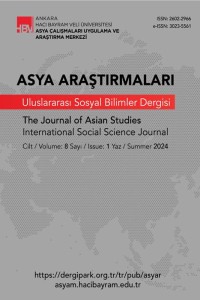
The Journal of Asian Studies, published both electronically (E-ISSN: 3023-5561) and in print (ISSN: 2667-6419) by the Asian Studies Application and Research Center of Ankara Hacı Bayram Veli University, has been continuing its mission since 2017. The journal aims to promote and disseminate studies that contribute to national and international scientific advancements across all disciplines within the social and human sciences, specifically focusing on "Asian Studies" both in Türkiye and worldwide.

Publication Frequency

The journal is published at least twice a year, in Spring and Autumn issues.

Language of Publication

The journal accepts manuscripts written in Turkish and English. Submitted works must be prepared in accordance with the grammar rules and scientific literature standards of the language in which they are written, ensuring clarity and coherence. Publications that do not meet these criteria will not be considered for review.

Manuscript Evaluation

Manuscripts submitted for publication are first reviewed by the Editorial Board (including the field editor, writing editor, and language editor) for compliance with the journal's publication principles. Following this initial review, the manuscript is sent to two expert reviewers in the relevant field for evaluation. The peer-review process is double-blind; the reviewers are not informed of the authors' identities, and vice versa. All reviewer reports are archived for a period of three years.

If one reviewer provides a positive report and the other a negative one, the manuscript is either sent to a third reviewer, or the Editorial Board may review the reports and make a final decision. Authors are expected to consider the critiques and suggestions of both the reviewers and the Editorial Board. If there are points of disagreement, authors have the right to object by providing a justified explanation.

Manuscripts returned to authors for revisions based on reviewer feedback must be resubmitted via the online system within one month after the necessary corrections are made. If deemed necessary, the revised manuscript may be re-evaluated by the reviewers who requested the changes.

Manuscripts that are not accepted for publication will be returned to the authors. Only original works that have not been published elsewhere, are not under review by another journal, have been approved by all authors regarding submission and content, and include an ethics statement will be considered for evaluation.

Ethical Statement

At the end of each article, the following information must be included: ethics committee approval, author contribution rates, funding and acknowledgments, and conflict of interest declaration. Prior to publication, the Editorial Board adds the following details in table format for each manuscript:

AUTHOR CONTRIBUTIONS: First Author %... ; Second Author %...

ETHICS COMMITTEE APPROVAL: Ethics committee approval was not required for this study.

FINANCIAL SUPPORT: No financial support was received for this study.

CONFLICT OF INTEREST: There are no potential conflicts of interest in this study.

COPYRIGHT AND SIMILARITY REPORT: The authors retain the copyright of their work published in the journal; a similarity report has been obtained for the study.

COMPLIANCE WITH SCIENTIFIC AND ETHICAL PRINCIPLES: It is declared that scientific and ethical principles were adhered to during the preparation of this study, and all referenced works are listed under the "References" section.

Plagiarism Policy

Before the evaluation process begins, the Journal of Asian Studies requires authors to upload a Plagiarism Report generated by plagiarism detection software such as iThenticate or Turnitin. The Editorial Board reviews the submitted plagiarism report, assessing both the similarity index and the manuscript's compliance with the journal’s writing guidelines and principles before initiating the review process.

The similarity rate in the plagiarism report must not exceed %20. Manuscripts with a similarity rate higher than %20 will be returned to the authors for revision. If the necessary corrections are not made, the manuscript will be rejected.

Privacy Statement

All data entered into the Journal of Asian Studies Management System (such as names, email addresses, and other personal information) will be used solely for the scientific activities of the Journal and the Asian Studies Application and Research Center of Ankara Hacı Bayram Veli University. This information will not be used for any other purpose and will never be shared with third parties.

Copyright

Authors are responsible for the accuracy of the ideas, suggestions, and references presented in their articles. No copyright fees are paid for articles published in the journal. By accepting the publication of their articles, authors agree to waive their copyright and transfer it to the Asian Studies Application and Research Center of Ankara Hacı Bayram Veli University. When uploading the article file, the "Copyright Transfer Form" must also be completed with a blue signature and uploaded as a PDF file. The Editorial Board is authorized regarding the publication of the article.
However, authors retain the following rights:
1. All registered rights other than copyright,
2. The right to reproduce the article for personal use, provided it is not sold,
3. The right to use all or part of the article in books, articles, or other works authored by the writer, provided that the journal is properly cited as a source.

Open Access

All works published in the Journal of Asian Studies are licensed under the CC BY-NC 4.0 license.

ETHICAL PRINCIPLES

The Journal of Asian Studies operates in accordance with international publishing ethics standards. In its publication processes, The Journal of Asian Studies adheres to the Code of Conduct and Best Practice Guidelines for Journal Editors and the Principles of Transparency and Best Practice in Scholarly Publishing, both published by the Committee on Publication Ethics (COPE).
Additionally, the journal follows the publishing ethics standards set by the Directory of Open Access Journals (DOAJ) and the Open Access Scholarly Publishers Association (OASPA).

RESEARCH ETHICS

The following points must be considered regarding ethics committee approval:
For research conducted in the field of social sciences and for studies requiring ethics committee approval, separate approvals must be obtained. This approval must be explicitly stated and documented within the article. All manuscripts should include a statement confirming compliance with Research and Publication Ethics.

For studies requiring ethics committee approval, details regarding the approval (name of the committee, date, and approval number) must be included in the methodology section and also on the first or last page of the article. In case reports, information confirming that an informed consent form was signed by participants must be provided within the article.

Research requiring ethics committee approval includes: All qualitative or quantitative studies involving data collection from participants through methods such as surveys, interviews, focus group studies, observations, or interview techniques. Additionally: Permission must be obtained and indicated for the use of scales, questionnaires, photographs, or any materials belonging to others. Compliance with copyright regulations for any intellectual or artistic works used must be clearly stated. If parts of the research data have been previously used or if the article is derived from a master's thesis or doctoral dissertation, this must be explicitly noted in a footnote. The decision to publish such articles rests with the Editorial Board. Researchers who are not affiliated with a university may apply to local ethics committees in their region to obtain an ethics approval report when necessary.

PUBLICATION ETHICS

Authors must adhere to the following ethical principles: Individuals who have not contributed to the scientific research or writing process should not be listed as authors. The same manuscript should not be submitted to more than one journal simultaneously. For studies derived from postgraduate theses, it is recommended (as per TÜBİTAK ULAKBİM TR Index) that supervisors should not be listed as the first author. Authors are advised to include, at the end of the article, statements regarding Author Contribution Rates, Acknowledgments and Funding (if any), and Conflict of Interest Declarations (as recommended by TÜBİTAK ULAKBİM TR Index). Authors must avoid unethical practices such as irresponsible authorship, plagiarism, fabrication, duplicate publication, salami slicing (publishing in parts), biased referencing, biased publishing, and violations of human or animal ethics. The Copyright Transfer Form must be completed, signed, and uploaded to the system as a PDF file (available on the homepage). During the writing process, authors must comply with the citation style specified by the journal. Unpublished or unpresented works should not be cited as references. No part of any work may be published, either in whole or in part, without permission or proper citation (to avoid plagiarism). Authors must disclose any financial support received for the study, if applicable.

EDITORIAL ETHICS

Editors must adhere to the following ethical responsibilities: Ensure that the full-text manuscripts sent to reviewers do not contain the authors' names, and never disclose author identities to reviewers. Assign at least two reviewers who are experts in the subject area of the submitted manuscript. Facilitate communication between reviewers and the corresponding author while maintaining the principles of double-blind peer review. Maintain transparent and objective relationships with all authors and reviewers, without any discrimination or bias. Refrain from using their position for personal or academic gain. Provide clear and detailed justifications for any decision to reject a manuscript. Uphold ethical standards related to scientific research, publishing, and peer review throughout the editorial process. For articles to be published in Turkish and English, assign a dedicated editor responsible for performing necessary language checks and corrections in these languages.


PEER REVIEW ETHICS

Reviewers must be experts in the fields addressed by the submitted manuscript. They should provide their critiques in an objective and clear manner. Reviewers must not request to know the identities of the author(s) of the work they are evaluating, and considering that manuscript texts are confidential, they should not be shared with third parties. Reviewers must not use information from the manuscript under review for their own research or seek any academic/personal gain. If they decide to reject a manuscript, they must provide clear and detailed reasons for their decision. Reviewers should also adhere to the principles of scientific research and publication ethics. They must include their title and name in the review report, complete the form in full, and sign it. (The Reviewer Evaluation Form is available on the homepage).


ARTICLE REVIEW PROCESS

The Journal of Asian Studies is an international peer-reviewed journal. Articles that have not been previously published, are not under review by another journal, and have been approved by all authors are accepted for evaluation. Submitted manuscripts are reviewed by the Editor, Editorial Board, or Publication Board for originality, methodology, significance of the subject matter, and alignment with the scope of the journal. All submitted articles undergo a fair double-blind peer review process. The aim of the peer review process is to ensure the publication of high-quality and original scientific work. All manuscripts submitted for publication in the Journal of Asian Studies follow the review process outlined below:

Preliminary Review
All submissions are first subjected to a preliminary review by the Editor or Editorial Board. This review assesses the manuscript's scientific content, adherence to publication principles, relevance to the journal's scope and formatting guidelines, similarity index based on plagiarism screening, copyright, and ethical declarations. If the manuscript does not meet the required criteria, it will either be rejected before entering the peer review stage or returned to the author(s) for revisions.

PEER REVIEW POLICY

The Journal of Asian Studies employs a double-blind review system at every stage of the process, ensuring that both reviewers' and authors' identities remain confidential. In each issue, the names of the reviewers who contributed during the publication process are listed in the relevant section.

PEER REVIEW PROCESS

Manuscripts that pass the preliminary review are sent by the editor to two reviewers selected from the reviewer pool, considering their areas of expertise. If necessary, the number of reviewers may be increased by the editors or the editorial board. Reviewers evaluate the submitted manuscripts based on criteria such as originality, contribution to the field, clarity of the research problem, critical review of relevant literature, methodology, presentation of findings, discussion of results in relation to existing literature, and the relevance of recommendations. Reviewers may choose to accept, reject, or request revisions (either technical/formatting or substantive/content-related) from the authors. If one reviewer submits a positive report and the other a negative one, the manuscript is sent to a third reviewer. Based on the reviewers’ feedback, a decision is made to either publish the manuscript directly, request revisions before publication, or reject it. Authors are given 1 month to complete the revisions specified in the reviewers’ reports. If the revisions are not submitted within this period, the manuscript may be rejected.

FINAL REVIEW

All manuscripts that receive positive feedback from reviewers and reach the publication stage undergo a final review by the editorial board. The editorial board reserves the right to decide not to publish a manuscript or to change its publication order, even if positive reports have been received from reviewers. Manuscripts that have been proofread, revised, and approved as "publishable" by the editorial board are placed in the publication queue and published following layout and formatting work. Authors who submit manuscripts to the Journal of Asian Studies are deemed to have accepted these peer review conditions and procedures of the journal.

FEE POLICY

No fees are charged to authors or their institutions under any circumstances.
The journal does not request any article submission or processing fees from authors.

Free

Baş Editör

Nasrullah Uzman
Prof. Dr. Nasrullah UZMAN ANKARA HACI BAYRAM VELİ ÜNİVERSİTESİ, EDEBİYAT FAKÜLTESİ, TARİH BÖLÜMÜ
Turkish Political Life, Migration Sociology, Turkish Foreign Policy, International Migration, History of The Republic of Turkiye, Political History, Ataturk's Principles History of Revolution, Late Modern Renewal History

Alan Editörleri

Mehmet Batuhan Çeken
Asst. Prof. Dr. Mehmet Batuhan ÇEKEN Ankara Hacı Bayram Veli Üniversitesi
Political History, Late Modern History
Default avatar
Prof. Dr. Fırat PURTAŞ ANKARA HACI BAYRAM VELİ ÜNİVERSİTESİ
Regional Studies
Default avatar
Assoc. Prof. Dr. Fatih Hakan DİKMEN Ankara Hacı Bayram Veli Üniversitesi
Microeconomics, Labor Economics, Health Economy, Agricultural Economics
Default avatar
Assoc. Prof. Dr. Tayfun HAYKIR ANKARA HACI BAYRAM VELİ ÜNİVERSİTESİ
Modern Turkish Literature in Turkiye Field
Halit Çal
Prof. Dr. Halit ÇAL Hacı Bayram Veli Üniversitesi
History of Architecture, Architectural, Turkish Islamic Arts (Other)
Kadir Ertaç Çelik
Asst. Prof. Dr. Kadir Ertaç ÇELİK ANKARA HACI BAYRAM VELI UNIVERSITY
International Relations Theories

Sorumlu Yazı İşleri Müdürü

Mehmet Batuhan Çeken
Asst. Prof. Dr. Mehmet Batuhan ÇEKEN Ankara Hacı Bayram Veli Üniversitesi
Political History, Late Modern History

İndeks Editörü

Fatih Özen
Res. Assist. Dr. Fatih ÖZEN Ankara Hacı Bayram Veli Üniversitesi
History of The Republic of Turkiye, Türkish Political Hİstory

İngilizce Editörü

Default avatar
Res. Assist. Sabina ÖZEN Hacettepe Üniversitesi
Modern Turkic Languages and Literatures (Other)

Yazım ve Dil Editörü

İbrahim Yılmaz
Asst. Prof. Dr. İbrahim YILMAZ ANKARA HACI BAYRAM VELI UNIVERSITY, *
Language Studies, Linguistics, Turkish Language and Literature, New Turkish Language (Turkish of Old Anatolia, Ottoman, Turkiye)

Mizanpaj Editörü

Fatih Mehmet Nefes
Doctoral Fatih Mehmet NEFES ANKARA HACI BAYRAM VELİ ÜNİVERSİTESİ, EDEBİYAT FAKÜLTESİ
Late Modern Discoveries and Colonialism History

Bilim ve Danışma Kurulu

Default avatar
Prof. Dr. Seyfullah YILDIRIM GAZİ ÜNİVERSİTESİ, GAZİ EĞİTİM FAKÜLTESİ
Turkish Folk Literature, Turkish Folklore, Turkish Folklore Outside Türkiye, Turkish Folklore in the Türkiye Field
Default avatar
Prof. Dr. Necdet HAYTA GAZİ ÜNİVERSİTESİ, GAZİ EĞİTİM FAKÜLTESİ
Late Modern History, Late Modern Military History, Late Modern Balkan History, Late Modern Press History, Late Modern Ottoman History, Late Modern Renewal History
Default avatar
Prof. Dr. Erdinç YAZICI ANKARA HACI BAYRAM VELİ ÜNİVERSİTESİ
Labor Economics and Industrial Relations, Labor Sociology
Fatma Açık
Prof. Dr. Fatma AÇIK GAZİ ÜNİVERSİTESİ
South-East (Latest Uyghur/Uzbek) Turkic Dialects and Literatures, Education
Default avatar
Prof. Dr. İlhami DURMUŞ ANKARA HACI BAYRAM VELİ ÜNİVERSİTESİ, EDEBİYAT FAKÜLTESİ
Old Anatolian History, History of Old Asia Minor, History of Central Asia, Turkish Savannah Culture
Atakan Akçay
Prof. Dr. Atakan AKÇAY Ankara Hacı Bayram Veli Üniversitesi
Archaeology, Ceramics in Archeology, Early Bronze Age Archeology, Hittite Archeology
Hale Şıvgın
Prof. Dr. Hale ŞIVGIN ANKARA HACI BAYRAM VELİ ÜNİVERSİTESİ

1977 yılında Ankara Üniversitesi Dil ve Tarih-Coğrafya Fakültesi Yakınçağ Tarihi bölümünden mezun oldu. 1981 yılında aynı fakültede Yakınçağ Tarihi Anabilim Dalı’nda yüksek lisans eğitimini tamamladı. 1987 yılında Ankara Üniversitesi Türk İnkılâp Tarihi Enstitüsü’nden doktora derecesini aldı. 1988’de Gazi Üniversitesi Fen-Edebiyat Fakültesi’nde Yardımcı Doçentlik görevine başladı. 1998’de Doçent, 2003’te Profesör oldu. Ayrıca 1988-1997 tarihleri arasında Tarih Bölümü Yeniçağ Anabilim Dalı Başkanlığı, 1997-2000 tarihlerinde ise Yakınçağ Tarihi Anabilim Dalı Başkanlıklarını yaptı. 1987-1988 yıllarında Milli Eğitim Bakanlığı Talim Terbiye Kurulu’nda Uzmanlık, 1988-89 yıllarında Milli Eğitim Bakanlığı’nda Müşavirlik, 1989-1994 yıllarında ise TBMM’de Başkan Danışmanı olarak görev yaptı. 2001 yılında Milli Güvenlik Akademisi’ne devam etti ve mezun oldu. 2001-2018 tarihleri arasında Gazi Üniversitesi Atatürk İlkeleri ve İnkılâp Tarihi Araştırma ve Uygulama Merkezi Müdürlüğü’nü yürütmüştür. 2004-2010 yıllarında Atatürk Dil ve Tarih Yüksek Kurumu Atatürk Araştırma Merkezi Yönetim Kurulu üyeliğini yürütmüştür. 2015’ten beri Genelkurmay Askeri Tarih ve Stratejik Etüt Başkanlığı Atatürk Araştırma Eğitim Merkezi yönetim kurulu üyesidir. Ayrıca Yakınçağ Osmanlı Tarihi, Türkiye Cumhuriyeti Tarihi ve Siyasi Tarih alanında Gazi Üniversitesi ve Kara Harp Okulunda(Milli Savunma Üniversitesi)dersler vermeye devam etmektedir, pek çok Yüksek Lisans ve Doktora tezi yönetmiştir. 2018 yılında yeniden Gazi Üniversitesi Edebiyat Fakültesi Tarih Bölümüne Yakınçağ Tarihi Anabilim dalı Başkanı olarak atanmıştır. Thomson Reuters tarafından taranan Gazi Akademik Bakış adlı dergiyi çıkarmaktadır. Birçok kitabı ve çok sayıda makalesi bulunmaktadır. Gazi Üniversitesinin 2018’de bölünmesi neticesinde kurulan “Ankara Hacı Bayram Veli Üniversitesinden 2022 yılında emekli olmuştur. Bazı özel üniversitelerde ders vermektedir.

Archaeological Science, History of The Republic of Turkiye, Political History, Late Modern History
Default avatar
Prof. Dr. M. Ertan GÖKMEN ANKARA ÜNİVERSİTESİ, DİL VE TARİH COĞRAFYA FAKÜLTESİ, DOĞU DİLLERİ VE EDEBİYATLARI BÖLÜMÜ, KORE DİLİ VE EDEBİYATI ANABİLİM DALI
World Languages, Literature and Culture, Korean Language, Literature and Culture
Serkan Kekevi
Assoc. Prof. Dr. Serkan KEKEVİ Düzce Üniversitesi Akçakoca Bey Siyasal Bilgiler Fakültesi Uluslararası İlişkiler Bölümü

Uluslararası İlişkiler alanında çalışmaktadır.

Turkish Foreign Policy, International Relations Theories, Politics in International Relations, Terrorism in International Relations
Default avatar
Prof. Dr. Çetin PEKACAR ANKARA HACI BAYRAM VELİ ÜNİVERSİTESİ
Historical North East Turkish Language (Khwarezm, Kipchak, Chagatai), Turkish Folk Literature
Mustafa Tanrıverdi
Assoc. Prof. Dr. Mustafa TANRIVERDİ İSTANBUL ÜNİVERSİTESİ

Mustafa Tanrıverdi lisans eğitimini 2007’de Kırıkkale Üniversitesi Fen-Edebiyat Fakültesi Tarih Bölümünde; yüksek lisansını 2009’da “Karapapakların Anadolu’ya Göçü (1877-1914)” adlı tez ile Gazi Üniversitesi’nde tamamladı. 2008’de Kafkas Üniversitesi Fen-Edebiyat Fakültesi Tarih Bölümünde araştırma görevlisi oldu. 2010’da İstanbul Üniversitesi Sosyal Bilimler Ensitüsü Yakınçağ Tarihi Bilim Dalı doktora programına kabul edildi. 2012-2013 yıllarında Rusya’da St-Petersburg Devlet Üniversitesi Rus Dili ve Kültürü Enstitüsü’nde Rusça dil bilgisini ilerletti. St-Petersburg’da, Tübitak burslusu olarak doktora tezi ile ilgili arşiv ve kütüphane çalışmalarını yürüttü. Yine tez çalışması kapsamında Gürcistan’da araştırmalarda bulundu. “Çarlık Rusyası Döneminde Tiflis Vilayeti” adlı tezini 2016 yılı Mayıs ayında başarıyla savundu. 2016’da Kafkas Üniversitesi’nde yardımcı doçent olarak göreve başladı. 2017'de İstanbul Üniversitesi Edebiyat Fakültesi Tarih Bölümü’nde doktor öğretim üyesi olarak atandı. 2022 yılında Yakınçağ Tarihi alanında doçent unvanını almaya hak kazandı. 2022-2023 Eğitim-Öğretim Döneminde Lomonosov Moskova Devlet Üniversitesi Tarih Fakültesi'nde "Osmanlı Devleti'nin Modernleşme Süreci" adlı seminer dersini verdi. 2022-2023 yıllarında Moskova ve Petersburg'daki arşivlerde Rusya'nın Kafkasya siyaseti üzerine araştırmalarda bulundu. 
Tanrıverdi'nin Rusya, Kafkasya ve Türk-Rus İlişkileri üzerine kitap, makale ve bildiriler olmak üzere bir çok yayını bulunmaktadır. 

Political History, Late Modern History, Late Modern Military History, Late Modern Ottoman History, Late Modern Russian History, Early Modern Russian History

1985 Rize doğumludur. İlk ve orta öğretimini Yolbaşı İlköğretim Okulu’nda tamamladı. 2004 yılında Rize Anadolu Lisesi’nden, 2011 yılında Gazi Üniversitesi Edebiyat Fakültesi Tarih Bölümü’nden mezun oldu. 2015 yılında Gazi Üniversitesi Sosyal Bilimler Enstitüsü’nde yüksek lisansını tamamladı. 2016 yılında Ankara Üniversitesi Dil ve Tarih-Coğrafya Fakültesi Genel Türk Tarihi kürsüsünde başladığı doktorasını, 2020 yılında Hazar Ötesi Türkmenleri konulu doktora tezi ile bitirdi. İngilizce ve Rusça bilen yazarın Hazar Ötesi Türkmenleri, Horasan, Afganistan ve Türkistan konusunda makaleleri ve çok sayıda gezi kitabı tercümesi vardır.

History of Central Asia
Default avatar
Prof. Dr. S. Göksel TÜRKÖZÜ erciyes üniversitesi

1972 yılında Ankara’da doğdu. 1994 Haziranında Ankara Üniversitesi Dil-Tarih Coğrafya Fakültesi Kore Dili ve Edebiyatı Anabilim Dalından mezun olduktan sonra Kasım ayında mezun olduğu bölümde araştırma görevlisi olarak göreve başladı. 1995 yılında Kore Hükümetinin yüksek lisans bursunu alarak Kore’ye gitti. 1996-1999 yılları arasından Ulusal Seul Üniversitesi Eğitim Fakültesi Kore Dili Eğitimi bölümünde yüksek lisans programını tamamladı. Kesintisiz olarak 1999 yılında aynı bölümde doktora programına başladı.
2004 Şubatında doktora programından mezun olup doktora derecesi alarak Türkiye’ye döndü. 2004–2006 yılları arasında Ankara Üniversitesi Dil-Tarih Coğrafya Fakültesi Kore Dili ve Edebiyatı Anabilim Dalında araştırma görevlisi olarak görev yaptıktan sonra 16 Mayıs 2006’da Erciyes Üniversitesine yardımcı doçent olarak geçiş yaptı. 2010 yılında doçent, 2015 yılında profesörlük unvanı aldı.
9 Ekim 1997 tarihinde Kore, Yonsei Üniversitesi tarafından düzenlenen ‘6. Yabancılar Arası Korece Şiir ve Kompozisyon Yarışması’, şiir dalında büyük ödül kazandı. 9 Ekim 2012 tarihinde Kore Hükümeti tarafından Kore Dilinin gelişimi ve tanıtımına katkıda bulunanlara verilen Kore Devletbaşkanı Nişanını aldı. 'Gümüş Somon'un Büyük Yolculuğu' adlı çevirisiyle 2017 yılında Kore Edebiyat Çeviri Enstitüsünün verdiği 'En İyi Çeviri' ödülüne layık görüldü.
Halen Kore Erciyes Üniversitesi Edebiyat Fakültesi Kore Dili ve Edebiyatı Anabilim Dalı başkanlığını yürütmektedir. Aynı zamanda ERÜ Avrasya Kore Araştırmaları Merkezi müdürlüğü yapmaktadır.
Kore dili eğitmenliği, araştırmacılığın yanı sıra edebiyat çevirileri de yapmaktadır. 

Korean Language, Literature and Culture
Hayati Beşirli
Prof. Dr. Hayati BEŞİRLİ Ankara Hacı Bayram Veli Üniversitesi
Sociology, Sociology of Culture, Social Change, Studies of the Turkic World
Mesut Karakulak
Assoc. Prof. Dr. Mesut KARAKULAK Ankara Hacı Bayram Veli University, Faculty of Literature, Department of History, Ankara, Turkey
Ankara HBVÜ, Genel Türk Tarihi Anabilim Dalı Öğretim Üyesi
General Turkish History, History of Central Asia
Default avatar
Prof. Dr. Aysun DEMİREZ Ankara Hacı bayram Veli Üniversitesi
Modern Turkic Languages and Literatures, South-West (Oghuz) Turkic Dialects and Literatures, South-East (Latest Uyghur/Uzbek) Turkic Dialects and Literatures, Translation Studies, Linguistic Performance Science, Linguistic Structures (Incl. Phonology, Morphology and Syntax), Comparative and Transnational Literature, Turkish Language and Literature, Old Turkic Language (Orhon, Uyghur, Karahan), Historical North East Turkish Language (Khwarezm, Kipchak, Chagatai), New Turkish Language (Turkish of Old Anatolia, Ottoman, Turkiye)
İsa Kalaycı
Assoc. Prof. Dr. İsa KALAYCI HATAY MUSTAFA KEMAL ÜNİVERSİTESİ
1981 yılında Kahramanmaraş'ın Göksun ilçesinde doğdu. Orta ve lise öğrenimini Kahramanmaraş'ta tamamladı.

Lisans : Kafkas Üniversitesi Fen-Edebiyat Fakültesi Tarih Bölümü (2001-2005)

Yüksek Lisans: Kafkas Üniversitesi Sosyal Bilimler Enstitüsü Tarih ABD, TC. Tarihi Bilim Dalı (2005-2007)= “Atatürk Dönemi’nde Türk-Sovyet İlişkileri (1919-1938)”.

Doktora : Fırat Üniversitesi Sosyal Bilimler Enstitüsü Tarih ABD, TC. Tarihi Bilim Dalı (2007-2014)= “Ortadoğu’dan Türkiye’ye Yapılan Göçler 1923-2000 (Irak ve Suriye Göçleri)”.

Ocak 2009'da Hatay Mustafa Kemal Üniversitesi Fen-Edebiyat Fakültesi Tarih Bölümü'nde Araştırma Görevlisi olarak başladığı öğretim elemanı görevine Mayıs 2014'te Yardımcı Doçent olarak devam etti. Kasım 2020 yılında aynı birimde doçent oldu. Halen Hatay Mustafa Kemal Üniversitesi'nde T.C. Tarihi alanındaki çalışmalarını sürdürmektedir.
Contemporary History of Middle East, History of The Republic of Turkiye, Ataturk's Principles History of Revolution
Togay Seçkin Birbudak
Prof. Dr. Togay Seçkin BİRBUDAK GAZİ ÜNİVERSİTESİ, GAZİ EĞİTİM FAKÜLTESİ
History Education, Late Modern History, Late Modern Balkan History, Late Modern Ottoman History
Default avatar
Prof. Dr. Ahmet TAŞAĞIL YEDITEPE UNIVERSITY, FACULTY OF ARTS AND SCIENCES, DEPARTMENT OF HISTORY
Pre-Islamic Turkish History, General Turkish History (Other)
Default avatar
Prof. Dr. Ali Merthan DÜNDAR ANKARA ÜNİVERSİTESİ
South-East Asian Language, Literature and Culture, Japanese Language, Literature and Culture, Contemporary Asian History
İsmet Türkmen
Prof. Dr. İsmet TÜRKMEN TOKAT GAZİOSMANPAŞA ÜNİVERSİTESİ
1980 yılında Ankara’da dünyaya gelen İsmet Türkmen, ilk ve orta öğrenimini bu şehirde tamamladı. 2002 yılında Gazi Üniversitesi Fen-Edebiyat Fakültesi Tarih Bölümünden mezun oldu. Aynı yıl Gazi Üniversitesi Sosyal Bilimler Enstitüsü, Türkiye Cumhuriyeti Tarihi Bilim Dalında Yüksek Lisansa başladı. 2005 yılında Prof. Dr. Mustafa TURAN danışmanlığında hazırladığı “İsmail Fâzıl Paşa’nın (Cebesoy) Hayatı, Askeri ve Siyasi Faaliyetleri” başlıklı tezi ile Yüksek Lisansını tamamladı. 2005 yılında aynı enstitü programında doktoraya başladı. 2010 yılında Prof. Dr. E. Semih YALÇIN danışmanlığında hazırladığı “Cumhuriyet Hükümetleri Döneminde Güneydoğu Anadolu’ya Yapılan Kamu Yatırımları (1960-1995)” adlı teziyle mezun oldu. 2006 yılında Gazi Üniversitesi Kastamonu Fen-Edebiyat Fakültesi Tarih Bölümünde Araştırma Görevlisi olarak çalışan İsmet Türkmen, 2006-2010 yılları arasında Tokat Gaziosmanpaşa Üniversitesi Atatürk İlkeleri ve İnkılâp Tarihi Bölümünde Okutman olarak görev yaptı. 2010 yılında Gaziosmanpaşa Üniversitesi Fen-Edebiyat Fakültesi Tarih Bölümü Türkiye Cumhuriyeti Tarihi Bilim Dalına Yard. Doç. Dr. olarak atandı. 2015 yılında Doçent, 2020 yılında ise Profesör unvanlarını alan İsmet Türkmen; Cumhuriyet Dönemi Türk Eğitim Tarihi, Yakın Dönem Harp Tarihi ve Türk Demokrasi Tarihi alanlarında çalışma yapmaktadır.
Turkish Political Life, History of The Republic of Turkiye, Ataturk's Principles History of Revolution
Default avatar
Prof. Dr. Zeynep BAĞLAN ÖZER Ankara Hacı Bayram Veli Üniversitesi
Russian Language, Literature and Culture

Prof. Dr. Abdullah Gündoğdu
Abdullah Gündoğdu graduated from Ankara University, Faculty of Language, History and Geography, Department of General Turkish History in 1986. He completed his master's degree in 1989 at the Department of History (General Turkic History) at the A.Ü. Institute of Social Sciences. In 1995, he received his doctorate with his thesis titled "History of the Khiva Khanate (Yadigâr Şibanileri Era: 1512-1740)". He started working as a research assistant at the Department of General Turkish History at the A.Ü. Faculty of Language, History and Geography between 1987-1998. He was promoted to Assistant Professor in the same department in 1998 and Associate Professor as of January 25, 2001. He was appointed Professor on February 12, 2008. He continues his duty at the same faculty. He speaks English, Russian and Persian as well as Modern Turkish languages. He worked in Uzbekistan, RF Tatarstan Autonomous Republic, Kazakhstan, Kyrgyzstan. He participated in many scientific meetings in Turkey and abroad.


Pre-Islamic Turkish History, Modern Turkish History, Turkish Society and Community
Default avatar
Prof. Dr. Konuralp ERCİLASUN ANKARA HACI BAYRAM VELİ ÜNİVERSİTESİ
General Turkish History
Default avatar
Prof. Dr. Yılmaz YEŞİL GAZİ ÜNİVERSİTESİ
Turkish Education
Varis Çakan
Prof. Dr. Varis ÇAKAN ANKARA HACI BAYRAM VELİ ÜNİVERSİTESİ

Prof. Dr. Vâris ÇAKAN’ın Kısaca Özgeçmişi
1968’de Çin Halk Cumhuriyeti’ne bağlı Uygur Özerk Bölgesi’nin (Doğu Türkistan) Atuş ilinde doğdu. İlk, orta ve lise eğitimini memleketi Atuş’ta tamamladı.1990’da bölgedeki Xinjiang Üniversitesi Tarih Fakültesini bitirdi. Temmuz 1990'dan Şubat 1995'e kadar Çin Halk Cumhuriyeti'ne bağlı Uygur Özerk Bölgesi Millet ve Din İşleri Başkanlığı'nda devlet memuru olarak görev yaptı. Türkiye’de Türk Tarihi alanında yüksek tahsil yapmak için kendi isteğiyle ve imkânlarıyla Uygur Özerk Bölgesi'ndeki görevimden ayrılıp 03 Şubat 1995'te Türkiye'ye geldi. Şubat-Ağustos 1995'te Ankara Üniversitesi TÖMER'de Türkiye Türkçesi eğitimi gördü. Eylül 1995'ten Ocak 2002'ye kadar Ankara Üniversitesi Sosyal Bilimler Enstitüsü Tarih (Genel Türk Tarihi) Anabilim Dalı'nda Yüksek Lisans ve Doktora yaptı. Mayıs 2000'de Gazi Üniversitesi Fen-Edebiyat Fakültesi (Şimdi Edebiyat Fakültesi) Tarih Bölümünde Öğretim Görevlisi olarak çalışmaya başladı. Ocak 2003’te 403 Sayılı Türk Vatandaşlığı Kanunun 6. Maddesi ile Türk Vatandaşlığına alındı.17 Kasım 2008'de Genel Türk Tarihi Bilim alanından Doçent oldu. Japonya’dan gelen resmi davet üzerine Ocak 2011'den Nisan 2012'ye kadar Japonya Osaka Üniversitesi Yabancı Diller Araştırma Enstitüsü'nde misafir öğretim üyesi ve araştırmacı olarak görev yaptı.05 Ekim 2016'da Gazi Üniversitesi Ortadoğu ve Orta Asya Araştırmaları Merkezi'ne (GORAM) vekaleten Müdür olarak atanan Prof. Dr. Vâris ÇAKAN, adı geçen merkezin farklı iki ihtisas alanı olduğunu düşünerek GORAM yerine Gazi Üniversitesi bünyesinde Asya Çalışmaları Uygulama ve Araştırma Merkezi'nin (ASYAM) kurulması için çalışmalarını başlatır. Merkezin kuruluş hazırladıkları tamamlandıktan sonra dönemin Gazi Üniversitesi Senatosunda kabul edilerek Merkez  yönetmeliğinin 30 Temmuz 2017 tarihinde 30139 sayılı Resmi Gazetede yayınlanması ile Merkez kurulur ve Merkezin kurucu Müdürü olarak görevine devam eder.  Asya Çalışmaları Uygulama ve Araştırma Merkezi'nin kurulması ile Prof. Dr. Vâris ÇAKAN büyük bir özveri ile çalışarak 2017 GÜZ döneminden itibaren  Merkez adına Asya Araştırmaları Uluslararası Sosyal Bilimler Dergisi''ni (ISSN:2667-6419, E-ISSN: 3023-5561) çıkartmaya başlar. 2017 GÜZ sayısı ile yayın hayatına başlayan söz konusu dergi Türkiye'de Asya ile ilgili olarak bilimsel makaleler yayınlayan ilk dergilerden biri olmuştur. Kısa adı ASYAR olan söz konusu dergi Prof. Dr. Vâris ÇAKAN ve ona gönüllü olarak destek veren akademisyen ve araştırmacıların desteği ile kısa zaman içinde yoğun ilgi görür ve uluslararası dizinlerde taranmaya başlar. Prof. Dr. Vâris ÇAKAN'ın   14 Mayıs 2024 tarihinde  Ankara Hacı Bayram Veli Üniversitesi Asya Çalışmaları Uygulama ve Araştırma Merkezi Müdürlüğü görevi sona erinceye kadar söz konusu dergi  İkisi özel  sayı olmak üzere  toplam 15 sayı yayınlanmıştır. Dergi Creative Commons Atıf-GayriTicari 4.0 (CC BY NC) Uluslararası Lisansı ile lisanslanmıştır ve Uluslar arası alan indexlerinde (dizinlerde) taranın dergi statüsündedir. Prof.Dr.Vâris ÇAKAN  25 Kasım 2016’da Gazi Üniversitesi Edebiyat Fakültesi Tarih Bölümü Genel Türk Tarihi Anabilim Dalına Profesör olarak atandı. 05 Ekim 2016 tarihinden itibaren Gazi Üniversitesi Asya Çalışmaları Uygulama ve Araştırma Merkezi Müdürlüğüne, Mart 2017’de Gazi Üniversitesi Edebiyat Fakültesi Tarih Bölümü Genel Türk Tarihi Anabilim Dalı Başkanlığına atandı. Gazi Üniversitesi   18 Mayıs 2018 tarihinde Gazi Üniversitesinin kanunla bölünmesi ile kurulan Ankara Hacı Bayram Veli Üniversitesine geçen Prof. Dr. Vâris ÇAKAN 07.03.2023 tarihine kadar Edebiyat Fakültesi Tarih Bölümü Genel Türk Tarihi Anabilim Dalı Başkanlığı'nı, 14.05.2024 tarihine kadar  Asya Çalışmaları Uygulama ve Araştırma Merkezi Müdürlüğünü yapmıştır. Halen Ankara Hacı Bayram Veli Veli Üniversitesi Edebiyat Fakültesi Tarih Bölümü Genel Türk Tarihi Anabilim Dalı Öğretim Üyesi olarak görev yapmakta olan Prof. Dr. Vâris ÇAKAN  evli ve iki çocuk babasıdır. Prof.Dr.Vâris Çakan Çince ve İngilizce biliyor. Ayrıca Uygur-Özbek ve Tatar Türk lehçelerini çok iyi düzeyde biliyor.

Prof. Dr. Vâris ÇAKAN’ın başta Orta Asya Türk Tarihinin Kaynakları, Orta Asya Türk Tarihine Giriş Cilt-1 İslam’a Kadar adlı kitapları olmak üzere yurtiçinde ve yurtdışında yayınlanan çok sayıda kitapta bölüm yazarlığı ve Orta Asya (Türkistan) tarihi, kültürü ve stratejisi ile ilgili makaleleri bulunmaktadır.


Studies of the Turkic World, Contemporary Asian History, General Turkish History, Pre-Islamic Turkish History, History of Central Asia, Turkish Society and Community, History of Muslim Turkish Countries and Societies
Default avatar
Prof. Dr. Mehmet Ali ÇAKMAK GAZİ ÜNİVERSİTESİ
History of Central Asia
Default avatar
Prof. Dr. Zaynabidin ABDİRASHİDOV Ankara Hacı Bayram Veli University, Department of Contemporary Turkish Dialects and Literatures, Ankara, Türkiye
Modern Turkic Languages and Literatures, Modern Turkic Languages and Literatures (Other), History of Central Asia, History of Empires, Imperialism and Colonialism, Early Modern Asian History
Default avatar
Assoc. Prof. Dr. Veli Savaş YELOK Ankara Hacı Bayram Veli Üniversitesi
Modern Turkic Languages and Literatures, South-East (Latest Uyghur/Uzbek) Turkic Dialects and Literatures, Linguistics, Old Turkic Language (Orhon, Uyghur, Karahan), New Turkish Language (Turkish of Old Anatolia, Ottoman, Turkiye)
Süleyman Özbek
Prof. Dr. Süleyman ÖZBEK Ankara Hacı Bayram Veli Üniversitesi

1984 yılında Ankara Üniversitesi Dil ve Tarih Coğrafya Fakültesi Ortaçağ Tarihi Kürsüsü’nden mezun oldu. Aynı Yıl mezun olduğu Fakülte’de Asistan olarak göreve başladı. 1988 yılında Yüksek Lisansını, 1995 yılında ise Doktora eğitimini tamamladı.

1989-1990 yılları arasında Mısır Arap Cumhuriyeti’nde burslu olarak ňaraştırma ve incelemelerde bulundu.

1995-1998 yılları arasında Sivas Cumhuriyet Üniversitesi’nde, 1998- 2003 yılları arasında ise Afyon Kocatepe Üniversitesi’nde, Yardımcı Doçent olarak Ortaçağ devri Türk - İslam tarihine ait Lisans ve Yüsek Lisans derslerini yürüterek akademik faaliyetlerini devam ettirdi.

2003 yılından itibaren Gazi Üniversitesi Fen-Edebiyat Fakültesi’nde öğretim üyesi olarak akademik faaliyetlerini devam ettiren Süleyman Özbek; 2008-2010 yıllarında Bosna Hersek Cumhuriyeti, Tuzla Üniversitesi’nde ve 2010-2011 yıllarında ise Suriye Arap Cumhuriyeti, Haleb Üniversitesinde misafir öğretim üyesi olarak Türk Tarihi ve Türk Kültürü dersleri verdi.

2013 yılında Doçent, 2019 yılında profesör payesini alan Süleyman Özbek Halen Hacı Bayram Veli Üniversitesi Edebiyat Fakültesinde akademik çalışmalarını devam ettirmektedir.

Medieval History, Political and Civilization History of Islam, History of Seljuk, History of Muslim Turkish Countries and Societies
Alimcan İnayet
Prof. Dr. Alimcan İNAYET EGE ÜNİVERSİTESİ, TÜRK DÜNYASI ARAŞTIRMALARI ENSTİTÜSÜ
Turkish Folklore Outside Türkiye
Neşe Özden
Prof. Dr. Neşe ÖZDEN Ankara Üniversitesi, Dil ve Tarih-Coğrafya Fakültesi

Professor Dr Neşe ÖZDEN
Ankara University, Ankara/TÜRKİYE
email:nozden@humanity.ankara.edu.tr; ozdennese53@gmail.com
work address: University of Ankara, Faculty of Language, History and Geography,
History Department, 06100 Sıhhiye-Ankara/TÜRKİYE.

Short Biography
Prof. Dr. Neşe Özden has worked at the History Department of the Faculty of Language and History-Geography (DTCF) at Ankara University since 1987.
Prof. Dr. Özden has been the Head of the Turkish Republican History Department, at the same faculty, since December 2010.

She was born in Amasya in 1964. She completed her primary, secondary and high school education in Ankara.
She graduated from the Department of Contemporary History at the “Faculty of Language and History-Geography at Ankara University” in 1985 with honors (90/100).

Professor Dr. Özden completed her doctorate at the School of Oriental and African Studies (SOAS), University of London in 1997.

She became the professor of Ankara University in 2009.

Professor Dr. Nese Ozden was the Ankara University "Senator" for three years, in 2021-2024. She was elected as the "Faculty Professor Representative" of Ankara University, Faculty of Language and History-Geography between 2012-2016. She was the "Head of the History Department" for three years between 2019-2022.

As a "visiting guest scholar" abroad, Prof. Dr. Özden gave lectures at various universities in "Bosnia-Herzegovina", "Estonia" and "Taiwan" for a total of 4 years (in 2004-2010).
(i). In BOSNIA-HERZEGOVINA; She has taught at Tuzla University in the city of Tuzla (via the Turkish Prime Ministrial TIKA, 2004-2006); and at Zenica University in the city of Zenica through the TIKA (2005-2006).
(ii). ESTONIA-Tallinn; Tallinn University, (through the TIKA) (one semester, 2006-2007).
(iii). TAIWAN-Taipei, the National Cheng-chi University; through the bilateral agreement between National Cheng-chi University and Ankara University (2009-2010).
====================================
Prof. Dr. Neşe Özden speaks English very well; Bosnian and Serbian at an intermediate level; and she has a working knowledge of Russian.
ENGLISH (1997-KPDS score:96, A/advanced)
BOSNIAN (2013-TÖMER score:72, B1/intermediate-4)
SERBIAN (2014-YDS score:50)
RUSSIAN (beginner)
======================================


======================================


PROF.DR.NEŞE ÖZDEN
Ankara Üniversitesi, DTCF
email:nozden@humanity.ankara.edu.tr; ozdennese53@gmail.com
iş adresi: Ankara Üniversitesi, Dil ve Tarih-Coğrafya Fakültesi, Tarih Bölümü, 06100 Sıhhiye-Ankara/TÜRKİYE.

Kısa Özgeçmişi
Prof. Dr. Neşe Özden, 1987 yılından beri, Ankara Üniversitesi Dil ve Tarih-Coğrafya Fakültesi Tarihi Bölümü'nde öğretim üyesidir. Prof. Dr. Özden Aralık 2010'dan bugüne, aynı fakültede, Türkiye Cumhuriyeti Tarihi Anabilim Dalı Başkanı'dır.
1964'te Amasya’da doğdu. İlk-orta-lise öğrenimini Ankara’da tamamladı.
Ankara Üniversitesi Dil ve Tarih-Coğrafya Fakültesi, Yakınçağ Tarihi Bölümü’nü 1985’te birincilikle (90/100) bitirdi.

Doktora öğrenimini, 1990-1997'de yılları arasında, Londra Üniversitesi Doğu ve Afrika Çalışmaları Fakültesi (School of Oriental and African Studies, SOAS)’nde tamamladı.
2009’da profesör (Ankara Üniversitesi) oldu.
2021-2024'te, üç yıl, Ankara Üniversitesi "Senatörü" oldu. 2012-2016’de, A.Ü. Dil ve Tarih-Coğrafya Fakültesi'nin "Fakülte Profesör Temsilcisi" seçildi. 2019-2022’de "Tarih Bölümü Başkanı" oldu.

Yurtdışında "misafir öğretim üyesi" olarak, "Bosna-Hersek", "Estonya" ve "Tayvan"daki üniversitelerde, toplamda 4 yıl (2004-2010 sürecinde) ders verdi.
(i).BOSNA-HERSEK'te Tuzla ve Zenica'da; Tuzla şehrindeki Tuzla Üniversitesi'nde Başbakanlık TİKA aracılığıyla (2004-2006, iki yıl) ve Zenica şehrindeki Zenica Üniversitesi'nde, Başbakanlık TİKA aracılığıyla (2005-2006);
(ii).ESTONYA-Tallinn'de; Tallinn Üniversitesi’nde, TİKA aracılığıyla (bir yarıyıl, 2006-2007);
(iii).TAYVAN-Taypey'de; National Cheng-chi Üniversitesi ile Ankara Üniversitesi'nin ikili antlaşması çerçevesinde (2009-2010, bir yıl) ders vermiştir.

================================
Prof. Dr. Neşe Özden, çok iyi derecede İngilizce, orta düzeyde Boşnakça ve Sırpça, başlangıç seviyesinde Rusça bilmektedir.
İNGİLİZCE (1997-KPDS puanı:96, A/çok iyi)
BOŞNAKÇA (2013-TÖMER puanı:72, B1/orta-4)
SIRPÇA (2014-YDS puanı:50)
RUSÇA (başlangıç)
================================


Contemporary European History, Contemporary Balkan History, History of The Republic of Turkiye
Üçler Bulduk
Prof. Dr. Üçler BULDUK ANKARA ÜNİVERSİTESİ, DİL VE TARİH COĞRAFYA FAKÜLTESİ
History of Central Asia, Turkish Society and Community, Turkish Cultural History
Default avatar
Dr. Sinan DEMİRTÜRK GAZİ ÜNİVERSİTESİ, GAZİ EĞİTİM FAKÜLTESİ
Turkish Foreign Policy, General Turkish History, History of The Republic of Turkiye
Default avatar
Assoc. Prof. Dr. Alper ALP ANKARA HACI BAYRAM VELİ ÜNİVERSİTESİ
Studies of the Turkic World, General Turkish History, Late Modern Russian History
Asian Studies International Journal of Social Sciences is licensed under a Creative Commons Attribution-Non Commercial 4.0 (CC BY NC) International License