2026
Publication Type
Fotovoltaik Güç Tahmininde Dense ve SimpleRNN Modellerinin Karşılaştırmalı Analizi
 |
April 30, 2026
|
Page
1-8
|
April 30, 2026
|
Page
1-8
Doğal Oksit Arayüz Tabakasının Metal-Oksit-Yarıiletken (Al/n-Si/Al) Yapısının Elektriksel Özelliklerine Etkisi
|
April 30, 2026
|
Page
15-24
Orta Anadolu Şartlarında Akkaraman Koyunlarına Ait Bazı Verim Parametreleri
|
April 30, 2026
|
Page
25-29
Variable Structure PID Control for Multivariable Attitude Stabilization Under Cross Axis Coupling in Helicopter Systems
|
April 30, 2026
|
Page
30-37
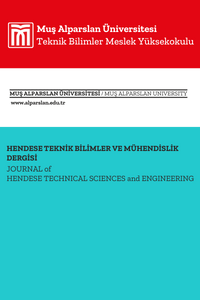
Hendese Journal of Technical Sciences and Engineering has the mission of monitoring important developments in the engineering discipline and contributing to society at national and international levels. The journal supports scientific progress in the field of engineering and technical sciences by publishing original research studies carried out using well-founded experimental and numerical methods. It focuses specifically on the rapidly evolving fields of science and technology and gives priority to articles published in these fields. It encourages interdisciplinary approaches, contributes to the discovery and development of new methods and technologies, and aims to bring the latest scientific and technological developments in this field to researchers and relevant communities.
Hendese Journal of Technical Sciences and Engineering, as an academic refereed journal that accepts only original research articles, covers current scientific studies in engineering, science and similar technical disciplines. The journal aims to make scientific contributions to important problems in engineering and technical sciences by focusing on topics such as innovation, design, analysis, experimental studies and theoretical research. Articles are reviewed by independent referees and host high-quality scientific contributions. Articles can be submitted in Turkish and English. In order to increase the international recognition of research articles, it is recommended that the articles be written in English.
I. TEMPLATES AND REQUIRED DOCUMENTS
- Turkish Article Template (Word)
- English Article Template (Word)
- Copyright Transfer Form (PDF): Must be signed by all authors and uploaded to the system in PDF format.
- Similarity Report (PDF): The full text of the manuscript must be checked using Turnitin or iThenticate, and the resulting report must be uploaded in PDF format.
II. SIMILARITY RATE
- The total similarity rate must be below 20%.
- The similarity from any single source must not exceed 3%.
- References, proper names, addresses, chemical compounds, and biological species names are excluded from evaluation.
- Uploading the similarity report in PDF format is mandatory.
III. PAGE STRUCTURE AND GENERAL LAYOUT
IV. MANUSCRIPT SECTIONS AND HEADING STYLES
- Main headings (e.g., 1. INTRODUCTION): written in bold uppercase, justified.
- First-level subheadings (e.g., 1.2. Manuscript Sections): bold, title case, justified.
- Second-level subheadings (e.g., 1.2.1. Classification of Headings): bold, sentence case, justified.
- INTRODUCTION
- MATERIALS AND METHODS
- RESULTS AND DISCUSSION
- CONCLUSIONS
- REFERENCES
V. WRITING STYLE AND FORMATTING
VI. FIGURES AND TABLES
VII. REFERENCES AND CITATION SYSTEM (IEEE STYLE)
The Hendese Journal of Technical Sciences and Engineering follows the IEEE (Institute of Electrical and Electronics Engineers) citation style, which is widely used in technical and engineering fields. This system is based on sequential numbering and ensures clarity and consistency.
- “This method was previously used in similar studies [3].”
- “Similar approaches are also observed in the literature [2], [4], [7].”
- “For detailed information, see [5]–[8].”
- “In the study conducted by Wangler [1], RF accelerator systems were described in detail.”
VIII. UNIT SYSTEM (SI – INTERNATIONAL SYSTEM OF UNITS)
- Quantities such as force, length, time, temperature, energy, pressure, velocity, stress, and density must be expressed in SI units. For example: length – meter (m), mass – kilogram (kg), time – second (s), temperature – Kelvin (K), pressure – pascal (Pa), energy – joule (J), power – watt (W), frequency – hertz (Hz), force – newton (N), and stress – megapascal (MPa).
- Dimensionless quantities (e.g., ratios, percentages, coefficients) should be written as pure numbers. Use a space between the numeric value and the unit (e.g., “25 mm”, “3.5 N·m”). Decimal points must be written with a dot (.), not a comma.
- All axes, labels, and legends in tables, graphs, and figures must also use SI units. If data are collected in non-SI units (e.g., imperial or CGS), the equivalent SI values must be provided in parentheses.
IX. LANGUAGE AND CONSISTENCY
- For Turkish manuscripts, spelling and punctuation must follow the rules of the Turkish Language Association (TDK) Spelling Guide. Technical terms should be used in Turkish whenever possible; if foreign terms are necessary, they should be written in italics and explained clearly.
- For English manuscripts, linguistic accuracy and technical terminology are the sole responsibility of the author(s). The structure and academic tone must be consistent and precise. Authors must choose either American (US) or British (UK) English and use it consistently throughout the entire text (e.g., color–behavior vs. colour–behaviour).
X. EK NOTLAR
- Formatting and typographic consistency must be maintained throughout the manuscript. The alignment of figures, tables, equations, and text must fully comply with the journal’s official Word template. Authors should not manually alter the predefined styles of headings, paragraphs, or captions.
- Each paragraph should end with one blank line, and unnecessary spaces, line breaks, or formatting inconsistencies should be avoided. Page setup, font, paragraph indentation, table alignment, and figure placement must remain consistent with the template.
- Figures, graphics, and tables must be positioned coherently within the text, and each should have an appropriate caption and numbering format. The caption styles and in-table fonts must follow the journal template precisely.
- Before submission, authors must carefully review the final version of their manuscript for spelling, formatting, alignment, and reference consistency. The editorial team conducts only preliminary format checks; the responsibility for content, language, and meaning lies entirely with the authors.
- Authors must ensure that all figures are in publishable resolution and that all tables and references are correctly formatted. Any attempt to redesign the template layout or upload figures/tables as images will not be accepted.
1- GENERAL PRINCIPLES AND PUBLISHING POLICY
Journal of Hendese Technical Sciences and Engineering adopts neutrality and integrity as fundamental principles in the processes of article submission and publication, focusing on the fair and reliable development and dissemination of knowledge. These processes directly reflect the quality of the work of authors and supporting institutions. It is of great importance for all stakeholders (authors, readers, researchers, publishers, reviewers, and editors) to adhere to ethical principles and standards. In the acceptance of articles, originality, high citation potential, and academic principles are taken into consideration. No fees are charged from authors for article submission and publication processes. The scientific, ethical, and legal responsibilities of articles to be published with DOI records belong to their authors.
In case of detecting manipulated or fabricated data usage in the article, this situation is reported to the institution where the authors work, and the article is rejected. The editorial team of Journal of Hendese Technical Sciences and Engineering (Editor-in-Chief, Editorial Board, and Editors) begins text reviews after examining the issue of plagiarism through iThenticate(R) and other scientific checks. The similarity rate upper limit is set at 20% (excluding references), and articles exceeding this rate are not considered for evaluation.
The editorial board of the journal expects all stakeholders to fulfill their ethical responsibilities and obligations within the framework of publication ethics. These ethical duties and responsibilities are prepared based on the guidelines and policies published by the Committee on Publication Ethics (COPE) and the Directive on Scientific Research and Publication Ethics of Higher Education Institutions, and the Directive on Scientific Research and Publication Ethics of the Interuniversity Board.
The Editorial Board of the journal evaluates all appeals and complaint cases in accordance with COPE guidelines. Authors should contact the editorial office directly regarding their objections and complaints. An ombudsman may be appointed for situations that cannot be resolved internally, but the final decision rests with the Editor-in-Chief. Additionally, the submission of documents showing ethical committee approval to the journal and providing necessary information within the article are among the requirements for scientific studies, including the following:
All types of research conducted through methods such as interview techniques, experiments, focus group studies, surveys, observations, and interviews where data is collected from participants.
-Experimental or scientific studies that involve the use of materials and data from humans and animals.
-Clinical studies conducted on humans.
-Studies involving animal experiments.
-Conducted under the Personal Data Protection Law.
In addition, in case presentations, a signed informed voluntary consent form must be submitted to the journal and should be mentioned in the article. Permission must be obtained for the use of non-authorial content such as photos, scales, surveys, etc., and these contents must be clearly stated in the article. Copyright regulations must be complied with when using intellectual and artistic works.
2. ETHICAL DUTIES, RESPONSIBILITIES, AND OBLIGATIONS
2.1. For Authors:
Authors submitting articles to Journal of Hendese Technical Sciences and Engineering must adhere to the following ethical responsibilities and obligations:
Originality of the work: Authors must ensure that their work is original and that when benefiting from other works, proper and accurate references or quotations are made.
Conflict of interest: It is the responsibility of authors to disclose any potential conflict of interest in all submitted works. These conflicts of interest should include employment, consultations, stock ownership, honorarium, paid expert testimony, patent applications/registrations, and grants or other funding. Potential conflicts of interest should be reported as early as possible.
Evaluation process and data requests: Authors should be prepared to meet requests for raw data related to their articles during the evaluation process. Additionally, they must have documents showing the rights to use the data used and have obtained necessary permissions from subjects.
Errors and corrections: Authors have the obligation to promptly inform the journal editor or publisher and collaborate with the editor in the process of correction, clarification, or withdrawal if an error or mistake is noticed in their work.
Multiple submissions and changes in the evaluation process: Authors cannot submit their work to multiple journals simultaneously. Changes in author responsibilities (such as adding, changing the order, or removing authors) cannot be proposed once the evaluation process of a work has started.
Funding sources and acknowledgment: All funding sources must be detailed at the end of the article. The responsible author must accurately determine the contributions of co-authors, in addition to being responsible for sections of the study.
Responsible author and communication: If an article is written by multiple authors, one of the co-authors should be selected as the responsible author. Authors must accept the author order and provide accurate contact information.
Gift authorship: The editorial board rejects the application without reviewing if suspicions of gift authorship arise. The responsible author must declare that they accept all responsibility for authorship during the submission and review stages of the article.
2.2. For Editors and Section Editors:
In Journal of Hendese Technical Sciences and Engineering, editors and section editors responsible for each publication must fulfill ethical duties, responsibilities, and obligations as determined based on the "COPE Code of Conduct and Best Practice Guidelines for Journal Editors" and "COPE Best Practice Guidelines for Journal Editors" published by the Committee on Publication Ethics (COPE). The Editor-in-Chief and editors have the authority to select articles to be published and do not discriminate based on factors such as race, ethnicity, gender, religion, and citizenship.
Editors must:
• Strive to meet the information needs of readers and authors,
• Ensure the continuous development of the journal,
• Manage processes to improve the quality of published studies in the journal,
• Support freedom of thought,
• Preserve academic integrity,
• Conduct business processes in accordance with intellectual property rights and ethical standards,
• Be transparent in cases requiring correction or explanation in publications,
• Ensure that every article published in the journal complies with policies and international standards,
• Be responsible for protecting the personal data of participants in evaluated studies and reject studies without explicit consent forms. Additionally, they are responsible for protecting the personal data of authors, reviewers, and readers,
• Prevent non-academic writings,
• Establish effective communication with all stakeholders involved in the publishing processes and organize regular meetings,
• Take preventive measures against abuses and share the results by conducting an objective investigation in case of complaints.
The responsibilities and obligations of editors and section editors towards authors are as follows:
• Make positive or negative decisions based on the importance, originality, validity, clarity of expression, and the purpose and objectives of the journal in relation to the study,
• Unless there is a serious problem, refer studies that are suitable for publication scope to the pre-evaluation stage,
• Take positive referee recommendations into account, but do not ignore them unless there is a serious problem,
• New editors and section editors should not change decisions made by previous editors unless there is a serious problem,
• "Blind Peer Review and Evaluation Process" should be published, and measures should be taken against negative situations.
Editors and section editors are responsible for authors as follows:
• Protect the intellectual property rights of published articles and defend the rights of the journal and authors in case of violations. They should be open to criticism and provide authors with the right to reply,
• Evaluate and not ignore cases involving negative results in studies,
• Evaluate and not ignore cases involving negative results in studies.
2.3. For Reviewers:
Reviewers should provide polite and constructive comments based on courtesy during the article review process, avoiding demeaning expressions. They should maintain an objective attitude during the review process, even if the blind review method is used, without allowing factors such as religion, language, race, political views, and commercial concerns to influence the evaluation. Reviewers should complete the process adhering to principles of impartiality and confidentiality.
If a reviewer notices possible conflicts of interest before entering the review stage, they should stop the review and inform the editor. After the evaluation, documents related to the article should be destroyed. A reviewer should refuse to evaluate a study that falls outside their area of expertise. They should respond positively or negatively to the review invitation, completing the evaluation of the accepted article in a timely manner.










Editor-in-Chief
Deputy Editor in Chief

Editor





Section Editors





Technical Assistant


Editorial Advisory Board Members