
Volume: 1 Issue: 1 , 2/28/25

Year: 2025

Editorial

Editorial

1. Başyazı

Research Article

Systematic Reviews and Meta Analysis

Urban Planning and Health, Urban Design, City and Regional Planning
Default avatar
Prof. Dr. Hikmet GÖKMEN Dokuz Eylül Üniversitesi
Built Environment and Design, Architectural Design
Urban Analysis and Development, Urban Aesthetics, Urban Design, City and Regional Planning
Default avatar
Assoc. Prof. Dr. Burcu GÜLAY DOKUZ EYLÜL ÜNİVERSİTESİ

Lisans eğitimini 2006 yılında İzmir Yüksek Teknoloji Enstitüsü Mimarlık Fakültesi’nde tamamlamıştır. 2006-2008 yılları arasında İzmir’de çeşitli mimarlık ofislerinde tasarım ve uygulama çalışmaları yürütmüştür. 2008 yılında yüksek lisans eğitimine Dokuz Eylül Üniversitesi Mimarlık Fakültesi Mimarlık Bölümü Bina Bilgisi Anabilim Dalı’nda başlamış, aynı dönem eş zamanlı olarak Yaşar Üniversitesi Mimarlık Fakültesi’nde öğretim elemanı olarak görev almıştır. “Sokağın günümüz koşullarında çocuk oyun alanı olarak ele alınması ve değerlendirilmesi” başlıklı yüksek lisans tezini 2010 yılında tamamlamıştır. Aynı yıl Dokuz Eylül Üniversitesi Mimarlık Fakültesi Bina Bilgisi Anabilim Dalı’nda başladığı doktora programına kabul edilmiş, “Çocuk-mimarlık çalışmalarının değerlendirilmesi ve ilköğretim için yapılı çevre eğitim programı önerisi (sosyal bilgiler dersi için)” başlıklı tezi yazmış ve deneysel desen oluşturduğu bu tezde çocuk-mimarlık alanında Türkiye’de ilk defa resmi müfredata uyumlu mimarlık tabanlı ders programını geliştirmiştir. Eğitim bilimleri alanında formasyonu bulunmaktadır.

2008 yılından beri, uzmanlık alanı olan çocuklar için yapılı çevre eğitimi konusunda toplamda yaklaşık 1000 çocuğa mimarlık eğitimi vermiş, atölyeler ve etkinlikler düzenlemiş, sivil toplum kuruluşları ve milli eğitim kurumları aracılığı, izinleri ve desteği ile bu çalışmaların yürütülmesini sağlamıştır.

2009 yılından beri sırasıyla araştırma görevlisi, yardımcı doçent ve doçent unvanları ile çalıştığı Dokuz Eylül Üniversitesi Mimarlık Fakültesi’nde doçentlik sonrasında ve halen, çocuk ve mimarlık, sürdürülebilir mimarlık ve çevre eğitimi, bilişim ve mimarlık, oyun ve mimarlık, mimarlık eğitimi ve pedagojisi, toplum - mimarlık ilişkisi konularında çalışmalarını sürdürmektedir. Makale, bildiri ve çeşitli araştırma çalışmalarının yanısıra, 2016 yılında DEGA girişimcilik eğitimi alarak girişimcilik alanında çalışmalarına başlamıştır. Fikirlerini hayata geçirmek için Tübitak’ın 1512 kodlu girişimcilik programına başvurmuş ve 2018 yılında fiilen Ankara’da Tubitak bünyesinde yapılan iki aşamalı proje elemelerinde Türkiye’de mimarlık ve toplum alanında ilk sosyal girişimi gerçekleştirmek üzere hibe ödülüne layık görülmüştür. Bu proje ile teknopark bünyesinde firma kuran girişimci, proje çıktısı olan kenti mimari odaklı olarak tanıtmayı amaçlayan aplikasyonunun satış aşaması sonrasında akademik faaliyetlerine ağırlık vermiştir.

Sustainable Architecture, Architectural Science and Technology, Architectural Design
Default avatar
Assoc. Prof. Dr. Ebru GÜLLER DOKUZ EYLÜL ÜNİVERSİTESİ
Built Environment and Design, Architecture, Aesthetics in Architecture, Architecture and Environmental Psychology, Design Culture and Social Context , Universal and Unobstructed Design, Architectural Design
Default avatar
Prof. Dr. Ebru CUBUKCU DOKUZ EYLÜL ÜNİVERSİTESİ
Regional Planning, Ecology, Sustainability and Energy, Urban Aesthetics, Urban Design, City and Regional Planning
Default avatar
Asst. Prof. Dr. Emine Duygu KAHRAMAN It is not affiliated with an institution
Architectural Heritage and Conservation, Urban Planning and Health, Urban Design
Architectural Design, Design, Plan, Project and Application in Architecture, Habitation and Industrial Products
Feyzal Özkaban
Assoc. Prof. Dr. Feyzal ÖZKABAN DOKUZ EYLÜL ÜNİVERSİTESİ
Architectural Heritage and Conservation
Default avatar
Prof. Dr. Hale SUCUOĞLU Dokuz Eylül Üniversitesi Buca Eğitim Fakültesi
Learning Theories, Education, Curriculum Development in Education, Program Design, Curriculum Design Instructional Theories, Instructional Design, Philosophical and Social Foundations of Education, Teacher Education and Professional Development of Educators
Kutluğ Savaşır
Assoc. Prof. Dr. Kutluğ SAVAŞIR DOKUZ EYLÜL ÜNİVERSİTESİ MİMARLIK FAKÜLTESİ MİMARLIK BÖLÜMÜ
Materials and Technology in Architecture, Ecology, Sustainability and Energy, Built Environment and Design, Architecture, Architecture for Disaster Relief, Physical Environment Control, Green Structures and Environments, Industrial Product Design, Building Science, Technologies and Systems, Real Estate Financing
İlgi Atay Kaya
Assoc. Prof. Dr. İlgi ATAY KAYA DOKUZ EYLÜL ÜNİVERSİTESİ, MİMARLIK FAKÜLTESİ Web

Assoc. Prof. Dr. İlgi Atay Kaya works at the Department of City and Regional Planning of Dokuz Eylül University (DEU). Her research interests include urban planning conflicts, locally unwanted land uses, sustainability measurement, Geographic Information Systems (GIS), remote sensing, and do-it-yourself urbanism. She received her degrees of Bachelor, Master, and Ph.D. in City and Regional Planning at İzmir Institute of Technology (IZTECH) in 2006, 2009, and 2014, respectively.

Participation and Governance, Ecology, Sustainability and Energy, City and Regional Planning, Urban Planning and Health
Default avatar
Assoc. Prof. Dr. İrem AYHAN SELÇUK DOKUZ EYLÜL ÜNİVERSİTESİ
City and Regional Planning

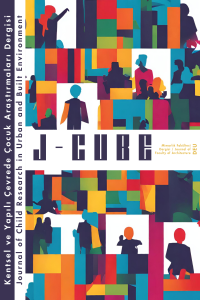
J-CUBE aims to contribute to the field by opening up current literature discussions through interdisciplinary approaches on studies that address the child-space relationship at urban and rural scales and investigate the effects of physical, social and psychological environmental qualities on child development. In this context, J-CUBE is open to studies that include current discussions on children's spatial behavior and preferences in urban and regional planning, architecture, urban design, urban protection, landscape, geography, design, protection and restoration, construction, art, history and related disciplines. Although priority will be given to original research and theoretical articles that will contribute to the literature, review articles, case reports, current discussions and comments, critiques and evaluations, book reviews, etc. are also welcomed.
J-CUBE is an open access, international journal published twice a year, in February and July, by Dokuz Eylül University, Faculty of Architecture. Studies to be published in the journal are accepted in English and Turkish.

Articles on J-CUBE include, but are not limited to, the following topics:

• Child and City
• Children and Architecture
• Children and Rural Areas
• Children and Urban Design
• Children and Urban Perception
• Child Friendly Cities
• Children and Built Environment Education
• Children and Nature
• Children and Urban Functions
• Children and Participation in Design
• Children and Participation in Urban Policies
• Children and Security
• Children and Aesthetics
• Children and Activity in Urban Areas
• Children and Local Governments

Articles written in Turkish or English can be published in J-CUBE. Authors accept that the articles they submit to J-CUBE have not been previously published in another publication or have not been submitted simultaneously to another publication, that all rights to the article will be transferred to J-CUBE if accepted for publication, and that the work will not be published in another language or place without permission from the journal. The primary responsibility in this regard belongs to the author(s), but authors must sign the Copyright Transfer Agreement and upload it to the system at the time of application.

Abstracts presented at scientific meetings can be proposed for publication in J-CUBE, provided that they have not been published in the proceedings book of the relevant meeting. If the article has been previously presented anywhere as a report, thesis, etc., it should be indicated in the footnote with the * symbol in the “Title” section. In addition, if the research and studies that form the basis of the article have been supported by individuals and institutions or prepared by benefiting from project/research support, information explaining this situation should be included in the “Acknowledgements” section. The primary responsibility in this regard also belongs to the author(s).
No evaluation or application fee is charged for articles submitted to the journal for publication, and there is no publication fee. Articles can be viewed on the web page of the open access journal, downloaded in pdf format and printed.
The journal editors, editorial board and referee board are not responsible for the views and opinions expressed in the published articles. The primary responsibility in this regard belongs to the author(s).
Each article to be published in the journal must include a summary / abstract of 150-250 words in both Turkish and English. An original research article and theoretical or review articles must be at least 4000 and at most 7000 words (each figure and table must be calculated as 250 words, including the title page, abstracts, references, tables and figure descriptions).
Copyright of Figures and Tables (Images, pictures, photographs, maps, charts):
It is the author's responsibility to obtain copyright permission for images and tables. If another version of the image or table used in the article has been published before, information about this source should be provided in the text and in the References.
The 'AnonymousMakale.doc' file to be uploaded and the 'İntihalTaramaSonucRaporu.pdf' file to be created by scanning it should not contain the author(s)'s identity information in any way. When the 'İntihalTaramaSonucRaporu.pdf' file is uploaded to the system, the Similarity Report option should be selected as the file type.
Evaluation Process:
In J-CUBE, plagiarism scan result report (such as Itenticate and Turnitin) and draft articles submitted with the copyright transfer form are first evaluated for their compliance with the article preparation guide and article template, and draft articles that do not comply with the aforementioned rules are sent back to the applicants. As a result of the evaluation, draft articles that are found to be “compliant with the rules” are evaluated in the second stage in terms of the article’s subject’s suitability to the journal’s purpose and scope and the academic competence of the written language. Draft articles that are not found suitable are sent back to the applicants, while referees are assigned to those that are found suitable. At this stage, in accordance with our double-blind refereeing policy, the author(s) are kept secret from the referees and the referees’ names are kept secret from the author(s).

The ‘AnonymousMakale.doc’ file to be uploaded and the ‘İntihalTaramaSonucRaporu.pdf’ file that will be created by scanning it should not contain the author(s)’s identity information in any way. The “similarity report” option (not an additional file) should be selected as the file type named ‘İntihalTaramaSonucRaporu.pdf’.
Referees are expected to make an evaluation regarding the originality of the articles, their contribution to the field, referencing current and related articles, the suitability of the method used, and the clarity and clarity of the language and style. Depending on these evaluations, the referees are asked to indicate their final decision by choosing one of four classes: (1) The draft article can be published as is, (2) The draft article can be published with partial corrections, (3) The draft article cannot be published as submitted; it can be resubmitted for referee evaluation after extensive corrections, (4) The draft article cannot be published.

The ethical principles of J-CUBE are prepared by the provisions of the "Directive on Scientific Research and Publication Ethics of Higher Education Institutions" (available at: [https://www.yok.gov.tr/Sayfalar/Kurumsal/mevzuat/bilimsel-arastirma-ve-etik-yonetmeligi.aspx](https://www.yok.gov.tr/Sayfalar/Kurumsal/mevzuat/bilimsel-arastirma-ve-etik-yonetmeligi.aspx)), relevant legislation, and the ethical principles published by the Committee on Publication Ethics (COPE) (available at: [https://publicationethics.org/](https://publicationethics.org/)).  

Free of Charge