 June 16, 2026
Page
1-12
June 16, 2026
Page
1-12
Volume
7
,
Number
1
Jun 16, 2026
10
Article
Publication Type
Articles
Research Article
Research Article
Experimental Investigation of Heat Transfer Efficiency of a Gravity-Assisted Heat Pipe Operating Under Different Conditions Using Parametric Nanofluids
June 16, 2026
Page
87-97
June 16, 2026
Page
87-97
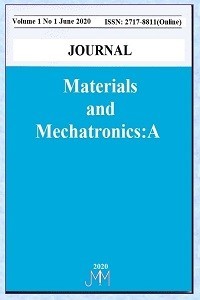
“Journal of Materials and Mechatronics: A (JournalMM)” is a science and technology journal which aims to deliver the latest scientific and technological developments in the field of Metallurgy and Materials, Mechatronics, Mechanical, Automotive, Electrics, Electronics, Biomedical, Chemical, Physics, Computer engineering and related engineering, which are relevant to scientists, engineers, industry and readers.
“Journal of Materials and Mechatronics: A (JournalMM)” is an open access peer-reviewed international scientific journal that accepts articles in all fields of Materials and Mechatronics engineering as well as original engineering articles. The journal also welcomes conference presentations among various disciplines and publishes theoretical and practical studies in related fields. Contributions from academia and industry are also encouraged in a similar way.
WRITING RULES
A- GENERAL PRINCIPLES
1. The article should be sent by the corresponding author as a Microsoft Word file.
2. The language of authorship is ENGLISH.
3. The work should consist of an original research article and a technical note; the main sections should be: Title, Abstract, Keywords, Introduction, Materials and Methods, Results and Discussion, Conclusion, Acknowledgments (if any), and References.
4. Main section titles are bold and all capitalized; 2nd degree titles are bold and the first letters of the words are uppercase and the others are lowercase; 3rd degree titles should be bold and only the first letter of the first word should be written in capital letters and all other words should be written in lowercase letters.
5. A 1.15 line spacing should be used before and after the main headings. In subtitles, only 1.15 line spacing space should be left between the previous line. No space should be left after the subtitle.
6. The title of the article in English should be short and descriptive, the first letters of the words should be capitalized, other words should be small and not more than fifteen words (excluding prepositions). Mathematical formulas should not be in the article title.
7. Main Headings and subheadings should be numbered.
B- RULES FOR PAGE LAYOUT
1. The text should be written on A4 size page with 12 font size, Times New Roman font, 1.15 cm line spacing. The font size can be reduced so that the summary and abstract on the 1st page of the article do not extend to the second page.
2. Margins are 2 cm above the page, 2 cm below, 2 cm to the left and 2 cm to the right.
3. Turkish and English titles should be centered on the page, the rest should be written justified, and 1 cm indent should be left at the beginning of the paragraph.
4. The total number of pages should not exceed 20 pages in original research articles and 7 pages in technical notes. Articles that exceed these page limits will not be considered for publication.
5. Article samples written according to the spelling rules of our journal can be accessed by clicking the links below.
RESEARCH ARTICLE
C- ABSTRACT, KEY WORDS, ABSTRACT, KEYWORDS SECTIONS
1. The "ABSTRACT" section should contain a minimum of 100 and a maximum of 250 words.
2. Keywords should be written with a minimum of 3 and a maximum of 6 words following the abstracts. In keywords, the initial letter of the keyword must be capitalized. Words should be separated by commas (,) and a space should be left and other words should be written.
D-FIGURES AND SCHEDULES
1. All Figures and Charts should be given on the potrait page style. If the table does not fit on the portrait page style, the Table can be divided into 2 parts and shown as a continuation Table. landscape page style should not be used.
2. "Figure" and "Table" should be used for Figures and Charts (Table 1., Figure 1.). In addition, Figure 1., Table 1. should be written in bold. Explanations and footnotes of the Tables and Figures should be given under the Table and should be written in 8 to 10 font size, and the sentence should not end with with “full stop” at the end of the sentence.
3. Figure should be placed centered on the page. Tables should be placed centered on the page. There should be no vertical lines in the charts.
4. Table titles should be 10 points, left-aligned and above the Table, and the content of the Table should be at least 9 points. Figures, graphics, photographs and etc. should be under the figure with the title "Figure" and left-aligned 10 point font size. Figure and Table should be given in the relevant places in the main document; they should not be uploaded as separate files or added to the end of the text.
E- EQUATIONS
1. Equations should be numbered and the equation number should be shown in parentheses based on the side of the equation and to the right. The main characters and variables should be italic, numbers and mathematical expressions should be plain, with the controls in 12 points. If reference is made in the text, "Equation 1." (The model for… is given in Equation 1). Microsoft Word program should be used in mathematical formulas and other additional programs should not be used.
F- REFERENCES IN THE TEXT
Manuscripts submitted to our journal must be prepared in accordance with the APA (American Psychological Association) 7th edition guidelines.
If the author’s name is not part of the sentence, the citation should be placed at the end of the sentence in parentheses.
Single author;
(Surname, Year) → (Kayalı, 2025)
Two authors;
(Surname & Surname, Year) → (Kayalı & Yalçın, 2025)
Three or more authors;
(Surname et al., Year) → (Kayalı et al., 2025)
Same author, same year;
(Surname, Yeara) → (Kayalı, 2025a), (Surname, Yearb) → (Kayalı, 2025b)
Same author, same year – combined citation;
(Surname, Yeara, Yearb) → (Kayalı, 2025a, 2025b)
When citing multiple sources in a single parenthesis, citations should be separated by semicolons and listed from oldest to most recent (Surname, 1977; Surname et al., 2013).
If the author’s name is part of the sentence;
Single author;
Surname (Year) followed by the rest of the sentence.
Two authors;
Surname and Surname (Year) followed by the rest of the sentence.
Three or more authors;
Surname et al. (Year) followed by the rest of the sentence.
Same author, different years;
Surname (Year, Year) followed by the rest of the sentence.
Same author, same year;
Surname (Yeara, Yearb) followed by the rest of the sentence.
Corporate author;
Organization Name (Year) followed by the rest of the sentence.
Direct quotations;
Surname (Year, p. page number) followed by the rest of the sentence.
G- UNITS AND NUMBERS
1. For numbers, only the dot (.) should be used as the decimal separator (20.23 instead of 20,23),
2. “/” Sign should not be used for units, it should be made exponential by leaving a space (g L-1 instead of g / L).
3. For very large numbers, it should be separated by three spaces (such as 100 000.85 instead of 100000.85).
H- REFERENCES SECTION
All references must be prepared in accordance with the APA (7th edition) guidelines.
The references section should be written in 12-point font, left-aligned, with a hanging indent of 1 cm applied to the second and subsequent lines of each reference.
All references must be listed in alphabetical order.
Multiple works by the same author published in the same year should be distinguished using lowercase letters (e.g., 2025a, 2025b).
Journal titles, conference names, and thesis-awarding institutions must be written in full (no abbreviations).
Journal Articles;
Surname, A. A. (Year). Title of the article. Journal Title, volume(issue), page range. https://doi.org/xx.xxx/yyyy
Kayali, Y. (2015). Investigation of diffusion kinetics of borided AISI P20 steel in a microwave furnace. Vacuum, 121(3), 129–134. https://doi.org/10.1016/j.vacuum.2015.08.006
Atlı, İ. S., & Çiftçi, H. (2025). Investigation of Hydrophobicity in Calcium Stearate-Epoxy Based Composite Materials. Journal of Materials and Mechatronics: A, 6(1), 214-225. https://doi.org/10.55546/jmm.1665380
Kayali, Y., Yalçin, M. C., & Buyuksagis, A. (2023). Effect of electrospark deposition coatings on surface hardness and corrosion resistance of ductile iron. Canadian Metallurgical Quarterly, 62(3), 483-496. https://doi.org/10.1080/00084433.2022.2119039
Books;
Surname, A. A. (Year). Title of the book. Publisher.
Callister, W. D., & Rethwisch, D. G. (2020). Materials science and engineering: An introduction (10th ed.). Wiley.
Totten, G. E. (2016). Steel heat treatment handbook (2nd ed.). CRC Press.
Edited Books;
Editor, E. E. (Ed.). (Year). Title of the book. Publisher.
Kou, S. (Ed.). (2019). Welding metallurgy (2nd ed.). Wiley.
Totten, G. E., & MacKenzie, D. S. (Eds.). (2003). Handbook of aluminum. CRC Press.
Book Chapters;
Surname, A. A. (Year). Title of the chapter. In Title of the book (pp. xx–xx). Publisher.
Porter, D. A., Easterling, K. E., & Sherif, M. Y. (2009). Phase transformations in steels. In Phase transformations in metals and alloys (pp. 299–340). CRC Press.
Chapters in Edited Books;
Surname, A. A. (Year). Title of the chapter. In E. E. Editor (Ed.), Title of the book (pp. xx–xx). Publisher.
Kou, S. (2019). Solidification phenomena in welding. In S. Kou (Ed.), Welding metallurgy (2nd ed., pp. 123–158). Wiley.
Theses;
Surname, A. A. (Year). Title of the thesis [Master’s thesis / Doctoral dissertation, University Name].
Yalçın, M. C. (2017). Optimization of sintering conditions depending on doping in BiNaTiO3 and KNaNbO3-based piezoelectric ceramics [Master’s thesis, Afyon Kocatepe University].
Yalçın, M. C. (2024). Investigating the effects of B and Mo additions on the mechanical and physical properties of FeNiMnCrCoTi0.1 high entropy alloy [Doctoral dissertation, Afyon Kocatepe University].
Conference / Symposium Proceedings;
Published in conference proceedings;
Surname, A. A. (Year). Title of the paper. In Title of the proceedings (pp. xx–xx). Publisher.
Lee, S., Park, J., & Kim, H. (2019). Additive manufacturing of titanium alloys. In Proceedings of the International Conference on Advanced Manufacturing (pp. 112–118). Springer.
Published in a journal;
Surname, A. A. (Year). Title of the paper. Journal Title, volume(issue), pages. DOI
Silva, R., & Costa, J. (2018). Optimization of machining parameters for aluminum alloys. Journal of Manufacturing Processes, 34(2), 301–306. https://doi.org/10.xxxx/xxxxx
Unpublished oral presentation;
Surname, A. A. (Year, Month Day). Title of the presentation [Conference presentation]. Conference name, Location.
Yılmaz, A., & Demir, M. (2022, October 14). Microstructural evolution of borided steels [Conference presentation]. International Conference on Materials Engineering, Ankara, Türkiye.
Unpublished poster presentation;
Surname, A. A. (Year, Month Day). Title of the poster [Poster presentation]. Conference name, Location.
Kaya, H. (2021, September 22) Wear behavior of plasma-nitrided steels [Poster presentation]. Materials Science Congress, İzmir, Türkiye.
Corporate Publications;
Organization Name. (Year). Title of the topic. URL / DOI
World Steel Association. (2022). Steel statistical yearbook 2022. https://worldsteel.org/steel-by-topic/statistics/
National Institute of Standards and Technology. (2021). Mechanical properties of metals. https://www.nist.gov/materials
Standards;
Standards Organization. (Year). Standard number: Title of the standard. Publisher.
ASTM International. (2021). ASTM E8/E8M-21: Standard test methods for tension testing of metallic materials. ASTM International.
International Organization for Standardization. (2020). ISO 15614-1: Specification and qualification of welding procedures for metallic materials. ISO.
Web Sources;
If a publication year is available;
Title of the page. (Year). URL
An overview of cast iron types. (2020). https://dokumhane.net/kutuphane/dokme-demir-turlerine-genel-bir-bakis/
If no publication date is available;
Title of the page. (n.d.). Retrieved Month Day, Year, from URL
An overview of cast iron types. (n.d.). Retrieved February 16, 2020, from https://dokumhane.net/kutuphane/dokme-demir-turlerine-genel-bir-bakis/
I- UPLOADING THE ARTICLE ON THE SYSTEM
1. When submitting an article, author's name (s), addresses and e-mail should be written clearly in the Cover Page and should not be shortened.
2. The author's names and addresses should not be given in the main text during the sending of the work to system due to the blind referee, and should not be implied in anyway. It should only be written on the Cover Page.
3. While submitting the article, Copyright Transfer Agreement, (ethical committee document, if needed) should be signed and uploaded to the system.
4. All authors of the article should fulfill and sign The Declaration of The Conflict of Interest. The fulfilled and signed declaration of the conflict of interest should then be scanned and uploaded to the system during the initial manuscript submission. The declaration of the conflict of interest can be found in https://dergipark.org.tr/tr/download/journal-file/23804.
5.All authors of the article should fulfill and sign The Declaration of Author Contribution. The fulfilled and signed declaration of author contribution should then be scanned and uploaded to the system during the initial manuscript submission. The declaration of author contribution can be found in https://dergipark.org.tr/tr/download/journal-file/23805.
6. All responsibility of the work belongs to the authors. Articles should be prepared in accordance with the international scientific ethical rules, which we have mentioned on this page. In addition to the above-mentioned Research and Publication Ethics Statement, The Research and Publication Ethics Declaration Form signed by the responsible author should be uploaded as an additional file at the submission stage.
7. Tables and Figures should not be loaded as supplementary files and should be given in the main document.
8. Plagiarism report (iThenticate will be used) must be loaded. Plagiarism should be below 25 %. in total, and should not exceed 5 % in each source.
Journal of Materials and Mechatronics: A started publishing in 2020. It is published by Prof. Dr. Yusuf KAYALI. Journal of Materials and Mechatronics: A is a peer-reviewed e-journal featuring original scientific articles in the fields of Metallurgical and Materials Engineering, Mechatronics, Mechanical, Automotive, Electrical, Electronics, Biomedical, Chemical, Physics, Computer Engineering. It is an international refereed scientific journal that will be published twice a year (June and December). There is no article fee and an open access policy has been adopted. The journal accepts scientific articles in English via the Dergi Park system. The article evaluation period is approximately 3 months.
Journal of Materials and Mechatronics: A only publishes studies that reflect an original research with its findings and results.
Journal of Materials and Mechatronics: A folllows guides and politics published by Committee on Publication Ethics (COPE) for ethical rules and responsibilities of authors, journal editors/subject editors, reviewers and publisher.
Plagiarism Check
Articles submitted to Journal of Materials and Mechatronics: A, are evaluated after passing through the Plagiarism Detection Program “ithenticate”. The similarity rate criterion is 25% or below. Similarity rate in a single resource should not exceed 5%. The manuscript, which does not pass similarity criterion as a result of the preliminary evaluation, is sent back to the author / authors again to make the necessary corrections without being evaluated.
Pre-checking the manuscript by author
The article submitted by the author must not have been previously published and submitted for evaluation to any journal.
The submission file must be in Microsoft Word 2010 and later.
URLs of references should be provided where available.
The text should be prepared according to rules specified in the author’s guide.
On the submission of the article, the instructions given in the Blind Referee link are applied.
The authors in the first submission sent to the journal cannot be added / removed later.
Blind Referee Process
Journal of Materials and Mechatronics: A is a peer-reviewed academic journal publishing scientific articles that go through the double-blind review process.
For review of submitted manuscripts, at least two referees are appointed by the editor (s) according to the content of the work and the expertise of the referees. All referee evaluation reports are sent electronically and anonymously. The names of the referees who made the assessment are not specified in the reports and in the journal due to the double blind process. However, after the evaluations, a letter of appreciation is sent to the referees.
Blind refereeing processes directly affect the quality of academic publications. The evaluation process is carried out with the principle of double-sided blind review. Referees cannot contact the authors directly, evaluation and referee reports are sent through the e-Mail management system. In this process, evaluation forms and referee reports are sent to the author (s) by the editor. Double-sided blind reviewing helps editors make decisions in an impartial manner to the authors. Authors also have the opportunity to improve their work by obtaining important information about their work.
Decision Making Process
The editors and the publisher send all works submitted for publication to at least two referees who are experts in their fields for evaluation. In case of a dispute between the referees, a third referee is appointed and the article is decided according to the majority’s decision. Evaluation forms filled in by the referees and corrections on the text, if they prefer, are sent to the authors by contacting the responsible author. The final corrected file from the author is re-evaluated by the referees and the field editor, and it is decided whether the study will be published or not.
Privacy
Studies sent to the referees for evaluation should be considered as confidential documents. Studies should not be shown to others and their contents should not be discussed. Where necessary, referees may seek advice from other colleagues, with the permission of the Chief Editor. The Editor-in-Chief can give this permission only in the event of an exceptional condition. The confidentiality rule also includes people who refuse to act as reviewers.
Impartiality Principle
No personal criticism should be made to the authors during the evaluation process. Evaluations should be made in an objective and contributing way.
Specifying a Source of information
The referees are obliged to inform the authors if there are any citations that are not cited in the study. Referees should pay particular attention to works that are not cited in the field or citations that overlap with similar works. The referees should inform the editors in the event of publication that is similar to any previously published work or information.
Information and Conflicts of Interest
Referees should not agree to evaluate if they have any collaborative connections with any author, company or institution for which they are asked for evaluating their work, and should inform editors of the situation as soon as possible.
Referees may not use unpublished works or parts of works in the manuscripts aubmitted to the journal without the written consent of the author (s) for evaluation. The information and ideas obtained during the evaluation should be kept confidential by the referees and should not be used for their own benefit. These rules include those who do not accept the reviewing.
Publication Language
Journal of Materials and Mechatronics: A (JournalMM), reviews research articles written in English.
Publication Frequency
In Journal of Materials and Mechatronics: A (JournalMM), which has been publishing issues since 2020, a volume has been published every year since 2020 and each volume consists of 2 issues (June, December).
Open Access Policy
Journal of Materials and Mechatronics: A publishes original research articles without any fee or charge.
All articles accepted and published by Journal of Materials and Mechatronics: A are freely available, openly accessible. We follow the guidelines presented by Budapest Open - Access Initiative (BOAI) regarding the Open-Access.
Wage Policy
Journal of Materials and Mechatronics: A (JournalMM), does not charge the author / authors at any stage (submission, evaluation and publication of articles) for publication procedures.
Journal of Materials and Mechatronics: A (JournalMM) dergisinde makale yayını ve makale süreçlerinin yürütülmesi için ücret talep edilmez.
Journal of Materials and Mechatronics: A (JournalMM) dergisine gönderilen ya da yayın için kabul edilen makaleler için işlem yapma ücreti ya da yayınlama ücreti alınmaz.









Editor-in-Chief

Prof. Dr.
Yusuf KAYALI
AFYON KOCATEPE UNIVERSITY

Electrochemical Technologies, Materials Science and Technologies, Tribology, Materials Engineering, Plating Technology, Corrosion, Metals and Alloy Materials
Section Editor-Materials Science and Engineering
Prof. Dr.
Fayaz HUSSAIN
NED University of Engineering and Technology
Biomaterial , Material Characterization
Assoc. Prof. Dr.
Ali GÜNEN
ISKENDERUN TECHNICAL UNIVERSITY
Materials Science and Technologies, Resource Technologies, Tribology, Plating Technology, Material Characterization, Metals and Alloy Materials
Assoc. Prof. Dr.
Ali ERÇETIN
BANDIRMA ONYEDI EYLUL UNIVERSITY
Industrial Product Design, Materials Science and Technologies, Powder and Particle Technology, Machine Design and Machine Equipment, Material Design and Behaviors, Casting Technologies, Composite and Hybrid Materials, Material Characterization, Material Production Technologies, Metals and Alloy Materials, Organic Semiconductors, Powder Metallurgy, Manufacturing Processes and Technologies (Excl. Textiles)
Prof. Dr.
Gökhan GÖRHAN
AFYON KOCATEPE UNIVERSITY, FACULTY OF ENGINEERING
Engineering, Construction Materials
SS
Asst. Prof. Dr.
Shkelzen SHABANI
University of Prishtina
Finite Element Analysis , Composite and Hybrid Materials, Material Characterization
Section Editor-Mechatronics Engineering
Assoc. Prof. Dr.
İsmail YABANOVA
MANISA CELAL BAYAR UNIVERSITY, HASAN FERDİ TURGUTLU FACULTY OF TECHNOLOGY

Assoc. Prof. Dr.
Güray SONUGÜR
AFYON KOCATEPE UNIVERSITY, FACULTY OF TECHNOLOGY
Section Editor-Mechanical Engineering
Asst. Prof. Dr.
Avinash LAKSHMIKANTHAN
Nitte Meenakshi Institute of Technology
Asst. Prof. Dr.
Faruk Emre AYSAL
GİRESUN ÜNİVERSİTESİ
Assoc. Prof. Dr.
Mehmet Erdi KORKMAZ
YILDIZ TEKNİK ÜNİVERSİTESİ
Assoc. Prof.
İsmail Doğan KÜLCÜ
IZMIR KATIP CELEBI UNIVERSITY
Assoc. Prof. Dr.
Manjunath PATEL G C
PES Institute of Technology and Management, Shivamogga
Section Editor-Electrical and Electronic Engineering

Prof. Dr.
Douniazad MEZDOUR
University Mohamed Seddik Benyahia
Assoc. Prof. Dr.
Said Mahmut ÇINAR
AFYON KOCATEPE ÜNİVERSİTESİ, MÜHENDİSLİK FAKÜLTESİ, ELEKTRİK MÜHENDİSLİĞİ BÖLÜMÜ
Asst. Prof. Dr.
Yavuz Bahadir KOCA
AFYON KOCATEPE UNIVERSITY
Section Editor-Computer and Software Engineering
Assoc. Prof. Dr.
Gür Emre GÜRAKSIN
AFYON KOCATEPE ÜNİVERSİTESİ
Section Editor-Energy Systems Engineering

Asst. Prof. Dr.
Ömer Faruk GÜLER
AFYON KOCATEPE UNIVERSITY, FACULTY OF TECHNOLOGY
Experimental Methods in Fluid Flow, Heat and Mass Transfer, Renewable Energy Resources , Energy Generation, Conversion and Storage (Excl. Chemical and Electrical)
Prof. Dr.
Ali KEÇEBAŞ
MUGLA SITKI KOCMAN UNIVERSITY
Solar Energy Systems, Geothermal Energy Systems, Thermal Power Systems, Installation Technologies
Section Editor- Biomedical Engineering
Assoc. Prof. Dr.
Yiğit Ali ÜNCÜ
Akdeniz Üniversitesi
Prof. Dr.
Mehmet Lütfi YOLA
HASAN KALYONCU UNIVERSITY
Section Editor- Automotive Engineering
Assoc. Prof. Dr.
Hicri YAVUZ
AFYON KOCATEPE ÜNİVERSİTESİ, AFYON MESLEK YÜKSEKOKULU
Prof. Dr.
Fatih AKSOY
Afyon Kocatepe Üniversitesi
HD
Asst. Prof. Dr.
Halil DEMOLLI
University of Prishtina
Section Editor-Chemical/Chemical Engineering
Prof. Dr.
Aysel BÜYÜKSAĞIŞ
Afyon Kocatepe Üniversitesi
Section Editor-Physics / Physics Engineering
Assoc. Prof. Dr.
Mehmet ÖZKAN
Afyon Kocatepe Üniversitesi
Language Editor
Prof. Dr.
Şükrü TALAŞ
AFYON KOCATEPE UNIVERSITY, FACULTY OF TECHNOLOGY
Prof. Dr.
Aytekin HITIT
AFYON KOCATEPE ÜNİVERSİTESİ, MÜHENDİSLİK FAKÜLTESİ, MALZEME BİLİMİ VE MÜHENDİSLİĞİ BÖLÜMÜ
Layout Editor / Secretariat

Asst. Prof. Dr.
Fatih ÇOLAK
Uşak Üniversitesi

Asst. Prof. Dr.
Mahmud Cemaleddin YALCIN
AFYON KOCATEPE ÜNİVERSİTESİ

Res. Assist.
Enes Furkan USLU
AFYON KOCATEPE UNIVERSITY
Advisory Board [en]

Prof. Dr.
Uğur ÇALIGÜLÜ
Fırat Üniversitesi
Fracture Mechanics, Materials Science and Technologies, Resource Technologies, Tribology, Materials Engineering, Casting Technologies, Physical Metallurgy, Plating Technology, Composite and Hybrid Materials, Material Characterization, Material Production Technologies, Metals and Alloy Materials, Powder Metallurgy, Manufacturing Metallurgy

Asst. Prof. Dr.
Aytaç Uğur YERDEN
İSTANBUL GEDİK ÜNİVERSİTESİ, MÜHENDİSLİK FAKÜLTESİ, ENDÜSTRİ MÜHENDİSLİĞİ BÖLÜMÜ, ENDÜSTRİ MÜHENDİSLİĞİ PR. (TAM BURSLU)
Virtual and Mixed Reality, Renewable Energy Resources , Mechatronics Engineering

Prof. Dr.
Oğuz ARSLAN
BİLECİK ŞEYH EDEBALİ ÜNİVERSİTESİ
Chemical Thermodynamics and Energetics, Engineering, Aerodynamics (Excl. Hypersonic Aerodynamics), Biomass Energy Systems, Solar Energy Systems, Geothermal Energy Systems, Wind Energy Systems, Energy Efficiency, Mechanical Engineering
Assoc. Prof. Dr.
Metin ÖZGÜL
AFYON KOCATEPE UNIVERSITY, FACULTY OF ENGINEERING
Electronic, Optics and Magnetic Materials, Functional Materials, Composite and Hybrid Materials, Material Characterization, Ceramics in Materials Engineering, Powder Metallurgy, Materials Engineering (Other)

Prof. Dr.
Mustafa Serhat BAŞPINAR
AFYON KOCATEPE ÜNİVERSİTESİ, TEKNOLOJİ FAKÜLTESİ
Construction Materials, Materials Engineering, Ceramics in Materials Engineering, Material Production Technologies

Prof. Dr.
Kubilay ASLANTAS
AFYON KOCATEPE ÜNİVERSİTESİ
Finite Element Analysis , Machine Design and Machine Equipment, Manufacturing Processes and Technologies (Excl. Textiles)


Prof. Dr.
Yılmaz YALÇIN
AFYON KOCATEPE UNIVERSITY
Casting Technologies, Material Characterization, Material Production Technologies

Prof. Dr.
Fatih Onur HOCAOĞLU
AFYON KOCATEPE ÜNİVERSİTESİ
Electrical Engineering, Electrical Energy Generation (Incl. Renewables, Excl. Photovoltaics)
Prof. Dr.
Mourad KEDDAM
Faculté´ de Génie Mécanique et Génie des Procédés, Laboratoire de Technologie des Matériaux
Materials Science and Technologies
ÖG
Assoc. Prof.
Özkan GÖKÇEKAYA
Division of Materials and Manufacturing Science, Graduate School of Engineering, Osaka University
Mechanical Engineering (Other), Material Characterization, Ceramics in Materials Engineering, Material Production Technologies, Metals and Alloy Materials
Assoc. Prof. Dr.
Erdoğan KANCA
İSKENDERUN TEKNİK ÜNİVERSİTESİ
Tribology, Manufacturing Processes and Technologies (Excl. Textiles)


AM
Assoc. Prof. Dr.
Adnan MAQBOOL
University of Engineering and Technology
Material Production Technologies
SA
Prof. Dr.
Selçuk AKTÜRK
MUGLA SITKI KOCMAN UNIVERSITY, FACULTY OF SCIENCE
Physical Sciences, Material Physics, Material Characterization, Metals and Alloy Materials
Asst. Prof. Dr.
Mst Alpona AKHTAR
University of North Texas, Alabama A & M University
Physical Metallurgy, Corrosion, Material Characterization, Metals and Alloy Materials
IC
Prof. Dr.
Ivan Enrique CAMPOS SILVA
Instituto Politecnico Nacional
Plating Technology, Material Characterization
PJ
SS
Dr.
Shabana SHAIKH
CSIR NCL PUNE
Nanochemistry, Electrical Energy Generation (Incl. Renewables, Excl. Photovoltaics), Hydrometallurgy, Electrochemical Energy Storage and Conversion, Chemical and Thermal Processes in Energy and Combustion, Chemical Engineering Design, Materials Science and Technologies, Automotive Safety Engineering, Automotive Combustion and Fuel Engineering
Dr.
Undrakh MISHIGDORZHIYN
Institute of Physical Materials Science of the Russian Academy of Sciences, Siberian Branch
Materials Science and Technologies, Plating Technology, Material Characterization