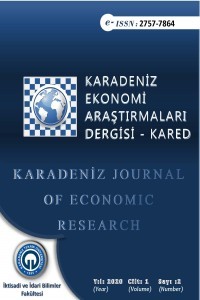
Karadeniz Journal of Economic Research (KARED), is an open-access and peer-reviewed journal; aiming to share original theoretical and applied studies in both Turkish and English with the scientific world.
Target Audience: Academics, researchers, postgraduate students, policy makers, public institutions, and private sector representatives.
Scope: The journal is open to scientific studies prepared at both national and international levels. While it is not limited to the Black Sea region, special emphasis is placed on economic research concerning the region.
Karadeniz Economic Research Journal is a biannual and free of charge international peer-reviewed journal which publishes original theoretical and applied scientific articles in both Turkish and English in the field of Economic and Administrative Sciences such as Economics, Labor Economics, Business Administration, Public Finance, International Relations, Management Information Systems, Political Science and Public Administration.
(Click to download the article publication and writing rules in PDF format)
PUBLICATION GUIDELINES
1. Scope: Karadeniz Journal of Economic Research is an open access and peer-reviewed journal that publishes original scientific articles in Turkish and English in the fields of Economics, Labour Economics, Business Administration, Public Finance, Econometrics, International Relations, Political Science and Public Administration, and Management Information Systems. The journal is published twice a year, in July and December.
2. Originality: Articles submitted for evaluation to the Karadeniz Journal of Economic Research must not have been previously published, accepted for publication, or submitted to another journal for publication.
3. Submission and Format: Articles should be submitted via Dergipark in MS Office Word format (.docx). All stages of the article process are conducted through the online journal system, which you can access with your username and password.
4. Author Information: During submission, author names, titles, ORCID numbers, institutional affiliations, and email addresses must be entered into the system. As the journal employs a double-blind peer review system, no author information should be included in the manuscript file.
5. Preliminary Check: Articles are checked using the iThenticate similarity software and reviewed by the editorial board. Manuscripts that do not adhere to language and spelling rules or to the formal and procedural requirements are rejected.
6. Peer Review Process: Articles deemed suitable are evaluated by two reviewers who are experts in the relevant field. If one reviewer’s opinion is positive and the other's is negative, the article is sent to a third reviewer; articles require two positive reviews to be accepted for publication.
7. Publication Process: The journal is published online, and the evaluation period for articles is approximately two months. When an article is accepted, the corresponding author is notified. Upon request, an acceptance letter signed by the editor can be provided to the author(s) after positive peer review reports have been received. Each accepted article is assigned a DOI (Digital Object Identifier).
8. Copyright: Upon submission, the copyright transfer form, duly completed and signed by the corresponding author, must be sent to iibf@ktu.edu.tr . If deemed necessary by the editor, the copyright transfer form may be required to be signed and sent by all authors.
9. Open Access: All articles published in our journal are open access under the Creative Commons Attribution 4.0 International License (CC BY 4.0). Under this license, articles may be copied, shared, adapted, and used for commercial purposes in any medium, provided that appropriate credit is given, a link to the license is provided, and it is indicated if changes were made.
10. Responsibility: The opinions expressed in the articles are those of the authors.
11. Copyright: All publishing rights of accepted and published articles, in both print and electronic media, belong to the Karadeniz Journal of Economic Research.
12. Contact: For questions, please contact iibf@ktu.edu.tr
WRITING GUIDELINES
1. Title:
The article title (in Turkish and English) should be centered, bold, in 12-point font, and in title case in the language of the article.
2. Abstract and Keywords:
• The abstract in both Turkish and English should be a maximum of 200 words, in 9-point font, title case, and single-spaced.
• Abstracts should include information about the aim, method, and results.
• Up to five keywords and JEL codes should be given below each abstract.
3. Font and Length:
• Articles should be prepared using Calibri font.
• The abstract should be in 9-point font and single-spaced.
• The main text should be in 11-point font, with 1.5 line spacing.
• Including appendices and references, the total length should not exceed 20 pages.
4. Page Layout:
All pages should be in A4 size with 2.5 cm margins (top, bottom, left, right).
5. Headings:
Section headings should be numbered as 1., 1.1., 1.1.2., etc.
6. Paragraphs and Spacing:
All text and headings should be left-aligned, with a 6 pt space between paragraphs.
7. Tables and Figures:
Tables and figures should be numbered and titled. Titles should be centered, in 10-point font, with the first letter of each word capitalized (the rest lowercase). Sources for non-original tables and figures should be indicated immediately below, left-aligned.
8. Equations:
Equations should be centered on the page, with the equation number in parentheses right-aligned on the same line.
9. Citation System:
In-text citations should be in the format (Author Surname, Year: Page). For sources with three or more authors, use (First Author Surname et al., Year: Page).
10. References:
All sources cited in the text must be listed in the references section, arranged alphabetically and in accordance with APA 7 guidelines. Journal names and book titles should be italicized. For APA 7 reference examples: https://www.citefast.com/styleguide.php?style=APA7&sec=Webpage
Note:
• Typesetting and final formatting will be carried out by the editorial board of the journal.
• Authors only need to follow the basic template and reference standards.
Reference Examples
Article
Alesina, A. and La Ferrara, E. (2005). Preferences for Redistribution in the Land of Opportunities. Journal of Public Economics, 89 (5–6), 897–931
Caian, A. et al. (2016). Agent Based-Stock Flow Consistent Macroeconomics: Towards a Benchmark Model. Journal of Economic Dynamics and Control, 69, 375-408.
Krugman, P. and Venables, A. J. (1995). Globalization and the Inequality of Nations. The Quarterly Journal of Economics, 110(4), 857-880.
Piketty, T. (2015). About Capital in the Twenty-First Century. American Economic Review, 105(5), 48-53.
Raza, S. A., Shahbaz, M., and Paramati, S. (2016). Dynamics of Military Expenditure and Income Inequality in Pakistan. Social Indicators Research, 131(13), 1035-1055.
Rodrik, D., Subramanian, A., and Trebbi, F. (2004). Institutions Rule: The Primacy of Institutions over Geography and Integration in Economic. Development. Journal of Economic Growth, 9(2), 131-165.
Xu, X. et al. (2019). Collaboration between Designers and Contractors to Improve Building Energy Performance. Journal of Cleaner Production, 219, 20-32.
Book
Acemoglu, D., and Robinson, J. A. (2005). Economic Origins of Dictatorship and Democracy. Cambridge University Press.
Acemoglu, D., and Robinson, J. A. (2013). Why Nations Fail: The Origins of Power, Prosperity, and Poverty. Crown Books.
Kazgan, G. (1992). İktisadi Düşünce veya Politik İktisadın Evrimi. İstanbul: Remzi Kitabevi.
Palley, T.I. (2012). From Financial Crisis to Stagnation – The Destruction of Shared Prosperity and the Role of Economics. New York: Cambridge University Press.
Romer, D. (1996). Advanced Macroeconomics. New York: McGraw-Hill.
Internet Sources
Carkovic, M. and Levine, R. (2002). Does Foreign Direct Investment Accelerate Growth?. http://siteresources.worldbank.org/INTFR/Resources/fdi.pdf (Accessed: 25.02.2015).
Raza, S. A. and Shahbaz, M. (2014). To Battle Income Inequality, Focus on Military Expenditures: Lesson from Pakistan. https://mpra.ub.uni-muenchen.de/57773/ (Accessed: 14.05.2018).
Sen, S.(2018). Investment Decisions under Uncertainty. http://www.levyinstitute.org/publications/investment-decisions-under-uncertainty (Accessed: 02.02.2019).
Edited Book Chapters
Herrmann, R. K., and Finkle, F. (2002). Linking Theory to Evidence in International Relations. In W. Carlsnaes, T. Risse, and B. A. Simmons (Eds.). Handbook of International Relations (pp. 119-136). London, England: Sage.
Kuemmerle, W. (2006). Innovation in Large Firms. In M. Casson, B. Yeung, A. Basu and N. Wadeson (Eds.). The Oxford Handbook of Entrepreneurship (pp.311-331). UK: Cambridge Scholars Publishing.
Oktar, S. and Eroğlu, N. (2015). Petrolün İlk Küresel Krizi: 1973 Krizi. In N. Eroğlu, İ. Eroğlu and H. İ. Aydın (Eds.), İktisadi Krizler ve Türkiye Ekonomisi (pp.177-190). Istanbul: Orion.
Translated Books
Stiglitz, J.E. (2016). The Price of Inequality: How Today’s Divided Society Endangers Our Future. (O. İşler, Trans.). Istanbul: İletişim Yayınları. (Original work published 2012).
Theses
Üzar, U. (2014). Türkiye’de Finansallaşma ve Ekonomik Büyüme İlişkisi [The Relationship Between Financialization and Economic Growth in Turkey]. Unpublished Master’s Thesis, Istanbul Technical University, Institute of Social Sciences.
.
Dr. Ekrem Bahçekapılı, eğitim teknolojileri ve uzaktan eğitim alanında uzmanlaşmış bir akademisyendir. Karadeniz Teknik Üniversitesi'nde lisans ve yüksek lisansını, Atatürk Üniversitesi'nde doktorasını tamamlamıştır.
Akademik çalışmalarında özellikle dijital okuryazarlık, e-öğrenme teknolojileri ve işitme engelli bireyler için yardımcı teknolojiler üzerine odaklanmıştır. Türk İşaret Dili için 3D sanal tercüman geliştirilmesi gibi önemli projelere liderlik etmiştir.
Son dönemde akıllı kampüs uygulamaları ve sanal gerçeklik teknolojilerinin eğitimde kullanımı üzerine çalışmalar yürütmektedir. Ulusal ve uluslararası akademik dergilerde çok sayıda yayını bulunmaktadır.
Dr Ferhat Cagri Aras is a Karadeniz Technical University Lecturer in International Relations in the faculty of economics and administrative sciences. His research focuses on South Asian development policies and the unmanned defence industry. He is particularly interested in Eurasian energy security and regional development agencies. Recently, his work is focused on regional policies and security strategies of Central Asian Countries with India. However, Dr Ferhat Çağrı Aras also continues field studies and case studies for the regional development programs of South Asia and the defence industry in Turkey.
http://www.ersanoz.com/paylasim/ersan-oz-ozgecmis.pdf
Prof. Dr. Ersan ÖZ, 4 Eylül 1975 tarihinde Manisa/Akhisar’da doğdu. İlk-orta ve lise öğrenimini Gölmarmarada tamamlayan ÖZ, 1997 yılında Karadeniz Teknik Üniversitesi İktisadi ve İdari Bilimler Fakültesi Maliye Bölümünden mezun oldu. Doktorasını 2000-2004 yılları arasında Dokuz Eylül Üniversitesi Sosyal Bilimler Enstitüsü Sosyal Bilimler Enstitüsü Maliye Programında “Vergilendirmede Kanunilik İlkesine Göre Türk Vergi Sisteminin Değerlendirilmesi” teziyle tamamladı. 2006’da yardımcı doçent, 2009 da doçent, 2014 de Profesör ünvanını aldı. Ulusal ve Uluslararası 100 makalesi, 7 kitabı, 30 tebliği bulunan ÖZ, 100'den fazla konferans vermiştir.
Akademik çalışma amaçlı Polonya, Amerika Birleşik Devletleri, İngiltere, Almanya, Hollanda, İtalya, İspanya, Bosna Hersek, Birleşik Arap Emirlikleri, Çek Cumhuriyeti, Azerbaycan, Kazakistan, Kırgızistan, Portekiz, Ürdün, Fransa ve Makedonya gibi ülkelerde bulunan Prof. ÖZ’ün çalışma alanı ulusal ve uluslararası vergi sistemleri, vergi hukuku ve vergi yargısı konularında yoğunlaşmaktadır. Prof. ÖZ, evlidir, iki çocuk sahibidir ve İngilizce bilmektedir.
Dr. Gisela Pereyra Doval is an Independent Researcher at CONICET and Associate Professor at the Faculty of Political Science and International Relations, National University of Rosario (UNR), Argentina. She holds a PhD in International Relations from UNR. Her research focuses on the foreign policies of Argentina and Brazil, regional integration, and the ideological dynamics of Latin American politics. Dr. Pereyra Doval has published widely and is actively involved in academic research and teaching in international relations.
1969 yılında Trabzon’da doğdu. 1991 yılında Ankara Üniversitesi Siyasal Bilgiler Fakültesi Kamu Yönetimi bölümünden mezun oldu. 2002’de Marmara Üniversitesi Sosyal Bilimler Enstitüsü Siyaset ve Sosyal Bilimler Anabilim dalında ‘Uluslaşma Sürecinde Türk Dil Politikaları (1839-1950)’ adlı tezle doktorasını tamamladı. 2003 yılında Yardımcı Doçent, 2012 yılında Doçent, 2018 yılında Profesör kadrosuna atandı. 1993’te Dumlupınar Üniversitesi’nde başladığı akademik hayatını Eylül 2017’den itibaren Karadeniz Teknik Üniversitesi’nde sürdürmektedir. Bu süreç içerisinde Kırgızistan’ın Commersky Üniversitesi’nde aralıklarla iki yıl misafir öğretim üyesi olarak bulundu. Sadoğlu, çalışmalarını ‘milliyetçilik’ ve ‘dil politikaları’ odağında yakın dönem Türkiye tarihi, kültür-siyaset ilişkisi, Balkanlar ve Orta Asya’daki etnik ve ulusal sorunlar üzerinde yoğunlaştırmaktadır.
Dr. Sujata Ashwarya is a professor in the Center for West Asian Studies [Middle Eastern], Jamia Millia Islamia, New Delhi. She received her MPhil and PhD degrees in West Asian Studies from Jawaharlal Nehru University, New Delhi. She is a recipient of several international fellowships, including the Asia Studies Visiting Fellowship at the East-West Center (2019), Washington, DC; the Summer Institute Academic Fellowship (2015) at the Schusterman Center for Israeli Studies, Brandeis University, Massachusetts, US; the Visiting Research Fellowship (2011-2012) at the Rothberg International School, Hebrew University of Jerusalem (HUJI); the Social Scientist Exchange Fellowship (2009) at Maison des Sciences de l'Homme (MSH); Hermes Post-doctoral Fellowship (2007) at MSH and Center d'Etudes et des Recherches Internationales (CERI), Paris; and Graduate Research Fellowship (2002-2003) at HUJI, Israel. She was also affiliated as a researcher at the Faculty of World Studies, University of Tehran, Iran. Her research interests include the political economy of energy, India's West Asia policy, the politics and foreign policy of Iran, Iraq, and Israel, and issues relating to democratization in the region. As a frequent traveler, she has presented more than 50 research papers at national and international conferences and seminars. She has over 40 published research articles and has written, edited, and co-edited 7 books. Her books include the following: The Arab Spring: Ten Years On (Berlin and London: Gerlach Press); Israel's Mediterranean Gas: Domestic Governance, Economic Impact, and Strategic Implications (Routledge, 2019); Contemporary West Asia: Perspectives on Change and Continuity (co-edited; Routledge, 2019); and India-Iran Relations: Progress, Problems, and Prospects (Routledge, 2017).
MUJIB ALAM is Professor at the MMAJ Academy of International Studies, Jamia Millia Islamia, New Delhi. He obtained MPhil and PhD degrees in West Asian (Middle Eastern) studies, specialising in Turkish studies, from New Delhi’s Jawaharlal Nehru University. Previously, he completed his Bachelor’s and Master’s degrees in Political Science from Utkal University (Odisha) and Aligarh Muslim University (Uttar Pradesh) respectively. As an HERMES-Post-Doctoral Fellow, he worked on his research at the Maison des Sciences de l’Homme (MSH) and Centre d’Etudes et de Recherches Internationales (CERI), Paris, France between Nov 2005 and May 2006. His research and teaching areas include contemporary Turkish studies (domestic politics and foreign policy), West Asian studies (international relations, foreign policy, conflict & peace studies of west Asian & north African countries), Foreign Policy Analysis (FPA), and International Organisation. He regularly gets published; presents paper in national and international conferences/seminars both in India and abroad. So far, he has authored/edited five books and has contributed a number of research articles to books and journals. His publications include Contemporary West Asia: Perspectives on Change and Continuity (co-edited; Routledge, 2019), Turkey in the Post-Cold War Period: The Regional Power Role, 1990-2002 (authored; New Century Pub, 2016), Perspectives on Turkey’s Multi-Regional Role in the 21st Century (edited; Knowledge World Pub, 2015), Indo-Turkish Relations: History and Current Dynamics (edited; New Century Pub, 2012), Turkey’s Role in Central Asia and the Caucasus (ATWS Monograph, 2005), and Global Politics of the Iraq Crisis and India’s Options (co-edited; Aakar Pub, 2004). He is a member of the Editorial Board of three academic journals published in Turkey, namely Electronic Journal of Political Science Studies (Trakkya), International Journal of Humanities and Art Research (Uludag Development Academy, Bursa), and Journal of the Faculty of Economics and Administrative Sciences (Kirklareli University, Kirklareli).
Dr. Rashed Alrasheed is an Assistant Professor and Master Program Coordinator in in political science at Applied Science University, Bahrain and a research fellow at Lancaster University, UK. He holds a bachelor’s degree in political science from Kuwait University, a master’s degree in diplomatic studies from the University of Jordan, and a doctorate in politics from Lancaster University. Alrasheed’s research interests center on Middle East studies with a focus on the international relations, security, and political sociology. He is also broadly interested in political identity, non-state actors, artificial intelligence, and the relationship between technology, society, and state in the Middle East. His research has been published in numerous academic journals and books. ORCID: 0000-0001-9945-1407. Email: zainrashedeen@gmail.com
Azeri (ana dili)
Türkce
İngilizce