Article Structure
- Journal of TAM Academy accepts articles in Turkish and English. Regardless of Turkish or English, the abstract and keywords in both languages must be included in the articles.
- For articles written in Turkish, the Extended Abstract in English should be added after the Abstract and Keywords section.
The English Extended Abstract should include the subject, purpose, research questions/hypotheses, the method used and the results achieved, and should not exceed two pages.
The order of articles in Turkish should be as follows:
- Turkish Article Title
- Essence
- Keywords (5 pcs)
- English Article Title
- Abstract
- Keywords
- Extended Summary in English
…
- If the article is written in English, the English abstract and keywords should be included under the English title. Then, under the Turkish title, Turkish abstract and keywords should be included. English Extended Abstracts are not required for articles written in English.
The order of articles in Turkish should be as follows:
- English Article Title
- Abstract
- Keywords (5 pieces)
- Turkish Article Title
- Essence
- Keywords (5 pcs)
- Introduction
...
- You can use our writing template at https://tamde.org/index.php/tamde/libraryFiles/downloadPublic/3 when submitting your articles. In order to make the editorial process faster, it is important that you submit your articles in accordance with our writing template. Journal of TAM Academy has the right to directly reject the articles that are not submitted in accordance with the spelling template.
- The article should be in A4 size. Page margins should be 2.5 cm for Top, Bottom, Right and Left, and the page should be positioned vertically. However, large tables, graphics, pictures, etc. only the page containing the content can be positioned horizontally.
- If an explanation about the article needs to be added, footnote should be given as number 1.
Example:
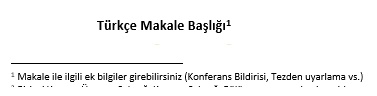
- Author information should be included after the title of the article. Author names should be added just below the title, separated by commas. Footnotes should be given to each author, starting with 1 if there is no article description, and 2 if there is an article description. In the footnote section, the author's title, institution, department, e-mail and ORCID information should be included, respectively.
(Authors who send their article to our journal for evaluation should not apply the 8th item at the first stage. In accordance with the double-blind refereeing system we have adopted, author information should not be included in the article at the first stage. If your article is found suitable for publication after the refereeing process, your article will be sent to you again by the editor to make the necessary arrangements.)
- The abstract should not be less than 100 words, and not more than 300 words. In the abstract part, the aim, method and the result of the study should be explained briefly. References should not be made in the abstract.
- Under the abstract, there should be 5 keywords as in the spelling template. Keywords should be capital letters.
- Titles such as Article Title, Abstract, Introduction, Content Titles, Conclusion and Bibliography should be 12 in font size and Calibri (Body) font. Only the initials of the titles should be written in capital letters.
- Main, intermediate and sub-titles should be used in the article in order to determine the structure of the article and to provide a regular information transfer in the main text. If necessary, the headings should be numbered after the Introduction.
Introduction
- Main Title
1.1. Subtitle
- Main Title
2.1. Subtitle
- Line spacing in the entire document should be 1.15 cm.
- Paragraph spacing should be Left, Right, and 0nk Before and 8nk After.
- All texts except the title should be in Calibri (Body) font and font size 11.
- While titling, the heading degree should be selected from the style menu of Word and the font specified in the previous article should be applied.
Figures, Tables and Images
- Figures and visuals should be numbered starting from one and the explanation should be below the content.
- Tables should also be numbered starting from one. However, unlike the figures and visuals, the explanation should be above the table.
- The paragraph spacing of the tables should be 0nk in Before, After, Left and Right, and the font size should be 10 points. Table height should be as narrow as possible according to the content.
- Table, figure and visual explanations should be in 10 points.
Bibliography Style
- Journal of TAM Academy accepts articles prepared according to the latest version (7th Edition) of the APA citation system.
- Journal of TAM Academy recommends using reference management systems such as Mendeley, Zotero, Endnote for citation and bibliography. Word's own bibliography management system is compatible with Turkish. However, when APA style is used in bibliography management systems such as Mendeley, Zotero, and Endnote, adaptation problems with Turkish can be experienced. To solve this problem, you need to download the Turkish-adapted style file of APA from https://github.com/citation-style-language/styles/blob/master/apa-tr.csl and add it from the style settings menu of the relevant program.
- In in-text references, pages, paragraphs, etc. information should be included. Example: It should be (Yılmaz & Köse, 2012, p. 217), not (Yılmaz & Köse, 2012: 217).
- The most commonly used resource types in APA 7th Edition are:
Single Author Book
References: Yılmaz H. (2016). Becoming Turkish: Nationalist Reforms and Cultural Negotiations in Early Republican Turkey 1923-1945. Syracuse University Press
In-text: (Yılmaz, 2016, p. 45).
Book with Two Authors
References: Yılmaz, M., & Köse, Aynur. (2012). Seçimler ve Değerler. Serander Yayınları
In-text: (Yılmaz & Köse, 2018, p. 94)
Book with Three Authors
References: Binark, M., Bayraktutan, G., & Durna, T. (2020). İletişim Hakkı ve Yeni Medya Tehditler ve Olanaklar. Uğur Mumcu Vakfı Yayınları.
In-text: (Binark vd., 2020, p. 16)
Book with More than Three Authors
References: Turban, E., Outland, J., King, D., Lee, J. K., Liang, T.-P., & Turban, D. C. (2018). Electronic Commerce 2018: A Managerial and Social Networks Perspective. Springer International Publishing.
In-text: (Turban vd., 2018, p. 314)
Translation Books
References: Goodfellow, I., Bengio, Y., & Courville, A. (2018). Derin Öğrenme (Fatoş Yarman Vural, R. G. Cinbiş, & S. Kalkan, Çev.). Buzdağı Yayınevi.
In-text: (Goodfellow vd., 2018, p. 59)
Compilation Books
References: Mutlu, E. (Der.). (2010). Kitle İletişim Kuramları. Ütopya Yayınevi.
In-text: (Mutlu, 2010, p. 66)
Journal Articles
References: Yılmaz, M. ve Karakaş, O. (2019). ANALYSIS OF 23 JUNE 2019 ISTANBUL METROPOLITAN MUNICIPALITY ELECTION IN TERMS OF POLITICAL VALUES. AJIT-e: Online Academic Journal of Information Technology, 10(38), 35-52. doi:10.5824/1309-1581.2019.3.002.x
In-text: (Yılmaz & Karakaş, 2020, p. 76)
Web Pages
References: Akan, Y. (2018, June 9). Yeni Medya Nedir ve Ne İş Yapar? | Pazarlama Türkiye. https://pazarlamaturkiye.com/gun-gectikce-populerlesen-yeni-medya-nedir-ve-ne-is-yapar/
In-text: (Akan, 2018, par. 2) – (Par., paragrafın kısaltmasıdır.)

 May 28, 2024
Page
1-18
May 28, 2024
Page
1-18