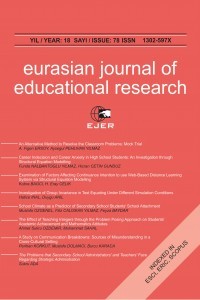
The Relationship of Art and Music Education with Adolescents' Humor Styles and Interpersonal Problem Solving Skills
Öz
Purpose: Today's education system focuses primarily on the academic skills of individuals. However, art and music education is thought to affect both humor and interpersonal problem-solving skills by supporting the social and emotional skills of adolescents. Therefore, this study was designed to investigate how receiving art and music education relates to adolescents’ humor styles and interpersonal problem-solving skills. Methods: A total of 178 adolescents were included in the study; this sample included 54 students attending the music department and 60 students attending the art department in a fine arts high school, and 64 students who were not receiving any art education and were studying in a regular high school. The “Humor Styles Questionnaire” and “Interpersonal Problem Solving Inventory (High School Form)” were used. Two-way analysis of variance and correlation coefficient significance test were applied to analyze the data. Findings: The results of the study showed that adolescents with healthy and compatible humor styles had effective problem-solving methods. Moreover, the results of the study revealed that the adolescents receiving art and music education both adopted more positive humor styles and preferred more effective methods for solving interpersonal problems than those who did not receive such education. These results demonstrate the importance of art education in supporting children developmentally. Implications for Research and Practice: Based on the results of the study, it can be asserted that a qualified art education is required, with sensitivity to the necessity of art education and its effect on development in societies.
Anahtar Kelimeler
Kaynakça
- Akyol, U. (2011). Ergenlerde iletisim becerilerinin yordayicilari olarak oz-duyarlik ve mizah tarzlari [Self-compassion and humor styles as predictor of communication skills in adolescents]. Yuksek Lisans Tezi, Mugla Univ. Egitim Bilimleri Enstitusu.
- Arslan, C., Hamarta, E., Arslan, E. & Saygin, Y. (2010). Ergenlerde saldirganlik ve kisilerarasi problem cozmenin incelenmesi [An investigation of aggression and interpersonal problem solving in adolescents]. Ilkogretim Online, 9, 379-388.
- Baris, A.D. (2002). Muzik egitimi alan ve almayan lise ogrencilerinin benlik tasarimi duzeylerinin cesitli degiskenlere gore incelenmesi [Regarding several variations examining levels of self-concept of the students both getting or not getting music education]. Yayinlanmamis Doktora Tezi, Gazi Univ. Egitim Bilimleri Enstitusu.
- Broh, B.A. (2002). Linking extra curricular programming to academic achievement: Who benefits and why? Sociology of Education, 75(1), 69-95.
- Buyukozturk, S. (2015). Sosyal bilimler icin veri analizi el kitabi. Ankara: Pegem Akademi.
- Buyukozturk, S., Kilic Cakmak, E., Erkan Akgun, O., Karadeniz, S. & Demirel, F. (2016). Bilimsel arastirma yontemleri [Scientific research methods]. Ankara: Pegem Akademi.
- Cam, S., & Tumkaya, S. (2008). Kisilerarasi problem cozme envanteri lise ogrencileri formu’nun gecerlik ve guvenirlik calismasi [Development of interpersonal problem solving inventory for high school students: The validity and reliability process]. Uluslararasi Insan Bilimleri Dergisi, 5, 1-17.
- Chen, G.H. & Martin, R.A. (2007). A comparison of humor styles, coping humor, and mental health between Chinese and Canadian university students. Humor, 20(3), 215–234.
Ayrıntılar
Birincil Dil
İngilizce
Konular
-
Bölüm
Araştırma Makalesi
Yayımlanma Tarihi
20 Kasım 2017
Gönderilme Tarihi
20 Kasım 2017
Kabul Tarihi
-
Yayımlandığı Sayı
Yıl 2017 Cilt: 17 Sayı: 72