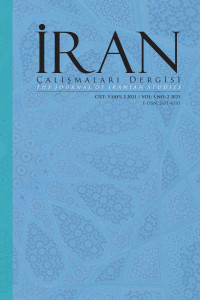
Volume: 9 Issue: 2 , 12/29/25

Year: 2025

Research Article

Book Review

Journal of Iranian Studies is an international peer-reviewed academic journal published twice a year, in June and December. The journal aims to promote and analyse Iran from an objective perspective at national and international level through scholarly studies on Iran in Turkish and English. Its aim is to publish research in various disciplines in order to provide a closer scientific and academic examination of Iran.


The Journal of Iranian Studies is open to scholarly research in Iran-related fields, especially in disciplines such as history, politics, social policies, economic policies, social studies, religious and sectarian studies, art and literature. Articles submitted on art and architecture should have an analytical and interpretive perspective within social, cultural, political and religious contexts. The journal does not cover formalist-descriptive art history topics.

Publication Principles and Author Guidelines

The information on this page is general information only. Please review the detailed author guideline before submitting your article. CLICK HERE for the guidelines.

a) Publication Principles
The articles published in the journal cannot be quoted without citing the source. Articles published in the journal cannot be published elsewhere. Studies that have been previously published elsewhere or submitted anywhere for publication will not be published in the journal. The journal publishes articles in Turkish and English. Authors are obliged to comply with the copyright and permission status of the visual materials etc. used in the articles. The journal bears no responsibility for the copyright and permission status of the materials used in the articles. Authors are expected to be meticulous in this regard and to indicate the copyright or permission status in the “disclosure” section. The journal does not charge any fee from the authors. The journal applies open access policy and does not charge readers for access.


b) General Rules
1) Articles submitted to the journal should be at least 6000 and maximum 9000 words including citations and references. Book reviews should be minimum 750 and maximum 1500 words.
2) Articles should include an abstract of 150-200 words in Turkish and English. Abstracts should not exceed 200 words. Turkish and English titles and abstracts must be a literal translation. Abstracts should be accompanied by 5 keywords ranked from general to specific in both languages
3) The text of the article should be written in Times New Roman font, 12-point font size and single line spacing. Footnotes used when needed should be written in 10-point font size and single line spacing. The main title of the article in English and Turkish should be written in 14-point font size and all other headings should be written in 12-point font size in bold. The title of the article and the bibliography should be written centrally, and all other headings should be left justified. Paragraph headings should also be left justified; paragraph headings should not be indented.
4) The titles of the articles should be numbered and the first title should be "1. Introduction". The main headings after the title "1. Introduction" should follow the number. Subheadings should also be numbered as 1.1., 1.2. etc. All headings, including the conclusion, should be numbered.
5) The references used at the end of the article should be given under the title "References". The bibliography title should start on a new page.
6) All materials such as tables, figures, photographs, etc. used in the article should be numbered. The materials should be placed above the material in the form of Table 1; Figure 2; Figure 3 etc., left justified and in bold.

c) Author Guidelines
As of 2021, the Journal of Iranian Studies has switched to the APA (American Psychological Association) 7th Edition reference system. The rules in the American Psychological Association - APA Publication Manual 7th Edition (2020) should be applied for references to source types that are not examples below.
Accordingly; citations are given in the form of a reference in the text in accordance with APA style and footnotes are not used in articles unless necessary. Footnotes may be used only when there is a need to explain a point. Citations in footnotes should also be given in accordance with APA style rules.


Important points that you should pay attention to when citing with APA 7 are as follows:

1) When referring in the text, only the surname of the first author should be written in publications with three or more authors. Other authors are indicated with the abbreviation "et al." or "vd." according to the language of the article.

For example; Baykal et al. (2014) or (Baykal et al., 2014). In studies with two authors, the surnames of both authors are written and the symbol "&" is placed between them. For example; "(Yeşil & Dinler, 2020)" or "According to Yeşil and Dinler (2020)...".

2) If the article you will cite has a DOI number, the DOI must be presented in the bibliography.

3) In the new version, the “access date” in references to websites in the bibliography have been removed. Access date can be given only when necessary.

4) In the current version, the place of publication has been removed from the bibliography. The place of publication does not need to be written in the bibliography.

5) The references in the bibliography should be listed alphabetically.

6) In in-text references, if a certain page of the source is used, the page number have to be specified. Paragraph numbers should be given in sources without page numbers such as websites. In cases where the page number is not specified, it will be understood that the entire source is cited. This rule applies to all sources.


For in-text citation and bibliography rules according to APA 7, CLICK HERE

Make sure that your citations are given according to the rules here. Make sure that your citations are given according to the rules here.
https://apastyle.apa.org/style-grammar-guidelines/references/examples 

Detailed examples and explanations can also be found in the publicly available Purdue University Writing Lab. https://owl.purdue.edu/owl/research_and_citation/apa_style/apa_formatting_and_style_guide/in_text_citations_the_basics.html 

You can also make use of the University Library of Western Sydney's publicly available APA7 examples and explanations.
https://library.westernsydney.edu.au/main/sites/default/files/pdf/cite_APA.pdf

The publication ethics of the Journal of Iranian Studies are based on the Code of Conduct and Best Practice for Journal Editors (Committee on Publication Ethics (COPE), 2011).

Editors' responsibilities:

Editorial decisions;
The editor and editorial board are responsible for deciding which articles submitted to the journal will be published. The editor evaluates the articles without taking into account the race, gender, sexual orientation, religious beliefs, ethnic origin, citizenship or political philosophy of the authors. The decision will be based on the importance, originality, and clarity of the article and the relevance of the work and its relevance to the scope of the journal. Existing legal requirements regarding defamation, copyright infringement and plagiarism are also taken into account.

Confidentiality;
The editor and any editorial staff member may not disclose any information about the submitted manuscript to anyone other than the corresponding author, reviewers, prospective reviewers, other advisors, and the publisher.

Disclosure and conflicts of interest;
Unpublished material described in the submitted manuscript may not be used by the editor or editorial board members for their own research purposes without the express written permission of the author.

Reviewers' responsibilties:
During the review process, reviewers assist the editor and editorial board in making decisions and also assist the author in improving the manuscript.
If the referee concludes that he/she is unable to review the research in an article in a qualified manner within the time limit, he/she notifies the editor and withdraws from the review process.

Confidentiality;
Manuscripts submitted for review are treated as confidential documents. They are not shared or discussed with others unless authorised by the editor.

Objectivity standards;
Comments are made objectively. Personal criticism of the author is inappropriate. Reviewers clearly express their views with supporting arguments.

Recognition of sources;
Reviewers identify works not included in the reference section of the article. They indicate whether observations or arguments derived from relevant publications are compatible with the sources. Reviewers inform the editor of their personal views on the manuscript under review and any significant similarities or overlaps between the manuscript and other published papers.

Disclosure and conflict of interest;
Privileged information or ideas obtained through peer review are kept confidential and not used for personal advantage or gain. Reviewers may not evaluate manuscripts in which they have conflicts of interest arising from competitive or collaborative relationships with authors or institutions.

Authors' duties:
Reporting standards;
Authors of original research reports should present an objective discussion of the significance and precise results of the work performed. Basic data must be correctly presented in the article. A paper should include sufficient details and references to allow others to reproduce the work. False or deliberately false statements constitute unethical behaviour and are unacceptable.

Data access and retention;
Authors may be asked to provide the raw data of their study with the manuscript for editorial review and, if applicable, should prepare for the data to be made publicly available. In any case, authors should ensure accessibility to other authorised professionals for at least ten years after publication (preferably through an institutional or subject-based repository or other data centre), provided that the confidentiality of participants can be maintained. Legal rights to proprietary data do not prevent publication.

Originality, plagiarism and acknowledgement of sources;
Authors shall only submit entirely original work and/or cite other works as appropriate. Reference should also be made to other publications that have been influential in determining the nature of the work reported.

Multiple or simultaneous publication;
In general, articles describing the same research should not be published in more than one journal. Submitting the same article to more than one journal constitutes unethical publishing behaviour and is unacceptable. 

Ownership of the paper:
Ownership should be limited to those who made significant contributions to the design, execution, or interpretation of the submitted work. All significant contributors should be listed as co-authors. The corresponding author ensures that all contributing co-authors are included and that persons not participating in the author list are not included. The corresponding author will also verify that all co-authors have approved the final version of the manuscript and agreed to its submission for publication.

Disclosure and conflicts of interest;
Authors are obliged to disclose the financial sources, collaborations and conflicts of interest they have used in reaching the results and interpretations of their articles. All sources of financial support for project-based studies should be disclosed.

Fundamental errors in published works;
When an author discovers a major error or inaccuracy in his/her published work, he/she is obliged to notify the journal editor or publisher immediately and to cooperate with the editor to withdraw the article or to correct it in the form of an erratum.

References;
Committee on Publication Ethics (COPE). (2011, 7 March). Code of Conduct and Code of Best Practice for Journal Editors;
Retrieved from http://publicationethics.org/files/Code_of_conduct_for_journaleditors_Mar11.pdf

PUBLICATION POLICY

Blind peer review is a method for ensuring that scientific publications are of the highest quality. Blind peer review is at the heart of good scientific publishing and is carried out by all reputable journals. Our reviewers play a crucial role in maintaining the high standards of our journal and all manuscripts are subject to the blind review process outlined below.

Pre-Evaluation:
The pre-evaluation process consists of two stages. In the first stage, all manuscripts submitted for evaluation are subjected to a similarity check in the plagiarism software. Manuscripts with a similarity rate of 20% or more are returned to the author(s). In the second stage, the manuscripts are checked for compliance with the journal's editorial rules and scope. Articles that pass these stages are included in the blind review process. The author(s) of the article rejected at the preliminary control stage are notified within 1 week.

Editorial Review:
The editor is responsible for deciding whether to accept the articles referred to him/her into the refereeing process or to reject them without entering the refereeing process. Manuscripts rejected at this stage are not original enough, have serious conceptual and/or methodological flaws, have inadequate or poor English/Turkish language skills, or are outside the scope and purpose of the journal.
At this stage, the author(s) of the rejected article will be notified within 10 days after the article is taken into consideration. For all articles rejected without review, the editor will provide feedback and, where possible, suggest other suitable outlets.

Manuscripts found suitable for the refereeing process are sent to 2 referees who are experts in their fields. The positive report of at least 2 referees is required for the article to be published. In case of need, it is at the discretion of the editor to apply to the 3rd referee.

Referee Evaluation:
In the double blind review process, the information of both authors and referees is kept confidential. In order to allow this process, authors should not include their identity information directly or indirectly in their articles.

Beyond the need to remove names and institutional information from the title of the manuscript, there are other important edits that need to be made to ensure that the manuscript is properly prepared for double blind peer review. Some considerations to assist in this process are as follows:

Use the third person singular pronoun when referring to previous work by the author(s), e.g. "as previously mentioned (Anonymous, 2007)" instead of "as previously mentioned"

In the text, cite works published by the author as follows (Anonymous, 2007). In the bibliography, the appropriate notation is as follows. (Anonymous, 2007, details omitted due to blind refereeing).

If you have received project support or funding from any private or public institution or organisation within the scope of the study, do not share any information about it. This information will be added at the layout stage if the manuscript is accepted.

Do not thank anyone in the article. This information will be added at the layout stage if the manuscript is accepted. When naming the article file, do not use your name and identity information, and make sure that your name is not mentioned in the document properties.

Our referee database is continuously updated and referees are randomly assigned taking into account their areas of expertise. The points we expect our referees to take into account in the evaluation of the manuscript are as follows:

Originality and contribution to literature

Of potential interest to a wide range of social scientists and/or practitioners

Candidate for the interest of a wide readership

Comprehensive evaluation of the existing literature

Methodology, analysis and interpretation competence

A clear, concise, and fluent style of expression

Reviewers are asked to provide comments to authors without disclosing their identity. Reviewers are also given the option to make confidential comments to the editor. Comments to the author(s) are also visible to other reviewers.

Please note that language correction is not part of the blind review process. However, reviewers are encouraged to make suggestions for improving the language and style of the manuscript.

In general, the refereeing process is completed within 2-3 months. If the referees' opinions contradict each other or if the referee report is delayed for any reason, another referee opinion will be obtained. If necessary, revised manuscripts may be sent back to the author(s) for further revision. Reviewers and/or the editor may request more than one revision, and additional reviewers may be invited at any time to evaluate the manuscript.

Final Evaluation:
The final decision is made by the "Editorial Board" for all articles that have been favourably evaluated by the referees and reached the publication stage. At this stage, the Editorial Board re-examines the article and checks whether the content of the article is compatible with the referees' decisions. Although the referee reports are positive, the Editorial Board may refrain from publishing the article in case of force majeure that the scope and rules of the journal are violated. In this case, the decision is communicated to the author(s) together with the referees' recommendations.

• The Journal of Iranian Studies is a signatory to the Budapest Open Access Initiative (BOAI), which promotes free access to research literature, and has adopted the Open Access Principles described in the initiative.
• Articles in the Journal of Iranian Studies are free to read and download.
• The Journal of Iranian Studies does not pay any fees to authors, referees, editors and editorial board.
• Journal of Iranian Studies is an open access journal that does not charge subscription fees.
• The Journal of Iranian Studies does not charge any fees for article submission, refereeing and editing processes, layout and publication printing (page or color fees).
• All works in the Journal of Iranian Studies are archived with the LOCKSS (Lots Of Copies Keep Stuff Safe) system through TÜBİTAK ULAKBİM DergiPark.

Editörler

Ahmet Yeşil
Assoc. Prof. Dr. Ahmet YEŞİL SAKARYA ÜNİVERSİTESİ, İLAHİYAT FAKÜLTESİ
Turkish Islamic Literature

Editör Yardımcıları

Menderes Kurt
Asst. Prof. Dr. Menderes KURT MARDİN ARTUKLU ÜNİVERSİTESİ
Middle East Studies, Contemporary History of Middle East, Early Modern History of Middle East
Burak Çakırca
Dr. Burak ÇAKIRCA BURSA TEKNİK ÜNİVERSİTESİ
International Politics
Default avatar
Res. Assist. Alperen AYDIN BURSA TECHNICAL UNIVERSITY
Turkish Foreign Policy
International Relations, Middle East Studies

Dr. Zana Baykal Sakarya Üniversitesi Ortadoğu Enstitüsü'nde araştırma görevlisi olarak çalışmaktadır. 

International Relations, Regional Studies, Middle East Studies, Turkish Foreign Policy
Melih Kazdal
Asst. Prof. Dr. Melih KAZDAL MARDİN ARTUKLU ÜNİVERSİTESİ
Political Science, International Relations, Middle East Studies
Religion, Society and Culture Studies, Islamic Sects

Kitap İnceleme Editörü

İsmail Akdoğan
Assoc. Prof. Dr. İsmail AKDOĞAN BURSA TEKNİK ÜNİVERSİTESİ
Middle East Studies

Alan Editörü (İngilizce)

Default avatar
Assoc. Prof. Dr. İbrahim EFE KİLİS 7 ARALIK ÜNİVERSİTESİ, İKTİSADİ VE İDARİ BİLİMLER FAKÜLTESİ, SİYASET BİLİMİ VE KAMU YÖNETİMİ BÖLÜMÜ
Discourse and Pragmatics, Communication and Media Studies, Migrant Cultural Studies, Culture, Representation and Identity, Race/Ethnicity and Crime, Political Science

Alan Editörü (Tarih)

Peace Studies, Political History (Other)
Default avatar
Prof. Dr. Osman ÖZGÜDENLİ MARMARA ÜNİVERSİTESİ, TÜRKİYAT ARAŞTIRMALARI ENSTİTÜSÜ
Political and Civilization History of Islam, History of Seljuk, History of Muslim Turkish Countries and Societies

Alan Editörü (Felsefe)

Linguistics, Philosophy, Religion, Society and Culture Studies

Alan Editörü (Fars Dili ve Edebiyatı)

Nezahat Başçı
Asst. Prof. Dr. Nezahat BAŞÇI MARDİN ARTUKLU ÜNİVERSİTESİ
Persian Language, Literature and Culture

Alan Editörü (Türk Dili ve Edebiyatı)

Gökhan Tunç
Prof. Dr. Gökhan TUNÇ ANADOLU ÜNİVERSİTESİ

Gökhan Tunç, 2002 yılında Ankara Üniversitesi, Dil ve Tarih-Coğrafya Fakültesi Türk Dili ve Edebiyatı Bölümünde lisans; 2006 yılında, Bilkent Üniversitesi Türk Edebiyatı Bölümünde yüksek lisans eğitimini tamamladı. 2011 yılında hazırladığı “Millî Mücadele’nin Türk Romanına Yansıması” adlı teziyle Ankara Üniversitesi Sosyal Bilimler Enstitüsünden doktor unvanını aldı. Adam Öykü, Atatürk Üniversitesi Türkiyat Araştırmaları Enstitüsü Dergisi, Bilig, Edebiyat Otağı, Erdem, Folklor ve Edebiyat, Hece, Karadeniz Araştırmaları, Kardeş Kalemler, Kebikeç, Millî Folklor, Şehriyar, Tübar, Turkish Studies, Türk Edebiyatı, Uluslararası Sosyal Araştırmalar, Yeni Türk Edebiyatı Araştırmaları gibi dergilerde yazıları yayımlandı. 2011 yılında Kadim Yayınlarından Çağdaş Mesnevinin Peşinde: Nâzım Hikmet’in Ferhad ile Şirin’i ve Sezai Karakoç’un Leylâ ile Mecnun’u adlı kitabı; 2018 yılında Ötüken Yayınlarından Rüzgâra Karşı Duran Şair: Etkilenme Endişesi Kavramı ve Yahya Kemal’in Türk Şiirine Etkisi ve Hece Yayınlarından Kavramlar ve Kuramlarla Modern Türk Şiiri İncelemeleri adlı kitapları yayımlandı. Hüseyin Cahit Yalçın’ın eski harflerle yayımlanan Hayâl İçinde adlı romanını bir inceleme ile birlikte yeni harflere aktardı. Ayrıca İş Bankası Kültür Yayınlarından yayımlanan Asfalt Ovalarda Yürüyen Abdal: Behçet Necatigil adlı kitabı yayına hazırladı. Anadolu Üniversitesi tarafından yayım­lanan Türk Klasikleri serisinin genel yayın yönetmenliğinde bulundu. Tunç, 2003 yılında Bilkent Üniversitesi, Türk Edebiyatı Bölümünden Melih Cevdet Anday Onur Ödülü’nü; 2011 yılında yayım­lanan Çağdaş Mesnevînin Peşinde: Nâzım Hikmet’in Ferhad ile Şirin’i ve Sezai Karakoç’un Leylâ ile Mecnun’u adlı kitabıyla İLESAM tarafından yılın edebî tenkit ödülünü; 2021 yılında Şiir ve Bellek: Modern Türk Şiirinde Bellek Metaforları kitabıyla Söylem Filoloji ve Mehmet H. Doğan ödülünü aldı. Hâlen Anadolu Üniversitesi Edebiyat Fakültesi Türk Dili ve Edebiyatı Bölümünde öğretim üyeliği görevini sürdürmektedir.

Modern Turkish Literature in Turkiye Field

Alan Editörü (İlahiyat)

Muammer İskenderoğlu 1972 yılında Trabzon’da doğdu. 1982’de Trabzon Merkez Uğurlu Köyü İlkokulu’nu, 1989’da Trabzon İmam Hatip Lisesi’ni bitirdi. Aynı yıl kazandığı Marmara Üniversitesi İlahiyat Fakültesi’nden 1993 yılında mezun oldu. 1994 yılında YÖK’ün açtığı Yurtdışı Lisansüstü Eğitim Bursu’nu kazanarak Sakarya Üniversitesi İlahiyat Fakültesi adına yurtdışına gönderildi. 1995-97 yılları arasında İngiltere Manchester Üniversitesi Ortadoğu Çalışmaları Bölümü’nde Yüksek Lisans yaptı. 1997’de Birmingham Üniversitesi İlahiyat Bölümü’nde başladığı Doktora çalışmasını Haziran 2001’de tamamladı. Türkiye’ye dönüşünü müteakip Sakarya Üniversitesi İlahiyat Fakültesi Felsefe ve Din Bilimleri Bölümü’nde göreve başladı. 2005 yılında Milli Eğitim Bakanlığı’ndan Arap Dili ve Edebiyatı bursu kazanarak Ürdün’e gitti ve 2005-2006 ders yılında Ürdün Üniversitesi’nde derslere katıldı. 2009 yılı yaz döneminde Tahran Üniversitesi’ne bağlı Loghatnameh Dehkhoda Institute & ICPS’de Fars Dili ve Edebiyatı çalıştı. 2010 yılı yazında da Tahran İmam Sadık Üniversitesi’nde derslere katıldı ve alanıyla ilgili çalışmalarda bulundu. 2011 yılı bahar döneminde Belçika Leuven Katolik Üniversitesi’nde alanıyla ilgili çalışmalarda bulundu. 2017-2021 yılları asasında Recep Tayyip Erdoğan Üniversitesi İlahiyat Fakültesi’nde görev yaptı. 2017-2021 yılları arasında Bolu Abant İzzet Baysal Üniversitesi İlahiyat Fakültesi’nde görev yaptı. Halen bağımsız araştırmacı olarak çalışmalarını sürdürmektedir.

Philosophy, Philosophy of Religion

Alan Editörü (Uluslararası İlişkiler ve Siyaset Bilimi)

Rahman Dağ
Prof. Dr. Rahman DAĞ MARMARA ÜNİVERSİTESİ
Political Science, Comparative Political Movement, Political Movement, Turkish Political Life, International Politics, Middle East Studies, Turkish Foreign Policy, International Security, Politics in International Relations

Alan Editörü (Sosyoloji)

Yusuf Adıgüzel
Prof. Dr. Yusuf ADIGÜZEL ANADOLU ÜNİVERSİTESİ
Media Studies, Communication Studies, Migration Sociology, Communication Sociology

Danışma Kurulu

Contemporary History of Iran
Fatemeh Janahmadi
Prof. Dr. Fatemeh JANAHMADİ Tarbiyat Modares University
History of Islam
Default avatar
Prof. Dr. Arif BİLGİN SAKARYA ÜNİVERSİTESİ
Ottoman Society

1978 Kasım’ı İstanbul’da doğdu. İlköğrenimini Fatih’te, ortaöğrenimini Üsküdar’da, lisans eğitimini Ankara Üniversitesi (İlâhiyat Fakültesi)’nde (2002) tamamladı. Yüksek lisansını (2004) ve doktorasını (2010) Ankara Üniversitesi Sosyal Bilimler Enstitüsü, İslâm Tarihi ve Sanatları Bölümünde (Türk-İslâm Edebiyatı) yaptı. 2005-2011 seneleri arasında farklı liselerde öğretmen olarak görevde bulundu. Ekim 2011 itibarıyla Sakarya Üniversitesi İlâhiyat Fakültesi Türk-İslâm Edebiyatı A.B.D.’de Yrd. Doç. Dr. olarak başladığı görevine 2018’den beri Doçent olarak devam etmektedir. Ayrıca 2023 yılı itibarıyla Anadolu Üniversitesi Türk Dili ve Edebiyatı bölümünde lisansını tamamlamıştır. Yayımlanmış telifleri, ulusal ve uluslararası makale ve tebliğleri vardır. Farklı seviyelerde olmakla birlikte, İngilizce, Farsça ve Arapça hakkında malumat sahibidir. Evlidir; Kerem Ali, İbrahim ve Alparslan isminde üç oğlu vardır. Yayımlanan bazı eserleri şöyledir: 1. Tanzimattan Cumhuriyet’e Değişen Metafizik ve Edebiyat- Abdülhak Hâmid Örneği, İz Yayıncılık, İstanbul, 2014. 2. Klasik Şerh Geleneğinde Üslûp -Kasîde-i Bürde Örneği, İz Yayıncılık, İstanbul, 2018. 3. Âşık Ömer, Ketebe Yayınevi, İstanbul, 2018. 4. Tasavvuf Edebiyatı -İsimler, Kavramlar ve İlişkiler Ağına Metodik Bir Yaklaşım- (9-13. yüzyıllar), Bursa Akademi Yayınları, 2023.

Linguistics, Persian Language, Literature and Culture, Turkish Islamic Literature, Art History, Religion, Society and Culture Studies, Sufism
Middle East Studies, Contemporary Mediterranean History, Contemporary Asian History, Contemporary European History, Middle Eastern and North African History
Political Theory and Political Philosophy, Intellectual History of Politics, Turkish Political Life
Default avatar
Asst. Prof. Dr. Muhammed Mücahid DÜNDAR SAKARYA ÜNİVERSİTESİ, İLAHİYAT FAKÜLTESİ
Religion, Society and Culture Studies, Islamic Sects, Kalam
Philosophy of State, Ethics, Philosophy of Law, Philosophy of Society, Political Science, Political Theory and Political Philosophy

1957 yılında Trabzon’da doğdu. 1979 yılında Atatürk Üniversite-si Edebiyat Fakültesi Arap-Fars Dili ve Edebiyatı Bölümü’nden mezun oldu. Aynı bölümde 1980 yılında Fars Dili ve Edebiyatı Anabilim Dalı’nda asistan olarak göreve başladı. 1985 yılın-da doktor, 1990 yılında yardımcı doçent, 1991 yılında doçent ve 1997 yılında profesör unvanlarını aldı. Atatürk Üniversitesi, Selçuk Üniversitesi ve Kırıkkale Üniversitesinde görev yaptı. Kırıkkale Üniversitesi'nde 11 Şubat 2010- 10 Şubat 2014 tarihleri arasında rektör yardımcılığı görevinde bulundu. Ankara'daki Mevlânâ Araştırmaları Derneği'nin başkanlığını 2004 yılından itibaren sürdürmektedir. Fars Dili ve Edebiyatı, Klâsik Türk Edebiyatı, Mevlânâ ve eserleri üzerinde çalışmalar yapmaktadır.

Persian Language, Literature and Culture, Cultural and Natural Heritage
Şahin Ahmetoğlu
Prof. Dr. Şahin AHMETOĞLU Kilis 7 Aralık Üniversitesi
Islamic Sects, Kalam
Social Policy (Other), Middle East Studies
Islamic Intellectual History, Ottoman history, Sufism
Nigar Gozalova
Assoc. Prof. Dr. Nigar GOZALOVA Azerbaijan National Academy of Sciences

Gozalova, Nigar, Dr, Senior researcher at the Institute of History, Azerbaijan National Academy of Sciences. Her fields of interest are the International Relations & Area Studies and History of the South Caucasus. She has studied the history of Azerbaijan statehood and international Relations of South Caucasus.

Contemporary History of Middle East, Turkish Society and Community, History of Muslim Turkish Countries and Societies

Dil ve Edebiyat Bilim Dalı Üyeliği, 2016 ← 2016
Polonyalı göçmenlerin (ikinci bir yuva arayışı içinde) İran'a gelişinin 75. yıldönümüne ilişkin uluslararası konferansın akademik personeli 2016 ← 2016
Beşeri Bilimler Metinleri ve Kitapları İnceleme Kurulu Üyeliği, 2016 ← 2016
Bilim, Araştırma ve Teknoloji Bakanlığı Fars dili ve edebiyatı ihtisas grubunun üyesi 2015 ← 2016
Cava Harezmi Festivali 2015 ← 2016 Zan ve Fars edebiyatı uzman grubunun jürisi
Fars dili ve İran araştırmaları derslerinin müfredatını derlemek ve gözden geçirmek için çalışma grubunun üyesi 2015 ← 2017
Grup yöneticisi 1394 ← 1396
Yüksek Öğrenim Geliştirme Ofisi'nin beşeri bilimler uzman grubunun üyesi, 2013 ← 2015
Grup yöneticisi 1392 ← 1393

Persian Language, Literature and Culture
Default avatar
Prof. Dr. Namir KARAHALİLOVİć University of Sarajevo
Contemporary History of Iran
Default avatar
Dr. Firuz-akhtar LUBIS The National University of Malaysia (UKM)
Persian Language, Literature and Culture, Comparative and Transnational Literature
Default avatar
Dr. Hossein MOHAMMADİ SİRAT Imam Sadıq University
Middle East Studies, Contemporary History of Iran
Default avatar
Dr. Olsi JAZEXHİU International Islamic University Malaysia
Middle East Studies
Default avatar
Assoc. Prof. Dr. Tajudeen SANNİ University of the West of England

SERMINE

SERMINE

Islamic Law
Fikret Birdişli
Prof. Dr. Fikret BİRDİŞLİ İNÖNÜ ÜNİVERSİTESİ
International Relations (Other)
İsmail Güleç
Prof. Dr. İsmail GÜLEÇ İSTANBUL MEDENİYET ÜNİVERSİTESİ
Classical Turkish Literature
Fevzi Yiğit
Assoc. Prof. Dr. Fevzi YİĞİT SİVAS CUMHURİYET ÜNİVERSİTESİ
Islamic Philosophy

Yayın Kurulu

Default avatar
Prof. Dr. Adnan ÇEVİK Muğla Sıtkı Koçman Üniversitesi
Political and Civilization History of Islam, History of Seljuk, History of Muslim Turkish Countries and Societies
Default avatar
Assoc. Prof. Dr. Mehdi Abbaszadeh FATHABADİ Shahid Bahonar University of Kerman
Middle East Studies, Contemporary History of Iran
Default avatar
Prof. Dr. Ali GÜZELYÜZ İstanbul Üniversitesi
Language Studies, Persian Language, Literature and Culture, South-East Asian Language, Literature and Culture
Default avatar
Prof. Dr. Naser NİKUBAKHT Tarbiyat Modares University
Persian Language, Literature and Culture
Fuat Aydın
Prof. Dr. Fuat AYDIN SAKARYA ÜNİVERSİTESİ, İLAHİYAT FAKÜLTESİ
History of Religion, Religion, Society and Culture Studies, Studies in Eastern Religious Traditions

Kısa Özgeçmiş

Abdulla Rexhepi, Kosova, Priştine Üniversitesi Doğu Çalışmaları Bölümü'nde Farsça dil ve edebiyatı öğretim üyesi ve doçenttir. Priştine'deki Doğu Çalışmaları Bölümü'nde lisans eğitimini, Tahran Üniversitesi'nde ise Farsça dil ve edebiyatı üzerine yüksek lisans eğitimini tamamlamıştır. Arnavut bölgelerinde Farsça dil ve edebiyatının varlığı, Alamiado Arnavut edebiyatı ve İran düşünce tarihi üzerine araştırmalar yapmaktadır. İki monografisi yayınlanmıştır: “Arnavutlar Arasında Farsça Edebiyatın Yaygınlığı” (Tahran, 2019) ve “Naim Frashëri ve Farsça Edebiyat” (Tirana, 2020). İki kitabın editörlüğünü yapmış ve bazı bilimsel makalelerin yazarıdır. 

Language Studies

Tarsus Lisesi'nden sonra (1969), İstanbul Üniversitesi İktisat Fakültesi Siyasî İlimler-Maliye disiplerinden mezun oldu (1973). Doktorasını aynı fakültede siyaset bilimi anlanından verdi (1979). 1984'te doçent, 1989'da profesör oldu. Toplum Felsefesi, Siyaset Sosyolojisi, Demokrasi Teorileri alanlarında çalışmakta; hâlen Bursa Uludağ Üniversitesi İİBF, Siyaset Bilimi ve Kamu Yönetimi Bölümü'nde öğretim üyesi olarak akademik hayatına devam etmektedir.

Public Administration, Sociology (Other)
İran Tarihi (1700-1925), Arşiv Belgelerine Göre Osmanlı-İran İlişkileri (1700-1925), Osmanlı Tarihi Çalışmaktadır.
Contemporary History of Iran

29511 Creative Commons License

The Journal of Iranian Studies is licensed under the Creative Commons Attribution-NonCommercial 4.0 International (CC-BY-NC 4.0) licence.
The journal accepts the Open Access Journal Policy for expanding and flourishing of knowledge.