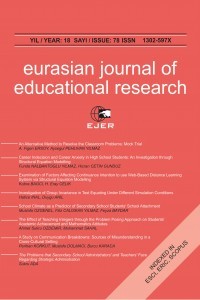
Investigating Relationships between Undergraduate Students’ Flow Experience, Academic Procrastination Behavior, and Calculus Course Achievement
Öz
Purpose: Calculus is generally offered as a freshman-year course and is a prerequisite for some advanced STEM-related courses in some undergraduate programs. However, some students experience difficulties in Calculus courses, leading to lower levels of achievement. Thus, there is a need to examine the factors which may be related to students’ achievement in Calculus courses. According to relevant literature, procrastination can diminish students’ achievement. Additionally, flow emerges as an important factor that may be related to students’ achievement and procrastination, but these relationships have not been studied in the context of Calculus courses.The purpose of this study was twofold. Firstly, undergraduate students’ academic procrastination was examined in relation to dimensions of flow experiences in a Calculus-I course. Secondly, undergraduate students’ academic achievement in Calculus-I course was explored in relation to their academic procrastination and dimensions of flow experiences. Research Methods: A total of 117 undergraduate students (54% female and 46% male, Mage=23.00) from various departments participated in an online survey. Findings: Multiple regression analysis showed that among flow-experience dimensions, “concentration on the task at hand” was negatively related to procrastination. In addition, two-step hierarchical regression analysis indicated that procrastination negatively predicted achievement in the first step. However, in the second step, only the “challenge-skills balance” dimension of flow positively predicted achievement. Implications for Research and Practice: In Calculus courses, if students are given tasks that foster their focus, their procrastination behavior can be diminished. In addition, if they are given tasks that are appropriate to their level and skills, their academic achievement can be predictably higher. In this context, real-life applications should relate to students’ own interests and skills. Therefore, their academic achievement can be higher.
Anahtar Kelimeler
Kaynakça
- Aitken, M. E. (1982). A personality profile of the college student procrastinator. Dissertation Abstracts 43A, 722-723.
- Akinsola, M. A. & Tella, A. (2007). Correlates of academic procrastination and mathematics achievement of university undergraduate students. Eurasia Journal of Mathematics, Science and Technology Education, 3(4), 363-370.
- Asci F.H., Caglar E., Eklund R., Altintas A. & Jackson S. (2007) Optimal performans duygu durum-2 olcekleri’nin uyarlama calismasi. [The adaptation study of dispositional flow scale-2 and flow state scale -2] Hacettepe Journal of Sport Sciences, 18, 182-196.
- Asikhia, O. A. (2010). Academic procrastination in mathematics: Causes, dangers and implications of counselling for effective learning. International Education Studies, 3(3), 205-210.
- Baker, F. A., & MacDonald, R. A. (2013). Flow, identity, achievement, satisfaction and ownership during therapeutic songwriting experiences with university students and retirees. Musicae Scientiae, 17, 131-146.
- Aysenur ALP – Semra SUNGUR / Eurasian Journal of Educational Research 72 (2017) 1-22 15
- Balkıs, M. (2006). Ogretmen adaylarının davranislarindaki erteleme egiliminin, dusunme ve karar verme tarzları ile iliskilerinin incelenmesi, [The relationships between student teachers’ procrastination behaviors, and decision-making styles] Yayınlanmamis Doktora Tezi. Dokuz Eylul Universitesi Egitim Bilimleri Enstitusu, İzmir.
- Bassi, M., Steca, P., Monzani, D., Greco, A., & Delle Fave, A. (2014). Personality and optimal experience in adolescence: Implications for well-being and development. Journal of Happiness Studies, 15(4), 829-843.
Ayrıntılar
Birincil Dil
İngilizce
Konular
-
Bölüm
Araştırma Makalesi
Yayımlanma Tarihi
20 Kasım 2017
Gönderilme Tarihi
20 Kasım 2017
Kabul Tarihi
-
Yayımlandığı Sayı
Yıl 2017 Cilt: 17 Sayı: 72