Jun 30, 2026
Publication Type
Articles
Research Article
Erratum
The Caucasian Journal of Science (CJO) is an international, peer-reviewed, open-access journal dedicated to advancing high-quality research in science education, environmental sustainability, and interdisciplinary applications of natural sciences. The journal aims to provide a scholarly platform for researchers, educators, and practitioners to disseminate original studies that contribute to improving teaching, learning, and innovation in science within local and global contexts.
CJO particularly emphasizes research that integrates sustainability perspectives, emerging technologies (e.g., artificial intelligence in education), and evidence-based practices in science education. The journal seeks to foster international collaboration and promote scientific knowledge that addresses contemporary environmental and educational challenges.
The journal publishes original research articles, review papers, and theoretical studies in the following areas:
- Science Education (Biology, Chemistry, Physics, STEM Education)
- Environmental and Sustainability Education
- Artificial Intelligence and Digital Technologies in Science Education
- Teacher Education and Professional Development in Science
- Curriculum Development and Instructional Design in Science
- Assessment, Evaluation, and Measurement in Science Education
- Interdisciplinary Studies Linking Natural Sciences and Education
- Applied Natural Sciences with Educational or Sustainability Perspectives
CJO prioritizes studies that offer empirical evidence, innovative methodologies, and practical implications. All submissions undergo a rigorous double-blind peer-review process and must adhere to international ethical publishing standards.

Tek Yazarlı / One author
Büyüköztürk, Ş. (2018). Sosyal bilimler için veri analizi el kitabı istatistik, araştırma deseni SPSS uygulamaları ve yorum. Pegem Akademi Yayıncılık.
Metin içi gönderme: (Büyüköztürk, 2018, s. 198)
Silverman, D. (2010). Qualitative research: theory, method and practice (3rd ed.). SAGE.
Metin içi gönderme: (Silverman, 2010, p. 110) veya Silverman (2010) suggests… (p. 110) Harris vd. (2001) ifade ettiği üzere (…) (p. 19)
İki yazarlı / Two authors
Yıldırım, A., & Şimsek, H. (2008). Sosyal bilimlerde nitel araştırma yöntemleri (6. Baskı). Seçkin Yayıncılık.
Metin içi gönderme: (Yıldırım & Şimsek, 2008, p. 78).
Üç ya da daha fazla yazarlı /Three or more authors
Anderson, L.W., Krathwohl, D. R., Airasian, P.W., Cruikshank, K. A., Mayer, R. E., Pintrich, P. R., et al. (2001). A taxonomy for learning, teaching, and assessing: a revision of Bloom’s taxonomy of educational objectives. Longman.
Metin içi gönderme: (Anderson et al., 2001, p. 41), “et al.” Türkçe metin içi kaynak gösterimlerinde “vd.” olarak eklenmelidir.
Doi numaralı / With a doi
Gillam, T. (2018). Creativity, wellbeing and mental health practice. Wiley Blackwell. https://doi.org/10.1007/978-3-319-74884-9
Metin içi gönderme: (Gillam, 2018, p. 11)
Kesharwani, P. (Ed.). (2020). Nanotechnology based approaches for tuberculosis treatment. Academic Press.
Metin içi gönderme: (Kesharwani, 2020, p. 49)
Kitap içi bölüm / Chapter in book
Clement, J. J. (2008). The role of explanatory models in teaching for conceptual change. In S. Vosniadou (Ed.), International handbook of research on conceptual change (pp. 417–452). New York/London: Routledge.
Metin içi gönderme: (Clement, 2008, p. 430)
Chiu, J., & Linn, M. C. (2012). The role of self-monitoring in learning chemistry with dynamic visualizations. In A. Zohar & Y. J. Dori (Eds.), Metacognition in science education (pp. 133–163). Dordrecht: Springer.
Metin içi gönderme: (Chiu & Linn, 2012, p. 141)
Magnusson, S., Krajcik, L., & Borko, H. (1999). Nature, sources and development of pedagogical content knowledge. In J. Gess-Newsome & N. G. Lederman (Eds.), Examining pedagogical content knowledge (pp. 95–132). Dordrecht, Netherlands: Kluwer.
Metin içi gönderme: (Magnusson et al., 1999, p. 130)
Chand, N. (2019). Standardized turmeric and curcumin. In R. C. Gupta, A. Srivastava, & R. Lall (Eds.), Nutraceuticals in veterinary medicine (pp. 3-24). Springer. https://doi.org/10.1007/978-3-030-04624-8 (With a doi/doi numaralı)
Metin içi gönderme: (Chand, 2019, p. 13)
Çeviri kitapta bölüm / Chapter in a translated book
Finger, J., & Bamford, B. (2010). Ölçme ve değerlendirmenin yönetimi. (K. Yılmaz & E. Oğuz, çev.). Sınıf yönetimi stratejileri öğretmen kılavuzu [The Classroom Teacher’s Book Of Management Essentials]. (Çev. Edt: T. Karaköse). Nobel Yayıncılık. s. 194-243.
Metin içi gönderme: (Finger & Bamford, 2010, s. 212)
Kitap İncelemesi / Book Review
Dent-Read, C., & Zukow-Goldring, P. (2001). Is modeling knowing? [Review of the book Models of cognitive development, by K. Richardson]. American Journal of Psychology, 114, 126-133.
Metin içi gönderme: (Dent-Read & Zukow-Goldring, 2001)
E-kitap / E-book
Acar, H. M. (2020). Yıldız tozu yoldaşlığı. https://thinpo.com/2ObKrVf
Metin içi gönderme: (Acar, 2020)

Chin, C. (2007). Teacher questioning in science classrooms: approaches that stimulate productive thinking. Journal of Research in Science Teaching, 44(6), 815–843. https://doi.org/10.1002/tea.20171
Metin içi gönderme: (Chin, 2007) veya Chin (2007)
Borji, V. & Sánchez, A. (2019). An exploratory analysis of the representations of functions in the university entrance exam in Spain and Iran. Eurasia – Journal of Mathematics, Science and Technology Education, 15(8), 1-12. https://doi.org/10.29333/ejmste/106258
Metin içi gönderme: (Borji & Sanchez, 2019)
He, J., Barrera-Pedemonte, F., & Buchholz, J. (2019). Cross-cultural comparability of noncognitive constructs in TIMSS and PISA. Assessment in Education: Principles, Policy & Practice, 26(4), 369-385. https://doi.org/10.1080/0969594X.2018.1469467
Metin içi gönderme: (He et al., 2019) veya He et al. (2019)
Sins, P. H. M., Savelsbergh, E. R., van Joolingen,W. R., & van Hout-Wolters, B. H. (2009). The relation between students’ epistemological understanding of computer models and their cognitive processing on a modelling task. International Journal of Science Education, 31(9), 1205–1229. https://doi.org/10.1080/09500690802192181
Metin içi gönderme: (Sins et al., 2009) veya Sins et al. (2009)
Nowiski, W., Haddoud, M. Y., Lancaric, D., Egerova, D., & Czegledi, C. (2017). The impact of entrepreneurship education, entrepreneurial self-efficacy and gender on entrepreneurial intentions of university students in the Visegrad countries. Studies in Higher Education, 44(2), 361-369. https://doi.org/10.1080/03075079.2017.1365359
Metin içi gönderme: (Nowiski et al., 2017) veya Nowiski et al. (2017)
Wolchik, S. A., West, S. G., Sandler, I. N., Tein, J., Coatsworth, D., Lengua, L., Johnson, A., Ito,H., Ramirez, J., Jones, H., Anderson, P., Winkle, S., Short, A., Bergen, W., Wentworth, J., Ramos, P., Woo, L., Martin, B., Josephs, M., … Brown, Z. (2005). Study of the brain. Psychology Journal, 32(1), 1-15. https://doi.org/10.1037/1061-4087.45.1.11 (up to 20 authors/20 yazardan daha fazla)
Metin içi gönderme: (Wolchik et al., 2017) veya Wolchik et al. (2017)
Förtsch, C., Werner, S., Dorfner, T., von Kotzebue, L., & Neuhaus, B. J. (2016). Effects of cognitive activation in biology lessons on students’ situational interest and achievement. Research in Science Education. https://doi.org/10.1007/s11165-016-9517-y (Erken görünüm makale kaynakça gösterimi)
Metin içi gönderme: (Förtsch et al., 2016) veya Förtsch et al. (2016)
Briscoe, R. (in press). Egocentric spatial representation in action and perception. Philosophy and Phenomenological Research. Retrieved from http://cogprints.org/5780/1/ECSRAP.F07.pdf (Baskıda olan makale kaynakça gösterimi)
…………………….
Lenske, G., Thillmann, H., Wirth, J., Dicke, T., & Leutner, D. (2015). Evaluation eines Tests zur Erfassung des pädagogisch-psychologischen Professionswissens von Lehrkräften [Evaluation of an test capturing pedagogical-psychological knowledge of teachers]. Zeitschrift für Erziehungswissenschaft, 18(2), 225-245. https://doi.org/10.1007/s11618-015-0627-5 (İngilizce dışında başka bir yabancı dilde kaynakça gösterimi)
Metin içi gönderme: (Lenske et al. 2015) veya Lenske et al. (2015)
Aynı yazarın aynı yıl yayınlanmış birden fazla eserinin metin içi gösterilmesi; (Alkan, 2019a, 2019b) veya Alkan’ın (2019a) çalışmasına göre (…)
Aynı yazara ait farklı yıllarda yayınlanmış çalışmaların metin içi gösterilmesi; (Alkan, 2010, 2012).
İki yazarlı çalışmaların metin içi kaynakça gösteriminde yazar adları ‘‘ve’’ (and) ile değil ampersen (&) işareti ile ayrılmalıdır.
Aynı soyisme sahip yazarlarda, karışıklığı önlemek için ismin ilk harfinin de kullanılması gerekir.
Metin içi gönderme: (M. Alkan, 2010; H. Alkan, 2018)

National Research Council (NRC). (2013). Developing assessments for the Next Generation Science Standards. National Academy Press.
The American Psychological Association (APA). (2020). Publication manual of the American Psychological Association (7th ed.).
American Psychiatric Association. (2013). Diagnostic and statistical manual of mental disorders (5th ed.). Author. https://doi.org/10.1176/appi.books.9780890425596
Nursing Council of New Zealand. (2012). Code of conduct for nurses [PDF]. https://www.nursingcouncil.org.nz/Public/Nursing/Code_of_Conduct/NCNZ/nursing-section/Code_of_Conduct.aspx?hkey=7fe9d496-9c08-4004-8397-d98bd774ef1b
Metin içi gönderme: The Nursing Council of New Zealand. (NCNZ, 2012) notes … (p. 11). veya (Nursing Council of New Zealand, NCNZ, 2012, p. 11).

Lankford, D. (2010). Examining the pedagogical content knowledge and practice of experienced secondary biology teachers for teaching diffusion and osmosis. (Unpublished doctoral dissertation). University of Columbia, Missouri.
Metin içi gönderme: (Lankford, 2010, s. 68)
Van Brunt, D. (1997). Networked consumer health information systems. (Doctoral Thesis). ProQuest Dissertations and Theses Date Base. (UMI No. 9943436)
Metin içi gönderme: (Van Brunt, 1997, s. 34)

Guo, D., Zhang, S., McTigue, E., & Wright, L. K. (2017, April). Do you get the picture?: A metaanalysis of the effect of graphics on reading comprehension. Paper presented at the American Educational Research Association conference, San Antonio.
Metin içi gönderme: (Guo et al., 2017)
Becker, J. R., & Rivera, F. (2005). Generalization schemes in algebra of beginning high school students. In H. Chick, & J. Vincent (Eds.), Proceedings of the 29th annual conference of the International Group for the Psychology of Mathematics Education (Vol. 4, pp. 121–128). PME.
Metin içi gönderme: (Becker & Rivera, 2005, p.123)

Bologna, C. (2019, October 31). Why some people with anxiety love watching horror movies. HuffPost. https://www.huffpost.com/entry/anxiety-love-watching-horrormovies_l_5d277587e4b02a5a5d57b59e Online kaynak gösterimlerinde “erişilmiştir (retrieved from)” ifadesine gerek yoktur.
Metin içi gönderme: (Bologna, 2019)
URL1. https://www.kosgeb.gov.tr/Content/Upload/Dosyagirisimcilik.pdf
Metin içi gönderme: (URL1)
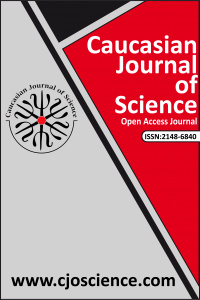
The Caucasian Journal of Science is a peer-reviewed journal established to publish research articles, short communications, case reports, review articles, and letters to the editor in the fields of Natural Sciences, Health Sciences, Engineering, and Science Education.
The ethical principles and rules applied by the journal are determined and adapted in accordance with the guidelines of the Committee on Publication Ethics (COPE). The journal also takes into account the recommendations of the International Committee of Medical Journal Editors (ICMJE) within the scope of international publishing standards and conducts its publication activities in full compliance with TR Index (TR Dizin) and the regulations of the Council of Higher Education (YÖK).
The journal adopts a diamond open access model to support equal access to scientific knowledge. Within this scope, no article processing charges (APC) or submission fees are required from authors, and all content is freely accessible to readers. The following principles have been established in organizing these rules according to the components of the journal.
Ethical Practices for Authors
- Authors are responsible for submitting original studies in the fields of Natural Sciences, Health Sciences, Engineering, and Science Education as specified in the scope of the journal.
- Authors must pay attention to proper citation according to the rules stated on the journal’s main page and use APA 7 format.
- Manuscripts submitted to the journal must not be under consideration by another journal at the same time, and authors must submit the “Copyright Transfer Form” together with the manuscript.
- Individuals listed as authors must have contributed to the study; individuals without academic contribution should not be included as authors.
- Authors are responsible for the accuracy of the data used in the study and must be ready to share the data when necessary (data availability and transparency principle).
- If artificial intelligence tools (e.g., ChatGPT, etc.) are used, this must be clearly stated. Artificial intelligence systems cannot be listed as authors (AI policy).
- Authors are obliged to provide supporting data such as reports, statistical results, and observational data when requested by reviewers. These data must be retained for at least 5 years.
- If authors notice an error in their work, they must inform the editor or field editor and request correction or withdrawal.
- In case of a conflict of interest regarding the submitted manuscript, all responsibility lies with the author, and the author bears all legal and administrative obligations.
Ethical Practices for Reviewers
- The journal applies a double-blind peer review system, and communication between authors and reviewers is prevented. All correspondence is conducted through the DergiPark system based on objective criteria. Reviewer reports are submitted through the same system, and reviewers requesting revisions are given the opportunity to re-evaluate the manuscript.
- Reviewers are assigned based on their expertise relevant to the submitted manuscript.
- Reviewers must act completely impartially, objectively, and based on scientific criteria during the evaluation process.
- Reviewers may not use the manuscripts they evaluate for personal benefit.
- In interdisciplinary studies, reviewer assignments are made according to the nature of the study by selecting reviewers from different fields to ensure objectivity.
- Authors may submit reviewer suggestions through the form on the journal’s main page; however, this does not influence the final reviewer selection. Suggested reviewers may be selected from national or international institutions, including retired academics who are experts in the field.
- Reviewers must hold at least a doctoral degree.
- Two primary reviewers and one alternate reviewer are assigned; in case of disagreement, a third reviewer is consulted as a final decision-maker.
- Reviewers must notify the journal management if they detect a conflict of interest.
- Reviewer evaluation forms must clearly state deficiencies, provide justification, and offer clear feedback to authors.
- Reviewers must express their critiques in accordance with academic writing standards. In case of inappropriate language, the reviewer is warned, and necessary actions are taken if repeated.
- Reviewers are expected to complete their evaluations within the given timeframe and comply with ethical responsibilities.
Ethical Practices for Editors
Editors must consider and adhere to the following:
- COPE Code of Conduct and Best Practice Guidelines for Journal Editors
- COPE Code of Conduct and Best Practice Guidelines for Journal Editors (communication guidelines)
- Editors make publication decisions solely based on scientific quality, originality, and relevance to the journal scope
- Editors are responsible for preventing conflicts of interest and ensuring transparency
- COPE Best Practice Guidelines for Journal Editors.
The editor is responsible for all published articles. The ethical duties and responsibilities of the editor are as follows:
General Responsibilities
- Ensuring that the journal reaches contemporary standards and contributes to the field is primarily the responsibility of the editor.
- The editor must guide authors without creating a hierarchical distance.
Editor–Reader Interaction
- The editor must ensure that content not subject to peer review (such as letters to the editor, invited papers, announcements) is clearly indicated.
- The editor must ensure that published articles are appropriate for the knowledge and expectations of readers.
Editor–Reviewer Relationship
- The editor must ensure that manuscripts are sent to appropriate reviewers.
- The editor must require reviewers to declare the absence of conflicts of interest before evaluation.
- The editor must provide all necessary documents and information to reviewers during evaluation.
- The editor must ensure the double-blind review process is maintained.
- The editor must monitor reviewers’ timely performance and feedback.
- The editor must collect feedback from reviewers periodically to improve the process.
- The editor must take necessary action against reviewers who violate ethical standards.
- The editor must continuously expand and update the reviewer pool..
Editor–Author Relationship
- The journal has clear writing rules stated on the main page, and the editor is responsible for informing authors about any changes.
- The editor reviews submitted manuscripts and forwards them to field editors. Field editors decide whether to proceed with evaluation or reject the manuscript. Rejection decisions must be justified objectively.
- The submission and acceptance dates are indicated in the manuscript.
- The editor is responsible for responding to authors’ inquiries regarding the manuscript process..
Editor–Editorial Board Relationship
- The editor may appoint or remove assistant editors or field editors when necessary.
- The editor must select qualified editorial board members who can contribute to the journal.
- The editor must ensure that editorial board members fulfill their responsibilities, including proper reviewer assignment, maintaining objectivity, and applying journal rules.
Journal Ethical Responsibilities
- The publisher accepts that the decision-making and peer review processes are under the responsibility of the editor.
- The journal adopts the principles of transparency, accountability, and academic integrity.
- The publisher ensures access to published articles via the official website and maintains open access.
- The journal is published both on its official website and on DergiPark, providing synchronized publication.
Plagiarism and Ethical Misconduct
Submitted manuscripts are screened using iThenticate or similar software. However, evaluation is based not only on similarity rates but also on editorial assessment and contextual analysis.
If plagiarism is detected by editors, the editorial board, or through complaints, the manuscript is rejected before publication.The journal defines unethical behavior as follows:
- In cases of ethical violations, the journal may publish corrections, retractions, or expressions of concern in accordance with COPE guidelines.
- The journal may retract articles in cases of plagiarism, data fabrication, ethical violations, or duplicate publication.
- Unjustified authorship (excluding contributors or including non-contributors)
- Failure to declare thesis or project origin
- Salami slicing (fragmentation of research)
- Failure to declare conflicts of interest
- Violation of the double-blind review process
- Republishing the same work in different languages in different journals.
Conflict of Interest
- All authors, reviewers, and editors must declare any potential conflicts of interest.
Other Indexes
Editor
Assistant Editors
Editorial Board