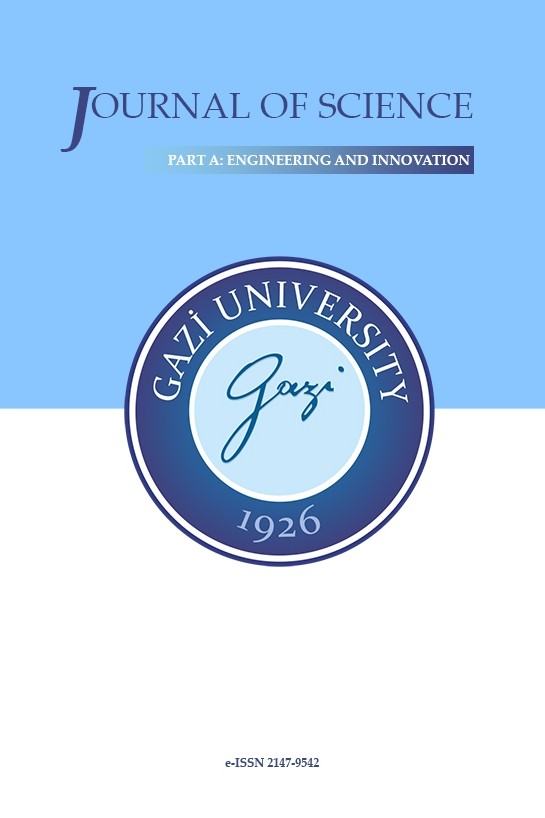

Gazi University Journal of Science and Technology A: Engineering and Innovation (GUJSA) journal publishes original and qualified research articles in all fields of engineering, technology and basic sciences. Technical notes, letters to the editor, discussions or case studies are excluded.
"Gazi University Journal of Science Part A: Engineering and Innovation (GUJSA)" is an open access journal and has adopted an Open Access Policy.
Innovative work, new methods, approaches or recent findings in engineering, technology and basic sciences with a balance of practice and theory are expected. Papers previously published in other journals are not accepted.
Submitted articles should be written in “MS Office Word” format in accordance with the “Article Writing Rules”.
Articles submitted in other formats will not be accepted.
This technical requirement ensures editorial consistency and does not restrict the open-access nature of the work.
The following FOUR (4) files must be uploaded while submitting an article to our journal.
1. Manuscript Template (📝 Manuscript Template.docx )
The article should be embedded in this template (without author names). Articles uploaded without the template will not be accepted.
2. Title Page (📝 Title Page.docx )
The Title of the Article, Abstract and Keywords, as well as the Contact Information (e-mail) of the Corresponding Author and the Names, Addresses and ORCID Numbers of all Authors should be included.
3. Licensing and Open Access Declaration (📝 Form.docx )
Authors retain the copyright of their manuscripts without any restrictions. Gazi University Journal of Science Part A: Engineering and Innovation (GUJSA) is a fully open-access journal. License Terms: All accepted articles are published under the Creative Commons Attribution-ShareAlike 4.0 International (CC BY-SA 4.0) license. Rights of Authors: By signing the Licensing and Open Access Declaration Form (formerly known as the Copyright Form), authors grant the journal a non-exclusive license to publish the work. The intellectual property and all proprietary rights remain fully with the authors. Permissions: This license allows third parties to share, adapt, and build upon the work for any purpose (including commercial), provided that appropriate credit is given and the new creations are licensed under the identical terms (ShareAlike)..
4. Similarity Reports (iThenticate)
Articles with a similarity rate of more than 20% (or 4% from a single reference) and 30% (including references, figure/table captions, article template) cannot be accepted. Authors should check the similarity rate with “iThenticate” when submitting the article and upload the files. This procedure applies to both initial submission and post-revision phases.
Publication Ethics and Malpractice Statement
A-Ethical Principles
GUJSA commits to adhering to international ethical standards and COPE guidelines. For all accepted manuscripts, a Licensing and Open Access Declaration Form must be signed. This form grants the journal a non-exclusive license to publish and distribute the work, while the full copyright and all proprietary rights remain permanently with the authors.
B-Ethical Responsibilities of the Authors
The similarity index must not exceed 20% (max 4% from a single source) and 30% with references. Authors acknowledge that their work will be available under the CC BY-SA 4.0 license. This allows others to share and adapt the work, even commercially, provided they credit the author and share derivative works under the same license.
Third-Party Materials: Authors must ensure that any included third-party content (images, tables, etc.) is compatible with the CC BY-SA 4.0 license. If certain materials are used under "Fair Use" or specific permissions, they must be clearly labeled as exceptions to the CC BY-SA license.
AI Policy: Generative AI tools cannot be listed as authors. Use of AI for content generation or data analysis must be disclosed in the "Acknowledgment" or a dedicated "AI Disclosure" section. Authors remain fully accountable for the accuracy and originality of AI-assisted outputs.
C-Ethical Responsibilities of the Reviewers
Reviewers must provide objective, confidential, and timely feedback. They are responsible for evaluating the scientific quality and originality of the manuscript while disclosing any potential conflicts of interest.
D-Responsibilities of the Editor Board
GUJSA follows a double-blind peer-review process. The process is free of charge and takes approximately 8 weeks. While the review is ongoing, the manuscript cannot be submitted elsewhere. Editors manage publication quality and ethical compliance following the COPE Short Guide to Ethical Editing..
Article submission and all other processes in the GUJSA are free of charge.