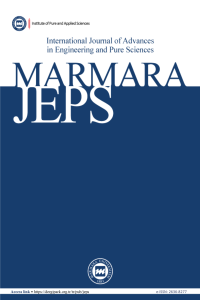
The journal "International Journal of Advances in Engineering and Pure Sciences," published by Marmara University, is a multidisciplinary international journal that has been in publication since 2008 (previously known as Marmara Journal of Science). It is indexed in the TÜBİTAK - ULAKBİM Engineering and Basic Sciences Database (TR Dizin).
Our journal is published four times a year, in March, June, September, and December.
We accept original research articles, technical notes, and publications produced from postgraduate theses in the fields of Basic Sciences, Engineering, and Technology.
Articles written in both English and Turkish are published in the journal.
All submitted articles are reviewed by at least two referees after an initial editorial screening. A double-blind peer review process is applied during the evaluation.
Submitted works must have a similarity rate of no more than 25% in total, and no more than 4% from a single source. Papers without a Copyright Transfer Form or that exceed the specified similarity limits are not considered for review.
The JEPS journal is indexed in the following databases:
TR Dizin
Google Scholar
Sobiad
The International Journal of Advances in Engineering and Pure Sciences (JEPS) is published four times a year in March, June, September, and December. It accepts original research articles and publications derived from postgraduate theses in the fields of Basic Sciences and Engineering. As a peer-reviewed journal, submitted papers are first reviewed by the editor and then evaluated by at least two expert referees.
Our journal accepts academic articles in the following fields, although the scope is not limited to these areas:
Basic Sciences:
Physics
Chemistry
Biology
Mathematics
Statistics
Engineering:
Computer Engineering
Environmental Engineering
Electrical and Electronics Engineering
Industrial Engineering
Energy Engineering
Genetic and Bioengineering
Food Engineering
Manufacturing Engineering
Civil Engineering
Geophysical Engineering
Chemical Engineering
Mechanical Engineering
Mechatronics Engineering
Metallurgical and Materials Engineering
Textile Engineering
Other Technological Fields:
Information Technology
Communication
Nanotechnology
Space Technologies
The articles featured in the International Journal of Advances in Engineering and Pure Sciences are based on original scientific work, whether theoretical, computational, or experimental, and derived from postgraduate thesis research in both basic and applied science fields.
Ethics: All articles published in our journal must adhere to scientific ethical guidelines.
Authors must comply with national and international ethical standards, and adherence to research and publication ethics should be explicitly stated within the "Article Writing Guidelines."
Scientific submissions should align with the recommendations of the ICMJE (International Committee of Medical Journal Editors) and COPE (Committee on Publication Ethics) "International Standards for Editors and Authors."
The submitted articles must not be previously published or under consideration for publication elsewhere. The responsibility for the content of the articles lies entirely with the author(s).
Articles can be submitted in Turkish and/or English, and the text must be clear, concise, and fluent, using technical terms appropriate to the field. Abstracts must be provided in both Turkish and English.
Articles should avoid unnecessary information or sources and must cite previously published data, formulas, and results with proper attribution. International conventions on nomenclature, abbreviations, and symbols should be followed. Any abbreviations specific to the article or field should be defined when first introduced in parentheses.
SI (Système International) units and abbreviations should be used throughout the article.
The International Journal of Advances in Engineering and Pure Sciences is a peer-reviewed journal, and articles are accepted after preliminary review by the editorial group and approval from at least two referees.
Submitted articles are first subjected to a preliminary review by the Journal Editor and/or Section Editor. All submissions are screened using the iThenticate plagiarism detection program. If the score is deemed inappropriate, the submission is rejected by the Editor or the Editorial Board. Even if the similarity score is acceptable, the Editorial Board retains the right to reject articles without sending them for peer review if they are deemed unsuitable for publication. Articles not conforming to the journal's formatting guidelines are returned to the authors for revision. Articles that pass preliminary review are sent to at least two reviewers for evaluation. The Journal Editor decides whether to accept the article for publication, based on the reviewers' reports. Reviewers must submit their evaluations within three weeks after accepting the review request, with reminders sent if the deadline is missed.
Manuscript Formatting:
The journal’s formatting guidelines also serve as the print format. Therefore, authors must carefully follow these guidelines. Articles that do not comply with the formatting requirements will be returned to the authors.
Manuscripts should be submitted electronically as MS Word files.
The text should be typed in 10-point Times New Roman font, single-spaced, with a 2.5 cm margin on all sides.
Figures, graphs, images, formulas, and tables should be original, clean, and well-prepared for print, inserted directly into the text. The Editorial Board is not responsible for converting these elements into digital format.
Article Structure:
The first page of the text should be in a single column, while all other pages should be in double columns. No indentation should be used for the first line of paragraphs. Single-line spacing should be applied throughout the text, with a 10-point space after paragraphs.
Title: The article title should be short, clear, and aligned with the topic, written in both Turkish and English. It should be centered, in bold, with the first letters capitalized, and written in 14-point Times New Roman font.
Authors and Affiliations: Authors' names should be centered, with surnames in uppercase, written in Times New Roman 10-point font. Different affiliations should be indicated with superscript numbers. Corresponding authors’ contact details should be included in the footer.
Abstract and Keywords: The abstract, both in Turkish and English, should not exceed 250 words. It should be written in 9-point font with the title in bold. Four to six keywords should be listed below the abstract.
Text Sections: For headings, a numbering system should be used (e.g., I, 1.1, 1.1.1), with the first-level headings in bold uppercase, second-level headings in italics, and third-level headings in normal italics. All text should be in 10-point Times New Roman font.
Figures and Tables: Figures and tables should be numbered and aligned according to the page layout. Titles should be placed above tables and below figures, using Times New Roman 10-point font. No abbreviations like "Fig." should be used; instead, write out the word "Figure" in full in the text.
References:
References should be presented in square brackets [X] in the order they appear in the text. They should be listed in 10-point Times New Roman font, following the APA style, without extra spaces between paragraphs. Examples include:
Books: [1] McInerney, M.J. (1999). Anaerobic metabolism and its regulation. In J. Winter (Ed.), Biotechnology (2nd ed., pp. 455-478). Wiley-VCH Verlag, Germany.
Theses: [1] Yapsakli, K. (2008). Application of Biological Activated Carbon (BAC) in drinking water treatment (Doctoral thesis). Boğaziçi University, Turkey.
Articles: [1] Zeng, R.J., Lemaire, R., Yuan, Z., & Keller, J. (2004). A novel wastewater treatment process: Simultaneous nitrification, denitrification, and phosphorus removal. Water Science and Technology, 50(10), 163-170.
Internet Sources: [1] Java Applets in Education, http://tech.irt.org/articles/js151, (Accessed June 2001).
Publication Process:
Articles that are ready for publication will be included in the next available issue, and issues are published collectively at the end of each quarter.
The journal's regular publication schedule is as follows:
Issue 1: End of March
Issue 2: End of June
Issue 3: End of September
Issue 4: End of December
A letter stating that "the submitted work has not been published elsewhere or submitted for publication elsewhere" must be uploaded as an additional document. All authors must sign a Copyright Transfer Form before publication can proceed.
Ethical Principles and Publication Policy
Publication Ethics
"International Journal of Advances in Engineering and Pure Sciences", published within the body of Marmara University Institute of Science, is a peer-reviewed journal whose publication processes are based on the scientific production, development and sharing of knowledge.
In the realization of scientific production, all components of the publication process; publishers, editors, authors, referees and readers must comply with ethical principles. In this context, the publication ethics and open access policy of the Journal of Marmara University Institute of Science, in line with the guidelines and policies published by the Committee on Publication Ethics (COPE) in open access (For example, the "Publication Ethics Committee (COPE) Code of Conduct and Best Practice Guidelines for Journal Editors, “Code of Conduct and Best Practice Guidelines for Journal Editors” and “COPE Best Practice Guidelines for Journal Editors”) require that all components of the publication process comply with ethical principles.
If situations such as manipulating and distorting the data used in the articles and using fake data are detected, this situation will be officially reported to the institution where the article writer works and the article will be rejected. Our journal has the right to request the output files of the analysis results from the authors according to the feedback given by the editor and / or referees.
Publisher's Ethical Responsibilities
Marmara University, the publisher of the "International Journal of Advances in Engineering and Pure Sciences", is a non-profit public education institution that pursues the public interest.
The publisher's ethical responsibilities are as follows:
• The publisher accepts that the decision maker and the refereeing process are the editor's responsibility during the article publishing process in the Third Sector Social Economy Magazine.
• The publisher provides open, electronic and free access to the journal on the journal's web page.
Responsibilities of the Editorial Board of the "International Journal of Advances in Engineering and Pure Sciences", published by Marmara University Institute of Science and Technology
• The Editorial Board of Marmara University Institute of Science and Technology "International Journal of Advances in Engineering and Pure Sciences" is responsible for every article submitted to the International Journal of Advances in Engineering and Pure Sciences Journal. and the Editorial Board knows this responsibility. This responsibility, considering only the public interest in decisions made on journal-related matters; it requires making decisions independently without considering personal gain. The relationship between the Publisher and the Editorial Board is based on the principle of independence, and all decisions taken by the editors are independent of the publisher and other persons and organizations.
• The Editorial Board strives to continuously improve the journal and increase its publication quality.
• Ensures the determination and implementation of journal policies such as publication, blind review, evaluation process, ethical principles.
• Protects the copyright of the article authors published in the journal.
• Responsible for taking measures regarding intellectual property rights, unscientific-unethical behaviors, plagiarism, sending (citation) gangs during the article and journal publishing process.
• Prepares an "Author's Guide" containing the information requirements of the author (s) and a "Referee Guide" containing the information that the referees will need during the evaluation phase, and updates it when necessary.
• Referees determine the policies that motivate the author (s).
• Keeps the records of each article and correspondence related to the journal electronically or in print.
Editor, Assistant Editors and Field Editors' Ethical Responsibilities
• Editors; They endeavor to meet the information needs of referees, author (s), researchers, practitioners and readers, to give feedback when necessary, to act according to the principles of clarity in matters that require correction in the publication process and clarification.
• While deciding on the publication of the articles, they take care that the articles are original and contribute to the scientific literature, readers, researchers and practitioners.
• While making positive or negative decisions about the articles, they take into account the original value of the articles, their contribution to the field, the validity and reliability of the research method, the clarity of the expression, and the purpose and scope of the journal.
• Unless the submitted articles have a significant problem, they take the pre-evaluation stage, consider the positive referee suggestions, and do not change the decisions made by the previous editor (s) unless there is a serious problem.
• They implement the policies of the blind review and evaluation process, which are among the publication policies of the journal, keep the identity information of the referees confidential, and ensure that each article is evaluated impartially and in time.
• They send the articles taking into account the field of expertise of the field editors and referees, and they support the impartial and independent evaluation.
• In order for the article to be evaluated objectively, they consider whether there is a conflict of interest between the editors, referees and author (s).
• They seek to ensure that the referee pool consists of a wide range and is constantly updated.
• They prevent unscientific evaluations that do not comply with academic etiquette.
• Ensures that the journal publishing processes are operated in accordance with the publication policies and guidelines, informs their field of duty in the process about the developments in publication policies, and prepares a training program when necessary.
• Those who take part in the broadcasting process are in effective communication with everyone and hold meetings at regular intervals.
• They ensure the protection of personal data in reviewed articles; protect individual data of authors, referees and readers.
• They pay attention to the protection of human and animal rights in the articles, they care about documenting the explicit consent of the participants of the article, they reject the article when they do not have the approval of the ethics committee for the participants of the article and their consent for experimental research.
• They take precautions against misconduct. When there are complaints about misconduct, he / she makes an objective investigation and shares the findings on the subject.
• They ensure that errors, inconsistencies or misdirections in the articles are corrected.
• Protect the intellectual property rights of the published articles and defend the rights of the journal and the author (s) in case of violation. In addition, they take necessary measures to ensure that the content of published articles does not infringe the intellectual property rights of other publications; They check for originality-similarity.
• They take into account the consistent criticism of the articles published in the journal, and allow the author (s) of the criticized articles to reply.
• They also consider studies that include negative results.
• They examine the complaints submitted to the journal and make the necessary explanations.
Ethical Responsibilities of Referees
Marmara University Institute of Science, "International Journal of Advances in Engineering and Pure Sciences Journal" applies the directional blind review principle in the article evaluation process, referees cannot directly communicate with the authors; The article evaluation forms and the notes stated on the text and the correction requests are forwarded to the author (s) by the editors through the journal management system. Referees who will evaluate the articles submitted to the International Journal of Advances in Engineering and Pure Sciences Journal of Marmara University Institute of Science should bear the following ethical responsibilities:
• Referees should only agree to evaluate articles related to their field of expertise.
• The evaluation should be done in neutral and confidentiality. In accordance with this principle, they should destroy the articles they have reviewed after the evaluation process, but use them after publication. Nationality, gender, religious belief, political belief and commercial concerns should not disturb the neutrality of the evaluation.
• When they understand that there is a conflict of interest-community of interest, they should refuse to evaluate the article and inform the editors.
• Make the assessment in accordance with academic etiquette and in a constructive language; Avoid personal comments containing insults and hostility.
• They should evaluate the article, which they accept, within due time.
Ethical Responsibilities of Authors
Ethical responsibilities of the author (s) who submitted an article to Marmara University Institute of Science, International Journal of Advances in Engineering and Pure Sciences:
• The author (s) should not send an article published elsewhere or submitted for publication, or more than one article simultaneously to the International Journal of Advances in Engineering and Pure Sciences.
• Must submit an original article to the International Journal of Advances in Engineering and Pure Sciences.
• It should be stated that the articles submitted to the journal are not sent to another journal and the Copyright Transfer Form should be filled in.
• Must correctly refer (cite) to the sources they use during article writing in line with ethical principles.
• The names of persons who do not contribute to the article should not be written as authors, it should not be suggested to change the order of the authors of an article submitted for publication, to remove or add authors.
• Notify the editors of the people who have a conflict of interest or a common interest in the article for publication.
• If information or raw data is requested from the author (s) during the evaluation process, they should submit the expected information to the Editors.
• They must document that the rights of use of the data they use in their articles, the permissions for research-analysis or the consent of the participants on which they conduct research.
• When they notice an error in the evaluation and early view or electronically published article, they should contact the editor to inform, correct or withdraw them.
• Approved by the ethics committee for studies that require data collection through quantitative or qualitative methods such as experiments, questionnaires, scales, interviews, observation, focus group work that require the decision of the ethics committee; The name of the ethics committee, the date and number of the decision should be stated on the first-last page of the candidate article and in the method section, and the document showing the ethics committee decision should be uploaded to the system with the application of the article. In addition, case reports should include information about obtaining informed consent / consent form in the article.
• In the article, they should present the evidences that they are attentive to ethical principles in the data collection process (obtaining permission from others to use documents such as scale, questionnaire, photograph). It should be stated in the articles that the copyright regulations for research and publication ethics and intellectual and artistic works are complied with. If the research was carried out on human and animal subjects, it should be reported that the research was carried out in accordance with international papers, guidelines, etc.
• Ethics committee approval is not required from the author (s) for review articles. However, for articles that do not require an ethics committee decision, it should be stated that an ethics committee decision is not required, on the first-last page and method section of the article.
Notifying the Editor of Non-Compliance with Ethical Principles
In Marmara University Institute of Science, International Journal of Advances in Engineering and Pure Sciences Journal, in the event of an unethical situation regarding editors, referees, authors or an article in the evaluation process, in an early appearance or published in an unethical situation, It must be sent to the address fbedergi@marmara.edu.tr .
Article submission and publishing processes are free of charge.
Prof. Dr. Bülent EKİCİ
Fen Bilimleri Enstitüsü Müdürü
Marmara Üniversitesi Fen Bilimleri Enstitüsü,
Göztepe Kampüsü 34722, Kadıköy, İSTANBUL, TÜRKİYE
Tel: +90 (216) 777 3630
E-posta: bulent.ekici@marmara.edu.tr
Sümeyra Gürkök 1981 yılında Ankara'da doğdu. Lisans derecesini 2002 yılında Ankara Üniversitesi Biyoloji Bölümü'nden, bütünleşik doktora derecesini ise 2012 yılında Orta Doğu Teknik Üniversitesi (ODTÜ) Biyoteknoloji Bölümü'nden almıştır. Doktorası sırasında, 2009 - 2010 yıllarında Manchester Biyoteknoloji Enstitüsü'nde bir yıl boyunca misafir araştırmacı olarak Manchester, İngiltere'de bulunmuştur. 2013 yılında Atatürk Üniversitesi Biyoloji Bölümü'ne Dr. Araştırma Görevlisi olarak katılmıştır. 2013 yılından bu yana Atatürk Üniversitesi Biyoloji Bölümü'nde görev yapmaktadır. 2018 yılında Yardımcı Doçent, 2023 yılında ise Doçent olmuştur.
Translated with DeepL.com (free version)
Sanem Arslan Yılmaz, Marmara Üniversitesi Bilgisayar Mühendisliği Bölümü'nde Dr. Öğretim Üyesi olarak görev yapmaktadır. 2017 yılında Boğaziçi Üniversitesi Bilgisayar Mühendisliği Bölümü'nden doktora derecesini almıştır. Kasım 2019 ile Ekim 2020 tarihleri arasında Barselona Süper Hesaplama Merkezi'nde (BSC) doktora sonrası araştırmacı olarak çalışmalarını sürdürmüştür. Araştırma ilgi alanları arasında Bilgisayar Mimarisi, Çok Çekirdekli Sistemler, Yüksek Performanslı Hesaplama, Hata Toleransı, Güvenilirlik ve Paralel Programlama yer almaktadır.
Semih Özel, Marmara Üniversitesi Endüstri Mühendisliği Bölümü'nde Dr. Öğretim Üyesi olarak çalışmaktadır. Doktora derecesini 2015 yılında Marmara Üniversitesi Endüstri Mühendisliği Bölümü'nden almıştır. Süreç yönetimi, KOBİ performans değerlendirmesi, teknoloji yönetimi, çok kriterli karar verme ve yapay sinir ağları ile tahminleme, pyton ile programlama alanlarında çalışmaktadır. IGDAŞ, TUSAŞ gibi önemli kurumlar ile işbirliği içinde bulunmuş ve çeşitli projelerde araştırmacı ve danışman olarak yer almıştır. 2008-2009 yılları arasında Bükreş Politeknik Üniversitesi'nde Avrupa Birliği FP6 Marie Cruie Yurt Dışı Araştırma Projesi kapsamında araştırmacı ve 2009 - 2010 yılları arasında Cardiff Üniversitesi'nde misafir araştırmacı olarak bulunmuştur.
Assoc. Prof. Dr. Serap Tepe – Academic, Consultant, and Trainer
Assoc. Prof. Dr. Serap Tepe serves as a faculty member at the University of Health Sciences in Türkiye and holds doctoral degrees in both Industrial Engineering and Occupational Health and Safety. Combining extensive professional experience in the private sector with her academic expertise, she provides both scientific and practice-oriented contributions to the field of occupational health and safety. Her research and professional interests include Risk Assessment, Psychosocial Risks, Occupational Health and Safety, and Multi-Criteria Decision-Making Methods. As a certified Class A Occupational Safety Specialist, Dr. Tepe not only conducts academic research and teaching but also serves as the Occupational Health and Safety Coordinator at her institution. In addition to her academic responsibilities, Dr. Tepe provides consultancy services, corporate risk management solutions, and professional training programs to organizations. She actively supports companies in achieving compliance with occupational health and safety regulations, enhancing risk assessment practices, and promoting employee well-being. She is also a certified Internal Auditor for Integrated Management Systems (ISO 9001:2015, ISO 14001:2015, ISO 45001:2018) and serves as an expert witness at both national and international levels. By integrating her academic knowledge with field expertise, Assoc. Prof. Dr. Serap Tepe contributes as a consultant, trainer, and subject-matter expert, adding value to organizations in Türkiye and across international platforms in the domain of occupational health and safety.
Doçent Dr. Meral Özomay, Marmara Üniversitesi, Fen Bilimleri Enstitüsü, Tekstil Eğitimi Anabilim dalında doktora derecesine sahiptir. Halen Marmara Üniversitesi, Teknoloji Fakültesi, Tekstil Mühendisliği Bölümünde Doçent Dr. Olarak görev yapmaktadır. Hazırgiyim Ana Bilim Dalı Başkanlığı görevini yürütmektedir. 2018 yılında açılışı yapılan ve pek çok bilimsel projeler ile desteklenen “Tekstil ve Yazma Eserler Konservasyon ve Restorasyon Ar-Ge Merkezi” isimli laboratuvarı kurmuş ve laboratuvar yöneticisi olarak görevini sürdürmektedir. Lisans, Yüksek Lisans ve Doktora çalışmalarına danışmanlık yapmaktadır. İlgi alanları hazırgiyim, tekstil terbiyesi, doğal boyama, çok kriterli karar verme yöntemleri, tekstil malzemeleri analizi, konservasyon ve restorasyondur.
Yeliz Karaca is an Associate Professor of Applied Mathematics, and a Senior Researcher Professor at the University of Massachusetts Chan Medical School (UMASS), USA; collaborator at Massachusetts Institute of Technology (MIT), USA. She received her Ph.D. degree in Mathematics with the dissertation entitled “Constituting an Optimum Mathematical Model for the Diagnosis of Multiple Sclerosis” from Marmara University, Türkiye in 2012. Among the other awards she has been given, she was also granted the “Cooperation in Neurological Sciences and Support Award” by Turkish Neurology Association as the first mathematician in Türkiye. She also holds a "medical card" as the only mathematician entitled for it. Furthermore, she received the Outstanding Young Scientist Award in 2012 and Best Paper Awards in her specialized discipline in 2012, 2013, 2014, 2016, 2017, 2019, 2020 as well as 2023, among the other awards in different categories. Another award of hers is Outstanding Reviewer Award (Mathematics Journal, MDPI) in 2021.
As for some publications, Dr. Karaca has a book entitled "Computational Methods for Data Analysis" published in 2018 by De Gruyter. Another publication is an edited book named "Computational Science and Its Applications" – Lecture Notes in Computer Science (ICCSA 2020, with series 1-7) by Springer. Her edited book is entitled "Multi-Chaos, Fractal and Multi-Fractional Artificial Intelligence of Different Complex Systems", published by Elsevier in 2022. Another work is entitled Computational Science and Its Applications – Lecture Notes in Computer Science (ICCSA 2023, with series I-9) by Springer. Another book is entitled Intelligent Fractal-Based Image Analysis: Applications in Pattern Recognition and Machine Vision, which is under the publication process by Elsevier. Besides these, another publication under publication process is a single-authored book, named "Computational and Mathematical Neuroscience, Biology & Medicine: Clinical and Medical Applications" by Wiley-IEEE Press.
She is the Editor-in-Chief of the book series named “Systems Science & Nonlinear Intelligence Dynamics” (https://www.worldscientific.com/series/ssnid) by World Scientific. She has been acting as an editor, guest editor and associate editor in many different issues in SCI indexed journals such as IEEE Access; Electronics, MPDI; International Journal of Big Data and Analytics in Healthcare (IJBDAH); ICCSA2020-Lecture Notes- Springer; Fractal AI-Based Analyses and Applications to Complex Systems, Fractals- World Scientific among others. In addition, she is the leading guest editor of several special issues, one of which is "Fractals-Fractional AI-Based Analyses and Applications to Complex Systems" (Part I, II, III, IV) at Fractals Journal, World Scientific. Some of the other special issues she has been running are as follows: “Advanced fractional calculus, differential equations and neural networks: analysis, modelling and numerical computations", at the Physica Scripta Journal – IOP science; “Advanced Fractals and Fractional Calculus with Science and Engineering Applications: Computing, Dynamics and Control in Complex Systems" (Part I, II) at the Applied Mathematics in Science and Engineering Journal, Taylor&Francis and "Dynamic Diseases: Mathematical Informed Expert and Knowledge Computing Technology-based Computational Medicine in Complex Systems", at Frontiers in Bioscience-Landmark.
Dr. Karaca has also been acting as a chair, co-chair, member of Advisory Scientific Committee and special session organizer of international conferences some of which are as follows: Image Processing, Wavelet and Applications (IWW), International Conference on Computational Science and Its Applications (ICCSA), International Conference on Nonlinear Science and Complexity (ICNSC), The International Conference on Fractional Differentiation and Its Applications (ICFDA), International Conference on Intelligent Information Processing (IETI ICIIP ) and International Conference on Applied and Industrial Mathematics (ICAIM).
Among her affiliated organizations in which she has active scientific roles and involvement with projects are Organization for Women in Science for the Developing World (OWSD); Complex Human Adaptive Organizations and Systems (CHAOS)- University of Perugia, Italy; International Engineering and Technology Institute (IETI) and Institute of Electrical and Electronics Engineers (IEEE, senior member). She is also a member of many associations and charities. She also has one charity she established herself and she is acting as the co-founder and project manager at Yönetim Araştırmaları Derneği (YÖNAD), which is a charity for Management Research, conducting scientific and industry-related projects, seminars, academic work and conferences.
Her research interests include complex systems sciences with applications in various terrains, applied mathematics, advanced computational methods, AI applications, computational (-algorithmic) complexity, fractional calculus, fractals and multifractals, stochastic processes, different kinds of differential and difference equations, discrete mathematics, algebraic complexity, complexity science, wavelet and entropy, solutions of advanced mathematical challenges, mathematical neuroscience and biology as well as well as advanced data analysis in medicine and other related theoretical, computational and applied domains.
NAYDENOVA Stela Ivanova
University “Prof. d-r Assen Zlatarov”, Faculty of Natural Sciences, Department of "Ecology and Environmental Protection". Оffice: 328IB
Tel +359898671061
stela.naydenova.eooc@gmail.com
WORK EXPERIENCE:
February 1998 – June 1999 Scientific researcher, University “Prof. d-r Assen Zlatarov”, Burgas
June 1999 – now Teacher and Scientific researcher, University “Prof. d-r Assen Zlatarov”, Burgas
2018 – now Environmental expert, Association Black Sea Institute, Burgas (https://www.blacksea.bg/)
2020 - now Environmental expert, Green Balkans - Stara Zagora NGO (https://greenbalkans.org/)
EDUCATION:
September 1992 - August 1997 Master's Degree in Industrial Ecology, Chemical Engineer, University “Prof. d-r Assen Zlatarov”, Burgas
November 2023 - now Doctoral student, University “Prof. d-r Assen Zlatarov”, Burgas
LANGUAGES: Bulgarian, English, French, Russian
COMPUTER SKILLS: Windows, Android, Linux, MS Office, EON-XR Reality’s Platform,
Environmental quality assessment software: AP-42, CORINAIR, WRPLOT View, Screen View, AERMOD ViewORGANIZATIONAL SKILLS AND COMPETENCES: Member of the organizing and scientific committee:
Ist Conference “To think environmentally for the future”, 2017 - 202417 years of research experience in the field of Environmental Biotechnology with focus on the water treatment and water quality monitoring including biosensors, toxicity detection, biodegradation of toxic compounds in water and mathematical modeling/optimization of technological processes. In recent years my scientific interests are mainly in the field of microbial electrochemistry and application of this natural phenomena as biotechnological tool.