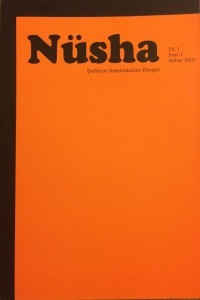
NÜSHA JOURNAL Of ORIENTAL STUDIES
PUBLICATION POLICY
Nüsha
Journal of Oriental Studies is a peer-reviewed international journal which is
published twice a year in June and December. Nüsha accepts the articles written
in the field of orientalism, (language, literature, literary history, culture);
verification and presentation of manuscripts, scientific criticism, book
criticism and translated articles. The articles to be published are required to
comply with the criteria of scientific research, to bring an innovation to the
world of science and not to be published elsewhere. Article processes are
carried out through https://dergipark.org.tr/tr/pub/nusha
Evaluation of articles
·
If the
manuscripts submitted to Nüsha Oriental Studies Journal are subjected to
preliminary evaluation in terms of compliance with the principles of the
journal, they are sent to two referees from the same field for scientific
review. In this process, the identity of the referees and the author is kept
confidential.
·
If one of the
referee reports for publication is positive and the other is negative, the work
is sent to a third referee.
·
The
articles that are decided to be published are published in the printed and
online form after the page arrangement.
·
All
responsibility for the content of the manuscripts published in Nüsha Journal of
Oriental Studies belongs to the authors.
Publishing language
·
The publication
language of Nüsha Journal of Oriental Studies is Turkish of Turkey. However, English, Arabic and Persian articles
may be published with the decision of the editorial board. In addition, Arabic,
Persian and Ottoman Turkish manuscripts that not more than 20 pages may be
published.
Spelling rules and page layout
·
Manuscripts
should be written in MS Word or compatible programs. The font should be Times
New Roman, 12 pt and 1.5 line spacing.
·
The page is
A4-size; top, bottom and right margin 2.5 cm; the left margin should be 3 cm.
·
Paragraph
spacing before must be 6 nk, after 0 nk.
·
The title of
the manuscript should be written in bold and should be compatible with the
content of the subject.
·
At the
beginning of the articles except for book criticism there must be Turkish and
English abstracts consisting of at least 200 words and keywords consist of 3 to
5 words. Turkish and English titles of the manuscript should be included.
Abstracts in Turkish or English are required for the articles in Arabic or
Persian.
·
Authors whose
work is accepted for publication are required to add a structured abstract that
consist of at least 700 words followed by an abstract in English with the title
of Structured Abstract. The structured abstract should include findings outside
the introductory part of the study and conclusions. Structured abstract will
make it easier for articles to be cited in abroad.
·
Titles should
be written in bold. The use of intermediate titles in long articles will be
beneficial for the reader.
·
The spelling
and punctuation guidelines of the Turkish Language Association should be taken
into consideration in cases where the article or subject necessitates.
·
It is
sufficient to show the places that you want to emphasize in the text with “quotes”.
·
When quoting
the block, the entire quotation should be in a tab (1.25 cm). References should
be cited when the citation is finished (source, year, page number).
·
In articles
with multiple authors, the manuscript should be uploaded to the system with the
name of first author. The names of subsequent authors should be indicated on
the system in the other authors section.
Reference
·
Nüsha Journal
of Oriental Studies accepts APA 6.0 or Endnotes citation.
·
In-text
references should be presented as author surname, year of the work and page
number. Ex. (Sahinoglu, 1991, p. 97).
·
If there is a
compiler, translator, author, proofreader or editor of a work, it should be surely
shown in the bibliography.
·
In electronic
sources, the author, the title of the work and the publication date should be
used. Access date must be given in the bibliography within the last six months.
·
References that
are not cited in the text should not be shown in the bibliography.
·
Bibliography
should be arranged alphabetically according to the surnames of the authors at
the end of the article. In more than one work of the same author, the author's
name is indicated with a straight line after the first source.
Author's
Surname, Initials of Author's Name. (Year). The
name of the book is italic and completely lowercase after the first letter
(except for special names). Place of Publication: Publisher.
Author's
Surname, Initials of Author's Name. (Year). The
name of the book is italic and completely lowercase after the first letter
(except for special names). (First Letters of Translator's Name. Translator's
Surname, Translated.) Print Place: Publisher.
Babacan, İ. (2015). “Tarzî-i Efşâr‟ın Türkçe şiirleriyle
Farsçada oluşturduğu folklorik bir üslup” Bilig. (Yaz, 74, s. 21-44) Ankara.
Coşguner, F. (2002). Menûçihrî-yi Dâmgânî, divanının
tahlili ve tercümesi. (Yayımlanmamış doktora tezi) Ankara Üniversitesi, Sosyal
Bilimler Enstitüsü, Ankara.
Dostoyevski, F. M. (2015). Yeraltından notlar. (N. Y.
Taluy, Çev.) İstanbul: İş Bankası Kültür Yayınları.
Irâkî, F. (1386/2007). Külliyât-ı Fahreddîn-i Irâkî.
(tsh. Doktor Nesrîn Muhteşem) Tahran: İntişârât-i Zevvâr.
Kırlangıç, H. (2014). Meşrutiyetten Cumhuriyete İran şiiri.
Ankara: Hece Yayınları.
———, (2010). Ahmed Şamlû ve şiri, yalnız yürüyen adamın
şarkısı. İstanbul: Ağaç Yayınları.
Murtaza, K. (1384/2005). Şamlû ve câ-yi şi„reş.
Vijenâme. (Sonbahar/Kış, I, s. 71-76)
https://www.noormags.ir/view/fa/articlepage/291218/ adresinden erişilmiştir.
(Erişim tarihi: 26.04.2018).
Şahinoğlu, M. N. (1991). “Attâr, Ferîdüddîn”, Türkiye
Diyanet Vakfı İslam Ansiklopedisi. (IV, s. 95- 98) İstanbul: Türkiye Diyanet
Vakfı Yayınları.
For detailed information, please refer to https://www.tk.org.tr/APA/apa_2.pdf
Contact: akademiknusha@gmail.com
Web Page: http://nusha.com.tr/
 June 28, 2022
Page
1-42
June 28, 2022
Page
1-42