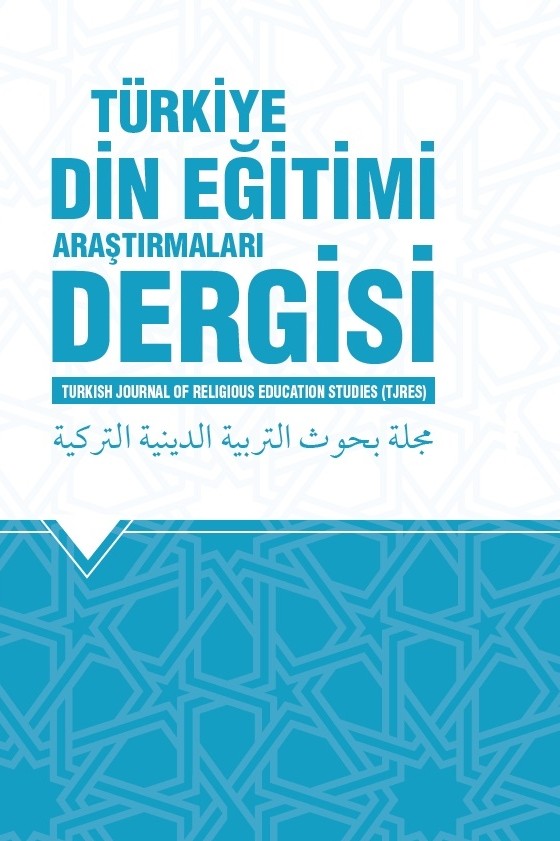
Turkish Journal of Religious Education Studies (TUDEAR) is published semi-annually with content of Turkish and English articles being evaluated by academics expert in the field.
While TUDEAR is committed to publishing scientific studies in the fields of education and religious education, it also publishes joint/interdisciplinary studies in these fields.
TUDEAR, the science of religious education in the basic field of Theology; researches on the philosophy, approach and models of education and religious education, history, methodology and its problems as well as scholarly works such as introduction of books and theses along with news on symposiums, seminars, conferences, panels, news on those who have passed away as well as evaluations.
Turkish Journal of Religious Education Studies (TUDEAR) - launched in 2016 - promotes research which contributes to our understanding of the relationship between religion and education in all phases of formal and non-formal educational settings. TUDEAR publishes articles which are national, international and transnational in scope from researchers working in any discipline whose work informs debate in religious education. Topics might include religious education policy curriculum and pedagogy, research on religion and young people, or the influence of religion(s) and non-religious worldviews upon the educational process as a whole.
Scope: Arts and Humanities -Religious Studies; Social Sciences - Education
TUDEAR publishes scientific articles on education and religious education; researches on the philosophy, approach and models of education and religious education, history, methodology and its problems as well as scholarly works such as introduction of books and theses along with news on symposiums, seminars, conferences, panels, news on those who have passed away as well as evaluations.
The target audience of our journal consists of professionals, experts, academicians, researchers, specialization and doctoral students working in the field of educational science, and undergraduate and graduate students studying in the field of educational science.
Please send your articles to our journal by including them in the "TUDEAR Article Template".
Turkish Journal of Religious Education Studies (TUDEAR), which is published semi-annually, has a structure in which both Turkish and English articles are evaluated by expert academics.
In order for the articles submitted for evaluation to be accepted, it is required that they have not been published anywhere before. Submitted articles are first reviewed by the editorial board. If an article meets the necessary conditions in terms of content and style, the reviewers then review the article for suitability for publication.
All articles are evaluated by two referees and, if deemed necessary, are sent to a third referee. Publication of an article is subject to the approval of the referees. Authors are obliged to make the necessary corrections requested by the referees. The final decision on the manuscripts submitted to our journal is made by the Editor-in-Chief, taking into account the referee evaluation reports.
In general, submitted manuscripts should be in the following format:
• Articles Articles should be at least 5000 and at most 12000 words.
• Manuscripts should be typed in MS Word processor with normal margins, 9.5 point Calibri font and 1.15 line spacing, justified on both sides.
• Tables, figures, illustrations and charts should be of a size appropriate to the page of the journal. If necessary, they may be typed in smaller font size and single-spaced.
Tables and charts should be numbered sequentially according to their appearance in your manuscript. Footnotes to the tables should be placed just below the body of the table and should be identified by lowercase identifying letters. Avoid using vertical rulers. As few tables as possible should be used and care should be taken to ensure that the data presented in the tables are not identical to results already presented elsewhere in the article.
A separate page should be created and should include the full name(s) and institutional title(s) of the author(s) and the postal address(es), work/mobile telephone number(s), e-mail address(es) of the corresponding author(s).
The manuscript should include the following sections:
• A 200-250 word abstract with a title in Turkish and 5-8 keywords.
• A title in English and a 200-250 word abstract containing 5-8 keywords.
• In addition, articles written in Turkish should be accompanied by an Extended English Abstract. This extended abstract should be between 1500-2000 words and should include the title, subheadings and all references of the article. This section can also be submitted after the manuscript has been accepted for publication.
The format used by TUDEAR for referencing is APA (American Psychological Association) Style 7th Edition. In both the citation and bibliography sections, authors should follow the spelling rules and format specified in the Publication Manual of the American Psychological Association, published by the American Psychological Association.
All transactions must be followed through the online system. Please follow the instructions provided to you during these procedures.
TUDEAR does not charge any submission or publication fee to authors.
Publication Ethics Principles
The ethical principles and publication policy of the Turkish Journal of Religious Education Studies have been prepared in accordance with the guidelines and policies published by the Committee on Publication Ethics (COPE).
Actions Contrary to Scientific Research and Publication Ethics
• Plagiarism: Representing the original ideas, methods, data or works of others as one's own work in whole or in part without citation in accordance with scientific rules,
• Forgery: Using non-existent or falsified data in scientific research,
• Distortion: Falsifying research records or data obtained, falsifying devices or materials that were not used in the research, falsifying or shaping the results of the research in line with the interests of the persons and organizations receiving support,
• Republishing: Presenting duplicate publications as separate publications for academic appointments and promotions,
• Slicing: Inappropriately and inappropriately dividing the results of a research into parts in a way that disrupts the integrity of the research and publishing them in more than one issue and presenting these publications as separate publications in academic appointments and promotions,
• Unfair authorship: Including or excluding people who have not actively contributed, changing the author ranking in an unjustified and inappropriate manner, removing the names of active contributors from the work in subsequent editions, using one's influence to have one's name included among the authors even though one has not actively contributed,
Click here to get information about other types of ethical violations in the Directive on Scientific Research and Publication Ethics of Higher Education Institutions.
Ethics Committee Permission
Our journal requires that the relevant ethics committee decision must be obtained for all studies in all disciplines that require ethics committee approval. In this context, authors should write the date and number of Ethics Committee approval in the “Sampling and Methods/ Materials and Methods” section. In case presentations, the information that the informed consent form has been obtained must be included in the article.
In line with the regulations implemented by Ulakbim TR Index since 2020, studies that do not have ethics committee permission are not evaluated in our journal.
Studies Requiring Ethics Committee Approval
In our journal, researches that require ethics committee permission include the following studies:
• All research conducted with qualitative or quantitative approaches that involve collecting data from participants through methods such as surveys, interviews, focus groups, observations, experiments and interview techniques,
• Studies in which humans and animals (including materials or data) are used for experimental or other scientific purposes,
• Clinical trials conducted on humans,
• Scientific research on animals,
• Retrospective studies within the framework of the Personal Data Protection Law.
In order for such studies to be included in the evaluation, the relevant ethics committee permissions must be obtained and these permissions must be clearly stated in the text of the article.
NOTE: Scientific research on humans and animals must be conducted in accordance with the Declaration of Helsinki and ARRIVE guidelines and approval must be obtained from the relevant ethics committee. Studies without ethics committee approval are not evaluated in our journal.
Control to Prevent Plagiarism
Plagiarism is presenting the ideas, methods, data, applications, writings, figures or works of others as one's own work, in whole or in part, without citing the authors in accordance with scientific rules.
TUDEAR screens all submitted articles to prevent plagiarism. Studies submitted for review are checked for plagiarism using Ithenticate software. The similarity rate is expected to be less than 15%. The main measure of similarity is the author's compliance with the citation and citation rules. If the similarity rate appears to be 1%, but the citation and quotation are not done properly, plagiarism may still be in question. In this respect, citation and quotation rules should be known and carefully applied by the author.
Plagiarism, duplication, false authorship/ denied authorship, research/data fabrication, article slicing, slicing and dicing, copyright infringement and concealment of conflict of interest are considered unethical behaviors. All articles that do not comply with accepted ethical standards are removed from publication. This includes articles containing possible irregularities and nonconformities detected after publication.
If plagiarism is detected in an article submitted or published in our journal, our journal will act in accordance with the COPE principles (Plagiarism in a submitted manuscript - Plagiarism in a published article).
Protection of Personal Data of Participants
TUDEAR requires that all research involving personal or sensitive data or materials relating to human participants that are not legally publicly available be subject to formal ethical review.
Addressing Allegations of Research Misconduct
TUDEAR adheres to COPE's Ethical Toolkit for a Successful Editorial. TUDEAR editors will take measures to prevent the publication of manuscripts in which plagiarism, citation manipulation, data falsification, data fabrication, and other research misconduct has occurred. In no case will TUDEAR editors knowingly allow such misconduct to occur. In the event that TUDEAR editors become aware of any allegations of research misconduct related to an article published in their journal, they will follow COPE's guidelines regarding allegations.
Ethical Violation Notifications
If readers notice a significant error or inaccuracy in an article published in TUDEAR or have any complaints about the editorial content (plagiarism, duplicate articles, etc.), they can send an e-mail to tudearjournal@gmail.com. We welcome applications as they will provide an opportunity for us to improve and we will respond quickly and constructively.
Changes in Author Staff
TUDEAR accepts requests for revisions, additions or deletions of author names before publishing an accepted manuscript. Requests for author additions, deletions, and reorganization of author names prior to publication of an accepted manuscript should be submitted to the TUDEAR Secretary by the corresponding author. This request must include:
• The reason for adding, removing or rearranging the name in question,
• Separate written confirmation (by e-mail, fax, or letter) from all authors that they agree with the addition, deletion, or reorganization. It should also include the consent of the author being added or removed, as the case may be.
Requests that are not originally sent by the corresponding author will be sent directly by the TUDEAR Secretary to the corresponding author, who should follow the above procedure. It should be noted that (1) the TUDEAR Secretary will inform the editorial board of the journal of such requests, and (2) an accepted manuscript in press will be held in abeyance until the author roster is agreed upon. Requests to add, remove, or revise author names after the manuscript has been published will not be considered.
Correction, Withdrawal, Expression of Concern
Editors may consider issuing a correction if minor errors are identified in the published article that do not affect the findings, interpretations and conclusions. Editors should consider retracting the manuscript if there are major errors/violations that invalidate the findings and conclusions. Editors should consider issuing a statement of concern if there is a possibility of research or publication misconduct by the authors; there is evidence that the findings are unreliable and that the authors' institutions have not investigated the incident; or the potential investigation seems unfair or inconclusive. COPE guidelines are followed regarding correction, retraction or expression of concern.
Special Issue Publication Policy
A special issue may be published once a year upon the request of the Editorial Board. Articles submitted for inclusion in the special issue are first subjected to a preliminary editorial review. Then they are examined for compliance with the journal's spelling rules and similarity screening is performed to prevent plagiarism. After these stages, it is included in the peer review process in which the double-blinding model is used.
Editorial Confidentiality Obligation
TUDEAR editors treat all submitted manuscripts as confidential documents, which means that they will not disclose information about a manuscript to anyone without the authors' permission. During the manuscript review process, the following people have access to the manuscripts: Editors, Reviewers, Editorial Board Members. The only situation in which details about a manuscript could be passed to a third party without the authors' permission is if the editor suspects serious research misconduct.
Use of Artificial Intelligence
The use of artificial intelligence in processes that do not affect the originality of the article, such as literature review or language control, is acceptable in studies submitted to our journal. However, the use of artificial intelligence should be carried out within the framework of ethical rules and should never be used for unethical purposes such as fabricated data and manipulation.
For studies involving the use of artificial intelligence, it is mandatory to inform our journal about this situation at the article submission stage. All responsibility for the use of artificial intelligence lies with the authors themselves.
Complaint Procedure
This procedure applies to complaints about content, procedures or policies that are the responsibility of TUDEAR or our editorial staff. Complaints can provide an opportunity and incentive for improvement, and we aim to respond quickly, courteously and constructively.
The complaint must relate to content, procedures or policies that are the responsibility of TUDEAR or our editorial team. Complaints should be emailed directly to tudearjournal@gmail.com and will be treated confidentially. The editor responds to complaints immediately. The editor follows the procedure outlined in the COPE flowchart regarding complaints.
Complaints are reviewed by the relevant member of the editorial team and if not resolved, the following processes are followed:
• If this initial response is deemed inadequate, the complainant may request that the complaint be escalated to a more senior member of the journal.
• If the complainant is not satisfied, the complaint may be forwarded to the editor-in-chief.
• A full response will be provided within two weeks, if possible.
COPE publishes a code of practice for editors of scientific journals. This will facilitate the resolution of disputes with editors, journals and publishers, but only after the journal's own grievance procedures have been exhausted.
Appeal Process
We welcome serious objections to the evaluations made by editors and reviewers. If you feel that we have rejected your paper because we misunderstood its scientific content, please send an appeal message to our editorial team at tudearjournal@gmail.com. Do not attempt to submit a revised version of your article at this stage. If, after reading your appeal letter, we realize that your appeal is justified, we may invite you to submit a revised version of your manuscript. Your paper will then be resubmitted to the external reviewer process. Please include as much detail as possible in the appeal letter. Finally, we can only consider one appeal per article, so please take the time and effort to write a detailed letter to make your appeal clear - you have one chance, so use it well. We have found that prolonged deliberation over rejected manuscripts is often unsatisfactory for both authors and editors, so we do not process multiple appeals for the same study.
Conflicts of Interest
Our journal guarantees the independent and impartial completion of the publication process, taking into account conflicts of interest between the author(s), reviewers and other editors.
Duties and Responsibilities of Stakeholders
Ethical Duties and Responsibilities of the Privilege Holder
• TUDEAR does not charge authors in any way.
• TUDEAR is committed to independent editorial judgment.
• Editors are responsible for all processes of the studies submitted to TUDEAR. In this context, editors are the decision makers, regardless of economic or political gains.
• TUDEAR protects the ownership and copyright of each published article and undertakes the obligation to keep a record of each published copy.
• In addition, it keeps the database open to access via the internet.
• It has the responsibility to take precautions against all kinds of scientific misconduct, citation mongering and plagiarism related to the editors.
Ethical Duties and Responsibilities of the Editorial Board
• The Editorial Board of the Turkish Journal of Religious Education Studies (hereinafter, the “Editorial Board”) and the Editors/Assistant Editors are responsible for each article submitted to the Turkish Journal of Religious Education Studies.
• The Editorial Board ensures the determination and implementation of journal policies such as publication, blind refereeing, evaluation process, and ethical principles.
• The refereeing of the article by the Editorial Board does not constitute a commitment to publication. Even if the refereeing process is positive, the decision of the Editorial Board and the Editors/Assistant Editors is required for publication.
• The Editorial Board encourages academic integrity. The Editorial Board ensures the originality of written works by checking them through the iThenticate plagiarism prevention program prior to publication.
• The Editorial Board always investigates allegations of plagiarism and misconduct in published articles. For example, if an author has plagiarized from other works, used third-party copyright material without permission where permission is required or with incomplete notification, the Editorial Board reserves the right to take various actions, including retracting the article, reporting the matter to the head of department, dean, and/or relevant academic institutions at the institution where the author works.
Ethical Duties and Responsibilities of Editors
Editors and issue editors of the Turkish Journal of Religious Education Studies should have the ethical duties and responsibilities specified in the “Code of Conduct and Best Practice Guidelines For Journal Editors” and “Cope Best Practice Guidelines For Journal Editors” guides available on our journal's website. These duties and responsibilities are summarized below.
1. Editors' Relations with the Reader
Editors are obliged to take into account the feedback from readers, researchers and practitioners about the published studies and to take the necessary responses and actions.
2. Editors' relations with Authors
• Editors make their decision about the article based on the original value of the article, the aims of the journal and ethical rules.
• The article should be included in the evaluation process if the article has a high original value and is prepared in accordance with the journal's objectives and ethical rules.
• Unless there is an important justification, the editor and the section editor should take into account the positive opinions of the referees.
• Editors are required to respond to requests and comments from authors with feedback.
3. Editors' Relations with Reviewers
• The referees to be appointed should be selected in accordance with the subject of the article.
• The referee should take care that there is no conflict of interest or relationship of interest between the referee and the authors.
• The editor is responsible for guiding the referees in the article evaluation process and providing the information requested.
• The editor is obliged to conceal the identity information of the author and the referee through blinded refereeing.
• The referees should take the necessary warnings and precautions to evaluate the article in a timely, impartial and scientific manner.
• They should endeavor to increase the number of referees for our journal.
4. Relations with the Advisory Board of Editors
Editors are required to take into account the opinions and suggestions of the advisory board about the articles.
5. Editors' relations with the journal owner and publisher
Editors' decisions about the article should be independent of the journal owner and the publishing organization.
6. Editors' decision to publish the article
Editors are responsible for observing the journal's editorial principles, journal objectives and international standards in the articles to be published in the journal.
7. Preservation of personal data
Editors are responsible for not transferring the personal information of article authors to third parties except with their consent.
8. Ethics committee, human and animal rights
Editors are responsible for protecting human and animal rights in the case of studies conducted on humans and animals. In studies that require an ethics committee report, the ethics committee is responsible for rejecting the manuscript if the approval of the ethics committee is not sent.
9. Protection of intellectual property rights
The editors are responsible for protecting the intellectual property rights of all articles submitted and published in the journal.
10. Complaints to the Editors
Editors are responsible for responding to complaints from reviewers, authors and readers in a clear and informative manner.
11. Conflicts of interest and relationships
Editors are responsible for taking precautions against conflicts of interest and conflicts of interest that may arise between authors, referees and third parties in order to complete the evaluation processes of the articles impartially and independently.
Ethical Duties and Responsibilities of Referees
• Reviewers evaluate manuscripts without regard to the origin, gender, sexual orientation or political philosophy of the authors. Reviewers also ensure a fair blind review process for the evaluation of manuscripts submitted to the journal.
• All information regarding manuscripts submitted to the journal is kept confidential. Reviewers should not negotiate with anyone other than those authorized by the editor.
• Reviewers have no conflict of interest with parties such as authors, funders, editors, etc.
• Reviewers assist editors in decision-making and may also assist authors in improving manuscripts.
• An objective judgment is always made by the reviewers. Reviewers express their views clearly, with appropriate supporting arguments.
• Reviewers should also inform the editor of any significant similarities or overlaps between the submitted manuscript and any other published manuscript within their knowledge.
Ethical Duties and Responsibilities of Authors
• Authors prepare and submit their work as original.
• Authors ensure that the citations and quotations made in their submitted articles are accurate and complete.
• Authors are required to indicate and explain the situations that may be a conflict of interest in the articles they submit.
• The editor, referee and section editor may request raw data of the article from the author. Therefore, the author should have the raw data of his/her article ready for submission.
• Authors should not submit the same manuscript for publication in any other journal. Simultaneous submission of the same work to more than one journal constitutes unethical behavior and is unacceptable.
• Appropriate references should be given for the work of others. Authors should refer to publications that have influenced their work. All sources used during the study process should be indicated.
• All sources of financial support should be disclosed. All authors should disclose any conflicts of interest involved in the creation of their work.
• When an author discovers a serious error or inaccuracy in a published article, he/she should promptly notify the journal editorial office. The author is then responsible for cooperating with the journal editorial office in withdrawing or publishing a correction to the article.
• Separate ethics committee approval must be obtained for the research conducted and for clinical and experimental human and animal studies that require ethics committee approval, and this approval must be stated and documented in the article.
PUBLICATION POLICIES
• The Turkish Journal of Religious Education Studies (TUDEAR) is published semi-annually (June-December) and has a structure in which articles in Turkish and English are evaluated by expert academics.
• While TUDEAR is committed to publishing scientific studies in the fields of education and religious education, it also publishes joint/interdisciplinary studies in these fields.
• Articles must not have been previously published or submitted for publication elsewhere.
• All articles are evaluated by two referees in a double blind review process and, if deemed necessary, sent to a third referee. Publication of an article is subject to the approval of the referees. Authors are obliged to make the necessary corrections requested by the referees. The final decision on the manuscripts submitted to our journal is made by the Editor-in-Chief, taking into account the referee evaluation reports.
• While our journal has the principle of publishing scientific studies produced in the fields of education and religious education, it also publishes joint/interdisciplinary studies in these fields.
• Our journal appeals to all education professionals, especially academics, researchers, teachers and graduate students, who work in the field of educational sciences and want to follow current developments in this field.
• The authors own the copyright of their works published in our journal and their works are licensed as CC BY-NC 4.0.
• Articles published in our journal are published as open access under the Creative Commons Attribution-NonCommercial 4.0 International (CC BY-NC 4.0) license. The full text of all published articles can be accessed free of charge at https://dergipark.org.tr/en/pub/tudear/archive. All studies published in our journal are digitally archived in LOCKSS.
• The publication of articles in the journal and the execution of article processes are not subject to any fee. No processing or submission fee is charged for articles submitted to the journal or accepted for publication.
• Our journal does not accept sponsorship and advertising in accordance with its publication policies. All expenses of our journal are covered by our publisher Prof. Dr. Mehmet BAHÇEKAPILI.
All expenses of the Journal of Turkish Religious Education Studies are covered by the publisher. The publication of articles in the journal and the execution of article processes are not subject to any fee. No processing or submission fee is charged for articles submitted to the journal or accepted for publication.
1990’da İstanbul’da doğdu. 2008’de Kartal Anadolu İmam Hatip Lisesi’nden; 2012’de Marmara Üniversitesi İlahiyat Fakültesi’nden mezun oldu. 2012-2017 yılları arasında Van Yüzüncü Yıl Üniversitesi İlahiyat Fakültesi’nde; 2017-2020 yılları arasında İzmir Kâtip Çelebi Üniversitesi İslami İlimler Fakültesi’nde Hadis Anabilim Dalı’nda araştırma görevlisi olarak görev yaptı. 2014’de Şia Tefsirlerinde Hadis Kullanımı -el-Ayyâşî Tefsiri Örneği- isimli teziyle yüksek lisansını; 2019’da Sahâbe Döneminde Coğrafya ve Kültürün Hadis Rivayetine Etkisi isimli teziyle doktorasını tamamladı. Hâlihazırda Yalova Üniversitesi İslami İlimler Fakültesi Hadis Anabilim Dalı’nda öğretim üyesi olarak görev yapmaktadır.
Professor of Psychology, Georgia Southern University
1988 Yılında Konya’nın Hadim ilçesinde doğdu. İlköğretimi Bademli İlköğretim Okulu’nda, liseyi Karaman Anadolu İmam-Hatip Lisesi’nde tamamladı. 2010’da Marmara Üniversitesi Atatürk Eğitim Fakültesi Din Kültürü ve Ahlak Bilgisi Öğretmenliği Bölümünü bitirdi. 2010-2012 yılları arasında MEB’e bağlı Kağıthane Ziyapaşa İlköğretim Okulu’nda Din Kültürü ve Ahlak Bilgisi dersi öğretmeni olarak çalıştı. 2012-13 yılları arasında Kahramanmaraş Sütçü İmam Üniversitesi İlahiyat Fakültesi İlköğretim Din Kültürü ve Ahlak Bilgisi Eğitimi Anabilim Dalı’nda araştırma görevlisi olarak bulundu. 2013’te yüksek lisans eğitimini “İlköğretim Din Kültürü ve Ahlak Bilgisi Programının (2010) Program Geliştirme İlkeleri Açısından Bir Değerlendirmesi” isimli teziyle İstanbul Üniversitesi Sosyal Bilimler Enstitüsü Felsefe ve Din Bilimleri Anabilim Dalı’nda tamamladı. 2013-2019 tarihleri arasında, İstanbul Üniversitesi İlahiyat Fakültesi Din Eğitimi Anabilim Dalı’nda araştırma görevlisi olarak çalıştı. 2019 Yılında “Güvenlik Toplumunda Dindarlık ve Din Eğitimi: Soybilimsel Bir Analiz” isimli çalışması ile İstanbul Üniversitesi Sosyal Bilimler Enstitüsü Felsefe ve Din Bilimleri Anabilim Dalı’nda doktora eğitimini tamamladı. 2020 yılından beri Kırklareli Üniversitesi İlahiyat Fakültesi Din Bilimleri ABD’de çalışmaktadır. Din eğitimi nazariyatı, öğretim programları, eğitim felsefeleri alanlarında çalışmalar yapmaktadır. Evli ve bir çocuk babasıdır.
Prof. Dr. Mahmut Zengin, İlahiyat alanında lisans (2000), Din Eğitimi alanında yüksek lisans (2004) ve doktora (2010) eğitimlerini Marmara Üniversitesinde tamamladı. Sakarya Üniversitesi İlahiyat Fakültesi Felsefe ve Din Bilimleri Bölümüne 2011 yılında Yardımcı Doçent olarak atandı. 2017 yılında Doçent olan Zengin, 2024 yılında Din Eğitimi alanında Profesör oldu. Hâlen Sakarya Üniversitesi İlahiyat Fakültesi Felsefe ve Din Bilimleri Bölümünde görev yapan Prof. Dr. Mahmut Zengin'in ulusal ve uluslararası dizinlerde taranan dergilerde yayımlanmış çok sayıda makalesi mevcuttur. Prof. Dr. Mahmut Zengin'in araştırma alanları arasında dini çalışmalar, İslami eğitim, değerler eğitimi, müfredat ve ders kitaplarında din öğretimi ve din öğretim yöntemleri yer almaktadır.

1976 yılında Hendek/Sakarya’da doğdu. Hendek Şehit Mahmut Bey İlköğretimi (1987), Hendek İmam-Hatip Lisesi (1996) ve Uludağ Üniversitesi İlahiyat Fakültesi (2002) mezunudur. Yüksek Lisansını, Marmara Üniversitesi Sosyal Bilimler Enstitüsü İlahiyat Anabilim Dalı Din Eğitimi Bilim Dalı’nda “Ömer Çam Hoca Hayatı, Eserleri ve Eğitim Anlayışı” adlı teziyle 2005’te tamamladı. 2002 yılından 2012 yılının Haziran ayına kadar Diyanet İşleri Başkanlığı’nda Din Görevlisi olarak vazifesini sürdürdü. 2012 yılının mart ayında Marmara Üniversitesi Sosyal Bilimler Enstitüsü İlahiyat Anabilim Dalı Din Eğitimi Bilim Dalı’nda “Din Eğitimi Açısından Kur’ân’da Nefis Kavramı” adlı tezini savunarak Doktorasını tamamladı. 2012 yılının Haziran ayında, Gümüşhane Üniversitesi İlahiyat Fakültesi Din Sosyolojisi Anabilim Dalına öğretim üyesi olarak atandı. 2012 yılının Eylül ayında, Gümüşhane Üniversitesi İlahiyat Fakültesi İlköğretim Din Kültürü ve Ahlak Bilgisi Öğretmenliği Bölümü öğretim üyeliğine atandı. 2013-2019 yılları arasında Gümüşhane Üniversitesi İlahiyat Fakültesi İlköğretim Din Kültürü ve Ahlak Bilgisi Öğretmenliği Bölüm Başkanlığını yürütmüştür. 2019-2021 yılları arasında Gümüşhane Üniversitesi İlahiyat Fakültesi Felsefe ve Din Bilimleri Bölüm Başkanlığı yapmıştır. 16.02.2022 tarihinde Düzce Üniversitesi İlahiyat Fakültesi'nde yeni görevine başlamıştır. 16.08.2023 tarihinden itibaren Düzce Üniversitesi Çocuk ve Gençlik Eğitimi Uygulama ve Araştırma Merkez Müdürlüğünü yürütmektedir. Evli ve dört çocuk babası olan Aktaş’ın ulusal ve uluslararası dergi ve kitaplarda yayınlanmış olan çeşitli eser ve makaleleri bulunmaktadır.
Prof. Dr. Recep KAYMAKCAN
1990 yılında Marmara Üniversitesi İlahiyat Fakültesinden mezun oldu. YÖK bursiyeri olarak gittiği İngiltere Leeds Üniversitesinde doktorasını 1998’de tamamladı. Aynı yıl Sakarya Üniversitesi İlahiyat Fakültesine Din Eğitimi Anabilim Dalına öğretim üyesi olarak atandı. 2002 yılında doçent ve 2007 yılında profesör unvanını aldı. 2013 yılında KYK Genel Müdürü olarak atanan Kaymakcan daha sonra GSB Bakanlık Müşaviri oldu. 2003-2018 yılları arasında akademik “Değerler Eğitimi Dergisi” editörlüğünü yaptı. Uluslararası Din ve Değerler Eğitimcileri Derneği üyesidir.
Akademik uzmanlık ve ilgi alanları:
Karşılaştırmalı din eğitimi, din eğitiminde program geliştirme, eğitim politikaları, değerler ve gençlik, insan hakları ve din eğitimi, okul öncesi din ve ahlak eğitimi, Diyanet ve din algısı.
Akademik çalışmalarından seçmeler:
Günümüz İngilteresinde Din Eğitimi, DEM Yayınları: İstanbul, 2004; Yeni Ortaöğretim Din Kültürü ve Ahlak Bilgisi Program İnceleme ve Değerlendirme Raporu, Sabancı Üniversitesi Eğitim Reformu Girişimi, Myra Yapım: İstanbul, 2007; Ahlak, Değerler ve Eğitimi, DEM Yayınları: İstanbul, 2020, 3. basım (H. Meydan’la birlikte); Türkiye’de Okul Öncesi Din ve Ahlak Eğitimi Raporu, EBSAM Stratejik Araştırmalar Merkezi, Ankara, 2021; Gençlerin Dine Bakışı ve Okullarda Din-Değerler Öğretimi, DEM Yayınları: İstanbul, 2021; Diyanet Çalışanlarının Sorunları Beklentileri, Din-Diyanet Algıları Araştırması, Diyanet-Sen, Ankara, 2023 (S. Yurdakul ile), Erken Çocuklukta Dini-Ahlaki Gelişim ve Öğrenme (Ed), DEM Yayınları, İstanbul, 2023.
"Christianity in Turkish Religious Education" Islam and Muslim Christian Relationship, vol. 10, no. 3, ss. 279-293, 1999; “İlahiyat Öğrencilerinin Kopya Çekmeye Karşı Yaklaşımları”, Sakarya Üniversitesi İlahiyat Fakültesi Dergisi, sayı 5, ss. 121-138, 2002; “Religious Education Culture in Modern Turkey”, ed. Marian de Souza et al., International Handbook of Religious, Spiritual and Moral Dimensions of Education, Springer, Dortrect (Hollanda), ss. 449-460, 2006; “Turkish Adolescents: High Islamic Faith in Secular State”, eds. H. G. Ziebertz & W. Kay, Religion and Youth in Europe, Lit Verlag, Berlin, ss. 230-245, 2006; “Islam in Turkish Religious Education: From Traditional Understanding to Modern”, ed. E. Aslan, Islamic Textbooks and Curricula in Europe, Peter Lang, New York, ss. 251-272, 2011; “A Model for Islamic Education from Turkey: the Imam-Hatip Schools, British Journal of Religious Education, 29:3, 279-292, 2017 (İ. Aşlamacı ile), “Europen court of human right’ judgements and compulsory religious educatiın in Turkey”, British Journal of Religious Education, 44:1, 2022 (A. Hendek ile), “Cumhuriyetin 100. Yılında Din Eğitimi Mirasımız”, eds. İ. Aşlamacı ve diğerleri (eds), İslam ve Yorum VII İnönü Üniversitesi, Ensar Neşriyat, İstanbul, ss. 11-27.
Dr. Dina Sijamhodžić-Nadarević is an associate professor teaching pedagogy/religious
pedagogy group of courses and the head of the Chair of Religious Pedagogy and Religious
Psychology at the Faculty of Islamic Studies, University of Sarajevo. She graduated in 2004
from the Faculty of Islamic Studies (Islamic Theology study program) and in 2006 from the
Faculty of Philosophy at the University of Sarajevo, Department of Pedagogy. She completed
her master's degree in Religious Pedagogy at the Faculty of Islamic Studies in Sarajevo in 2009
and obtained her doctorate in 2013 from the Faculty of Philosophy at the University of Sarajevo,
Department of Pedagogy.
She has published four books and over 40 scientific papers (book chapters and articles) in
Bosnian, English, and German. Some of the works she has published include:
A Study on the Competencies of Personnel of the Islamic Community in Bosnia and
Herzegovina: From Acquired to Necessary Competencies (El-Kalem, Sarajevo, 2022);
Evaluation in the System of Quality Assurance of Higher Education (El-Kalem, Sarajevo,
2013); Self-evaluation of Educational Work in Bosnian-Herzegovinian Madrasas (Ilum and
CNS, Sarajevo, 2009); "Research-Based Reform of Madrasa Curriculum in Bosnia and
Herzegovina and its Implications for Fostering Teachers’ Professional Development" (Chapter
14 in the book Supporting Modern Teaching in Islamic Schools Pedagogical Best Practice for
Teachers, Routledge, Taylor & Francis Group, 2022, UK and USA, Scopus index); "Die
Islamische Religionspädagogik in Tradition und Theologie, Eine Spurensuche nach
Merkmalen" (Chapter in the book "Religionspädagogische und fachdidaktische Ansätze,"
Vandenhoeck & Ruprecht, Brill, Germany, 2022); "Bringing The World into University
Educator and Leadership Classes with Virtual Exchange: A Practical Guide for Faculty"
(Chapter in the book "Recipes to Combat the Isms: Volume One: Equity," ICPEL Publications
USA, 2022); "Madrasa Education in Bosnia, Herzegovina" (Chapter in the book "Rethinking
Madrasa Education in a Globalized World," Routledge Taylor & Francis Group, London &
New York, 2018, Scopus index); "Philosophy and Pedagogy of Islamic Education in Today’s
Europe". Journal of Muslims in Europe, BRILL, 2024,13, 365–378. (Scopus index);
"Contribution of Islamic Religious Education to Intercultural Values in Pluralistic European
Cultures: Insights from Bosnia and Herzegovina", Religions 14 (MPDI), no. 4:453 (Scopus,
Web of Science – Q1).
Turkish Journal of Religious Education Studies is licensed under a Creative Commons Attribution-NonCommercial 4.0 International (CC BY-NC 4.0) License.