Publication Principles
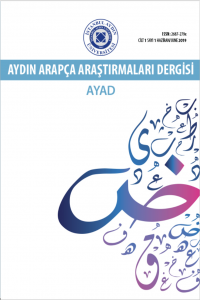
The Journal of Aydin Arabic Studies (AYAD) is an international peer-reviewed journal published twice a year, in June and December, by the Department of Arabic Teaching of the Faculty of Education of Istanbul Aydın University.
The Journal of Aydin Arabic Studies (AYAD) publishes research, examination, criticism and evaluation articles on Arabic language, literature, education, eloquence, culture, art, philosophy, literary history and Arabic translation, provided that they are original.
The articles to be sent to the Journal of Aydin Arabic Studies (AYAD) must first be a "research article" of original nature or a "compilation article" that contributes to the field, evaluates previously published studies, and puts forward new and remarkable opinions on this subject. In addition, "evaluation" articles and "book reviews" in the article format of scientific books published in the relevant fields are also within the scope of the publication of the journal. With the decision of the Editorial Board, Turkish, Arabic, English or Persian translations of original articles from foreign languages that are thought to contribute to the field may also be included, provided that they do not exceed one third of the journal. In order for the "translated articles" to be published, it is obligatory to send the permission letter to be obtained from the author or right holder of the original article along with the translated text. In order for the articles to be published in Aydın Journal of Arabic Studies, they must not have been previously published elsewhere or accepted for publication.
Articles produced from papers presented in a scientific meeting but not published can be accepted provided that this situation is clearly stated in the footnote.
GENERAL RULES
The language to be used in the articles and articles published in the
journal is Turkish, Arabic, English and Persian.
If there is an institution supporting the study, the last word of the article title (*) should be placed on the same page and the information of the institution supporting the article should be stated as a footnote.
The submitted articles should not be less than 3,000 words including bibliography and annexes and should not exceed 10,000 words.
Articles should be arranged according to the Chicago system. For detailed information, please refer to the manual: https://dergipark.org.tr/tr/download/journal-file/23095. Please make sure that the references given in the footnote are in the bibliography. The upper limit of the plagiarism rate determined by the editorial board forour journal is 15percent. The filtering options in the plagiarism detection program are set as follows: - Excluding Bibliography - Excluding Quotes - Excluding text parts with less than 5 words (Limit match size to 5 words) - Other filtering options in the program menu are not included in the reporting.
Writing Rules
Page Layout
The entire text area should be 170 mm X 240 mm, leaving a gap of 3 cm on the
top, 2 cm on the bottom, 2.5 cm on the inner edge, and 2 cm on the outer edge.
Font Times
New Roman font should be used in
Turkish and English texts. Turkish "Abstract", English "Abstract" sections and main text should be 12 pt and footnote section should be 10 pt; text, abstract and footnotes should be aligned in two directions. In the main text, the indentation value should be 1.25 in the first line, 6 nk after the paragraph spacing value, and the line spacing value should be 1.15.
Arabic and Persian texts should be in Traditinol Arabic font and 16 font size. The footnote section should be 12 points; the text, abstract and footnotes should be aligned in two directions. In the main text, the indentation value should be 1.25 in the first line, 6 nk after the paragraph spacing value, and the line spacing value should be 1.15.
Titles
The article should be arranged to consist of the main title and subtitles.
Main Title
Turkish and English titles should be in Times New Roman character, using capital letters, bold, 14 font size. After leaving a line of space after the title, the author's name should be written in a right-aligned manner, and the author's name should be written in 12 font size with a small surname and a large surname. Author information should be given in the footnote with the asterisk to be added after the author name.
Arabic and Persian titles should be in Traditional Arabic character, bold and 18 font size. The author's name should be left-aligned and in 16 font size after leaving a line of space after the title. Author information should be given in the footnote with the asterisk to be added after the author's name.
Abstract
should not exceed 150 words and the title “ABSTRACT” should be bold, 12-point font, the abstract text should be written in 12-point font, the entire text should be justified and single paragraph in Times New Roman font style in Microsoft Word format. The title “KEYWORDS” should be in 12-point font size and bold, and keywords should be in 12-point font size and italicized. At least five and at most seven keywords appropriate to the article should be written and the first letters of these words should be capitalized and the other letters should be lowercase. In the “ABSTRACT”, brief information about the subject, research method and results of the article should be given.
The first page of the article should include the abstract in the language in which it is written.
Abstract
The title of the Abstract should be 12 points and bold. The English abstract should not exceed 150 words, should be 12 points and should be leaned on both sides. Keywords title should be written in 12 font size and bold, and keywords should be in 12 font size and italic. The first letters of at least three and at most five keywords suitable for the article should be written in capital letters and the other letters should be small. In the "Abstract" section, brief information about the subject, research method and result of the article should be given.
Chapters
The section subtitles (such as INTRODUCTION, CONCEPTUAL FRAMEWORK, LITERATURE REVIEW, RESEARCH METHODOLOGY, FINDINGS, CONCLUSION, …) created according to the content of the article should be in capital letters, 12 points and bold, and should be written without using numbering.
Main Text
If the tables, figures, graphics and pictures used in the Main Text are not originally created by the author(s), they can be used in the text by showing the "source". Tables, figures, graphics and pictures should be placed to fit the text part and their titles should be written in 11 font size and centered. The tables and graphs used in the text are shown in Table 1, Table 2./ Graph 1., Graph 2. … etc. Table numbers and titles should be written before the table. Figure 1., Figure 2 with the numbers and titles of the figures, graphs and pictures at the bottom after themselves (figure, graphic and picture)./ Picture 1., Picture 2. … etc. The first letters of the words used in the table, figure, graphic and picture titles should be formed as large and the others should be small. If the tables, figures, graphics and pictures used in the Table, Figure, Graphic and Pictures Text are not originally created by the author(s), they can be used in the text by showing the "source". Tables, figures, graphics and pictures should be placed to fit the text part and their titles should be written in 11 font size and centered. The tables and graphs used in the text are shown in Table 1, Table 2./ Graph 1., Graph 2. … etc. Table numbers and titles should be written before the table. Figure 1., Figure 2 with the numbers and titles of the figures, graphs and pictures at the bottom after themselves(figure, graphic and picture)./ Picture 1., Picture 2. … etc. The first letters of the words used in the table, figure, graphic and picture titles should be formed as large and the others should be small.
Result
The title should be written in bold and 12 pt, and the text part should be written in Times New Roman font style.
Source
The title of the source should be written in bold and 12 pt. When writing bibliographic identities, the indentation value should be 1.25; the paragraph interval should then be 6 lines, and the line interval should be 1.5 lines.
Reference and bibliography representation in the article
should be arranged according to the Chicago system. For detailed information, you can review the guide: https://dergipark.org.tr/tr/download/journal-file/23095We
recommend using the Applications section in Microsoft Word or the Zotero program for ease.
Click for a draft article. AYAD ARTICLE TEMPLATE
1. BOOK
a) Single Author:
Talip Özdeş, Maturidi's Understanding of Tafsir (Istanbul: İnsan Pub., 2003), 15.
In the bibliography:
dentical, Talip. Maturidi's Understanding of Tafsir. Istanbul: İnsan Publications, 2003.
b) Two Authors:
Bekir Topaloglu and Ilyas Celebi, Dictionary of Kalam Terms (Istanbul: ISAM Pub., 2010), 57.
In the bibliography:
Topaloglu, Bekir and Ilyas Celebi. Glossary of Terms. Istanbul: ISAM Publications, 2010.
e)Book Chapter or Other Parts:
Hisham Ibrahim Mahmud, “Mukaddime,” in Tel? iṣu 'l- edille li-? ava? di 't-tevḥid, thk. Hisham Ibrahim Mahmud (Cairo: Daru 's-Salam, 1431/2010), 1: 14.
References:
Mahmud, Hisham Ibrahim. “Mukaddime”. Telḫiṣu’l-edille li-ḳavaʿidi’t-tevḥid icinde, thk. Hisham Ibrahim Mahmud, 1: 5-44. Cairo: Daru's -Salaam,1431/2010
2. ARTICLE
* In the footnote –if available– the specific page number consulted should be indicated. The page range of the entire article should be specified in the bibliography.
a) Printed:
Adam Çiftçi, “Suca Teşebbüsten Abandonment in Islamic Criminal Law”, Cumhuriyet University Journal of the Faculty of Theology 19, p. 1 (June 2015): 23.
In the bibliography:
Çiftçi, Adem. “Renunciation of Suca Entrepreneurship in Islamic Criminal Law”. Cumhuriyet University Faculty of Theology Journal 19, p. 1 (June 2015): 23-46.
b) Online:
Ramazan Altıntaş, "The Status of Mind in the Face of Naslar", Journal of Kalam Research 1, p. 1(2003): 411, accessed 22 February 2016, http://dergipark.ulakbim.gov.tr/kader/article/view/1076000016.
In the bibliography:
Altıntaş, Ramadan. “The Condition of Reason in the Face of Naslar”. Journal of Kalam Research 1, p. 1 (2003): 11-20. Accessed 22 February 2016.
http://dergipark.ulakbim.gov.tr/kader/article/view/1076000016.
3. ENCYCLOPEDIA “ARTICLE”
Ömer Faruk Akun, “Ali Mustafa Efendi”, Turkish Religious Foundation Islamic Encyclopedia, vol. 2 (Ankara: TDV Pub., 1989), 416.
In the bibliography:
Akun, Ömer Faruk. “Ali Mustafa Efendi”. Turkish Religious Foundation Encyclopedia of Islam. 2: 416-417. Ankara: TDV Publications, 1989.
4. THESIS
Abdullah Demir, “Ebu İshak Zahid es-Saffar 'inKelam Yöntemi” (Doctoral Thesis, Cumhuriyet University, 2014), 122.
In the bibliography:
Akyuz, Ismail. “Conservative Charities in Turkey”. Master's thesis, Sakarya University, 2008.
5. UNPUBLISHED CONFERENCE
Mustafa Akdağ and Hidayet Tok, "The Effect of Traditional Teaching and Power Point Supported Teaching on Student Access" (XIII. Paper Presented at the National Education Sciences Congress, İnönü University Faculty of Education, Malatya, July 06-09, 2004).
In the bibliography:
Akdağ, Mustafa and Hidayet Tok. “The Effect of Power Point Supported Teaching with Traditional Teaching on Student Access” XIII. Paper Presented at the National Education Sciences Congress, İnönü University Faculty of Education, Malatya, July 06-09, 2004.
6. WEB PAGE
“Google Privacy Policy”, last updated August 19, 2015, https://www.google.com/intl/en_en/policies/privacy/.
In the bibliography:
Google. “Google Privacy Policy”. Last updated August 19, 2015. https://www.google.com/intl/en_en/policies/privacy/.
 December 31, 2025
Page
267-289
December 31, 2025
Page
267-289