Volume: 7 Issue: 2 , 12/23/25

Year: 2025

Research Article

Review

Default avatar
Assoc. Prof. Bahar SULTAN QURRAİE KARABÜK ÜNİVERSİTESİ
Architectural Science and Technology, Sustainable Architecture
Birkan Büyükarıkan
Asst. Prof. Dr. Birkan BÜYÜKARIKAN ISPARTA UYGULAMALI BİLİMLER ÜNİVERSİTESİ
Machine Learning (Other), Data Mining and Knowledge Discovery, Artificial Intelligence, Deep Learning, Pattern Recognition, Image Processing, Information and Computing Sciences
Default avatar
Asst. Prof. Dr. Burak KÜÇÜKELYAS Bursa Teknik Üniversitesi
Composite and Hybrid Materials, Computational Material Sciences, Corrosion, Functional Materials, Material Characterization, Metals and Alloy Materials, Powder Metallurgy, Nanomaterials
Ecir Uğur Küçüksille
Prof. Dr. Ecir Uğur KÜÇÜKSİLLE Süleyman Demirel University
Information and Computing Sciences, Software and Application Security, Natural Language Processing
Industrial Engineering
Networking and Communications, Artificial Intelligence, System and Network Security, Algorithms and Calculation Theory
Default avatar
Asst. Prof. Dr. Mehmet MİMAN HARRAN ÜNİVERSİTESİ Web
Industrial Engineering
Murat İnce
Assoc. Prof. Murat İNCE ISPARTA UYGULAMALI BİLİMLER ÜNİVERSİTESİ, TEKNİK BİLİMLER MESLEK YÜKSEKOKULU, BİLGİSAYAR TEKNOLOJİLERİ BÖLÜMÜ
Engineering
Plating Technology, Finite Element Analysis , Materials Engineering, Composite and Hybrid Materials, Ceramics in Materials Engineering, Material Production Technologies, Powder Metallurgy
Default avatar
Assoc. Prof. Dr. Sait Özmen ERUSLU TEKİRDAĞ NAMIK KEMAL ÜNİVERSİTESİ, ÇORLU MÜHENDİSLİK FAKÜLTESİ, MAKİNE MÜHENDİSLİĞİ BÖLÜMÜ Web
Finite Element Analysis , Material Design and Behaviors
Default avatar
Asst. Prof. Dr. Serkan ATEŞ MEHMET AKIF ERSOY UNIVERSITY
Composite and Hybrid Materials, Solid Mechanics, Material Design and Behaviors
Default avatar
Prof. Dr. Serra Zerrin KORKMAZ KONYA TEKNİK ÜNİVERSİTESİ
Design for Disaster Relief, Structural Integrity and Damage
İlker Sugözü
Assoc. Prof. Dr. İlker SUGÖZÜ MERSIN UNIVERSITY, FACULTY OF ENGINEERING, DEPARTMENT OF MECHANICAL ENGINEERING Web
Engineering, Material Design and Behaviors, Mechanical Engineering

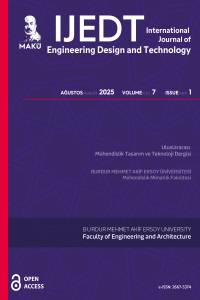
International Journal of Engineering Design and Technology (IJEDT) is a peer-reviewed journal published by the Faculty of Engineering and Architecture at Burdur Mehmet Akif Ersoy University. It publishes innovative research in the fields of engineering, design, technology, architecture, and planning. Our journal aims to merge academic and industrial advancements, sharing the outcomes of research activities at both national and international levels on a scientific platform.

To achieve this, we follow an extensive publication policy with a multidisciplinary approach that includes various engineering disciplines, architecture, and landscape architecture.

IJEDT accepts articles for original research, reviews, and technical notes in the following disciplines:

- Computer Engineering
- Environmental Engineering
- Electrical and Electronics Engineering
- Energy Systems Engineering
- Food Engineering
- Civil Engineering
- Mechanical Engineering
- Materials Engineering
- Architecture
- Forest Engineering
- Landscape Architecture

Manuscript Format: Manuscripts should be prepared on A4 size paper, leaving a margin of 2.5 cm from the top, bottom, right, and left. The text should be single-column, single-spaced, with a single line space between paragraphs.

Title and Authorship Information: The title of the paper should be in 14-point Arial, bold, lowercase, and centered. Leave a line space after the title. Author names should be in 10-point Arial, centered, followed by the authors' addresses, telephone and fax numbers, and the corresponding author's email address, in 10-point Arial, with the initial letters capitalized, and centered below. If the authors are from different institutions, superscript numerals should be used to indicate their affiliations.

Section Headings: Headings for sections (INTRODUCTION, METHODS, etc.) should be in 10-point Arial, bold, uppercase, followed by a line space before continuing with the text. Subheadings should have the initial letters capitalized, using 10-point Arial, bold. After the ABSTRACT, leave a line space before listing up to five keywords. The English title, followed by the ABSTRACT and Keywords, should be provided with a line space before moving to the main text.

Main Text: The main text should be in 10-point Arial font.

Structure: The manuscript should include the following sections: Title, Author Names and Affiliations, Contact Information, Corresponding Author's Email, Abstract, Keywords, Main Text (Introduction, Materials and Methods, Results and Discussion, Conclusion), Acknowledgments (if applicable), Abbreviations (if applicable), References.

Abstract: The abstract should not exceed 200 words and must contain the objectives, methods, and key findings of the study. It should be written in a single paragraph without citations.

Latin Nomenclature: Names of microorganisms and Latin terms should be italicized, and international conventions for abbreviations should be observed.

Tables and Figures: Titles for tables should be placed above the table, and titles for figures should be placed below the figure, both should be numbered. References to tables and figures in the text are required. Data presented in tables and figures should not be duplicated in the text. Titles of tables and figures should be descriptive and understandable. Figures and images should be in high-resolution.

Mathematical Equations: Mathematical equations should be numbered and referenced in the text.

In-text Citations: Citations in the text should follow the format (Author Surname, Year) for single and two authors, and Author Surname et al., Year for more than two authors. For Turkish sources, “ve” should be used to separate two authors' names. [(Burns, 2003), (Kılıç, 2008), (Anderson and Bjorn, 2003), (Anderson et al., 2003), (Yüksel et al., 2008)].

References: References should be listed alphabetically by the authors' surnames under the heading 'References'.

Reference Format: Follow the examples below for formatting references. Journal names should be italicized. For web references, official web pages should be cited where possible, including the date of access.

Article: Boki, K., Shinoda, S., Ohno, S. (1989). Effects of filtering through bleaching media on the decrease of peroxide value of autoxidized soybean fat. Journal of Food Science, 54: 1601-1603.

  • Book: Hamilton, D., Dennis, S. (2004). Pesticide Residues in Food and Drinking Water. John Wiley & Sons Ltd, England.

  • Book Chapter: Ozer, B.H. (1999). Microflora of white-brined cheeses. In: Encyclopaedia of Food Microbiology. Robinson, R.K., Batt, C.A., Patel, P.D. (eds.), Academic Press, London, UK, pp. 397-402.

  • Conference Proceedings: Akdemir, O., Hepbaşlı, A., Kınık, Ö. (2004). Recent situation of energy consumption in Turkey dairy industry. In: International Dairy Symposium: Recent Developments in Dairy Science and Technology, May 24-28, 2004, Isparta, Turkey, Book of Proceedings, pp. 10-16.

Revisions: Manuscripts returned to authors for revisions should be resubmitted within three weeks with necessary modifications. Submissions not returned within this timeframe will be considered as new submissions.

Footnotes: The use of footnotes within the text is discouraged.

Compliance: Manuscripts that do not adhere to the above guidelines will not be considered for review.

Ethical Considerations

Research Ethics: All submitted manuscripts should adhere to the highest ethical standards of research. Studies involving human participants, animals, or potentially sensitive data must have received appropriate ethical approval and must be conducted in accordance with international ethical standards.

Conflict of Interest: Authors must disclose any financial or other substantive conflicts of interest that might be construed to influence the results or interpretation of their manuscript. All sources of financial support for the project should be disclosed.

Authorship Criteria: Authorship should be limited to those who have made a significant contribution to the conception, design, execution, or interpretation of the reported study. All those who have made substantial contributions should be listed as co-authors.

Data Availability: Authors are encouraged to make the data supporting their findings publicly available, either by depositing in publicly available repositories or by providing the data within the manuscript or as supplementary information.

Plagiarism and Originality: Manuscripts must be the original work of the author(s) and have not been published elsewhere in any form or language (partially or in full), unless the new work concerns an expansion of previous work. (Please provide transparency on the re-use of material to avoid the hint of text-recycling (“self-plagiarism”)). The journal uses plagiarism detection software to screen submitted content for originality.

Peer Review Process:
All submissions are subject to peer review by at least two independent experts in the field. The review process is double-blind; both reviewers and authors are kept anonymous.

Appeals and Complaints: Authors have the right to appeal editorial decisions. A detailed explanation of the appeals process and contact information for complaints will be provided on the journal's website.

Formatting and Submission

Submission Platform: Manuscripts should be submitted electronically through the journal's online submission platform. Instructions for submission, including how to register and make a submission, are detailed on the journal's website.

Language: Submissions must be in English. Non-native English speakers are strongly encouraged to have their manuscript professionally edited before submission to improve readability and grammar.

Graphics and Supplementary Materials: High-quality graphics (in TIFF, JPEG, or PDF format) and supplementary materials can be submitted. These should enhance the manuscript and not repeat data already presented.


Uluslararası Mühendislik, Tasarım ve Teknoloji Dergisi (International Journal of Engineering Design and Technology, IJEDT) is a peer-reviewed journal where original research and review articles are published biannually by Burdur Mehmet Akif Ersoy University, Faculty of Engineering and Architecture (Burdur, Turkey) in the field of engineering, architecture, design and technology. In order to improve the overall scientific quality of the journal, following guidelines have been established by the publisher.

Editorial Policy
General Guidelines stated in the Code of Conduct and Best Practice Guidelines for Journal Editors and Code of Conduct for Journal Publishers are followed by all papers submitted to IJEDT. Prior to submission, authors are highly recommended to read the Journal’s Instructions to Authors. Authors should also follow the European Association of Science Editors (EASE) Guidelines for Authors and Translators of Scientific Articles to be Published in English. For any research involving human or animal data, the recommendations of the International Committee of Medical Journal Editors should be followed by the authors of the manuscripts.


Peer review
All contributions are evaluated according to the criteria of originality and quality of their scientific content.

• All manuscripts pass through an initial screening process (technical and overall quality evaluation) in the editorial office followed by an internal review by the technical and scientific editors.

• After the first evaluation, editors have the right to decline formal review of a manuscript if it is (i) on a topic outside the scope of the Journal, (ii) lacking technical merit, (iii) fragmentary and providing marginally incremental results or (iv) poorly written.

• If the manuscript is considered suitable for further evaluation, manuscripts are double-blind-reviewed by a peer review system involving at least two independent reviewers to ensure high quality of manuscripts accepted for publication.

• If requested, the revised version is evaluated by the reviewers, and editors make a decision about final acceptance based on their suggestions. If necessary, further revision can be asked for to fulfil all the requirements of the reviewers.

• The final version is then sent to the technical editor in order to produce a galley proof, and the authors receive this proof for final check before publishing.

• All manuscripts are posted online as pdf files in their final form, indexed in databases.


Publication fee
IJEDT welcomes article submissions and does not charge any publication fee.

Confidentiality
Editors handle all papers submitted to IJEDT in strict confidence. With the exception of reviewers, they do not disclose any information regarding submissions to third parties, unless in case of a suspected misconduct, where COPE recommendations are followed. Submissions are also confidential for reviewers and they are not allowed to share or distribute any part of the manuscripts which they receive for evaluation to third parties. For a case of suspected misconduct, reviewers are encouraged to contact the editorial office immediately in a confidential manner. Reviewers can also recommend a particular course of action in their confidential comments to the editor, following Code of Conduct and Best Practice Guidelines for Journal Editors and Code of Conduct for Journal Publishers.

IJEDT conducts a double-blind peer review process, i.e. the names of the reviewers are confidential to ensure the critical evaluation of the work. Reviewers are asked not to disclose their names or contact details in their comments for authors.

Authorship
An author is an individual who substantially contributed to the idea or design of a research, acquisition of data, analysis or interpretation of data, was involved in drafting, writing or revising the manuscript critically for important intellectual content. Other contributors should be mentioned in the Acknowledgements section of the manuscript and cannot be considered as authors of the study. Correct and full names of all authors and their ORCID IDs should be on the title page of the manuscript. Names of authors must be supplemented with their affiliations and a valid address of the corresponding author. The phone and fax numbers and e-mail address of the corresponding author should be stated in the first page of the manuscript. All authors must guarantee that the submitted manuscript is not published anywhere previously and will not be submitted to anywhere before the editorial board makes a final decision on the manuscript.

Funding sources
Details for all funding sources of the research should be stated in the Acknowledgements. Authors should provide the full official funding agency name(s) and grant number(s).

Alteration in authorship
Alteration in authorship after the submission of the manuscript to IJEDT can be justified only by the additional work required during the revision. Any change is not allowed after the acceptance of the manuscript for publication. Alteration in authorship should be indicated in the responses to reviewers, and should be accepted by all authors. The corresponding author is primarily responsible for any alteration in the revised version of the manuscript, including the order of authors.

Correction of data
All authors should be responsible for the accuracy of the published data. For the correction of data, the corresponding author receives the galley proof of the paper and is asked to correct it carefully within 4 days before publication.


Retraction of an article
A retraction of an article is used to correct errors in submission or publication. Authors can retract the paper and should follow the Committee on Publication Ethics (COPE) retraction guidelines. In case of a duplicate or overlapping publication, fraudulent use of data, plagiarism or unethical research, the paper will be retracted by the editor, and a retraction notice will be included into the electronic database while all links to the retracted article will be maintained.


Ethical considerations
Conflict of interest:
• Authors should declare any conflict of interest in their submission form. Authors are requested to suggest at least three potential reviewers before submission, and these reviewers cannot be their colleagues, collaborators or members of their institutions.

• Reviewers should notify the editors on any conflict of interest which prevents them from reviewing the paper, and they are recommended to follow the COPE guidelines.

• For the manuscripts submitted by the members of the Editorial Board or their collaborators, peer reviewing is modified to exclude them from the entire evaluation process in order to minimize any bias during the evaluation.

• During revision, the editors follow the Code of Conduct and Best Practice Guidelines for Journal Editors and Code of Conduct for Journal Publishers.


Research involving human subjects, animals or plants
• If the research involves humans or animals, the authors are recommended to follow the guidelines of the International Committee of Medical Journal Editors.

• In studies involving human subjects, their informed consent to participate in the study should be supplied by the authors. For subjects under the age of 18, their parents or guardians should give the permission for their participation in the study.

• For all tested subjects, the manuscript must accompany with a statement detailing compliance with relevant guidelines and/or appropriate permissions or licenses.

• Any research on animals must comply with institutional, national or international guidelines and, where possible, should be approved by an ethics committee.

• Any experimental research on plants, including collection of plant materials, must comply with institutional, national, or international guidelines.

• Field studies should be conducted in compliance with local legislation, and a statement specifying the appropriate permissions and/or licences should be included in the manuscript.


Publication misconduct
• The Journal follows the Code of Conduct and Best Practice Guidelines for Journal Editors and Code of Conduct for Journal Publishers.

• In a case of a suspected misconduct such as redundant or duplicate submission, plagiarism, text recycling, violation of ethical norms, etc., researchers, reviewers or readers are encouraged to contact the Editorial Office (ogursoy@yahoo.com).

• The overlapping in the manuscript is highly restricted to the maximum of 25% with no more than 10% from a single source; otherwise, the manuscript will be rejected. If these terms are violated, COPE recommendations will be followed and all parties involved will be notified.


Copyright
IJEDT applies the Creative Commons Attribution Non-Commercial 4.0 CC BY-NC license to all published papers, which permits use, distribution and reproduction in any medium, provided the original work is properly cited and is not used for commercial purposes. Before publication, the Copyright Transfer Form must be signed by the corresponding author and returned to the editorial office of the journal. Copyright of published papers is retained by the Burdur Mehmet Akif Ersoy University, Faculty of Engineering and Architecture (Burdur, Turkey). Authors have the right to use their published article freely and in noncommercial purposes, as long as its integrity is maintained and its original authors, citation details and publisher are clearly stated. Individual users may access, download, copy, display, and adapt the manuscripts published in IJEDT, provided that the authors’ intellectual and moral rights, reputation and integrity are not compromised. Users must ensure that any reuse complies with the copyright policies of the owners. If the content of the published manuscripts is copied, downloaded or otherwise reused for noncommercial research and educational purposes, a link to the appropriate bibliographic citation (authors, journal title, manuscript title, volume, year and page numbers, and the link to the published version on the Journal’s website) should be provided. Copyright notices and disclaimers must not be deleted.

No fee is charged from the author or institution under any name.

Dergi Sahibi

Burdur Mehmet Akif Ersoy Üniversitesi Rektörü

Hüseyin Dalgar
Prof. Dr. Hüseyin DALGAR BURDUR MEHMET AKİF ERSOY ÜNİVERSİTESİ

Prof. Dr. Hüseyin Dalgar, 1978 yılında Burdur’un Bucak ilçesinde doğdu. 2000 yılında Süleyman Demirel Üniversitesi İşletme Bölümünü birincilikle bitirdi. 2002’de aynı üniversitede yüksek lisansını, 2006’da doktorasını tamamladı. 2012’de doçent, 2017’de profesör unvanlarını aldı.
2003 yılında Bucak Hikmet Tolunay MYO’da öğretim görevlisi olarak başladığı kariyerinde, bölüm başkanlığı, müdürlük ve Burdur Mehmet Akif Ersoy Üniversitesi’nde çeşitli idari görevlerde bulundu. 2017-2023 yılları arasında üniversitenin rektör yardımcılığı görevini üstlenerek önemli projelere liderlik etti.

2023’te Cumhurbaşkanlığı kararnamesi ile Burdur Mehmet Akif Ersoy Üniversitesi Rektörlüğüne atanmıştır. Prof. Dr. Dalgar, akademik kariyerinde 40’a yakın makale ve bildiri ile 3 kitap çalışması yapmıştır.

Auditing and Accountability, Financial Statement Analysis, Management Accounting, Cost Accounting

Dergi Sahibi

Hüseyin Dalgar
Prof. Dr. Hüseyin DALGAR BURDUR MEHMET AKİF ERSOY ÜNİVERSİTESİ

Prof. Dr. Hüseyin Dalgar, 1978 yılında Burdur’un Bucak ilçesinde doğdu. 2000 yılında Süleyman Demirel Üniversitesi İşletme Bölümünü birincilikle bitirdi. 2002’de aynı üniversitede yüksek lisansını, 2006’da doktorasını tamamladı. 2012’de doçent, 2017’de profesör unvanlarını aldı.

2003 yılında Bucak Hikmet Tolunay MYO’da öğretim görevlisi olarak başladığı kariyerinde, bölüm başkanlığı, müdürlük ve Burdur Mehmet Akif Ersoy Üniversitesi’nde çeşitli idari görevlerde bulundu. 2017-2023 yılları arasında üniversitenin rektör yardımcılığı görevini üstlenerek önemli projelere liderlik etti.

2023’te Cumhurbaşkanlığı kararnamesi ile Burdur Mehmet Akif Ersoy Üniversitesi Rektörlüğüne atanmıştır. Prof. Dr. Dalgar, akademik kariyerinde 40’a yakın makale ve bildiri ile 3 kitap çalışması yapmıştır.

Auditing and Accountability, Financial Statement Analysis, Management Accounting, Cost Accounting

Dekan

Ahmet Uyumaz
Prof. Dr. Ahmet UYUMAZ Burdur Mehmet Akif Ersoy University
Internal Combustion Engines, Automotive Combustion and Fuel Engineering

Baş Editör

Ahmet Çalık
Prof. Dr. Ahmet ÇALIK BURDUR MEHMET AKİF ERSOY ÜNİVERSİTESİ

Email: acalik@mehmetakif.edu.tr

Mechanical Engineering, Biomechanic, Solid Mechanics, Numerical Modelling and Mechanical Characterisation

Alan Editörleri (Elektrik-Elektronik Mühendisliği)

Ahmet Çifci
Asst. Prof. Dr. Ahmet ÇİFCİ BURDUR MEHMET AKİF ERSOY ÜNİVERSİTESİ, MÜHENDİSLİK-MİMARLIK FAKÜLTESİ

Ahmet Cifci received the B.S., M.S. and Ph.D. degrees in Electrical and Electronics Engineering from Sakarya University, Türkiye, in 2007, 2011 and 2015, respectively.
From 2009 to 2016, he was a Lecturer with the Vocational School of Burdur within Burdur Mehmet Akif Ersoy University. Since 2016, he has been an Assistant Professor with the Department of Electrical-Electronics Engineering, Faculty of Engineering and Architecture, Burdur Mehmet Akif Ersoy University, Burdur, Türkiye. He has held administrative positions such as Senate Membership, Department Head of Electrical-Electronics Engineering, Vice-Director of the Institute of Science, and Vice-Dean, currently continues his role as Vice-Dean of the Faculty of Engineering and Architecture. He also serves as the Deputy Director at the Digital Technologies in Livestock Sector Joint Application and Research Center at Burdur Mehmet Akif Ersoy University. He has authored and co-authored numerous scholarly papers in peer-reviewed journals, books, and national/international conferences. His academic and research interests include high voltage engineering, power systems, and artificial intelligence.
Dr. Cifci is a member of the Chamber of Electrical Engineers of Türkiye.
Deep Learning, Machine Learning Algorithms, Artificial Intelligence (Other), Electrical Engineering, Electrical Energy Transmission, Networks and Systems, Electrical Energy Generation (Incl. Renewables, Excl. Photovoltaics), Power Plants, Photovoltaic Power Systems, High Voltage

Alan Editörleri (Bilgisayar Mühendisliği)

İsmail Kırbaş
Prof. Dr. İsmail KIRBAŞ MEHMET AKİF ERSOY ÜNİVERSİTESİ

Prof. Dr. İsmail Kırbaş, Sakarya Üniversitesi'nde Elektronik ve Bilgisayar Eğitimi alanında doktora derecesini tamamlamış, şu anda Mehmet Akif Ersoy Üniversitesi Bilgisayar ve Bilişim fakültesinde dekan, HAYTEK Ortak Uygulama Araştırma merkezinde de müdür olarak görev yapmaktadır. Kırbaş, özellikle kablosuz vücut alan ağı protokolleri, yapay zeka, nesnelerin interneti ve makine öğrenmesi gibi alanlarda çalışmalar yapmaktadır. Eğitim geçmişinde Kocaeli Üniversitesi’nde lisans ve yüksek lisans derecelerini tamamlamış olan Kırbaş, yenilikçi projelere öncülük eden bir akademik kariyere sahiptir.

Prof. Dr. Kırbaş’ın çalışmaları, özellikle yapay zekâ ve veri madenciliği tekniklerini kullanarak tarım ve sağlık gibi çeşitli sektörlerde dijital dönüşüme katkı sağlamaktadır. Ulusal ve uluslararası birçok projede araştırmacı ve yürütücü olarak yer alan Kırbaş, bilimsel alanda çok sayıda yayına ve patentlere sahiptir.

Networking and Communications, Deep Learning, Machine Learning Algorithms, Computer Software, Embedded Systems

Alan Editörleri (Çevre Mühendisliği)

Environmental Engineering
Environmental Biotechnology (Other), Water Quality and Water Pollution, Environmental Engineering, Environmental Pollution and Prevention

Alan Editörleri (Elektrik-Elektronik Mühendisliği)

Ahmet Çifci
Assoc. Prof. Dr. Ahmet ÇİFCİ BURDUR MEHMET AKİF ERSOY ÜNİVERSİTESİ, MÜHENDİSLİK-MİMARLIK FAKÜLTESİ

Ahmet Cifci received the B.S., M.S. and Ph.D. degrees in Electrical and Electronics Engineering from Sakarya University, Türkiye, in 2007, 2011 and 2015, respectively.
From 2009 to 2016, he was a Lecturer with the Vocational School of Burdur within Burdur Mehmet Akif Ersoy University. Since 2016, he has been an Assistant Professor with the Department of Electrical-Electronics Engineering, Faculty of Engineering and Architecture, Burdur Mehmet Akif Ersoy University, Burdur, Türkiye. He has held administrative positions such as Senate Membership, Department Head of Electrical-Electronics Engineering, Vice-Director of the Institute of Science, and Vice-Dean, currently continues his role as Vice-Dean of the Faculty of Engineering and Architecture. He also serves as the Deputy Director at the Digital Technologies in Livestock Sector Joint Application and Research Center at Burdur Mehmet Akif Ersoy University. He has authored and co-authored numerous scholarly papers in peer-reviewed journals, books, and national/international conferences. His academic and research interests include high voltage engineering, power systems, and artificial intelligence.
Dr. Cifci is a member of the Chamber of Electrical Engineers of Türkiye.
Deep Learning, Machine Learning Algorithms, Artificial Intelligence (Other), Electrical Engineering, Electrical Energy Transmission, Networks and Systems, Electrical Energy Generation (Incl. Renewables, Excl. Photovoltaics), Power Plants, Photovoltaic Power Systems, High Voltage
Default avatar
Assoc. Prof. Dr. Ercan AVŞAR Technical University of Denmark
Image Processing, Pattern Recognition, Deep Learning

Alan Editörleri (Endüstri Mühendisliği)

Mehmet Fatih Demiral
Assoc. Prof. Dr. Mehmet Fatih DEMİRAL BURDUR MEHMET AKİF ERSOY ÜNİVERSİTESİ
Computer Software, Operations Research, Quantitative Decision Methods , Multiple Criteria Decision Making, Industrial Engineering
Banu Özkeser
Dr. Banu ÖZKESER Koluman Otomotiv Endüstri A.Ş.

https://drbanu.weebly.com/

ORCID ID: https://orcid.org/0000-0002-0289-1674

Industrial Engineering, Manufacturing Processes and Technologies (Excl. Textiles), Technology Management and Business Models, New Product Development, Innovation Management, Operation Strategy, Production and Operations Management

Alan Editörleri (Enerji Sistemleri Mühendisliği)

Zuhal Akyürek
Prof. Dr. Zuhal AKYÜREK BURDUR MEHMET AKİF ERSOY ÜNİVERSİTESİ
Energy, Chemical Engineering
Default avatar
Dr. Sireetorn KUHARAT University of Salford
Finite Element Analysis , Mechanical Engineering (Other), Aerospace Structures
Ertaç Hürdoğan
Prof. Ertaç HÜRDOĞAN Osmaniye Korkut Ata Üniversitesi

Ertaç Hürdoğan, 1979 yılında Kıbrıs'ta doğdu. 2000 yılında Çukurova Üniversitesi Mühendislik-Mimarlık Fakültesi Makine Mühendisliği Bölümü'nden mezun oldu ve aynı bölümde Araştırma Görevlisi olarak çalışmaya başladı. 2003 yılında Çukurova Üniversitesi Fen Bilimleri Enstitüsü Makine Mühendisliği Anabilim Dalında Yüksek Lisansını, 2010 yılında ise Doktorasını tamamladı. 2010 yılında Osmaniye Korkut Ata Üniversitesi Mühendislik Fakültesi Enerji Sistemleri Mühendisliği Bölümüne Yardımcı Doçent olarak atandı. 2017 yılında Makine Mühendisliği Enerji Bilim Dalında Doçent oldu ve 2018 yılında Osmaniye Korkut Ata Üniversitesi Mühendislik Fakültesi Enerji Sistemleri Mühendisliği Bölümüne Doçent olarak atandı. 2023 yılında Profesör unvanını aldı.

2017-2020 yılları arasında Osmaniye Korkut Ata Üniversitesi Fen Bilimleri Enstitü Müdür Yardımcılığı ve 2019-2020 yılları arasında Osmaniye Korkut Ata Üniversitesi Mühendislik Fakültesi Enerji Sistemleri Mühendisliği Bölümü Başkanlığı ve 2020-2025 yılları arasında  Osmaniye Korkut Ata Üniversitesi Mühendislik ve Doğa Bilimleri Fakültesi Dekan Yardımcılığı görevlerinde bulundu. Prof. Dr. Ertaç HÜRDOĞAN, 2013 yılından beri Osmaniye Korkut Ata Üniversitesi Enerji Eğitim Etüt Uygulama ve Araştırma Merkezi (ENERMER) Müdürlüğü ve 2025 yılından beri Osmaniye Korkut Ata Üniversitesi Mühendislik ve Doğa Bilimleri Fakültesi Dekanlığı görevlerini yürütmektedir.

Prof. Dr. Ertaç Hürdoğan, 130'dan fazla bilimsel yayının yazarı veya ortak yazarıdır. Çalışma alanları arasında enerji verimliliği, yenilenebilir enerji, ısıtma, soğutma ve iklimlendirme sistemleri, damıtma sistemleri, kurutma sistemleri, enerji-ekserji analizleri ve ısı transferi yer almaktadır.

Engineering, Solar Energy Systems, Energy Efficiency, Energy Generation, Conversion and Storage (Excl. Chemical and Electrical)

Alan Editörleri (Gıda Mühendisliği)

Damla Bilecen Şen
Asst. Prof. Dr. Damla BİLECEN ŞEN BURDUR MEHMET AKİF ERSOY ÜNİVERSİTESİ, MÜHENDİSLİK-MİMARLIK FAKÜLTESİ, GIDA MÜHENDİSLİĞİ BÖLÜMÜ
Food Engineering, Meat Technology, Food Packaging, Preservation and Processing, Food Microbiology, Food Technology
Default avatar
Assoc. Prof. Dr. Salih AKSAY MERSIN UNIVERSITY, FACULTY OF ENGINEERING, DEPARTMENT OF FOOD ENGINEERING, FOOD ENGINEERING PR.
Food Engineering, Food Sciences, Food Biotechnology, Food Chemistry and Food Sensory Science
Oğuz Gürsoy
Prof. Dr. Oğuz GÜRSOY BURDUR MEHMET AKIF ERSOY UNIVERSITY, FACULTY OF ENGINEERING AND ARCHITECTURE, DEPARTMENT OF FOOD ENGINEERING
Food Engineering, Food Sciences, Food Chemistry and Food Sensory Science, Food Microbiology, Food Technology, Dairy Technology
Erdal Ağçam
Assoc. Prof. Dr. Erdal AĞÇAM Çukurova Üniversitesi, Mühendislik Fakültesi, Gıda Mühendisliği Bölümü
Food Engineering, Food Technology, Fruit-Vegetables Technology

Alan Editörleri (İnşaat Mühendisliği)

Kadir Mercan
Asst. Prof. Dr. Kadir MERCAN MEHMET AKIF ERSOY UNIVERSITY, MEHMET AKİF ERSOY APPLICATION AND RESEARCH CENTER

.

Engineering, Soil Mechanics in Civil Engineering, Biomechanic, Solid Mechanics, Micro and Nanosystems, Nanoelectronics
Ahmad Reshad Noorı
Asst. Prof. Dr. Ahmad Reshad NOORI İSTANBUL GELİŞİM ÜNİVERSİTESİ
Civil Engineering, Numerical Modelization in Civil Engineering
Default avatar
Assoc. Prof. Dr. Ali GHAMARİ University of Science and Technology of Iran
Earthquake Engineering

Alan Editörleri (Makine Mühendisliği)

Salih Akpınar
Prof. Dr. Salih AKPINAR ERZURUM TECHNICAL UNIVERSITY
Solid Mechanics

I am not knowing Turkish. So, only English biography is provided. 

Finite Element Analysis , Structural Engineering
Default avatar
Assoc. Prof. Petar ILİNčİć University of Zagreb, Faculty of Mechanical Engineering and Naval Architecture
Mechanical Engineering (Other)
Coskun Özalp
Prof. Dr. Coskun ÖZALP Osmaniye Korkut Ata Üniversitesi
Computational Methods in Fluid Flow, Heat and Mass Transfer (Incl. Computational Fluid Dynamics), Mechanical Engineering, Circuit Machines

Alan Editörleri (Malzeme Mühendisliği)

Finite Element Analysis , Materials Engineering, Plating Technology, Composite and Hybrid Materials, Ceramics in Materials Engineering, Material Production Technologies, Powder Metallurgy
Default avatar
Prof. Dr. Mustafa TAŞKIN MERSİN ÜNİVERSİTESİ, MÜHENDİSLİK FAKÜLTESİ
Materials Science and Technologies, Material Production Technologies

Alan Editörleri (Mimarlık)

Default avatar
Prof. Dr. Hülya YÜCEER İZMİR YÜKSEK TEKNOLOJİ ENSTİTÜSÜ, MİMARLIK FAKÜLTESİ, KÜLTÜR VARLIKLARINI KORUMA VE ONARIM BÖLÜMÜ, RESTORASYON ANABİLİM DALI
Architectural Heritage and Conservation, Protection, Restoration and Repair in Buildings, Environment, Habitation and Products
Default avatar
Asst. Prof. Dr. Hilal TUNCER PÜRSELİM BURDUR MEHMET AKİF ERSOY ÜNİVERSİTESİ
Built Environment and Design, Architectural Heritage and Conservation, Protection, Restoration and Repair in Buildings, Environment, Habitation and Products, Cultural Heritage Management (Incl. World Heritage)

Alan Editörleri (Orman Mühendisliği)

Cengiz Yücedağ
Prof. Dr. Cengiz YÜCEDAĞ BURDUR MEHMET AKİF ERSOY ÜNİVERSİTESİ, MÜHENDİSLİK-MİMARLIK FAKÜLTESİ, PEYZAJ MİMARLIĞI BÖLÜMÜ
Green Structures and Environments, Forest Ecosystems, Silviculture
Default avatar
Prof. Dr. Oliver GAİLİNG University of Göttingen

Prof. Dr. Oliver Gailing is Chair of the Department of Forest Genetics and Forest Tree Breeding at the University of Göttingen. He received the Diploma degree in Biology in 1994 from the University of Bochum and the Ph.D. degree in Plant Genetics from the University of Halle-Wittenberg, Germany, in 2000. In 2009, he was granted the venia legendi for Forest Genetics from the University of Göttingen. From 2009 to 2017 he was a Professor for Forest Genetics at Michigan Technological University, United States. Since 2017 he is Professor and Department Chair of Forest Genetics and Forest Tree Breeding at the University of Göttingen. He is also Honorary Professor at the Transsilvania University of Brasov, Romania (since 2018) and adjunct Professor at Michigan Technological University (since 2017). His research program focuses on population genetic of forest trees and on the study of evolutionary forces acting on plant populations and species during their history and on the evolution of adaptive and species-specific characters. Specifically, genetic structures and their spatial and temporal dynamics have been analysed in natural forest ecosystems based on molecular genetic markers. Dr. Gailing has coordinated and participated in numerous national and international projects (EVOLTREE, Hardwood Genomics, Sustainable energy pathways, IMPAC: Novel genotypes for mixed cropping, Barcoding sequences for community phylogenies). His research activities are documented in more than 200 peer-reviewed journal publications.

Tree Improvement
Alperen Kaymakcı
Prof. Dr. Alperen KAYMAKCI KASTAMONU ÜNİVERSİTESİ
Forest Industry Engineering, Wood Physics and Mechanics

Alan Editörleri (Peyzaj Mimarlığı)

Sima Pouya 1984 yılında İran’ın Kirmanşah şehrinde dünyaya geldi. İlk ve ortaöğretimini babasının memleketi Şebister/Tebriz’de bitiren Pouya, lisans eğitimini Tebriz Üniversitesi Peyzaj Mimarlığı
bölümünde tamamladı. 2013 yılında Karadeniz Teknik Üniversitesi Peyzaj Mimarlığı bölümünden yüksek lisans derecesi aldı ve yine Karadeniz Teknik Üniversitesi Peyzaj Mimarlığı bölümünde doktora
programını tamamladı. 2018 yılında İnönü Üniversitesi’ne doktor öğretim üyesi olarak atanan Pouya, 2020 yılında doçent unvanı aldı. Akademik olarak “doğanın iyileştirici yönü kapsamında iyileştirme
bahçelerinin planlaması ve tasarımı, özel gereksinimli bireyler için peyzaj tasarımı, bahçe terapisi” vb. alanlara ilgi duyan Pouya, halen İnönü Üniversitesi Peyzaj Mimarlığı bölümünde çalışmalarına devam etmektedir. Sima Pouya ileri derecede Farsça, İngilizce, Azerbaycan Türkçesi ve Türkiye Türkçesi bilmektedir.

Landscape Planning, Landscape Design, Landscape Management, Universal and Unobstructed Design
Sara Demir
Prof. Dr. Sara DEMİR BURSA TEKNİK ÜNİVERSİTESİ

Sara DEMIR, PhD., is Assoc. Prof. Dr. in the Landscape Department at the Bursa Technical
University, Bursa, Turkey. Her fields of expertise include landscape planning, historical lanscape
character asssessment, landscape character assessment, landscape ecology, nature conservation,nature-based solution,blue- green
infrastructure, ecosystem restoration, ecotourism, sustainable tourism, multi-criteria decision-making methods, geographic
information system.

Ecology, Sustainability and Energy, Landscape Architecture, Landscape Repair, Landscape Planning, Landscape Management, Universal and Unobstructed Design, Tourism
Latif Gürkan Kaya
Prof. Dr. Latif Gürkan KAYA BURDUR MEHMET AKİF ERSOY ÜNİVERSİTESİ
Ecology, Sustainability and Energy, Landscape Architecture, Computer Technology in Landscape Architecture , Landscape Planning

Alan Editörleri (Tekstil Mühendisliği)

Onur Balcı
Prof. Dr. Onur BALCI KAHRAMANMARAŞ SÜTÇÜ İMAM ÜNİVERSİTESİ TEKSTİL MÜHENDİSLİĞİ BÖLÜMÜ
Textile Science, Textile Chemistry, Textile Technology, Textile Finishing
Textile Sciences and Engineering

Alan Editörleri (Otomotiv Mühendisliği)

Mechanical Engineering, Automotive Engineering, Internal Combustion Engines, Automotive Combustion and Fuel Engineering
Kadir Aydın
Prof. Dr. Kadir AYDIN ÇUKUROVA ÜNİVERSİTESİ, MÜHENDİSLİK FAKÜLTESİ

Prof. Dr. Kadir Aydın; 24.10.1962 tarihinde Afyonkarahisar ili Dereçine Kasabasında doğmuştur. İlk, orta ve Meslek Lisesi eğitimini Konya ili Akşehir ilçesinde tamamlamıştır. Çukurova Üniversitesi Makine Mühendisliği Bölümünden 1983 yılında Lisans derecesini, 1986 yılında da Yüksek Lisans derecesini almıştır. Doktora çalışmalarını burslu olarak Liverpool Üniversitesi Makina Mühendisliği Bölümünde 1993 yılında tamamlayarak mecburi hizmet görevi için 1993 yılında Çukurova Üniversitesi Makine Mühendisliği Bölümünde Yardımcı Doçent olarak göreve başlamış ve 1995 yılında Doçent, 2001 yılında da Profesör olmuştur. 2013-2020 yılları arasında Çukurova Teknoloji Geliştirme Bölgesinde (Çukurova Teknokent) Yönetim Kurulu Başkanı ve Genel Müdür olarak görev yapmıştır. Araştırma alanları İçten Yanmalı Motorlar, Taşıt Teknolojisi, Yanma, Hidrojen ve Elektrikli Araçlar, Alternatif Yakıtlar (Biyodizel, Biyoetanol ve Biyogaz) ve Eklemeli Üretim olup, tescil edilmiş patentleri, 250’nin üzerinde yayınlanmış ulusal ve uluslararası kitap, makale ve bildirisi bulunan, aynı zamanda çok sayıda Ar-Ge projesini başarı ile tamamlayan Prof. Dr. Kadir AYDIN evli, 2 çocuk ve 1 torun sahibidir. Halen Çukurova Üniversitesi Otomotiv Mühendisliği Bölümü’nde Profesör ve Makoto Mühendislik Dan. İth. İhr. San. Tic. Ltd. Şti. Genel Müdürü olarak görev yapmaktadır.   

Hybrid and Electric Vehicles and Powertrains, Internal Combustion Engines, Automotive Combustion and Fuel Engineering, Vehicle Technique and Dynamics

Uluslararası Editör Danışma Kurulu

Azim Doğuş Tuncer
Dr. Azim Doğuş TUNCER Cooling Photonics S.L
Experimental Methods in Fluid Flow, Heat and Mass Transfer, Computational Methods in Fluid Flow, Heat and Mass Transfer (Incl. Computational Fluid Dynamics), Energy, Solar Energy Systems
Default avatar
Asst. Prof. Dr. Bogdan CHİLİBAN Lucian Blaga University of Sibiu
Machine Design and Machine Equipment, Engineering Education, Manufacturing and Industrial Engineering in System Engineering, Technology Management and Business Models
Valentin Grecu
Dr. Valentin GRECU Lucian Blaga University of Sibiu
Decision Support and Group Support Systems, Sustainable Operation Management, Production and Operations Management
Default avatar
Prof. Dr. Sadık ARTUNÇ Mississippi State University

Sadık C. Artunç, FASLA, FCELA, PLA, PE is a professor who has recently returned to his fulltime faculty position after serving seventeen years as the Head of Department of Landscape Architecture at Mississippi State University (MSU) (January 2007 – December 2023). Prior to his tenure at MSU, he taught at the Robert S. Reich School of Landscape Architecture of Louisiana State University between 2007 - 1981. Sadık has dedicated his academic career to educating students in innovative, humanistic, and environmentally sensitive planning, design, and implementation and to serving as an enthusiastic advocate for the profession and education of professionals. With the highest standards of professional ethics, he has been a successful and very consistent role model for his students and colleagues.
A native of Turkey, Sadık is a naturalized citizen of the U.S.A. He has a B.S. and M.S. in forestry and forest engineering from the University of Istanbul, and a M.L.A. from the University of Michigan. He is a registered landscape architect in the U.S.A. and a registered forester and forest engineer in Turkey. His teaching involves design implementation and construction, site planning and design, and regional planning and design. His professional consulting involves large-scale planning and design with a focus mostly on recreation and tourism, resource planning, and design implementation/construction. He has worked on projects in the United States, Guatemala, Nicaragua, and Turkey. Prior to arriving in the United States in 1975, he worked in Turkey as a forester and forest engineer for the Ministry of Forestry, and later as a recreation planner in the Central Planning Office of the National Parks Service and, finally, as the planning director of the Uludağ (Olympus) National Park for the Department of National Parks in Bursa, Turkey.
Sadık has been an active member of various professional organizations and societies since 1981. Always a tireless and enthusiastic promoter of the profession of landscape architecture and ASLA, Sadık served at various leadership capacities and levels: the Louisiana Chapter president (1991); chapter trustee (1996–2001); and finally, as the national vice-president of membership (2002–2004), during which time ASLA membership had a tremendous growth in numbers. Sadık was nominated and ran for the office of President of ASLA in 2005. Sadık was inducted into the ASLA Council of Fellows in 2000. Most recently, he served as the President-elect, President, and Past-President of the CELA. During his three-year service which has been impacted by the COVID, the annual conference was cancelled in 2020, held the first ever virtual annual conference was held in 2021, and the first face-to-face and virtual (hybrid) conference was held in 2022. Also, during his term, the CELA Board of Directors enacted and endowed the Charles Fountain Scholarship for minority students studying landscape architecture.
His teaching, scholarly, and professional activities through ASLA, CELA, CLARB, LAAB, ECLAS, IFLA, and Turkish Society of Landscape Architecture (PEMAT and PEMDER) have contributed to an increased visibility and awareness of the profession. He has over one fifty hundred publications to his credit in refereed journals, proceedings of professional conferences, national registration exams, magazines, and book chapters. He has received twenty-one academic and professional awards during his academic and professional career from his students, his colleagues, and his peers.

Environmental Rehabilitation and Restoration, Environmental Assessment and Monitoring, Landscape Ecology, Regional Analysis and Development, Landscape Planning
Saif Ali Kadhim
Lecturer Saif Ali KADHİM University of Technology - Iraq
Experimental Methods in Fluid Flow, Heat and Mass Transfer, Computational Methods in Fluid Flow, Heat and Mass Transfer (Incl. Computational Fluid Dynamics), Non-Newtonian Fluid Flows (Incl. Rheology), Fluid Mechanics and Thermal Engineering (Other), Solar Energy Systems, Thermal Power Systems, Renewable Energy Resources , Chemical and Thermal Processes in Energy and Combustion, Mechanical Engineering
Default avatar
Lecturer Radu Emanuil PETRUSE Lucian Blaga University of Sibiu
Virtual and Mixed Reality, Augmented Reality, Simulation, Modelling, and Programming of Mechatronics Systems, CAD/CAM Systems, Additive Manufacturing

Associate Prof. Dr. Hijaz Ahmad completed his MS in computational mathematics from the Department of Mathematics, COMSATS University Islamabad, Wah Campus. In 2022, he completed his PhD in Computational and Applied Mathematics from the Department of Basic Sciences and Islamiat, University of Engineering and Technology Peshawar, Pakistan and then he started his Post-doc from Lebanese American University, Beirut, Lebanon. His research work is focused on the development and advancement of numerical techniques for finding the numerical solution of mathematical models in the form of partial differential equations and fractional partial differential equations arising in finance, computational biology, and different disciplines of engineering. He has introduced modified variational iteration algorithm-I and modified variational iteration algorithm-II for the numerical solution of nonlinear partial differential equations and fractional iteration algorithm-I for finding the numerical solution of nonlinear non-integer order partial differential equations. The scope of his research is quite broad, covering numerical analysis, fractional calculus, mathematical biology and mathematical physics. Dr Ahmad is included in the World's Top 2% Scientists 2022, 2023 and 2024 (by Stanford University and Elsevier).

Numerical Analysis, Approximation Theory and Asymptotic Methods
Default avatar
Assoc. Prof. Dr. Ali GHAMARİ University of Science and Technology of Iran
Earthquake Engineering
Nadir Yılmaz
Prof. Dr. Nadir YILMAZ Howard University

Nadir Yilmaz is a professor and the department chair of Mechanical Engineering at Howard University, as well as, a licensed professional engineer (P.E.) and consultant. He received B.S., M.S., and Ph.D. degrees in Mechanical Engineering from Istanbul Technical University, Bradley University and New Mexico State University, respectively. He is a Fellow of American Association for the Advancement of Science (AAAS), American Society for Engineering Education (ASEE), American Society of Mechanical Engineers (ASME), National Society of Professional Engineers (NSPE) and Society of Automotive Engineers (SAE International). He has been a noted author of many publications in the fields of combustion, CFD, rocket propulsion and automotive engineering. He was a NASA Academic Mission Services (NAMS) Faculty Researcher, and a U.S. Department of Energy Visiting Faculty at Los Alamos National Laboratory and Sandia National Laboratories. He has educated and mentored many underrepresented minority and female students via various STEM programs including the NSF-funded AMP (Alliance for Minority Participation) program.

Dr. Yilmaz serves as the Editor-In-Chief for the SAE International Journal of Fuels and Lubricants and as a member of the editorial board of numerous international journals. In addition, he serves on SAE Foundation Board of Trustees, NSPE Education Foundation Board of Trustees, New Mexico AMP Advisory Board and the Board of Directors of Society of Automotive Engineers of Turkey. Dr. Yilmaz has also served as the Past Chair of SAE Education Board, NSPE Higher Education Executive Board, ASEE Aerospace Division, SAE Washington DC Section and ASME New Mexico Section. In a Governor-appointed position, Dr. Yilmaz previously served on the New Mexico State Board of Licensure for Professional Engineers and Professional Surveyors.

Computational Methods in Fluid Flow, Heat and Mass Transfer (Incl. Computational Fluid Dynamics), Mechanical Engineering, Automotive Engineering, Internal Combustion Engines, Automotive Combustion and Fuel Engineering, Aerospace Engineering
Hamit Solmaz
Prof. Dr. Hamit SOLMAZ Gazi University, Faculty of Technology, Automotive Engineering Department
Thermodynamics and Statistical Physics, Energy, Mechanical Engineering, Automotive Engineering, Internal Combustion Engines, Automotive Combustion and Fuel Engineering
Farzad Jaliliantabar
Dr. Farzad JALİLİANTABAR University of Saskatchewan
Energy, Automotive Combustion and Fuel Engineering, Agricultural Machines
Default avatar
Assoc. Prof. Dr. Mohd Ezree ABDULLAH Universiti Tun Hussein Onn Malaysia (UTHM)

Professional

Civil Construction Engineering, Transportation and Traffic, Transportation Engineering
Mujtaba Ahsan
Assoc. Prof. Mujtaba AHSAN North South University

Graduated in Architectural Design from the Bangladesh University of Engineering & Technology in 2000 and obtained a professional doctorate degree (Arch.D) in architecture from the University of Hawaii at Manoa in 2006. Teaching architecture and design since 2006 at the North South University in Bangladesh.  

Architectural Design

İngilizce Dil Editörü

Kadir Mercan
Asst. Prof. Dr. Kadir MERCAN MEHMET AKIF ERSOY UNIVERSITY, MEHMET AKİF ERSOY APPLICATION AND RESEARCH CENTER

.

Engineering, Soil Mechanics in Civil Engineering, Biomechanic, Solid Mechanics, Micro and Nanosystems, Nanoelectronics

Sekretarya

Yasin Aşık
Res. Assist. Yasin AŞIK MEHMET AKIF ERSOY UNIVERSITY
Landscape Planning, Landscape Architecture (Other)