The main purpose of Manufacturing Technologies and Applications (MATECA) is to contribute to sustainable production by ensuring that the results of research, development and application studies in manufacturing processes are collected in a written source. The journal also contributes to the rapid spread of innovative concepts and communication channels among experts and researchers in research and academic institutions related to professional workers and investment institutions serving in the manufacturing industry. In this context, original research and review articles and technical notes are published in the journal.
Manufacturing Technologies and Applications is an international refereed journal published only three times a year in April, August and December. Additional numbers and special issues are published if needed. The scope of Manufacturing Technologies and Applications includes the following areas:
-Traditional and nontraditional machining methods
-Additive manufacturing
-Casting, forming and molding methods
-Powder metallurgy and coating methods
-Welding, joining and assembly
-Design, modeling and simulation
-Imaging, control and automation
Original scientific articles for publication in the Manufacturing Technologies and Applications must be submitted online after registration is completed on the journal website (http://dergipark.ulakbim.gov.tr/mateca). Click (EN)(Template) (TR)(Sample Article) for a sample article.
Font and Page Layout
1. The margins for each side (right-left, top-bottom) of the page structure should be 2 cm. Page numbers should be at the bottom and middle of the page.
2. The articles sent to the journal should be prepared using single-spaced, 11-point Times New Roman font. Each paragraph should be indented 0.5 cm left and no space should be left between paragraphs.
Article Text
3. The article should consist of English title, Author information, English abstract, Turkish title, Turkish abstract, keywords under the abstracts, followed by introduction, main text, conclusion, acknowledgments, references and appendices.
4. Articles should be based on the Turkish Language Association's spelling guide and spelling rules. When using unconventional words in Turkish, the foreign language equivalent can be given in parentheses at the first occurrence.
5. In the article (Text, tables, graphics, figures, etc.) the SI unit system should be based and a point should be used in decimal notation.
Title and Author Information
6. English and Turkish titles should be written over the Turkish and English abstracts, with the first letter capitalized, single-spaced, left aligned, Times New Roman, 12 points and bold.
7. In the works to be sent, the names of the authors should be written in 10 points under the English title. The imprint information of the author should be added under the names of the authors in 8 points with a star or numbered footnote.
Summary and Keywords
8. All submitted articles must include English and Turkish abstracts. Keywords should be written in English/Turkish with a minimum of 3 and a maximum of 6, with the first letter capitalized under the abstract. The titles of the abstracts should be written with the first letter capitalized and left aligned. The abstract of the article should be a minimum of 200 words and a maximum of 250 words.
9. Abstracts and Keywords should be written in Times New Roman font, 10 pt and 9 pt, single-spaced, respectively. Only the titles of these sections should be bold.
Main Text and Section Headings
10. The main text should be written using Times New Roman font, 11 points, single-spaced and justified. The first lines of paragraphs should start 0.5 cm inside. The main title and subheadings of the article should be numbered in decimal form such as 1., 1.1., 1.1.1, starting from the Introduction (excluding the References), left aligned and written in bold. Subheadings should be made up to the third level (such as 1.1.2.) at the most in the text, and if necessary, lower-level headings should be written in italics and bold (without numbers). In the article, the main headings should be in capital letters, only the first letter of the 2nd degree subheadings should be capitalized, and the first word of the 3rd degree subheadings should be in capital letters. There should be a single line before the main headings and a 6 pt space after the heading.
Tables, Figures and Graphics
11. Tables, figures and graphics should be centered on the page in a way that is numbered consecutively (Table 1, Table 2, Figure 1, Figure 2, Graphic 1, Graphic 2 etc.) in appropriate places in the text. Each table, figure or graphic should be given a title. The title should be written in Times New Roman, 10 points above the table, below the figure or graphic. A single point should be placed after the table, figure or graphic number and the title of the table, figure or graphic should be written. The paragraph spacing between the Title and the Table, Figure or Graphic should be "then 6 pt". Tables can also be used horizontally if needed. The text in tables, figures and graphics should be at least 9 points.
12. Tables should not be included in the text as a software program output, the author(s) should bring the results into tables themselves. The resolution of the figures should be at least 300 dpi.
Mathematical Equations
13. Mathematical equations/formulas should be written in the text as left aligned. Mathematical equations and formulas should be numbered in the article. Numbering should be done in parentheses at the far right of the line.
Acknowledgement
14. If the study is supported by a research institution or fund, the name of the supporting institution/organization and the project number should be written before the References section.
References
15. References in the text should be given in square brackets. References should be written in the formats given below in the references section, in 10 points.
Authors are required to use reference management software such as Mendeley, Zotero, or EndNote when organizing their references. If you prefer to format the references for your article using the Mendeley reference management software, please select the “Elsevier (numeric, with titles)” style, which fully complies with our journal's citation and reference formatting guidelines.
To install this style, follow these steps:
1. Open Mendeley and navigate to the “View” menu.
2. Go to “Citation Style” and select “More Styles...” from the dropdown list.
3. In the newly opened window, click on the “Get More Styles” tab at the top.
4. Enter “Elsevier (numeric, with titles)” in the search bar, and click “Use this style” next to the displayed citation style.
5. Complete the process by clicking the “Done” button at the bottom-right corner.
To add new references to Mendeley, use the “Add” option, and then select “Add Entry Manually.” For publications with DOI numbers, use the DOI field in the entry window. For sources without a DOI, enter the required details manually to enable automatic reference generation.
Articles that are not prepared in accordance with the MATECA writing guidelines will not be considered for evaluation.
REFERENCE FORMATTING
Journal Article: Initial of the author's first name(.) Last name, Full title of the article, Journal Name or International Abbreviation, volume (issue) year page numbers.
M. Günay, I. Korkut, E. Aslan, U. Şeker, Experimental investigation of the effect of cutting tool rake angle on main cutting force, J Mater Process Technol 166 (2005) 44–49. https://doi.org/10.1016/j.jmatprotec.2004.07.092
Book: Initial of the author's first name(.) Last name, Book Title, Publisher name, Place of publication, year.
E.M. Trent, Metal Cutting, Butterworth-Heinemann, Valencia, 2016.
Book Chapter: Initial of the chapter author's first name(.) Last name, Chapter title, editor(s) (if available), Book Title, Publisher name, Place of publication, year.
D. Ulutan, T. Özel, Hard machining, in: M. Koç, T. Özel (Eds.), Modern Manufacturing Processes, 6th ed., John Wiley & Sons, Inc, New York, 2019.
Conference Paper: Initial of the author's first name(.) Last name, Title of the paper, Name of the conference, location of the conference, year: page numbers.
A. Parlak, R. Kaçar, H.Ertek Emre, Adjoining of AA6033 Aluminum-AH36 Grade steel coupling with robotic GMAK method using transition plate, in: 4th International Conference on Engineering Technology and Applied Sciences, Kiev, 2019: pp. 122–142.
Standart-Patent: Standard number, name of the standard, place of publication, year.
ASTM E8, Standard test methods for tension testing of metallic materials, 2004.
Thesis: Initial of the author's first name(.) Last name, Title of the thesis, Type (Master’s thesis, Doctoral dissertation), University and iNstitute, year.
T. Meral, Paslanmaz çeliğin delinebilirliğinin deneysel ve nümerik olarak incelenmesi, Yüksek Lisans Tezi, Karabük Üniversitesi Fen Bilimleri Enstitüsü, 2018.
Online Resources: Author(s) or Responsible Institution, Title of the publication, URL, access date.
Texas Instruments, RS-422 and RS-485 Standards Overview and System Configurations, Http://www.Ti.Com/Lit/an/Slla070d/Slla070d.Pdf (2012).
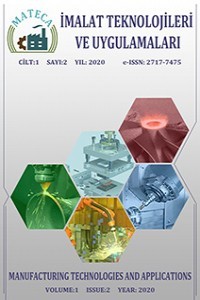
Manufacturing Technologies and Applications (MATECA) journal started its publication life in 2020 and is published by Mustafa GÜNAY. MATECA publishes original scientific articles in the fields of Traditional and Non-traditional machining methods, Additive manufacturing methods, Casting, Plastic forming and Molding methods, Powder metallurgy and Coating methods, Welding, Joining and Assembly, Design, Modeling and Simulation, Imaging, Control and Automation. It is an international peer-reviewed scientific e-journal to be published three times a year (April, August and December). There is no article fee and an open access policy has been adopted. The journal accepts scientific articles in English and Turkish via the DergiPark system. The article evaluation period is approximately 3 months.
Manufacturing Technologies and Applications (MATECA) journal publishes original research and review articles.
MATECA follows guides and politics published by Committee on Publication Ethics (COPE) for ethical rules and responsibilities of authors, journal editors/subject editors, reviewers and publisher.
Plagiarism Check
Articles submitted to Manufacturing Technologies and Applications (MATECA), are evaluated after passing through the Plagiarism Detection Program “ithenticate”. The similarity rate limit is 20% at most, excluding references. The article that is not found suitable as a result of the preliminary evaluation is sent to the author(s) again for the necessary corrections without being evaluated.
Pre-checking the Manuscript by Author
The article submitted by the author must not have been previously published and submitted for evaluation to any journal.
The submission file must be in Microsoft Word document file format.
URLs of references should be provided where available.
The text should be prepared according to rules specified in the author’s guide.
Blind Referee Process
Manufacturing Technologies and Applications (MATECA) is a peer-reviewed academic journal in which scientific articles passed through the double-blind peer-review process are published.
For review of submitted manuscripts, at least two referees are appointed by the editor (s) according to the content of the work and the expertise of the referees. All referee evaluation reports are sent electronically and anonymously. The names of the referees who made the assessment are not specified in the reports and in the journal due to the double blind process. However, after the evaluations, a letter of appreciation is sent to the referees.
Blind refereeing processes directly affect the quality of academic publications. The evaluation process is carried out with the principle of double-sided blind review. Referees cannot contact the authors directly, evaluation and referee reports are sent through the e-mail management system. In this process, evaluation forms and referee reports are sent to the author(s) by the editor. Double-sided blind reviewing helps editors make decisions in an impartial manner to the authors. Authors also have the opportunity to improve their work by obtaining important information about their work.
Decision Making Process
The editors and the publisher send all works submitted for publication to at least two referees who are experts in their fields for evaluation. In case of a dispute between the referees, a third referee is appointed and the article is decided according to the majority’s decision. Evaluation forms filled in by the referees and corrections on the text, if they prefer, are sent to the authors by contacting the responsible author. The final corrected file from the author is re-evaluated by the referees and the field editor, and it is decided whether the study will be published or not.
Privacy
Studies sent to the referees for evaluation should be considered as confidential documents. Studies should not be shown to others and their contents should not be discussed. Where necessary, referees may seek advice from other colleagues, with the permission of the Chief Editor. The Editor-in-Chief can give this permission only in the event of an exceptional condition. The confidentiality rule also includes people who refuse to act as reviewers.
Impartiality Principle
No personal criticism should be made to the authors during the evaluation process. Evaluations should be made in an objective and contributing way.
Citation of Reference
The referees are obliged to inform the authors if there are any citations that are not cited in the study. Referees should pay particular attention to works that are not cited in the field or citations that overlap with similar works. The referees should inform the editors in the event of publication that is similar to any previously published work or information.
Information and Conflict of Interest
Referees should not agree to evaluate if they have any collaborative connections with any author, company or institution for which they are asked for evaluating their work, and should inform editors of the situation as soon as possible.
Referees may not use unpublished works or parts of works in the manuscripts submitted to the journal without the written consent of the author(s) for evaluation. The information and ideas obtained during the evaluation should be kept confidential by the referees and should not be used for their own benefit. These rules include those who do not accept the reviewing.
Publication Language
Manufacturing Technologies and Applications (MATECA) reviews research articles written in Turkish and English.
Publication Frequency
In MATECA, which has been publishing issues since 2020, one volume is published every year and each volume consists of 3 issues (April, August and December).
Open Access Policy
Manufacturing Technologies and Applications journal provides instant open access to its content, adopting the principle that providing scientific studies free of charge will increase the global sharing of knowledge.
All articles accepted and published by Manufacturing Technologies and Applications journal are freely available, openly accessible. We follow the guidelines presented by Budapest Open-Access Initiative (BOAI) regarding the Open-Access.
Wage Policy
Manufacturing Technologies and Applications (MATECA) journal, does not charge the author / authors at any stage (submission, evaluation and publication of articles) for publication procedures.
No fee is charged in the journal article submission, process and publication stages.
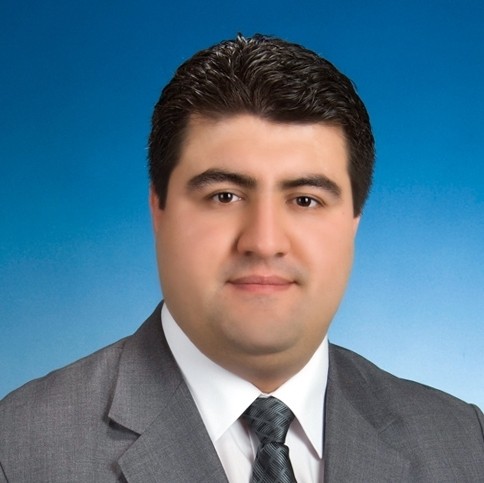
Mehmet Erdi Korkmaz graduated from his Phd in 2018. He is currently working as Assoc. Prof. Dr. at Karabük University. He got his master degree in Mechanical Engineering from the same university. He also takes a Bachelor degree in mechanical engineering from Middle East Technical University. He had been studied as guest researcher at Ghent University, Belgium in 2017. His research areas are mechanical behaviour of materials, Constitutive material model parameters, Finite element modeling of machining process, tribology in machining and additive manufacturing. He has authored or co-authored over 100 publications, including scientific papers in high impact international journals and conference proceedings. His expertise and contributions in the field of machining have afforded him many collaborative works with important Institutions. He is a reviewer for many international Journals (for Elsevier, Springer, Sage, etc.).
Dr. Mozammel Mia, currently serving as Associate Professor in BBS, has an academic and research focus on manufacturing and business informatics. With a long track record academic and research success, he is now more oriented towards nationally impactful contributions.
Awarded with the prestigious Commonwealth Scholarship for his Ph.D. in the UK at Imperial College London, he worked on Manufacturing Informatics that has opened a new wing of research combining the data-driven approach with fundamental investigation and modelling in the field of wear-and-friction. Since then, he is more inclined to data-driven research approaches for manufacturing and business informatics with national and industrial impact.
In early years, Dr. Mia's research contributions were notably focused on manufacturing processes, optimization of production systems, process sustainability, smart and intelligent manufacturing. His research theme includes employment of experimental, simulation, and modeling approaches to advance the understanding of scientific and engineering aspects. He has enriched himself with active collaborations on different research projects with esteemed scholars from multi-countries and continents. This indicates his capability to team work with diverse people and bring outstanding success.
The success of his students in national and international domains i.e., award-winning projects, admission to the top universities for higher studies, placements in big companies, starting their own business or it be scientific publication - all of these testify his teaching and supervision success that further inspires him to add more value for students.
Şenol Bayraktar is a Assoc. Prof. Dr. at Recep Tayyip Erdoğan University, Rize, Turkey. He received his MSc and PhD from Gazi University, Department of Manufacturing Engineering, Ankara, Turkey, in 2011 and 2016, respectively. His research interests involve on the machinability of materials (drilling, turning, milling, etc.) and the efficiency of asynchronous motors. He experienced on the industrial design of neonatal and intensive care devices in the industrial sector and served as manufacturing manager in different sectors. Especially in recent years, he has been working on the effect of silicon, zinc, strontium, magnesium and titanium on the machinability of heat treated and non-heat-treated aluminum alloys. He has been working as an manager and researcher in national projects and reviewer in prestigious international journals. He has articles and book chapters published in Elsevier, Springer and Taylor Francis publishing.
Prof.Dr. Serdar SALMAN
Prof. Dr. Serdar SALMAN 1962 yılında İstanbul’da doğmuştur. İlkokul eğitimini Ankara’da, Orta Okulu Ankara ve Hopa’da, Lise öğrenimine Hopa’da başlayıp 1979 yılında Denizli Cumhuriyet Lisesinde tamamlamıştır.
1979-1980 yılında Ege Üniversitesi’nde okumuştur. 1980 yılında başladığı, İstanbul Teknik Üniversitesi Sakarya Mühendislik Fakültesi Metalurji Mühendisliği Bölümünden 1984 yılında mezun olmuştur.
1985 yılında Marmara Üniversitesi Teknik Eğitim Fakültesi Metal Eğitimi Bölümünde Araştırma Görevlisi olmuştur. Yıldız Üniversitesi Fen Bilimleri Enstitüsü Metalurji Mühendisliği Ana bilim Dalında “Kaynak İşleminde Oluşan Artık Gerilmeler ve Ölçülmesi” konulu yüksek lisans tezini Prof. Dr. Ahmet Topuz’un danışmanlığında hazırlayarak 1987 yılında Metalurji Yüksek Mühendisi unvanını almıştır.
1987-1988 yılları arasında Askerlik görevini Topçu Asteğmen rütbesi ile yapmıştır. 1991 yılında 9 ay süreyle YÖK-Dünya Bankası II. Endüstriyel Eğitim Projesi kapsamında İngiltere’de (Huddersfield Üniversitesi) bulunmuştur. 1992 yılında Marmara Üniversitesi Teknik Eğitim Fakültesinde Öğretim Görevlisi olmuştur.
1995 yılında Yıldız Teknik Üniversitesi Fen Bilimleri Enstitüsü Metalurji Mühendisliği Ana bilim Dalında, Prof. Dr. Zeki Çizmecioğlu’nun danışmanlığında sürdürdüğü, “Plazma Püskürtme Tekniği ve Alev Püskürtme Tekniğiyle Al2O3-13% TiO2 ve Cr2O3-5% SiO2-3% TiO2 Seramik Kaplanmış Malzemelerin Özellikleri” isimli tezini tamamlayarak Doktor Mühendis unvanını almıştır. 1995 yılında MÜTEF Metal Eğitimi Bölümü Malzeme Eğitimi Anabilim Dalına Yardımcı Doçent olarak atandı. Aynı Anabilim dalında 1997 yılında Doçent, 2003 yılında ise Profesör olmuştur.
Dumlupınar Üniversitesi Mühendislik Fakültesi Makine Mühendisliği Bölümü ve Fen Bilimleri Makine Mühendisliği Anabilim Dalında 1997-1998 yıllarında kısmi zamanlı olarak ders vermiştir. 1999-2011 yılları arasında Marmara Üniversitesi TUAR Müdürlüğü, 2003-2006 yılları arasında Marmara Üniversitesi Teknik Eğitim Fakültesinde Dekan Yardımcılığı ve Metal Eğitimi Bölüm Başkanlığı, 2005-2007 yılları arasında Marmara Üniversitesi Fen Bilimleri Enstitüsü Müdür Yardımcılığı görevleri yapmıştır. 2007 yılında 1 yıl süreyle ABD Georgia Tech Material Science Department ‘da Misafir Profesör olarak bulunmuştur.
2012-2015 yılları arasında, Mehmet Akif Ersoy Üniversitesi Mühendislik-Mimarlık Fakültesinin Kurucu Dekanlığını yapmıştır. Marmara Üniversitesi Teknoloji Fakültesi Metalurji ve Malzeme Mühendisliği Bölüm Başkanlığı görevlerini 2016-2017 yılları arasında yaptıktan sonra halen görev yapmakta olduğu Milli Savunma Üniversitesi Rektör Yardımcılığı görevine 06.12.2017 tarihinde atanmıştır.
60’ı aşkın indeksli dergilerde olmak üzere 200’ü aşkın Uluslararası ve Ulusal makale ve bildiriye sahip olan Prof. Dr. Serdar SALMAN, 5 adet Araştırma projesinin de yürütücülüğünü yapmıştır. Halen 2 TÜBITAK projesinin yürütücülüğünü yapmaktadır. Prof. Serdar SALMAN'ın kaynak teknolojisi, toz metalurjisi, seramik kaplama ve biyo-malzemeler alanlarında çalışmaları bulunmaktadır.
Uluslararası Kongrelerde sunum, Düzenleme Kurul Başkanı ve Oturum Başkanı olarak görev yapmak üzere ABD, Güney Kore, Çin, Meksika, Pakistan, Yunanistan, Bulgaristan, Küba, İspanya, Hırvatistan, Makedonya, Güney Afrika, Hollanda, Almanya, Sırbistan, Ukrayna, Azerbaycan, Fas ve İngiltere ve Kazakistan gibi ülkelerde bulunmuştur.
Malzeme Biliminin Temelleri ve Metalografi adlı iki kitabı bulunmaktadır. 11 adet Doktora ve 37 adet Yüksek Lisans tezinin Danışmanlığını yapmıştır. Halen 3 Doktora ve 1 Yüksek Lisans tezinin danışmanlığını sürdürmektedir.
2017 yılından itibaren Milli Savunma Üniversitesi’nde Rektör Yardımcısı olarak görev yapmaktadır, İngilizce bilmektedir.
Prof. Dr. Serdar SALMAN, evli olup 2 evlat babasıdır.
Mehmet Erdi Korkmaz graduated from his Phd in 2018. He is currently working as Assoc. Prof. Dr. at Karabük University. He got his master degree in Mechanical Engineering from the same university. He also takes a Bachelor degree in mechanical engineering from Middle East Technical University. He had been studied as guest researcher at Ghent University, Belgium in 2017. His research areas are mechanical behaviour of materials, Constitutive material model parameters, Finite element modeling of machining process, tribology in machining and additive manufacturing. He has authored or co-authored over 100 publications, including scientific papers in high impact international journals and conference proceedings. His expertise and contributions in the field of machining have afforded him many collaborative works with important Institutions. He is a reviewer for many international Journals (for Elsevier, Springer, Sage, etc.).