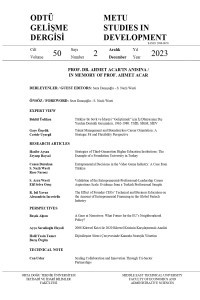
Middle East Technical University Studies in Development (METUSD) publishes articles in economics, business administration, international relations, political science and public administration fields. The journal tries to encourage scholars, researchers, and academics to share their theoretical and empirical studies, innovative ideas and critical insights in those fields of social sciences. The journal includes studies not only about Turkey but also regions, especially the European Union and the Middle East and countries.
Established in 1970, Middle East Technical University Studies in Development (METUSD) (ODTÜ Gelişme Dergisi) is one of the oldest scholarly journals in Turkey. It is bilingular (Turkish and English) and currently publishes two issues per year, June and December online. The journal is a double-blind refereed journal soliciting original research articles in the fields of economics, business administration, international relations, political science and public administration and related fields.
WRITING GUIDELINES
1. The METUSD Journal accepts articles written in Turkish or English. The responsibility for the scientific content, language, and style of the articles published in the journal belongs to the author(s). Authors must prepare their manuscripts in accordance with the journal’s publication and ethical guidelines. Studies submitted to the journal must adhere to the writing and grammar rules.
2. Articles must be submitted online in MS Office Word format (2013/2016/2019/Office 365) via the DergiPark website (dergipark.org.tr). All submissions must be made through the DergiPark system (articles sent via e-mail or directly to the editorial board will be rejected).
3. An author could not have more than one article published in the same issue, even if the works are co-authored. Manuscripts submitted by author(s) whose previous submission are still under review will not be evaluated until the ongoing review process is completed.
4. Submitted manuscripts must be unpublished and must not be under consideration for publication elsewhere or in another language.
5. Acceptance of an article for publication automatically transfers the copyright of the article to METUSD. During the submission process, the “Copyright Transfer Form” must be completed and signed by the corresponding author and uploaded to the system separately from the manuscript files.
6. The “cover page” and the “full text” must be uploaded SEPARATELY as ADDITIONAL FILES in MS Office Word format (2013/2016/2019/Office 365). Since the journal uses a double-blind review system, the authors’ information must appear ONLY on the cover page and must not appear anywhere in the full text. This separate cover page must contain the following information:
(i) Title of the article;
(ii) Name(s) of the author(s);
(iii) Institutional affiliations of the author(s);
(iv) Full contact information for all authors (address, phone, e-mail, ORCID number, etc.);
(v) An abstract containing 100–150 words summarizing the aim, method, and findings of the study for in Turkish and in English
(vi) 3 to 5 keywords, avoiding general and plural terms and multiple concepts;
(vii) For ECONOMICS articles, 3 to 5 JEL codes. JEL codes can be accessed at: http://www.aeaweb.org/econlit/jelCodes.php
* The cover page must NOT be included in the same file as the manuscript.
** Failure to upload a proper separate cover page will result in rejection before the review process begins.
7. For articles in Turkish ONLY, an “extended summary” in English, between 500 and 1000 words, should be added at the end of the manuscript.
8. The title of the manuscript should be written in lowercase letters except for the first letter and proper nouns.
9. Main headings and subheadings must be short and numbered decimally such as 1., 1.1., 1.1.1., 1.1.2., 1.1.2.1. The first letter of headings and subheadings and proper nouns are capitalized; all other letters must be lowercase. Subheadings must be in italics.
10. Tables, figures, graphs, and images should be numbered consecutively and titled. Tables should be prepared as editable text, not images. The number and title should be centered above the table, figure, graph, or image, with first letters of words capitalized except conjunctions. The sources should be cited below. Images should be in one of the following formats with proper resolution: (TIFF, PNG, or JPEG), (EPS or PDF), or (MS Office files).
11. Decimal numbers should be separated by periods; not by commas.
12. Equations should be numbered consecutively. Equation numbers should appear in parentheses aligned to the right margin. If derivations are shortened, the full derivation should be provided on a separate page for reviewers (this should not be published).
13. If there is more than one appendix, they should be labeled A, B, etc. Tables, figures, formula and equation appendices should be numbered separately in the appendices section (e.g., Equation A.1, Table A.1, Figure A.1). Mathematical equations must be submitted as editable text (using the word processor’s equation editor), not as images. Consecutive equations that need to be shown separately from the text must be numbered (if explicitly stated in the text).
14. An in-text citation system must be used. All references must appear in the text (not in footnotes), with the author’s surname, year of publication, and page number if necessary.
Examples:
“…(Mann, 1979: 76–8)...”; “… Lieberman (1979: 35) …”; “… Leibenstein (1957a: 18–30; 1957b: 18–20)”...; “… (Bulutay et al., 1976)...”; “… (Thirlwall, 1973; Singh, 1975: 206)...”.
• Translated sources: When citing a translated source, both the original and translated publication years must be provided, beginning with the original.
Examples:
“Brown (1972/1983) ...”; “… (Piaget, 1966/2000)...”.
• Secondary citations: When citing a source through another source, the original source should be mentioned in the text or in parentheses.
Examples:
“...Brown (1972) argues that ... (quoted in Kazak, 1999)”;
“… (Brown, 1972, quoted in Kazak, 1999).”
• Secondary citation of a source with unknown publication year: If the publication year of the original source is unknown, it should be omitted in the citation. In the reference list, only the secondary source should be included.
Example:
“According to Brown ... (quoted in Kazak, 1999).”
15. All sources cited in the text must be listed in the references section on a SEPARATE PAGE. Sources should be arranged alphabetically by the author’s surname, without distinguishing by type (thesis, book, article, report, etc.). Works by the same author should be listed starting from the earliest publication year. When examined in detail, the references should appear as follows:
i. Books (Single or Multiple Authors)
AUTHOR(S), INITIAL(S). (Year), Title in Italics, Publisher, Place of Publication (optional), total pages (if needed).
Example:
SMITH, J. A. (2005), Economic Growth and Institutions, Cambridge University Press.
ii. Edited Books
EDITOR(S), INITIAL(S). (ed[s].) (Year), Title in Italics, Publisher.
Example:
JOHNSON, M. (ed.) (2001), Trade and Development in Asia, Oxford University Press.
iii. Book Chapter in an Edited Volume
AUTHOR(S), INITIAL(S). (Year), “Chapter Title”, in Book Title, ed(s). Editor(s)' name(s), Publisher, page range.
Example:
FOROUTAN, F. (1996), “Turkey 1976–85: Foreign Trade, Industrial Productivity and Competition”, in Industrial Evolution in Developing Countries, eds. M. J. Roberts and J. R. Tybout, A World Bank Book, Washington, 1-64.
EDITOR(S), Initial(s). (ed[s].) (Year), Title in Italics, Publisher.
Example:
JOHNSON, M. (ed.) (2001), Trade and Development in Asia, Oxford University Press.
iv. Journal Articles
AUTHOR(S), INITIAL(S). (Year), “Article Title”, Journal Name, Volume (Issue), page range. DOI no. (if available).
Example:
ŞENSES, F. (1991), “Turkey’s Stabilization and Structural Adjustment Program in Retrospect and Prospect”, The Developing Economies, XXIX-3, 210–234.
v. Conference Papers (Published Proceedings)
AUTHOR(S), INITIAL(S). (Year), “Title of the Paper”, in Proceedings Title, ed(s). Editor(s), Publisher, page range.
Example:
KAYA, A. (2008), “Innovation Dynamics in Turkish Manufacturing”, in Proceedings of the International Conference on Innovation, Eds. T. Ünal and M. Bener, Ankara University Press, 102-117.
vi. Working Papers / Discussion Papers
AUTHOR(S), INITIAL(S). (Year), Title, Working Paper No. xxx, Institution Name.
Example:
YILMAZ, K. (2004), Trade Reforms and Productivity in Turkey, Working Paper No. 2004/12, Turkish Economic Association.
vii. Theses and Dissertations
AUTHOR(S), INITIAL(S). (Year), Title, Type of thesis, Institution.
Example:
ÖZDEMİR, H. (2010), Fiscal Policy and Inflation in Turkey, PhD Thesis, Middle East Technical University.
viii. Newspaper / Magazine Articles
AUTHOR(S), INITIAL(S). (Year), “Article Title”, Newspaper/Magazine Name, Date, page range (if available).
Example:
ÇELİK, S. (2020), “Economic Recovery and its Discontents”, Hürriyet, July 15.
ix. Online Newspaper Article
AUTHOR(S), INITIAL(S). (Year), "Article Title", Newspaper/Magazine Name, Date, web address, (access date)
Example:
TAMER, M. (2015), “E-ticaret Hamle Yapmak için Tüketiciyi Bekliyor”, 20 Haziran 2023, Milliyet. http://www.milliyet.com.tr, (accessed: 27 June 2025)
x. Reports by Institutions / Organizations
INSTITUTION NAME (Year), Title of Report, Publisher or Institution Name, Place.
Example:
OECD (2021), Economic Outlook, OECD Publishing, Paris.
xi. Online Sources (with author)
AUTHOR(S), INITIAL(S). (Year), “Title”, Website Name, [online], available at: URL (accessed: Date). DOI. no. (if available)
Example:
AKYÜZ, Y. (2019), “Global Financial Instability”, UNCTAD Blog, [online], available at: https://unctad.org/global-instability (accessed: 10 March, 2025).
xii. Online Sources (pre-publication)
AUTHOR(S), INITIAL(S). (Year), " Title", Website Name or Journal Name, Early online publication, [online], access address: URL (accessed: Date). DOİ. no. (if available)
Example:
SMITH, J. A. (2010), “Citing Advance Online Publication, A Review”, Journal of Psychology. Early online publication. [online], available at: http://dx.DOİ.org/10.1037/a45d7867 (accessed: 14 June, 2015)
xiii. Online Sources (no author / institutional author)
INSTITUTION NAME (Year), Title, [online], available at: URL (accessed: Date).
Example:
WORLD BANK (2020), Doing Business 2020, [online], available at: https://www.DOİngbusiness.org (accessed: 12 April, 2025).
xiv. Legislation / Legal Documents
Country. Law/Regulation Name (Year), Law No. xxx, Official Gazette No. xxx, Date.
Example:
Turkey. Labour Law (2003), Law No. 4857, Official Gazette No. 25134, June 10.
xv. Multiple Works by Same Author (same year)
Use a, b, c after the year for distinction.
Example:
LEIBENSTEIN, H. (1957a), X-Efficiency Theory, Harvard University Press.
LEIBENSTEIN, H. (1957b), Economic Backwardness and Growth, Wiley.
xvi. Multiple Authors (3 or more)
List all authors up to three; for more than three, list the first followed by et al. only if space is a concern.
Example:
BULUTAY, T., TEKELİOĞLU, E. and YENTÜRK, N. (1976), Sources of Growth in the Turkish Economy, SPO Publication.
16. At the end of the article, authors' contributions, conflicts of interest, acknowledgements, ethics committee approval (if available), and financial support must be disclosed. Studies based on research requiring ethics committee approval must provide documented proof of this approval; submission and publication are not possible without this approval.
Manuscripts that do not meet these requirements will be returned to the authors.
Click here for the sample Word Template. This Word template represents the exact format of the journal. The submitted manuscript is expected to be uploaded to the system in this format. It is important to save and submit the manuscript without including any author information in the file name.
ETHICS POLICY
The METU Studies in Development (METUSD) Journal is obliged to adhere to the Principles of Transparency and Best Practice in Scholarly Publishing prepared by the Committee on Publication Ethics (COPE) in the publication of articles. Both editors and reviewers pledge to comply with the COPE Guidelines for Editors and COPE Ethical Guidelines for Reviewers, respectively.
METUSD applies the open access criteria specified by the Directory of Open Access Journals (DOAJ), the Open Access Scholarly Publishers Association (OASPA), and the Budapest Open Access Initiative (BOAI). Additionally, the METUSD Journal considers Higher Education Institutions Scientific Research and Publication Ethics Directive and the publication principles determined by DergiPark under TÜBİTAK ULAKBİM.
Authors submitting their work to the METUSD Journal are responsible for adhering to ethical rules and are deemed to declare that they have not committed any ethical violations. Submissions that violate ethical standards will not be reviewed, and any other submissions by the author(s) will not be considered. If an ethical violation is identified, a report will be sent to the author(s) and, if necessary, to the relevant institutions.
In this context, all stakeholders contributing to the publication process (authors, researchers, reviewers, and editors) are expected to fulfill the following responsibilities to ensure adherence to ethical principles.
Ethical Responsibilities of Authors
• The author(s) is (are) fully responsible for ensuring that the manuscripts comply with scientific and ethical standards. Any consequences arising from failure to comply with ethical principles rests with the author(s).
• The author(s) guarantees (guarantee) that the submitted manuscript is original, has not been published elsewhere, and is not under consideration for publication elsewhere and/ or in another language.
• The author(s) confirms (confirm) that the manuscript text, tables, figures, and images do not infringe the copyright of others. In multi-author papers, all authors confirm their individual contributions, accept responsibility for the work, and approve the final version of the manuscript.
• The author(s) may be requested to provide raw data as a part of the review process; in such cases, the author(s) commits (commit) to supply the required data and information to the editorial and scientific boards.
• No author’s name can be removed, added, or reordered without the written consent of all authors during the review process. However, changes to titles and affiliations are allowed.
• If author(s) identifies (identify) errors or omissions in the work during the review or after publication, the author(s) is (are) responsible for informing the editor and/or publisher and cooperating with the editor to correct or retract the work.
• If the research is derived from a thesis, this must be indicated in a footnote on the first page of the manuscript.
• The use of generative AI tools or AI-supported technologies to generate data, statistics, or results is strictly prohibited. No section of the manuscript may be produced using generative AI or AI-supported tools. Such tools may ONLY be used to improve readability or language quality. Detailed information on the use of artificial intelligence can be found on the TÜBİTAK’s “A Guide to Generative Artificial Intelligence” webpage.
• For all studies that require Ethics Committee approval, the ethics committee approval document must be uploaded as a SUPPLEMENTARY FILE when the manuscript is submitted to the system. In addition, information regarding the approval (name of the committee, date, and approval number) must be stated on the last page of the article and in the methodology section, indicating compliance with ethical guidelines.
• Manuscripts that do not comply with the journal’s publication principles will not be included in the peer review process.
Ethical Responsibilities of Reviewers
The METUSD Journal conducts its review process within the principle of double-blind review. The reviewer comments and evaluation forms are communicated to the authors through the editorial system (Dergipark). In this context, reviewers are expected to consider the following ethical responsibilities:
• The reviewers are expected to agree to review only manuscripts that fall within their scope of expertise and for which they can dedicate time to review.
• The reviewers must evaluate manuscripts impartially and independently of the authors' gender, sexual orientation, race, ethnicity, nationality, beliefs, political views, etc. The reviewers must act honestly, fairly, and confidentially.
• The reviewers must avoid conflicts of interest with authors, the study, institutions, or funding sources (if any). If a conflict exists, reviewers must withdraw from the review.
• Article evaluation forms must be completed fully for all types of reviewer decisions (minor revisions, major revisions, and rejections). Furthermore, after revisions, a post-revision decision form must be completed for the revised article. In case of a rejection decision, a detailed justification must be provided.
• The reviewers must maintain confidentiality regarding the reviewed work and the review process even after the article review process has been concluded.
• The reviewers must not use any unpublished data from manuscripts they have reviewed for their own purposes.
Ethical Responsibilities of Editors
• The editors evaluate submitted manuscripts for compliance with the journal’s aims, scope, publication principles, ethical standards, and academic originality. They may decide to initiate peer review or reject the manuscript.
• The editors treat authors and manuscripts impartially, regardless of gender, sexual orientation, race, ethnicity, nationality, beliefs, or political views.
• The editors implement double-blind peer review and other procedures in line with the journal’s policies. At least two reviewers are consulted; if one recommends acceptance and the other rejection, a third reviewer is consulted.
• The editors do not share manuscript information with anyone other than the corresponding author, reviewers, and editorial board. They ensure confidentiality until publication.
• The editors must avoid conflicts of interest with author(s), institutions, or funding sources (if any); if a conflict arises, they must recuse themselves.
• If editors detect or are informed of violations of scientific publishing ethics, they act in accordance with the Publication Ethics Guidelines of Higher Education Institutions.
• The editors cannot use unpublished information from submitted manuscripts for their own research without the authors’ explicit written permission.
Dr. Danışoğlu lisans derecesini ODTÜ İşletme Bölümü’nden, istatistik alanında yaptığı yüksek lisansı ile ekonomi yan dalıyla birlikte tamamladığı finans doktorasını Texas Tech Üniversite’sinden almıştır. Eylül 1990’da araştırma görevlisi olarak katıldığı İşletme Bölümü’nde 1996’dan bu yana tam zamanlı öğretim üyesi olarak görevini sürdürmektedir. Dr. Danışoğlu’nun temel araştırma konuları varlık fiyatlandırması ve bankacılıktır. Bu alanlardaki çalışmaları pek çok bilimsel dergide yayınlanan Dr. Danışoğlu, birçok yüksek lisans ve doktora tezine de danışmanlık yapmıştır. Son zamanlarda, sosyal etki yatırımları alanına yoğun bir ilgi geliştirmiştir. Bu alandaki çalışmalarıyla yatırımcıların aynı anda sosyal ve finansal getiri elde etme amacı güttüğü çoklu değer yatırımı literatürüne katkıda bulunmayı amaçlamaktadır. Dr. Danışoğlu’nun yayınları en iyi bilimsel makale ödülüne layık görülmüş, danışmanlığını yaptığı tez öğrencileri ise ODTÜ tarafından verilen en iyi tez ödülünü almaya hak kazanmışlardır. Dr. Danışoğlu, bölümün lisans, yüksek lisans, doktora ve yöneticiler için işletmecilik yüksek lisans programlarında, ayrıca ODTÜ Uygulamalı Matematik Ensitüsü’nde dersler vermektedir. Banka yönetimi ve finansal türevler alanlarında hazırladığı derslerin yanı sıra lisans ve lisansüstü programlarda verilen mikroekonomi dersine de düzenli olarak katkı sağlamaktadır. 10 yıldan uzun süre Texas Tech Üniversitesi’nin Finans Bölümü’nde misafir öğretim üyesi olarak görev yapmış ve çeşitli finans dersleri vermiştir. Ayrıca, ODTÜ Eğitimde Üstün Başarı Ödülü’ne sahiptir.
Dr Aliakbar Jafari is an Associate Professor of Marketing at the University of Strathclyde Business School in Scotland. Before joining academia, he held international marketing positions in the Iranian automotive industry. He sits on the Editorial Review Board of Consumption, Markets & Culture, Senior Editorial Advisory Board of Journal of Islamic Marketing, Editorial Advisory Board of Journal of Halal Service Research, and the Editorial Board of Marketing Theory, Interdisciplinary Journal of Management Studies, and Tourism Planning and Development. He studies markets primarily as socioculturally embedded contexts in which multiple formal and informal institutions and their actors interact, values and systems of meanings are (re)created, and diverse practices, processes, and offerings (i.e., products and services) are (re)shaped.
https://people.ieu.edu.tr/tr/devrimsezer
https://iue.academia.edu/DevrimSezer
Özgeçmiş
Prof. Dr. Haldun Yalçınkaya Kuleli ve Harbiye’deki öğrenimini müteakip İstanbul Üniversitesinde Uluslararası İlişkiler alanında lisansüstü eğitimini tamamlamıştır. Yüksek lisans tezini “Barışı Koruma” ve doktora tezini ise “Savaşın Dönüşümü” üzerine yazmıştır. Doktorasını tamamladıktan sonra Oxford Üniversitesi, ABD Kara Harp Okulu’nda (West Point) ve Florida Üniversitesi’nde akademik çalışmalar yapmıştır. Savaş, terörizm, Uluslararası Güvenlik ve Uluslararası İlişkiler konularında çok sayıda kitap ile ulusal ve uluslararası akademik makaleler yayınlamıştır.
Profesyonel yaşantısında on yıl subay olarak çeşitli askeri birliklerde ve ayrıca Afganistan’da Uluslararası Güvenlik ve İstikrar Harekatında görev almıştır. İkinci on yılda Harbiye’de Uluslararası İlişkiler Öğretim Üyesi olarak görev almıştır. 2013 yılından itibaren TOBB Ekonomi ve Teknoloji Üniversitesi Siyaset Bilimi ve Uluslararası İlişkiler bölümünde öğretim üyesi olarak çalışmaktadır.
Bununla birlikte Bodrum+ Institute’nü 2022 yılında kurmuş olup, Bilgi Devriminin yaşattığı paradigma değişiminin getireceği değişimlere ayak uyduracak şekilde önümüzdeki yıllarda Yüksek Öğretimde yaşanacak sorunlara alternatif olacak bir yüksek öğretim eko sistemi kurma girişimine liderlik etmektedir.
Global Counter Terrorism Forum, United Nations Counter Terrorism Research Network, NATO Center of Excellence Defence Against Terrorism, University of Oxford Changing Character of War Project gibi uluslararası girişimlerde uzman, araştırmacı ve danışman olarak görev yapmıştır.
Sumru Altuğ, Beyrut Amerikan Üniversitesi Issam Fares Kamu Politikası ve Uluslararası İlişkiler Enstitüsü'nde (IFI) araştırma görevlisidir. 2018-2023 yılları arasında Beyrut Amerikan Üniversitesi Ekonomi Bölümü'nde profesör ve bölüm başkanı olarak görev yapmıştır. 1997 yılından bu yana CEPR Araştırma Görevlisi olarak çalışmaktadır. Daha önce, 1999-2002 yılları arasında İngiltere'deki Durham Üniversitesi ve York Üniversitesi'nde profesörlük görevlerinde bulunmuş, 1995-1999 ve 2003-2018 yılları arasında Koç Üniversitesi'nde sırasıyla doçent ve tam profesör olarak çalışmıştır. ABD'de 1984-1994 yılları arasında Minnesota Üniversitesi'nde yardımcı doçent olarak görev yapmıştır. Kariyerinin çeşitli aşamalarında Wisconsin Üniversitesi, Duke Üniversitesi, VPI ve SU, Orta Avrupa Üniversitesi, Hong Kong Şehir Üniversitesi ve Kyoto Üniversitesi'nde misafir öğretim üyesi olarak görev yapmıştır. Diğer görevlerinin yanı sıra, 2010-2015 yılları arasında Türkiye'nin İstanbul kentinde KU-TUSIAD Ekonomi Araştırma Forumu'nun direktörlüğünü yapmıştır ve 2021-2025 yılları arasında Mısır'ın Kahire kentinde Ekonomi Araştırma Forumu (ERF) Mütevelli Heyeti üyeliği görevini üstlenmiştir. Sumru Altug, 1978 ve 1980 yıllarında sırasıyla Pittsburgh Üniversitesi'nden lisans ve yüksek lisans derecelerini, 1985 yılında ise Carnegie-Mellon Üniversitesi'nden ekonomi alanında doktora derecesini almıştır. Dinamik makroekonomi, iş döngüleri ve yapısal ekonometri alanlarında çalışmakta olup, alanındaki en prestijli ekonomi dergilerinde makaleler yayınlamıştır. 2003 ve 2008 yıllarında Cambridge University Press tarafından yayınlanan dinamik makroekonomik analiz ve varlık fiyatlandırması konulu iki kitap da dahil olmak üzere bes kitap yazmıştır. 2000-2003 yılları arasında Economic Journal dergisinde yardımcı editör olarak görev yapmış ve Birleşik Krallık Ekonomik ve Sosyal Araştırma Konseyi (ESRC) bünyesindeki Siyaset, Ekonomi ve Coğrafya (PEG) Araştırma Koleji'nin üyesi olarak çalışmıştır. Diğer ödüllerin yanı sıra, 1984 yılında Carnegie-Mellon Üniversitesi'nden Alexander Henderson Ekonomi Teorisi Mükemmellik Ödülü'nü ve 2017 yılında Türkiye Bilimsel ve Teknolojik Araştırma Kurumu (TÜBİTAK) Sosyal Bilimler Bilim Ödülü'nü almıştır.
Willi Semmler is the Arnhold Professor of International Cooperation and Development at the New School for Social Research, New York, and was a professor at American University, Washington, D.C., and Bielefeld University, Germany, and was a Fulbright Professor at the University of Vienna. He is an honorary doctor of the American University Europe-Fon and was an evaluator of research projects for the EU Commission and a visiting scholar at the ECB and the IMF while working for the IEO at the IMF. He is also a member of the Center on Capitalism and Society, Columbia University, directed by Edmund Phelps (Nobel Laureate in Economics), a research associate at La Sapienza, Rome, and an associate editor of the journal Econometrics and Statistics. His research is on empirical macroeconomics, financial economics, and the economics of climate change. He has numerous journal and book publications, and his research has appeared in publications of the World Bank, the IMF, the ECB, and ILO.
Thomas Marois is Professor of Political Economy, Director of the Public Banking Project, and Tier 1 Canada Research Chair in Public Banking for Sustainability, Inclusion and Prosperity at McMaster University, Canada. He is a leading scholar of public banks worldwide, focusing on public-public collaboration for the financing of green and just transitions. Thomas is author of the 2021 book Public Banks: Decarbonisation, Definancialisation, and Democratisation (Cambridge University Press), which was awarded the 2023 Joan Robinson Prize by the European Association for Evolutionary Political Economy. He sits on the Council of Europe Development Bank Award for Social Cohesion Jury and is a member of the Knowledge Advisory Committee for the Finance in Common Summit Secretariat.
Olga Kravets is a senior lecturer at Royal Holloway University of London and holds a PhD in Economics from the University of Sydney, Australia. Her research interests are in history and politics of consumer culture, markets, and marketing with the focus on studying inequalities from critical perspectives. She co-edited The SAGE Handbook of Consumer Culture and The Routledge Companion to Marketing and Feminism. Her research has been published in Business History Review, Journal of Marketing, Journal of Material Culture, Marketing Theory among others and in edited books.