He was born in 1981 in Tosya district of Kastamonu province, he completed his primary education at Tosya Fevzipaşa Primary School and his secondary and high school education at Tosya Anatolian High School. In 1999, He passed the university entrance exam and enrolled in the Social Studies Teaching program at the Fatih Faculty of Education, Karadeniz Technical University (KTU). He graduated first in his class in 2003. After his undergraduate studies, He began his master's degree in History Teaching at the KTU Institute of Social Sciences, Secondary Education Social Sciences Education Program. In 2004, He was appointed as a research assistant at the KTU Faculty of Education, Secondary Education Social Sciences Education Department. In 2006, He completed his master's degree with his thesis titled "History Teachers' Views on Worksheets" at the KTU Institute of Social Sciences, Secondary Education Social Sciences Education, History Teaching Program. He continued his work as a research assistant in the Primary Education Department of the same faculty in 2005 and 2006. In 2006, He was appointed as a research assistant at Gazi University, Institute of Educational Sciences, Department of Primary Education, Social Studies Education Division, and enrolled in the doctoral program. Winning a YÖK (Council of Higher Education) doctoral research scholarship, He conducted research at the University of Illinois at Urbana-Champaign in the United States between 2009 and 2010. In 2010, He completed his doctorate with his thesis entitled "The Effect of Using Worksheets in Social Studies Teaching on Students' Academic Achievement and Attitudes Towards the Course". In 2011, He was appointed as an assistant professor at KTU, Fatih Faculty of Education, Department of Primary Education, Social Studies Education Division. He received the title of associate professor in 2014. In 2015, He transferred to Kastamonu University (KÜ), Faculty of Education, Department of Primary Education, Social Studies Education Division, as an associate professor. In 2019, He received the title of professor in the same department. He became the first academician in Turkey to graduate with a bachelor's degree in social studies education and subsequently receive his associate professorship and professorship in the same field. He held administrative positions such as Vice Rector, Dean of the Faculty of Education, Director of Graduate School, Director of Tosya Vocational School, Director of the Child Education Application and Research Center, Head of the Department of Social Studies Education at Kastamonu University, , and Tosya District Examination Coordinator for ÖSYM (Student Selection and Placement Center). He has participated in various international and national projects related to social studies, history, and life skills education and has numerous publications. He currently continues his work at Kastamonu University, Faculty of Education, Department of Turkish and Social Sciences Education, Social Studies Education Department. He is married and has two children. His foreign language is English.
fmeseci@istanbul.edu.tr
İstanbul Üniversitesi Hasan Ali Yücel Eğitim Fakültesi Büyükçekmece Yerleşkesi B133 İstanbul
Born in 1974 in Karşıyaka district of İzmir province. Completed primary, secondary and high school education in Bayraklı neighborhood of Karşıyaka. In 1992, he was admitted to Atatürk University, Kazım Karabekir Faculty of Education, Department of Secondary Education Social Sciences, History Teaching Division. He graduated from this program in 1996 and started working as a history teacher at Şehit Hacıbey Kaya High School in Sarıoğlan district of Kayseri province in the same year. In 1997, he was appointed as a research assistant at Atatürk University, Kazım Karabekir Faculty of Education, Department of Secondary Education Social Sciences, History Teaching Division. In 1998, he completed his master's thesis titled "The Socio-Economic Structure of Koyulhisar District in the 15th and 16th Centuries," and in 2005, his doctoral thesis titled "Students' Approach to History Presentation Tools (Erzurum Example)," and in 2006, he was appointed as Assistant Professor in the same department. Kaya received the title of Associate Professor in February 2017 and Professor in September 2025 in the field of History Education. He teaches courses on Special Teaching Methods and Instructional Technologies and Material Design in the History Teaching Department. Kaya is married and has one child.
E-mail: ramco@atauni.edu.tr
Address: Atatürk University, Kazım Karabekir Faculty of Education, Department of History Education, 25240, Campus/ERZURUM
He graduated from Marmara University, Department of History Teaching in 2005. He earned the title of specialist in the field of history teaching at the same university with his thesis entitled “History Teaching as A Citizen Education Tool: The Case of Trabzon-Tunceli”. He got his PhD degree and became a doctor in 2013 with his thesis “The Role of History in the Construction of Individual and Collective Identities”. He has received the title of Associate Professor in the field of History Education in 2022.
He has been working as the Erasmus Program Institutional Coordinator since 2011. Special Teaching Methods, Human Rights and Democracy Education, Contemporary Approaches in History Teaching, Philosophy of History and Research Methods, and History Teaching are among the courses that he has been teaching at the Undergraduate and Graduate levels. Mr. Pamuk, who is conducting his studies in the fields of History Education, the Relationship between Identity and History, Philosophy of History and Historiography, has books, book chapters, articles and papers related to his fields of study and also acts as a referee in various journals.
E mail: akifpamuk@marmara.edu.tr
Adress: Atatürk Faculty of Education Maltepe Campus Block A3 34852 / Maltepe - Istanbul
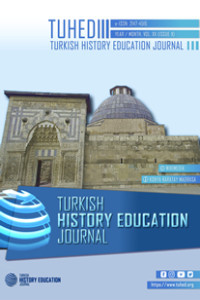
TURKISH HISTORY EDUCATION JOURNAL (TUHED) is an international, academic, non-profit, peer reviewed, free access, online journal which aims to enhance theory, research, and practice in history education at all levels through the publication of primary research, review, and translated articles. TUHED committed to no single approach, discipline, methodology or paradigm. Its main concern is to improve effective teaching of history at all level both local and international scale. TUHED recognizes that many disciplines especially history and other social sciences have important contributions to improve history teaching thus invites researchers and writers from them. The journal welcomes both qualitative and quantitative empirical research, theoretical and conceptual analyses, and reviews related to history education, history of history education and historiography.
TUHED is published online bi-annually (May and October).
TUHED aims to increase the quantity and quality of the studies in this field therefore have adopted the free and open access publication policies. Readers are advised to register the new publication notification service. This can be done by using Journal Register link at the top of the homepage. This will allow the Contents page of new issue to be forwarded to reader via e-mail. This e-mail addresses will not be used for any other purposes, please dfer to the journals safety regulations. Libraries are advised to include TUHED - Turkish History Education Journal in their open access journals database. For detailed information about open access journal systems please check Public Knowledge Project web page.
Within the Budapest Open Access Initiative framework TUHED supports the idea of knowledge sharing for free and without interference. For this purpose, TUHED provides free and unlimited open access to its content. Users have the right to read, download, copy, distribute, print, search, or link to the full texts of the articles. Also, TUHED does not require submission, evaluation or publication fee for the manuscripts.
This journal seeks articles related to the history education/teaching/didactics and historiography. Its scope will include the following topics:
1. Reports on new classroom techniques, methods, curricula, evaluation technics and all types of teaching materials related to field of history education.
2. Analyses of the history of history education at local and international scale.
3. Analyses of important interpretations, leading historians, historiographical problems, history writing and methodology.
4. Critical review essays on books, textbooks, and journal articles related to history teaching and historiography.
5. Translated re-publication of significant international articles aiming to inform Turkish researchers about studies on history education in different countries.
TUHED invites all scholarly work to contribute to history didactic, history teaching, and history of history teaching written either in Turkish or English.
Please organize your manuscript prior to application in accordance with the TUHED Manuscript Template (Link). TUHED uses Publication Manual of the
American Psychological Association, 6th edition as a citation and referencing guide. Please see APA 6th edition for more information.
TUHED does not have an article submission or article processing charges (APCs).
Submission Preparation Checklist:
As part of the submission process, authors are required to check off their submission's compliance with all of the following items, and submissions may be returned to authors that do not adhere to these guidelines.
• The submission has not been previously published in any other journal, nor submitted to another journal for publication consideration.
• The submission is original and written by stated author(s).
• The submission is written either in Turkish or English. Manuscript written in English has to have min. 200 max. 250 words abstract followed by 5-7 keywords.
• The submission should not exceed 8.000 words (including abstract and bibliography).
• The submission file is in MS Word (.doc or .docx) format.
• Proofreading have been performed.
• Authors' names, institutions and address information should be excluded in the first submission text.
Documents to be uploaded to the system:
During the first submission, the following files must be uploaded to the system:
1. Maximum 8000 words, Turkish or English full text article formatted according to the TUHED Manuscript Template (Link). (Name, institution information, e-mail, ORCID number and acknowledge must be removed!)
2. Ethical Declaration Form: If the study requires ethics committee approval, the relevant document (s) should be attached to the back of this form (as the 2nd and 3rd page) and uploaded to the system as a single PDF file. If a personal data collection tool or a copyrighted image is used, the required usage permission documents must be attached to this form as well.
3. Similarity report (The similarity report of the article should be obtained using İntihal.net or IThenticate services and this report should be uploaded to the system during the first application)
4. (For the Applications in English) Certificate of Editing: This certificate has to obtained from the relevant institutions showing that the proofreading has been performed on the English article.
For the articles accepted for publication after the peer-review process, the following files must be uploaded to the system:
a) Applications in Turkish:
1. Full text article in Turkish with a complete name, institution information, e-mail, ORCID number, and Acknowledge
2. Full text article in English with a completed name, institution information, e-mail, ORCID number, and Acknowledge
3. Certificate of Editing: This certificate has to obtained from the relevant institution, indicating proofreading has been performed on the English article.
b) Applications in English:
1. Full text article in English with a completed name, institution information, e-mail, ORCID number, Ethics Declaration, and Acknowledge.
Note: ORCID number must be entered for all authors of the article.
Guidelines for publication reviews and interviews:
Review and interview works should also formated in accordance with TUHED Manuscript Template in terms of layout and format, but section and sub-titles can be edited the authors in accordance with the content.
Guidelines for translation works:
This section aims to share with Turkish readers important works in the fields of history education / teaching or historiography published in Old Turkish or other languages. Your translation works should conform to the TUHED Manuscript Template in terms of layout and format, but chapters but section and sub-titles can be determined by the authors in accordance with the content.
For all translation / reprint submissions:
1. Authors has to obtain required translation and reprint permission from the legal copyringht holder. Permission documents should be uploaded system as an Appendix to the Ethical Declaration Form.
2. Translations should include the entire article / book chapter (without skipping any section, paragraph or footnotes).
3. Make no adding to the main text, place the additional information, explanation and critcs belogns to translator in the footnote section by adding the translator's note (tn) at the beginning of the sentence.
4. Submit the original version of the work as an Appendix to the translation text in image form.
Our publication ethics and publication malpractice statement is mainly based on the Code of Conduct and Best-Practice Guidelines for Journal Editors (Committee on Publication Ethics, 2011). It is expected from all stakeholders of TUHED to adopt, embrace and follow the ethical principles below.
a) Editors' Responsibilities:
1. The editor and any editorial staff must not disclose any information about a submitted manuscript to anyone other than the corresponding author, reviewers, potential reviewers, other editorial advisers, and the publisher, as appropriate.
2. The editor is responsible for deciding which of the papers submitted to the journal will be published. The editor will evaluate manuscripts without regard to the authors' race, gender, sexual orientation, religious belief, ethnic origin, citizenship, or political philosophy. The decision will be based on the paper’s importance, originality, and clarity, the study’s validity, and its relevance to the journal's scope. Current legal requirements regarding libel, copyright infringement, and plagiarism should also be considered.
3. Unpublished materials disclosed in a submitted paper will not be used by the editor or the members of the editorial board for their research purposes without the author's explicit written consent
b) Reviewers' Responsibilities:
1. The peer-reviewing process assists the editor and the editorial board in making editorial decisions and may also serve the author in improving the paper.
2. Any selected referee who feels unqualified to review the research reported in a manuscript or knows that its prompt review will be impossible should notify the editor and withdraw from the review process.
3. Any manuscripts received for review must be treated as confidential documents. They must not be disclosed to or discussed with others except as authorized by the editor.
4. Reviews should be conducted objectively. Personal criticism of the author is inappropriate. Referees should express their views clearly with supporting arguments.
5. Reviewers should identify cases in which relevant published work referred to in the paper has not been cited in the reference section. They should point out whether observations or arguments derived from other publications are accompanied by the respective source. Reviewers will notify the editor of any substantial similarity or overlap between the manuscript under consideration and any other published paper of which they have personal knowledge.
6. Privileged information or ideas obtained through peer review must be kept confidential and not used for personal advantage. Reviewers should not consider manuscripts in which they have conflicts of interest resulting from competitive, collaborative, or other relationships or connections with any of the authors, companies, or institutions associated with the papers.
c) Authors' Responsibilities:
1. Authors are obliged to submit the Ethical Declaration Form, which declares that they comply with research ethics and copyright rules, and to obtain ethics committee approval from the relevant institutions for studies carried out on humans. (see ethical principles flowchart).
2. Authors of original research reports should present an accurate account of the work performed as well as an objective discussion of its significance. Underlying data should be represented accurately in the paper. A paper should contain sufficient detail and references to permit others to replicate the work. Fraudulent or knowingly inaccurate statements constitute unethical behavior and are unacceptable.
3. Authors could be asked to provide the raw data of their study together with the paper for editorial review and should be prepared to make the data publicly available if practicable. In any event, authors should ensure accessibility of such data to other competent professionals for at least ten years after publication (preferably via an institutional or subject-based data repository or other data center), provided that the confidentiality of the participants can be protected and legal rights concerning proprietary data do not preclude their release.
4. Authors will submit only entirely original works, and will appropriately cite or quote the work and/or words of others. Publications that have been influential in determining the nature of the reported work should also be cited.
5. In general, papers describing essentially the same research should not be published in more than one journal. Submitting the same paper to more than one journal constitutes unethical publishing behavior and is unacceptable. Manuscripts that have been published as copyrighted material elsewhere cannot be submitted. In addition, manuscripts under review by the journal should not be resubmitted to copyrighted publications. However, by submitting a manuscript, the author(s) retains the rights to the published material. In case of publication, they permit the use of their work under a CC-BY license [http://creativecommons.org/licenses/by/3.0/], which allows others to copy, distribute and transmit the work as well as to adapt the work and make commercial use of it.
6. Authorship should be limited to those who have made a significant contribution to the conception, design, execution, or interpretation of the reported study. All those who have made significant contributions should be listed as co-authors. The corresponding author ensures that all contributing co-authors and no uninvolved persons are included in the author list. The corresponding author will also verify that all co-authors have approved the final version of the paper and have agreed to its submission for publication.
7. All authors should include a statement disclosing any financial or other substantive conflicts of interest that may be construed to influence the results or interpretation of their manuscript. All sources of financial support for the project should be disclosed.
8. When an author discovers a significant error or inaccuracy in his/her own published work, it is the author’s obligation to promptly notify the journal editor or publisher and to cooperate with the editor to retract or correct the paper in form of an erratum.
Plagiarism Policy:
Publishing a piece of work having similar or the same content as other studies without citing them is ethical misconduct as well as being an offense against the law. The editorial board has the right to act in accordance with COPE’s rules and regulations in case of any claim related to a manuscript having plagiarism, referencing manipulation, and/or data forgery. The authors are required to upload the similarity report of the manuscript to the system during the application stage. The manuscripts having correspondences with other studies over 25% will be sent back to their authors without the initiation of the peer-review policy. The authors may submit their manuscripts after ensuring that the correspondence report of their respective manuscripts shows less than 25% similarity.
Notification of Non-Ethic Practices:
In case the unethical situation is determined about an article in an early view or an evaluation process, which does not comply with ethical principles, please inform us by sending an e-mail to editortuhed@gmail.com. If it is determined that the data used in the article is manipulated or distorted this situation will be officially notified to the relevant institutions, and the article will be rejected, if published, it will be withdrawn. Our journal has the right to request raw data or analysis results from the authors according to the evaluation made by the editor and referees.
Copyright Policy:
Turkish History Education Journal (TUHED) site and its metadata are licensed under a Creative Commons Attribution-NonCommercial 4.0 International License CC BY-NC. This license term allows readers to share, copy, redistribute the material in any medium or format, adapt, remix, transform, build upon the material as long as they give appropriate credit, provide a link to the license, and indicate if changes were made. This license does not allow anyone to use the material for commercial purposes.
Authors retain the copyright for material published in the TUHED including but not limited to all rights to authorize subsequent publication or translation. The material appearing in the TUHED may be distributed freely by electronic or any other means provided that any such distribution is without charge and as long as the Journal is acknowledged as the source. However, no article may be reprinted in any publication without the explicit written permission of the author(s).
Authors warrant that the article contains no libelous or unlawful statements, they did not use any unlawful method or material during the research, they obtained all legal permissions pertaining to the research, and they adhered to ethical principles during the research.
Any factual inaccuracies or opinions expressed therein are the authors’ own and do not necessarily reflect the knowledge, views, or positions of the TUHED. Authors also warrant that “Turkish History Education Journal and the Journal Editors” will not be held liable against all copyright claims of any third party or in lawsuits that may be filed in the future, and that we will be the only person who will be liable in such case.
Conflict of Interests:
Matters in which persons or groups benefit economically or personally may also cause a conflict of interests. The reliability of scientific research and published papers is partly related to objectively handling the conflicts of interests in the processes of planning, applying, writing, assessing, revising, and publishing them.
Financial relations might include the most easily defined conflicts of interests, which may inevitably influence the reliability of the journal as well as the authors in a negative way. , These conflicts may arise from various issues including inter-personal relationships, academic competition, or intellectual approaches. The authors may want to avoid those sponsors, either commercial or non-profit ones, that may restrict access to all study data or propose to interfere with the processes of data analysis, interpretation, manuscript preparation, publication, etc.
To prevent conflict of interests, the editors may try not to assign certain people as reviewers of certain manuscripts submitted by certain authors The editor giving the final decision about a manuscript should ensure that she/he does not have a personal or financial relationship with the relevant author(s).
To make the reviewing processes independent of any unethical conduct, the authors are expected to inform the editorial board in case of a potential conflict of interests.
The editorial board of TUHED promises to consider all these possibilities and strive to make the reviewing process as objective as possible.
Open Access Policy:
Aiming to support the idea of accessing information most efficiently, TUHED adopts open access policy and supports the idea of requiring peer-reviewed journals to become open access appearing in the Budapest Open Access Initiative signed on September 12, 2012. Thus, the open-access policies adopted by TUHED can be found at http://www.budapestopenaccessinitiative.org/boai-10-recommendations.
Budapest Open Access Initiative defines the concept of “open access” as [peer reviewed works’] “… free availability on the public internet, permitting any users to read, download, copy, distribute, print, search, or link to the full texts of these articles, crawl them for indexing, pass them as data to software, or use them for any other lawful purpose, without financial, legal, or technical barriers other than those inseparable from gaining access to the internet itself. The only constraint on reproduction and distribution, and the only role for copyright in this domain, should be to give authors control over the integrity of their work and the right to be properly acknowledged and cited.” In thinking of sharing knowledge/information in the expansion of scientific developments, open-access policies promise a great potential for researchers and readers. Based on this perspective, TUHED invites its readers to freely access and use its published works by referring to their sources and authors. The readers do not need to obtain permission from the authors or the publisher.
Review and Publication Policy:
The reviewing process of the manuscripts sent to TUHED proceeds following these steps:
1- The manuscript is reviewed by the Editor to see whether its aims, subject, content, and style of writing fits the requirements of TUHED (Maximum 10 days). The manuscript is approved by the Editor and sent to Field Editor. Manuscripts which is not approved by the Editor are sent back to their authors/owners for revision and resubmission.
2- The examination/review of the Field Editor results in the decision of either sending the manuscript to reviewers or returning them to their authors/owners for revision (Maximum 10 days).
3- The selection processes of referees are based on expertise and experience in the relevant field. The referees are given 15 days to review a manuscript sent to them.
4- If a reviewer thinks that she/he cannot complete the reviewing process within the given time, she/he can ask the Editor for extra time or let the Editor know that she/he is not being able to review the manuscript due to various reasons, such as the shortage of time. Doing these things help the Editor assign new reviewers without losing too much time.
5- If a reviewer cannot review the manuscript assigned to her/him within the given scope of time, she/he is sent a reminder e-mail with an additional 10 days for completing the reviewing process. If she/he does not return the reviewed manuscripts within the additional time, that manuscript may withdraw from her/him. After then, it is assigned to another referee.
6- If there is a divergence of opinion between the two reviewers (one accepting the manuscript and the other rejecting it), the manuscript is assigned to a third reviewer.
7- The decision for a manuscript is supposed to be given within the first 45-60 days. Then the authors are informed about the decision. The accepted papers are to be published in the following issue of TUHED.
Publication Fee Policy (Free of Charge)
Turkish History Education Journal does not require any subscription, submission, evaluation, or publication (APC) fee or any other type of payment for accessing and/or using electronic information sources.
Committee on Publication Ethics (COPE). (2011, March 7). Code of Conduct and Best-Practice Guidelines for Journal Editors. Retrieved from:
http://publicationethics.org/files/Code_of_conduct_for_journal_editors_Mar11.pdf
Turkish History Education Journal does not require any subscription, submission, evaluation or publication (APC) fee or any other type of payment for accessing and/or using electronic information sources.
E-mail: ahmetsimsek1071@gmail.com
Adress: Istanbul University - Cerrahpasa Hasan Ali Yücel Education Faculty Büyükcekmece Campus F Blok F 306 Alkent 2000, Büyükcekmece , Yigittürk St. No:5/9/1, 34500 Büyükcekmece/Istanbul
E-mail: ibrahim.turan@iuc.edu.tr
Adress: İstanbul Üniversitesi - Cerrahpaşa, Hasan Ali Yücel Eğitim Fakültesi, Büyükçekmece Yerleşkesi B Blok BA401 Alkent 2000, Büyükçekmece Yerleşkesi, Yiğittürk Caddesi No: 5/9/1, 34500 Büyükçekmece/İstanbul
E-Mail: fedurna@gmail.com
Adress: Turkish German University - International Office, Merkez, Şahinkaya Cd. No:106, 34820 Beykoz/İstanbul
E-mail: nevalakca@gmail.com
Address: Çukurova University Faculty of Education Department of Turkish and Social Sciences Education Social Studies Teaching Faculty of Education Dean's Office Building Floor: 3 Sarıçam Balcalı/Adana
Bahri Ata was born in İzmit in 1969. He graduated from the Department of History, the Faculty of Arts and Sciences, METU, Ankara, Turkey. He worked as a history teacher in İmece Primary School, Kağıthane, İstanbul between 1991 and 1994. Later on He became a lecturer of History of Turkish Republic at Abant İzzet Baysal University, Bolu. In 1997, He completed his Master thesis related to the transfer of Telegraph Techology to the Ottoman Empire under the advisorship of Prof. Dr. Zafer Toprak. In 1998 he completed his second M.A. thesis concerning to History Education at Institute of Social Sciences, Gazi University under the advisorship of Prof. Dr. Mustafa Safran.
He completed his military service as history teacher at Işıklar Military School, Bursa between 2001 and 2002. He took an active role in the renewal of the curriculum of Social Studies and History courses and textbooks at the Board of Education between 2003-2006. He began to work as an assistant professor at Faculty of Education, Gazi University in 2005. He became an associate professor in 2010, Professor in 2017. He is interested in history education, social studies education, Museum education, science and technology history.
His memberships are as follows;
• Specialized Committee Member, UNESCO National Commission of Turkey (2010-2014)
• Museum Consulting Member, Atatürk Köşk Müzesi, Çankaya (2012-2014)
• TÜBİTAK Science Center Supervisory Board Member (2014-2016)
• Member of Board of Education, Ministry of Education, Turkey (2018-2021)
fmeseci@istanbul.edu.tr
İstanbul Üniversitesi Hasan Ali Yücel Eğitim Fakültesi Büyükçekmece Yerleşkesi B133 İstanbul
Born in 1974 in Karşıyaka district of İzmir province. Completed primary, secondary and high school education in Bayraklı neighborhood of Karşıyaka. In 1992, he was admitted to Atatürk University, Kazım Karabekir Faculty of Education, Department of Secondary Education Social Sciences, History Teaching Division. He graduated from this program in 1996 and started working as a history teacher at Şehit Hacıbey Kaya High School in Sarıoğlan district of Kayseri province in the same year. In 1997, he was appointed as a research assistant at Atatürk University, Kazım Karabekir Faculty of Education, Department of Secondary Education Social Sciences, History Teaching Division. In 1998, he completed his master's thesis titled "The Socio-Economic Structure of Koyulhisar District in the 15th and 16th Centuries," and in 2005, his doctoral thesis titled "Students' Approach to History Presentation Tools (Erzurum Example)," and in 2006, he was appointed as Assistant Professor in the same department. Kaya received the title of Associate Professor in February 2017 and Professor in September 2025 in the field of History Education. He teaches courses on Special Teaching Methods and Instructional Technologies and Material Design in the History Teaching Department. Kaya is married and has one child.
E-mail: ramco@atauni.edu.tr
Address: Atatürk University, Kazım Karabekir Faculty of Education, Department of History Education, 25240, Campus/ERZURUM
He was born in 1981 in Tosya district of Kastamonu province, he completed his primary education at Tosya Fevzipaşa Primary School and his secondary and high school education at Tosya Anatolian High School. In 1999, He passed the university entrance exam and enrolled in the Social Studies Teaching program at the Fatih Faculty of Education, Karadeniz Technical University (KTU). He graduated first in his class in 2003. After his undergraduate studies, He began his master's degree in History Teaching at the KTU Institute of Social Sciences, Secondary Education Social Sciences Education Program. In 2004, He was appointed as a research assistant at the KTU Faculty of Education, Secondary Education Social Sciences Education Department. In 2006, He completed his master's degree with his thesis titled "History Teachers' Views on Worksheets" at the KTU Institute of Social Sciences, Secondary Education Social Sciences Education, History Teaching Program. He continued his work as a research assistant in the Primary Education Department of the same faculty in 2005 and 2006. In 2006, He was appointed as a research assistant at Gazi University, Institute of Educational Sciences, Department of Primary Education, Social Studies Education Division, and enrolled in the doctoral program. Winning a YÖK (Council of Higher Education) doctoral research scholarship, He conducted research at the University of Illinois at Urbana-Champaign in the United States between 2009 and 2010. In 2010, He completed his doctorate with his thesis entitled "The Effect of Using Worksheets in Social Studies Teaching on Students' Academic Achievement and Attitudes Towards the Course". In 2011, He was appointed as an assistant professor at KTU, Fatih Faculty of Education, Department of Primary Education, Social Studies Education Division. He received the title of associate professor in 2014. In 2015, He transferred to Kastamonu University (KÜ), Faculty of Education, Department of Primary Education, Social Studies Education Division, as an associate professor. In 2019, He received the title of professor in the same department. He became the first academician in Turkey to graduate with a bachelor's degree in social studies education and subsequently receive his associate professorship and professorship in the same field. He held administrative positions such as Vice Rector, Dean of the Faculty of Education, Director of Graduate School, Director of Tosya Vocational School, Director of the Child Education Application and Research Center, Head of the Department of Social Studies Education at Kastamonu University, , and Tosya District Examination Coordinator for ÖSYM (Student Selection and Placement Center). He has participated in various international and national projects related to social studies, history, and life skills education and has numerous publications. He currently continues his work at Kastamonu University, Faculty of Education, Department of Turkish and Social Sciences Education, Social Studies Education Department. He is married and has two children. His foreign language is English.
e-mail: akbaba@gazi.edu.tr
Adress: Gazi University Gazi Faculty of Education Emniyet Neighborhood Bandırma Street Bosna Building, No: 6/31
06500 Yenimahalle, Ankara, TURKEY
He graduated from Marmara University, Department of History Teaching in 2005. He earned the title of specialist in the field of history teaching at the same university with his thesis entitled “History Teaching as A Citizen Education Tool: The Case of Trabzon-Tunceli”. He got his PhD degree and became a doctor in 2013 with his thesis “The Role of History in the Construction of Individual and Collective Identities”. He has received the title of Associate Professor in the field of History Education in 2022.
He has been working as the Erasmus Program Institutional Coordinator since 2011. Special Teaching Methods, Human Rights and Democracy Education, Contemporary Approaches in History Teaching, Philosophy of History and Research Methods, and History Teaching are among the courses that he has been teaching at the Undergraduate and Graduate levels. Mr. Pamuk, who is conducting his studies in the fields of History Education, the Relationship between Identity and History, Philosophy of History and Historiography, has books, book chapters, articles and papers related to his fields of study and also acts as a referee in various journals.
E mail: akifpamuk@marmara.edu.tr
Adress: Atatürk Faculty of Education Maltepe Campus Block A3 34852 / Maltepe - Istanbul
Prof. Dr. Fatih Yazıcı completed his undergraduate education in History at Sakarya University (2004), his master's degree in Social Studies Teaching at Gaziosmanpaşa University (2009), and his doctorate in History Teaching at Marmara University (2013). He was appointed to Gaziosmanpaşa University, Faculty of Education, Department of Turkish and Social Sciences Education as an Assistant Professor in 2014. Yazıcı, who became an Associate Professor in 2018, became a Professor in the field of Social Studies Education in 2024. Prof. Yazıcı currently works for Gaziosmanpaşa University, Faculty of Education, Department of Turkish and Social Sciences Education. Prof. Yazıcı has many articles published in journals indexed in national and international directories. Prof. Fatih Yazıcı's research areas include social studies education and history education.
E-mail: nevalakca@gmail.com
Address: Çukurova University Faculty of Education Department of Turkish and Social Sciences Education Social Studies Teaching Faculty of Education Dean's Office Building Floor: 3 Sarıçam Balcalı/Adana
fmeseci@istanbul.edu.tr
İstanbul Üniversitesi Hasan Ali Yücel Eğitim Fakültesi Büyükçekmece Yerleşkesi B133 İstanbul
Born in 1974 in Karşıyaka district of İzmir province. Completed primary, secondary and high school education in Bayraklı neighborhood of Karşıyaka. In 1992, he was admitted to Atatürk University, Kazım Karabekir Faculty of Education, Department of Secondary Education Social Sciences, History Teaching Division. He graduated from this program in 1996 and started working as a history teacher at Şehit Hacıbey Kaya High School in Sarıoğlan district of Kayseri province in the same year. In 1997, he was appointed as a research assistant at Atatürk University, Kazım Karabekir Faculty of Education, Department of Secondary Education Social Sciences, History Teaching Division. In 1998, he completed his master's thesis titled "The Socio-Economic Structure of Koyulhisar District in the 15th and 16th Centuries," and in 2005, his doctoral thesis titled "Students' Approach to History Presentation Tools (Erzurum Example)," and in 2006, he was appointed as Assistant Professor in the same department. Kaya received the title of Associate Professor in February 2017 and Professor in September 2025 in the field of History Education. He teaches courses on Special Teaching Methods and Instructional Technologies and Material Design in the History Teaching Department. Kaya is married and has one child.
E-mail: ramco@atauni.edu.tr
Address: Atatürk University, Kazım Karabekir Faculty of Education, Department of History Education, 25240, Campus/ERZURUM
e-mail: akbaba@gazi.edu.tr
Adress: Gazi University Gazi Faculty of Education Emniyet Neighborhood Bandırma Street Bosna Building, No: 6/31
06500 Yenimahalle, Ankara, TURKEY
He graduated from Marmara University, Department of History Teaching in 2005. He earned the title of specialist in the field of history teaching at the same university with his thesis entitled “History Teaching as A Citizen Education Tool: The Case of Trabzon-Tunceli”. He got his PhD degree and became a doctor in 2013 with his thesis “The Role of History in the Construction of Individual and Collective Identities”. He has received the title of Associate Professor in the field of History Education in 2022.
He has been working as the Erasmus Program Institutional Coordinator since 2011. Special Teaching Methods, Human Rights and Democracy Education, Contemporary Approaches in History Teaching, Philosophy of History and Research Methods, and History Teaching are among the courses that he has been teaching at the Undergraduate and Graduate levels. Mr. Pamuk, who is conducting his studies in the fields of History Education, the Relationship between Identity and History, Philosophy of History and Historiography, has books, book chapters, articles and papers related to his fields of study and also acts as a referee in various journals.
E mail: akifpamuk@marmara.edu.tr
Adress: Atatürk Faculty of Education Maltepe Campus Block A3 34852 / Maltepe - Istanbul
Prof. Dr. Fatih Yazıcı completed his undergraduate education in History at Sakarya University (2004), his master's degree in Social Studies Teaching at Gaziosmanpaşa University (2009), and his doctorate in History Teaching at Marmara University (2013). He was appointed to Gaziosmanpaşa University, Faculty of Education, Department of Turkish and Social Sciences Education as an Assistant Professor in 2014. Yazıcı, who became an Associate Professor in 2018, became a Professor in the field of Social Studies Education in 2024. Prof. Yazıcı currently works for Gaziosmanpaşa University, Faculty of Education, Department of Turkish and Social Sciences Education. Prof. Yazıcı has many articles published in journals indexed in national and international directories. Prof. Fatih Yazıcı's research areas include social studies education and history education.
He received his bachelor’s degree from the Department of History, Faculty of Letters at Hacettepe University in 2011. He completed his first master’s degree in 2017 and his Ph.D. in 2020 in the Department of Modern History at Gaziantep University, where he had started his graduate studies in the same year as his undergraduate graduation. During this period, he also completed a second master’s degree in the Department of Curriculum and Instruction at the Institute of Educational Sciences, Gaziantep University, between 2013 and 2015. Between 2014 and 2021, he served as a Research Assistant at the Institute of Educational Sciences at Gaziantep University. From 2021 to 2023, he worked as a Postdoctoral Researcher at Istanbul University-Cerrahpaşa, Hasan Ali Yücel Faculty of Education, within the scope of a scientific research project supported by the TÜBİTAK National Postdoctoral Research Fellowship Program. In 2024, he was appointed as an Assistant Professor in the Department of Philosophical, Social, and Historical Foundations of Education at the same faculty, where he currently serves.
Dr. Eyüp Cücük’s research interests include the history of education, educational historiography, educational sciences, the history of educational policies, modernization in education, and the philosophical, social, and historical foundations of education. He has published numerous papers, articles, books, and book chapters on national and international scales in these fields. Additionally, he has taken on roles such as principal investigator, researcher, auxiliary staff, and scholar in many scientific research projects supported by national and international institutions and organizations.
ORCID No: 0000-0003-2660-8009
Contact: cucukeyup@gmail.com
Address: İstanbul Üniversitesi-Cerrahpaşa Hasan Ali Yücel Eğitim Fakültesi Büyükçekmece Yerleşkesi, Alkent 2000 Mahallesi Yiğittürk Caddesi No:5/9/1, 34500 Büyükçekmece/İstanbul/TÜRKİYE.
ANNOUNCEMENTS:
New Publication Policy:
TUHED will begin implementing the Continuous Publication system, which has become widely used in international academic publishing in recent years, as of January 1, 2026.
In this system, articles that have successfully completed the review process and received acceptance for publication will be made available without delay for the issue publication date. The publication date of each article will be utilized in place of the issue date. In contrast to our previous Early View publication policy, every article published under this new system will feature issue, page, and DOI information.
It is important to note that this modification will not impact the article review and acceptance procedures.
Turkish History Education Journal site and its metadata are licensed under a Creative Commons Attribution-NonCommercial 4.0 International License
Permissions beyond the scope of this license is available at COPYRIGHT
