Hatay'da doğan Dr. Mustafa Kaya, 2010-2014 yılları arasında Van Yüzüncü Yıl Üniversitesi, Sanat Tarihi Bölümü’nde Lisans eğitimini tamamladı. Aynı üniversitede 2015-2018 yıllarında Sosyal Bilimler Enstitüsü Sanat Tarihi Anabilim Dalı’nda “Hatay Mihrapları” başlıklı yüksek lisans tezi ile bilim uzmanı olmuştur. Daha sonrasında 2018 yıllarında 100/2000 YÖK öncelikli alanlarından Türk İslam Sanatları Anabilim Dalı’nda burslu doktora programını kazanmıştır. 2018-2022 yıllarında “Acara Bölgesi’nde Osmanlı Dönemi ve Sonrası Geleneksel Ahşap Cami Mimarisi”, başlıklı çalışma sonrasında Doktor unvanını almıştır. Çeşitli Arkeolojik ve Yüzey Araştırmalarında Kazı başkan yardımcısı ve Sanat Tarihçi (Ekip Üyesi) olarak görev yapan Kaya, 2024 yılı itibari ile Mersin Üniversitesi İslami İlimler Fakültesi, Türk İslam Sanatları Tarihi Anabilim Dalı’nda Dr. Öğr. Üyesi olarak akademik göreve başlamıştır. Türk ve İslam Sanatı Anabilim Dalı kapsamında çeşitli bilimsel araştırmalar yapmaktadır. İngilizce (B2) ve Gürcüce (B1) bilmektedir.
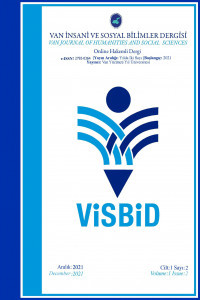
Van Journal of Humanities and Social Sciences (ViSBiD), published electronically, is an academic and peer-reviewed journal that includes original scientific research papers in the fields of humanities and social sciences.
Academic and ethical values are seen as the main purpose in the functioning of the journal, and a transparent, independent and objective process is adopted as a principle.
Articles with good scientific quality, contributing to the field, presenting academic knowledge with current problems, new approaches and theoretical background are first published after the evaluation of the Editorial Board and then the relevant referees.
ViSBiD accepts articles written in Turkish and English.
Ethical Principles and Publication Policy
Publication Ethics
The publication processes of Van Journal of Humanities and Social Sciences (ViSBiD) are based on the principle of producing, developing and sharing information in an unbiased manner with scientific method. In the realisation of scientific production; publishers, editors, authors, referees and readers must comply with ethical principles. In this context, the publication ethics and open access policy of Van Journal of Humanities and Social Sciences requires all components of the publication process to comply with ethical principles in line with the guidelines and policies published by the Committee on Publication Ethics (COPE) in open access (for example, "Committee on Publication Ethics (COPE) Code of Conduct and Best Practice Guidelines for Journal Editors; "Code of Conduct and Best Practice Guidelines for Journal Editors" and "COPE Best Practice Guidelines for Journal Editors").
When cases such as manipulation, distortion and fabrication of data used in articles are detected, the institution where the author of the article works is officially notified of this situation and the article is rejected. ViSBiD has the right to request the output files of the analysis results from the authors according to the feedback given by the editor and/or referees. Only one of the studies uploaded to the system by the same author(s) in a year is evaluated. If accepted, it is published. The following ethical duties and responsibilities of ViSBiD have been prepared in accordance with the guidelines and policies of the Committee on Publication Ethics (COPE).
Ethical Responsibilities of Authors
Author(s) submitting manuscripts to Van Journal of Humanities and Social Sciences are expected to comply with the following ethical responsibilities:
• The publication processes applied by Van Journal of Humanities and Social Sciences are based on the impartial and reputable development and dissemination of knowledge, aiming to improve the quality of the work of the authors and the institutions they are affiliated with, and guided by ethical standards that directly and first•degree bind everyone involved in the publication network.
• Studies submitted to ViSBiD must be original, and citations and quotations must be complete and accurate according to the journal rules.
• Person(s) who do not contribute intellectually to the content of the study should not be indicated as an author.
• Any situations and relationships that may constitute a conflict of interest, if any, of the studies submitted to the journal should be explained.
• The journal management may request raw data from the author(s) within the framework of the evaluation process, in such a case, the author(s) should be ready to present the expected data and information to the Editorial Board.
• The author(s) should have a document showing that they have the rights to use the data used, the necessary permissions related to the research/analyses, or the consent of the experimental subjects.
• In the event that the author(s) notices a mistake or error in the published, early view or review stage of the manuscript, he/she has the obligation to inform the Editor or the Editorial Board and to cooperate with the editor in the correction or withdrawal process.
• Authors cannot have their manuscripts in the submission process of more than one journal at the same time. Each application can be started after the completion of the previous application. Work published in another journal cannot be submitted to Van Journal of Humanities and Social Sciences.
• Only 1 (one) of the studies uploaded to the system belonging to the same author(s) within one (year) is evaluated. If accepted, it is published.
• It cannot be proposed to change the author responsibilities (such as adding an author, changing the author order, removing an author) of a study whose evaluation process has started.
Ethical Duties and Responsibilities of Editors
General Duties and Responsibilities
The editorial board is responsible for every publication published in Van Journal of Humanities and Social Sciences. In the context of this responsibility, editors have the following roles and obligations:
• To endeavour to meet the information needs of readers and authors,
• Ensuring the continuous development of the journal,
• Carrying out processes to improve the quality of studies published in the journal,
• Supporting freedom of thought,
• Ensuring academic integrity,
• Continuing business processes without compromising intellectual property rights and ethical standards,
• Demonstrating openness and transparency in terms of publication in matters requiring correction and explanation.
Relations with the Reader
The Editorial Board should make decisions by taking into account the expectations of knowledge, skills and experience needed by all readers, researchers and practitioners. It should pay attention that the published studies contribute to the readers, researchers, practitioners and scientific literature and are original. In addition, editors are obliged to take into account the feedback from readers, researchers and practitioners and to provide explanatory and informative feedback.
Relations with Authors
The duties and responsibilities of the editors towards the authors are as follows:
• Editors should make a positive or negative decision based on the importance, original value, validity, clarity of expression, and the aims and objectives of the journal.
• Unless there is a serious problem with the studies that are suitable for the scope of publication, they should be included in the preliminary evaluation stage.
• Editors should not ignore favourable referee recommendations unless there is a serious problem with the study.
• New editors should not change the decisions made by the previous editor(s) unless there is a serious problem.
• "Blind Review and Evaluation Process" should be published and editors should prevent deviations that may occur in the defined processes.
• Authors should be notified and returned in an explanatory and informative manner.
Relations with Referees
The duties and responsibilities of the Editors and Field Editors towards the referees are as follows:
• Determine the referees in accordance with the subject of the study.
• They are obliged to provide the information and guides that the referees will need during the evaluation phase.
• They have to observe whether there is a conflict of interest between authors and reviewers.
• Keep the identity information of the referees confidential in the context of blind refereeing.
• Encourage reviewers to evaluate the manuscript in an impartial, scientific and objective manner.
• Determine practices and policies to improve the performance of reviewers.
• Take necessary steps to dynamically update the referee pool.
• Prevent unkind and unscientific evaluations.
• Take steps to ensure that the referee pool consists of a wide range of referees.
Relations with the Editorial Board
Editors should ensure that all editorial board members carry out the processes in accordance with the publication policies and guidelines. They should inform the Editorial Board members about the publication policies and keep them informed about the developments. Editors should also
• Ensure that editorial board members evaluate the studies impartially and independently.
• Identify new members of the Editorial Board who can contribute and have appropriate qualifications.
• They should send the studies suitable for the expertise of the members of the Editorial Board for evaluation.
• Interact regularly with the Editorial Board.
• Organise meetings with the Editorial Board at regular intervals to review the development of the journal and publication policies.
Relations with the Journal Owner and Publisher
The relationship between the editors and the publisher is based on the principle of editorial independence. According to the written agreement between the editors and the publisher, all decisions of the editors are independent from the publisher and the journal owner.
Editorial and Blind Review Processes
Editors are obliged to implement the "Blind Review and Evaluation Process" policies in the journal publication policies. In this context, editors ensure that the evaluation process of each study is completed in a fair, impartial and timely manner.
Quality Assurance
Editors are responsible for the publication of each article published in the journal in accordance with the journal's publication policies and international standards.
Protection of Personal Data
Editors are obliged to ensure the protection of personal data regarding the subjects or images included in the evaluated studies. Unless the explicit consent of the individuals used in the studies is documented, they are responsible for rejecting the study. Editors are also responsible for protecting the personal data of authors, reviewers and readers.
Ethics Committee, Human and Animal Rights
Editors are responsible for ensuring the protection of human and animal rights in the evaluated studies. They are responsible for rejecting the study in the absence of ethics committee approval for the subjects used in the studies and permissions for experimental research.
Precautions Against Possible Abuse and Misconduct
Editors are obliged to take precautions against possible misconduct and abuse. In addition to conducting a rigorous and objective investigation in identifying and evaluating complaints regarding this situation, it is among the responsibilities of the editor to share the findings on the subject.
Ensuring the Integrity of Academic Publications
Editors should ensure that errors, inconsistencies or misleading judgements in the manuscript are corrected quickly.
Protection of Intellectual Property Rights
Editors are responsible for protecting the intellectual property rights of all published articles and defending the rights of the journal and the author(s) in case of possible violations. In addition, editors are obliged to take the necessary measures to ensure that the contents of all published articles do not violate the intellectual property rights of other publications.
Constructivism and Openness to Discussion
Editors
• Should take into account the convincing criticisms of the works published in the journal and show a constructive attitude towards them.
• They should give the author(s) of the criticised studies the right to reply.
• They should not ignore or exclude studies with negative results.
Complaints
The editors are obliged to carefully examine complaints from authors, reviewers or readers and respond in an enlightening and explanatory manner.
Political and Commercial Concerns
The owner of the journal, the publisher, and no other political or commercial factors influence the independent judgement of the editors.
Conflicts of Interest
The editors guarantee the independent and impartial completion of the publication process, taking into account conflicts of interest between the author(s), reviewers and other editors.
Ethical Responsibilities of Referees
The evaluation of all studies by "Blinded Refereeing" directly affects the quality of the publication. This process provides confidence through objective and independent evaluation of the publication. In Van Journal of Humanities and Social Sciences, the evaluation process is carried out with the principle of double blind refereeing. Reviewers cannot communicate directly with the authors, and evaluations and comments are communicated through the journal management system. In this process, reviewer comments on evaluation forms and full texts are communicated to the author(s) through the editor. In this context, reviewers who evaluate studies for ViSBiD are expected to have the following ethical responsibilities:
• Only accept to review manuscripts related to their field of specialisation.
• They should evaluate with impartiality and confidentiality.
• If he/she thinks that he/she is faced with a conflict of interest during the evaluation process, he/she should refuse to review the study and inform the journal editor.
•Due to the principle of confidentiality, they should destroy the studies they have reviewed after the evaluation process. They can only use the final versions of the studies they have reviewed only after they are published.
• Evaluate objectively only in relation to the content of the study. They should not allow nationality, gender, religious beliefs, political beliefs and commercial concerns to influence the evaluation.
• Evaluate in a constructive and courteous manner. They should not make derogatory personal comments containing hostility, slander and insult.
• They should carry out the work they have accepted for evaluation on time and in accordance with the above ethical responsibilities.
• While making the evaluation, they should show what kind of errors and deficiencies there are in the text, and should not just fill in the article scoring sheet.
Ethical Responsibilities of the Publisher
Van Journal of Humanities and Social Sciences Editors and Editorial Board act with the awareness of the following ethical responsibilities:
• The editors are responsible for all processes of the studies submitted to Van Journal of Humanities and Social Sciences. In this context, editors are the decision•makers, regardless of economic or political gains.
• It is committed to independent editorial judgement.
• It protects the ownership and copyright of every article published in Van Journal of Humanities and Social Sciences and undertakes the obligation to keep a record of each published copy.
• It has the responsibility to take measures against all kinds of scientific misconduct, citation gangsterism and plagiarism related to editors.
If You Encounter an Unethical Situation
If you encounter any unethical behaviour or content in Van Journal of Humanities and Social Sciences other than the ethical responsibilities mentioned above, please report it via e-mail to visbid@yyu.edu.tr.
ViSBiD does not charge any fees for published articles.
I studied archaeology at Aegean University, and my master's thesis was on the cuneiform language of Urartian. I completed PhD in the Department of Linguistics at Ankara University with a thesis on Turkish-Kurdish language contact. I took part on an EU project, Approaches to Multilingual Schools in Europe (AMuSE) led by Prof. Dr. Jochen Rehbein. I currently work at Van Yuzuncu Yil University as an associate professor and do studies on Urartian texts, endangered languages, and language contact.
Erkan Yılmaz, 2000 yılında Ankara Üniversitesi, DTCF Coğrafya bölümünde eğitime başlamış, 2004 yılında mezun olmuştur. 2004 yılında aynı bölümde yüksek lisans eğitiminde başlayan Yılmaz, 2006 yılında, “Çamlıdere Barajı Havzasında Erozyon Problemi” adlı yüksek lisans tezi ile mezun olmuştur. 2007 yılında, doktora eğitimine başlamış, 2013 yılında, “Ankara Şehrinde Şehir Isı Adası Oluşumu” teziyle doktor ünvanı almıştır. Yılmaz, 2014 yılında yardımcı doçent kadrosuna atanış, 2020 yılında doçent olmuştur. Halen, fiziki coğrafya, iklim değişikliği, şehir iklimi, paleoiklim konularında çalışmaktadır.
Ayhan Kaya is Professor of Politics and Jean Monnet Chair of European Politics of Interculturalism at the Department of International Relations, Istanbul Bilgi University; Director of the Jean Monnet Centre of Excellence; and a member of the Science Academy, Turkey. He is currently European Research Council Advanced Grant holder (ERC AdG, 2019-2024). He received his PhD and MA degrees at the University of Warwick, England. Kaya was previously a Jean Monnet Fellow at the European University Institute, Robert Schuman Centre for Advanced Studies, Florence, Italy, and adjunct lecturer at the New York University, Florence in 2016-2017. He previously worked and taught at the European University Viadrina as Aziz Nesin Chair in 2013, and at Malmö University, Sweden as the Willy Brandt Chair in 2011. He is specialised on European identities, Euro-Turks in Germany, France, Belgium and the Netherlands, Circassian diaspora in Turkey, the construction and articulation of modern transnational identities, refugee studies in Turkey, conventional and nonconventional forms of political participation in Turkey, and the rise of populist movements in the EU. His recent manuscripts are Syrian Refugees in Turkey: Between Reception and Integration (Switzerland: Springer IMISCOE, 2023, co-authored with Z. Şahin-Mencütek, E. Gökalp-Aras, and S. B. Rottmann), and Populism and Heritage in Europe. Lost in Diversity and Unity (London: Routledge, 2019). His recent edited volumes are Nativist and Islamist Radicalism: Anger and Anxiety (London: Routledge, 2023, with Aysenur Benevento and Metin Koca); Memory in European Populism (London: Routledge, 2019, with Chiara de Cesari). Some of his books are Turkish Origin Migrants and their Descendants: Hyphenated Identities in Transnational Space (Palgrave, 2018), Europeanization and Tolerance in Turkey (London: Palgrave, 2013); Islam, Migration and Integration: The Age of Securitization (London: Palgrave, 2012); Contemporary Migrations in Turkey: Integration or Return (Istanbul Bilgi University Press, 2015, in Turkish, co-edited with Murat Erdoğan), Belgian-Turks, Brussels: King Baudouin Foundation, 2008, co-written with Ferhat Kentel), Euro-Turks: A Bridge or a Breach between Turkey and the EU (Brussels: CEPS Publications, 2005, co-written with Ferhat Kentel, Turkish version by Bilgi University); wrote another book titled Sicher in Kreuzberg: Constructing Diasporas, published in two languages, English (Bielefeld: Transkript verlag, 2001) and Turkish (Istanbul: Büke Yayınları, 2000). He also translated Ethnic Groups and Boundaries by Fredrik Barth and Citizenship and Social Classes by T. H. Marshall and Tom Bottomore to Turkish language. He also edited several books on migration, integration, citizenship, and diasporas. Kaya’s publications have been translated to several languages such as French, German, Japanese, Italian, Arabic and Dutch. Kaya was actively involved in two FP7 and three Horizon 2020 projects, and now he is involved in two different Horizon 2020 research projects on migration. Kaya received Turkish Social Science Association Prize in 2003; Turkish Academy of Sciences (TÜBA-GEBİP) Prize in 2005; Sedat Simavi Research Prize in 2005; Euroactiv-Turkey European Prize in 2008, the Prize for the best Text Book given by TÜBA; and also the Prize for excellence in teaching at the Department of International Relations, Istanbul Bilgi University in 2013 and 2017.
Siyaset bilimci ve göç araştırmacısı olan Prof. Dr. M. Murat ERDOĞAN, Uluslararası Metropolis Danişma Kurulu Üyesi, UNESCO-Türkiye İletişim Komitesi üyesi ve İltica ve Göç Araştırmaları Merkezi’ne bağlı IGAM-ACADEMY Başkanıdır.
Prof. Erdoğan, 1987-2017 yılları arasında Hacettepe Üniversitesinde çalışmış, 2009 yılında Hacettepe Üniversitesi Göç ve Siyaset Araştırmaları Merkezini (HUGO) kurmuş ve 2017’ye kadar müdürlüğünü yapmıştır. 2017-2022 yıllarında Türk-Alman Üniversitesi’inde görev yapan ve burada Siyaset Bilimi ve Uluslararası İlişkiler Bölüm Başkanlığı ve kurucusu olduğu Göç ve Uyum Araştırmaları Merkezi (TAGU) Müdürlüğünü yapan Erdoğan; Mart 2022-Ekim 2024 arasında Ankara Üniversitesi Siyasal Bilgiler Fakültesi Mülkiye Göç Araştırmaları Merkezi’nin kurucu müdürü olarak görev yaptı. Akademik ilgi alanları iradi ve zorunlu göçler, mülteciler, yurtdışındaki Türkiye kökenliler, AB, siyasal karikatürler, siyasal davranışlar, İslamafobi, Almanya ve Türk dış politikası olan Prof.Erdoğan, Avrupa’daki Türk diasporası konusunda “Euro-Turks-Barometre”, Türkiye’deki Suriyeliler konusunda ise “Suriyeliler Barometresi” başlıklı kamsamlı ve düzenli kamuoyu araştırmalarını da yürütmektedir.
Vefa Taşdelen: 1966 yılında İnebolu’da doğdu. İlk ve orta öğrenimini burada tamamladı. 1989 yılında İstanbul Üniversitesi Edebiyat Fakültesi Felsefe Bölümü’nden mezun oldu. Aynı bölümde Varoluşçuluk ve Edebiyat Etkileşimi başlıklı yüksek lisans tezini hazırladı. Van’ın Gürpınar ilçesinde iki yıl öğretmenlik yaptıktan sonra 1994 yılında Yüzüncü Yıl Üniversitesi Eğitim Fakültesine araştırma görevlisi olarak girdi. 1997-2000 yıları arasında, Seyir Estetik ve Sanat Dergisi’ni yönetti. 2000 yılında Ankara Üniversitesi Eğitim Bilimleri Enstitüsü’nde araştırma görevlisi oldu. 2004’te Søren Kierkegaard’un Varoluş Alanlarında Benliğin Oluşamaması Sorunu ve Bir Çözüm Önerisi Olarak Sevgi Alanı, 2006’da Eğitim Hermeneutiği Sorunsalı Üzerine Felsefi Bir Araştırma başlıklı doktora tezlerini savundu. 2007’de Yüzüncü Yıl Üniversitesi Fen-Edebiyat Fakültesi Felsefe Bölümü’ne öğretim üyesi olarak girdi. 2012 yılında Yıldız Teknik Üniversitesi Eğitim Fakültesi Eğitim Bilimleri Bölümü’ne geçiş yaptı. Çeşitli dergilerde felsefe, eğitim, sanat, edebiyat konularında yayımlanmış makale ve denemeleri bulunan Taşdelen 2017-2020 yılları arasında Kırgızistan-Türkiye Manas Üniversitesi Edebiyat Fakültesi Felsefe Bölümü’nde geçici görevle çalıştı. Halen Yıldız Teknik Üniversitesi Eğitim Fakültesinde görev yapmaktadır.
Eserleri: Sanat Akımları Sorunsalı ve Sürrealizm (inceleme, Girişim Yayınları, 1996) Kaygı Kavramı (Søren Kierkegaard’dan çeviri-inceleme, Hece Yayınları, 2004), Kierkegaard’da Benlik ve Varoluş (inceleme, Hece Yayınları, 2004), Felsefe Eğitim Sanat: Saffet Bilhan Armağanı (derleme, Sabri Büyükdüvenci’yle birlikte, Hece Yayınları, 2006), Hermeneutiğin Evrimi, Kesitler (inceleme, Hece Yayınları, 2008), Eğitimden Felsefeye: Necmettin Tozlu Armağanı (derleme, Ahmet Yayla ve Alaattin Karaca’yla birlikte, Yüzüncü Yıl Üniversitesi Yayınları, 2011), Felsefeden Edebiyata, (deneme-inceleme, Hece Yayınları, 2013), Çağın Sorunları Karşısında Eğitim (derleme, Necmettin Tozlu ve Mehmet Önal’la birlikte, Bayburt Üniversitesi Yayınları, 2014), Felsefe Kültürü (Hece Yayınları, 2015), Felsefe ve Edebiyat Sempozyumu Bildiri Metinleri (derleme, Z. Taştan, A. Eyim, M. Erzen, E. Rızvanoğlu ile birlikte, Yüzüncü Yıl Üniversitesi Yayınları), Dünyada ve Türkiye’de Üniversite (derleme, Necmettin Tozlu ve Mehmet Önal’la birlikte, Bayburt Üniversitesi Yayınları, 2016). Kaygıdan Umuda Varoluşun Renkleri (inceleme, Hece Yayınları, 2017). Önsözler (Søren Kierkegaard’dan çeviri, Ralph Lebro’yla birlikte, Beyaz Gemi Yayınları, 2022),
Ayhan Kaya is Professor of Politics and Jean Monnet Chair of European Politics of Interculturalism at the Department of International Relations, Istanbul Bilgi University; Director of the Jean Monnet Centre of Excellence; and a member of the Science Academy, Turkey. He is currently European Research Council Advanced Grant holder (ERC AdG, 2019-2024). He received his PhD and MA degrees at the University of Warwick, England. Kaya was previously a Jean Monnet Fellow at the European University Institute, Robert Schuman Centre for Advanced Studies, Florence, Italy, and adjunct lecturer at the New York University, Florence in 2016-2017. He previously worked and taught at the European University Viadrina as Aziz Nesin Chair in 2013, and at Malmö University, Sweden as the Willy Brandt Chair in 2011. He is specialised on European identities, Euro-Turks in Germany, France, Belgium and the Netherlands, Circassian diaspora in Turkey, the construction and articulation of modern transnational identities, refugee studies in Turkey, conventional and nonconventional forms of political participation in Turkey, and the rise of populist movements in the EU. His recent manuscripts are Syrian Refugees in Turkey: Between Reception and Integration (Switzerland: Springer IMISCOE, 2023, co-authored with Z. Şahin-Mencütek, E. Gökalp-Aras, and S. B. Rottmann), and Populism and Heritage in Europe. Lost in Diversity and Unity (London: Routledge, 2019). His recent edited volumes are Nativist and Islamist Radicalism: Anger and Anxiety (London: Routledge, 2023, with Aysenur Benevento and Metin Koca); Memory in European Populism (London: Routledge, 2019, with Chiara de Cesari). Some of his books are Turkish Origin Migrants and their Descendants: Hyphenated Identities in Transnational Space (Palgrave, 2018), Europeanization and Tolerance in Turkey (London: Palgrave, 2013); Islam, Migration and Integration: The Age of Securitization (London: Palgrave, 2012); Contemporary Migrations in Turkey: Integration or Return (Istanbul Bilgi University Press, 2015, in Turkish, co-edited with Murat Erdoğan), Belgian-Turks, Brussels: King Baudouin Foundation, 2008, co-written with Ferhat Kentel), Euro-Turks: A Bridge or a Breach between Turkey and the EU (Brussels: CEPS Publications, 2005, co-written with Ferhat Kentel, Turkish version by Bilgi University); wrote another book titled Sicher in Kreuzberg: Constructing Diasporas, published in two languages, English (Bielefeld: Transkript verlag, 2001) and Turkish (Istanbul: Büke Yayınları, 2000). He also translated Ethnic Groups and Boundaries by Fredrik Barth and Citizenship and Social Classes by T. H. Marshall and Tom Bottomore to Turkish language. He also edited several books on migration, integration, citizenship, and diasporas. Kaya’s publications have been translated to several languages such as French, German, Japanese, Italian, Arabic and Dutch. Kaya was actively involved in two FP7 and three Horizon 2020 projects, and now he is involved in two different Horizon 2020 research projects on migration. Kaya received Turkish Social Science Association Prize in 2003; Turkish Academy of Sciences (TÜBA-GEBİP) Prize in 2005; Sedat Simavi Research Prize in 2005; Euroactiv-Turkey European Prize in 2008, the Prize for the best Text Book given by TÜBA; and also the Prize for excellence in teaching at the Department of International Relations, Istanbul Bilgi University in 2013 and 2017.
Vefa Taşdelen: 1966 yılında İnebolu’da doğdu. İlk ve orta öğrenimini burada tamamladı. 1989 yılında İstanbul Üniversitesi Edebiyat Fakültesi Felsefe Bölümü’nden mezun oldu. Aynı bölümde Varoluşçuluk ve Edebiyat Etkileşimi başlıklı yüksek lisans tezini hazırladı. Van’ın Gürpınar ilçesinde iki yıl öğretmenlik yaptıktan sonra 1994 yılında Yüzüncü Yıl Üniversitesi Eğitim Fakültesine araştırma görevlisi olarak girdi. 1997-2000 yıları arasında, Seyir Estetik ve Sanat Dergisi’ni yönetti. 2000 yılında Ankara Üniversitesi Eğitim Bilimleri Enstitüsü’nde araştırma görevlisi oldu. 2004’te Søren Kierkegaard’un Varoluş Alanlarında Benliğin Oluşamaması Sorunu ve Bir Çözüm Önerisi Olarak Sevgi Alanı, 2006’da Eğitim Hermeneutiği Sorunsalı Üzerine Felsefi Bir Araştırma başlıklı doktora tezlerini savundu. 2007’de Yüzüncü Yıl Üniversitesi Fen-Edebiyat Fakültesi Felsefe Bölümü’ne öğretim üyesi olarak girdi. 2012 yılında Yıldız Teknik Üniversitesi Eğitim Fakültesi Eğitim Bilimleri Bölümü’ne geçiş yaptı. Çeşitli dergilerde felsefe, eğitim, sanat, edebiyat konularında yayımlanmış makale ve denemeleri bulunan Taşdelen 2017-2020 yılları arasında Kırgızistan-Türkiye Manas Üniversitesi Edebiyat Fakültesi Felsefe Bölümü’nde geçici görevle çalıştı. Halen Yıldız Teknik Üniversitesi Eğitim Fakültesinde görev yapmaktadır.
Eserleri: Sanat Akımları Sorunsalı ve Sürrealizm (inceleme, Girişim Yayınları, 1996) Kaygı Kavramı (Søren Kierkegaard’dan çeviri-inceleme, Hece Yayınları, 2004), Kierkegaard’da Benlik ve Varoluş (inceleme, Hece Yayınları, 2004), Felsefe Eğitim Sanat: Saffet Bilhan Armağanı (derleme, Sabri Büyükdüvenci’yle birlikte, Hece Yayınları, 2006), Hermeneutiğin Evrimi, Kesitler (inceleme, Hece Yayınları, 2008), Eğitimden Felsefeye: Necmettin Tozlu Armağanı (derleme, Ahmet Yayla ve Alaattin Karaca’yla birlikte, Yüzüncü Yıl Üniversitesi Yayınları, 2011), Felsefeden Edebiyata, (deneme-inceleme, Hece Yayınları, 2013), Çağın Sorunları Karşısında Eğitim (derleme, Necmettin Tozlu ve Mehmet Önal’la birlikte, Bayburt Üniversitesi Yayınları, 2014), Felsefe Kültürü (Hece Yayınları, 2015), Felsefe ve Edebiyat Sempozyumu Bildiri Metinleri (derleme, Z. Taştan, A. Eyim, M. Erzen, E. Rızvanoğlu ile birlikte, Yüzüncü Yıl Üniversitesi Yayınları), Dünyada ve Türkiye’de Üniversite (derleme, Necmettin Tozlu ve Mehmet Önal’la birlikte, Bayburt Üniversitesi Yayınları, 2016). Kaygıdan Umuda Varoluşun Renkleri (inceleme, Hece Yayınları, 2017). Önsözler (Søren Kierkegaard’dan çeviri, Ralph Lebro’yla birlikte, Beyaz Gemi Yayınları, 2022),
Prof. Dr. Mehmet Ali Çelikel graduated from Hacettepe University, Department of English Linguistics in 1993. He completed his MA in English Language and Literature at the University of Hertfordshire in England in 1997. He got his PhD with a thesis entitled “The Post-Colonial Condition: The Fiction of Rushdie, Kureishi and Roy” at Liverpool University in England in 2001. He has published two academic books in Turkish on post-colonial novel, entitled as Sömürgecilik Sonrası İngiliz Romanında Kültür ve Kimlik [Culture and Identity in Postcolonial English Novel] in 2011 and Çağdaş İngiliz Romanında Küreselleşme, Göç ve Kültür [Globalisation, Migration and Culture in Contemporary British Novel]. He currently works as a Professor at the Department of English Language and Literature, Marmara University, Turkey. mehmet.celikel@marmara.edu.tr
https://orcid.org/0000-0003-0402-9858
Dr. Murat Boysan deneyimli bir klinik araştırmacı ve psikolojik danışman olarak Ankara Sosyal Bilimler Üniversitesi’ nde görev yapmaktadır. Araştırmacı yüksek lisans derecesini Yüzüncü Yıl Üniversitesi Tıp Fakültesi Psikiyatri Anabilim dalından almıştır. Sonrasında Biyometri ve Genetik alanında çalışmalarına devam etmiştir. Doktora derecesini Ankara Üniversitesi Rehberlik ve Psikolojik Danışmanlık programında tamamlamıştır. Travma ve stresörle ilişkili bozukluklar, sirkadyen ritim ve psikolojik problemlerde bilişsel yatkınlık akademik çalışma alanları arasındadır.